M-1 Visa for Flight School: The Straight Path to US Pilot Training
TL;DR
- The M-1 visa for flight school functions as a quality filter, requiring international students to enroll in structured, FAA-approved Part 141 vocational programs.
- Eligibility begins with school admission: a SEVP-approved academy must issue your Form I-20 before you can schedule a U.S. embassy visa interview.
- Application expenses include the school I-20 processing fee, the SEVIS I-901 fee, and the DS-160 visa fee, which sit outside flight tuition.
- Administrative efficiency at the flight school dictates your total timeline far more than embassy processing speeds.
- The M-1 visa is a vocational training authorization, allowing you to earn globally recognized FAA certificates, but it does not permit employment at U.S. airlines afterward.
The M-1 visa for flight school is not a bureaucratic hurdle. It is a strategic filter that forces you onto the fastest path to a pilot certificate. Most international students treat it as paperwork to survive before the real work begins, and that framing costs them months of wasted effort.
The visa’s core restriction, that it only applies to vocational Part 141 programs, is actually the single best quality filter in American flight training. Part 141 schools operate under FAA-approved syllabi with structured progression. The loose, hour-building approach of Part 61 is not an option for you, and that is a gift.
This article covers who qualifies for the M-1 visa, what the process costs, and how long it really takes. The visa already eliminated the unstructured path, so your only real decision is which Part 141 school earns your trust.
Why the M-1 Visa Is a Filter, Not a Form
Most international students treat the M-1 visa for flight school as paperwork to survive. That framing gets the entire process backwards. The visa’s core restriction is the single best quality filter in American flight training.
The restriction is simple: the M-1 only applies to vocational Part 141 programs. In accordance with SEVIS, the M1 Student Visa is issued only for students enrolled in Part 141 flight courses like Private Pilot, Instrument Rating, Commercial Pilot, and Professional Pilot programs. That means the FAA has already vetted the syllabus before you ever sit in a cockpit.
Part 141 schools operate under FAA-approved syllabi with stage checks and structured progression. Part 61 offers flexibility, but also the freedom to drift. Students on the loose path burn through money chasing hours without a disciplined sequence guiding them toward checkride readiness.
The M-1 visa does not just let you train. It forces you into the training environment most likely to get you certified efficiently. That structure is the difference between finishing in eighteen months and finishing in four years. The visa already made the hard choice for you, so stop second-guessing it.
Students who chase Part 61 loopholes waste months searching for a workaround that does not exist. Those months are better spent inside a structured program where every flight lesson builds on the last one. The visa’s restriction is not a limitation. It is a shortcut to the disciplined path most pilots wish they had taken.
The filter works before you ever file a visa application. It eliminates the unstructured training that causes students to stall out, and it does so before you spend a dollar on tuition. The question is no longer which training category to choose. It is which Part 141 school deserves your I-20.
That decision, not the visa paperwork, is where your entire flight training in the USA journey will succeed or fail. Choosing an organized school with a proven international student process matters more than any other variable you control.
Who Actually Qualifies for an M-1 Visa
Eligibility for an M-1 visa for flight school comes down to one distinction most applicants never consider: vocational training versus academic study. The visa exists for students who want a skill, not a degree.
The Vocational and Academic Split
The M-1 visa allows international students to attend U.S. flight schools for vocational training, while the F1 Visa is for academic-based aviation programs. A bachelor’s degree in aeronautical science belongs on an F-1. A Private Pilot certificate belongs on an M-1.
The distinction changes which schools you can attend, what the curriculum looks like, and how immigration evaluates your intentions. Choosing the visa before choosing the program is the only order that works.
The School, Not You, Starts the Process
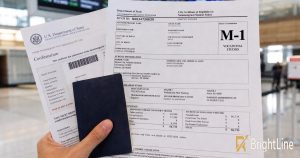
Eligibility begins before you file a single form. You must be enrolled in a SEVP-approved school, and that school must issue you an I-20 Form. The school initiates the I-20, not the student. You cannot apply for the visa until a school decides you belong in its program. The M1 visa pathway starts with the school’s decision.
What the I-20 Actually Proves
The I-20 certifies that a SEVP-approved school has accepted you into a specific Part 141 program with a defined curriculum. Immigration officers read it as proof that your training has structure and an endpoint. A school that hesitates on the I-20 is telling you something. If the admissions office cannot manage visa paperwork, the flight school will not manage your training either.
Why the Filter Works in Your Favor
Every eligibility requirement narrows the field of schools you can attend. That narrowing guarantees that the school you choose has already passed federal scrutiny for its curriculum and its recordkeeping.
Students who chase Part 61 flexibility discover too late that no visa supports that path. The M-1 filter removes that mistake before it costs you a year and tens of thousands of dollars.
The Real Cost of the M-1 Visa Process
Most applicants budget for tuition and nothing else. The application fees catch them flat-footed, right at the moment the process demands precision.
Step 1. Pay the I-20 processing fee before anything else. A non-refundable fee of $350 is required to compile and submit your I-20 information, and the visa application process cannot move forward without it.
Step 2. Budget for the SEVIS I-901 fee. This funds the Student and Exchange Visitor Program that tracks your enrollment, and it is paid online before you ever schedule an interview.
Step 3. Cover the visa application fee at the US embassy. This is the standard MRV fee charged for most nonimmigrant visa categories, and it is non-refundable even if the visa is denied.
Step 4. Prepare for the visa issuance fee, which applies only to certain countries under reciprocity agreements. Check the US State Department’s reciprocity table for your home country before assuming the cost is fixed.
These fees sit entirely outside your tuition bill. The full flight school cost conversation usually ignores them, which is exactly why students get blindsided a week before their interview.
Think of these fees as the price of the filter. A few hundred dollars is a small cost compared to enrolling in the wrong program and discovering months later that the school cannot deliver the structured training the visa requires.
The filter works only if you pay attention to what it is filtering. The fees separate committed applicants from casual browsers. That separation protects you from wasting far more on a school that cannot get you certified.
How Long the M-1 Visa Really Takes
The timeline for an M-1 visa for flight school is rarely the bottleneck students fear. The school’s speed in issuing the I-20 determines everything that follows. Applicants who move deliberately through each step control their own pace. The process rewards preparation, not hesitation.
- Secure admission. Get accepted by a Part 141 school and receive the I-20 Form. This step carries the widest variance because it depends entirely on the school’s administrative efficiency. An organized school issues the I-20 quickly; a disorganized one costs you weeks.
- Pay the SEVIS fee. The I-901 fee must be settled before the visa interview. Payment confirmation is instant, but applicants who forget this step discover it at the embassy counter. That is the wrong place to learn.
- File the DS-160. This online application takes an evening to complete, yet it stalls more applicants than any other step. Every field must match your passport exactly, and inconsistencies trigger administrative processing that adds unpredictable delay.
- Attend the interview. Embassy appointment availability fluctuates with season and location. Applicants who book early get the date they want. Those who wait accept whatever the calendar offers.
- Enter the United States. Visa in hand, the final step is straightforward. Customs officers verify your I-20 and SEVIS record, then you are cleared for training.
Every step in this chain connects to the one before it. A slow school delays your I-20, which pushes back the SEVIS payment, the DS-160, and the interview. The entire timeline hinges on the school’s administrative discipline.
That is why the M-1 visa timeline rewards students who choose a school that treats paperwork with the same rigor it applies to flight instruction. The visa process is the first test of that discipline, and it happens before you ever sit in a cockpit.
The M-1 visa is one of seven admission gates between you and your first training flight. Check all seven with the free BrightLine 7-Gate Admission Tracker.
Part 141 vs. Part 61: The Choice That Decides Everything
Every international student eventually hits the same fork in the road: Part 141 or Part 61. The M-1 visa for flight school quietly removes that fork before you ever reach it. That removal is the best financial decision you will not have to make.
Part 141 training runs on an FAA-approved syllabus. Every lesson is mapped, every maneuver is logged against a standard, and stage checks force you to prove proficiency before advancing. The structure feels rigid until you realize it is the discipline that keeps your training hours from multiplying without reason.
Part 61 offers flexibility that sounds appealing. No set curriculum, no stage checks, just you and an instructor working at your own pace. That freedom is a trap for students who need a defined path, and it is not visa-eligible for vocational training anyway.
Yet some students still burn months hunting for a Part 61 loophole. They contact schools, ask about “special arrangements,” and hope immigration rules bend. The visa restriction to Part 141 protects you from the unstructured training that burns through money. Visa requirements, FAA regulations, and immigration limits must all align, and they only align on the Part 141 side.
Choosing the wrong training category is the single biggest risk in this entire flight school process. It costs time and money you cannot recover, and it usually surfaces only after you have already committed to a school.
The M-1 visa already made this decision for you. Part 141 is the only path that works, and that clarity is an advantage. The real choice is not between training categories. It is which Part 141 school earns your trust with the I-20 and the syllabus that follows it.
What Flight Schools Must Do to Enroll You
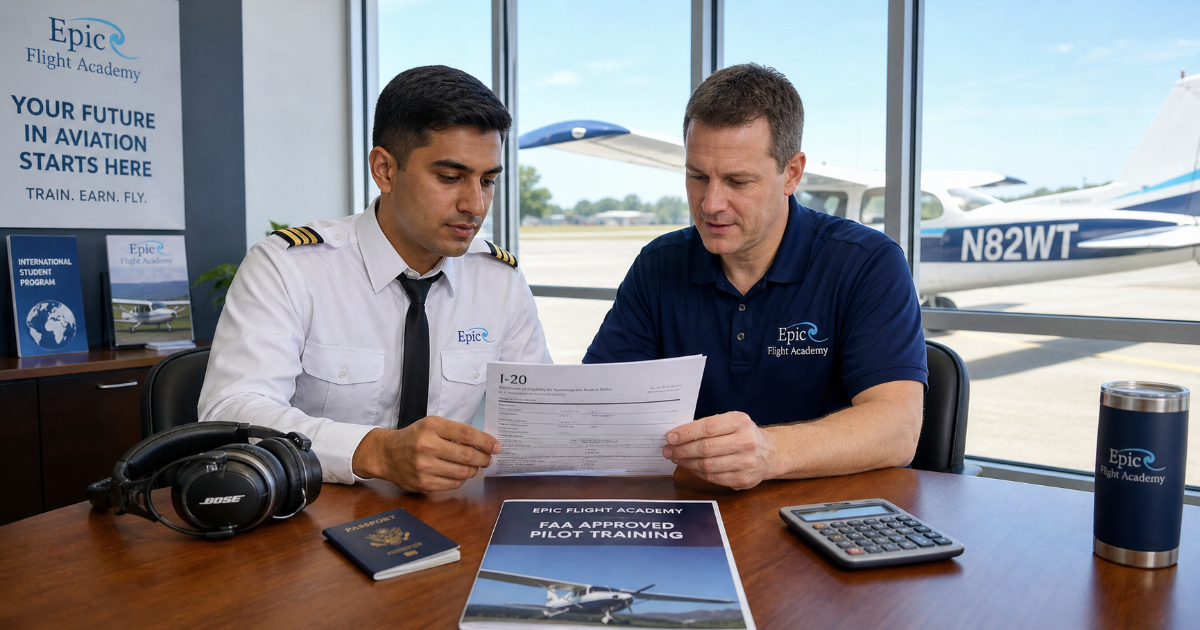
The M-1 visa process reveals a school’s true competence before you ever sit in an aircraft. A school that handles international admissions poorly will likely handle your training the same way. The I-20 Form requirement is the first test of that competence.
- Issue the I-20. This document is mandatory for entry into the United States.
- Maintain SEVP certification. Losing this status cancels every pending enrollment.
- Report enrollment to SEVIS. Federal rules demand accurate, timely student records.
- Provide the Part 141 syllabus. The FAA-approved curriculum must match what you were promised.
- Coordinate your visa interview. Experienced schools prepare you for embassy questions.
- Track your training milestones. Structured progression keeps your visa status valid.
Notice what this list reveals. Every responsibility is administrative, not instructional. A school that fumbles paperwork will fumble your logbook, your stage checks, and your check-ride scheduling.
Ask every school you consider how many international students they currently enroll. Ask how long their I-20 issuance takes. A school’s visa competence is a leading indicator of its training quality. If they cannot manage the first process, do not trust them with the second.
This is why the visa process works as a filter. Schools that enroll international students at scale have the systems in place to move you through each step without friction. Schools that treat your application as an afterthought will treat your training the same way.
The paperwork is not separate from the training. It is the first stage of it.
Can a Non-US Citizen Become a Pilot? Yes, With Conditions
Yes, a non-US citizen can absolutely earn a pilot certificate through an M-1 visa for flight school. The condition most applicants miss is that the visa trains you to fly, not to work.
The M-1 visa grants entry for vocational study and allows you to earn FAA certificates along the way. Those certificates are recognized globally, which makes them a powerful asset when you return home. Airlines in your home country value FAA training because it meets international safety standards.
This is where the misconception takes root. An M-1 visa does not lead to a US airline job. The visa is for training, not employment, and immigration law draws that line sharply. Students who plan to fly for American carriers discover this too late, after spending years and significant money on a path that cannot end where they expected.
Treat that clarity as a feature, not a flaw. The restriction forces honesty about your end goal before you spend a dollar on training. If your plan is to return home with US certificates, the M-1 visa is the industry standard for a fast-tracked transition into the cockpit. If your plan is to fly for a US airline, that goal requires a different immigration strategy entirely.
Know the difference before you choose a school. The right Part 141 program will ask about your post-training plans during the first conversation. A school that does not ask is a school that does not understand the visa it is helping you obtain. The M-1 visa is a training credential, not an employment pathway. Flight training on an M-1 works brilliantly when the destination is home. Just be certain that is your destination.
Choose the School That Earns Your Visa
The M-1 visa for flight school already did the hard part. It filtered out the unstructured Part 61 path that burns through savings with no syllabus to catch drifting progress.
Stop hunting for loopholes that do not exist. The only decision left is which Part 141 school earns your I-20 and your trust. A school that fumbles your visa paperwork will fumble your stage checks too. Administrative precision predicts instructional quality. That correlation is the entire game.
Evaluate each school the way you will evaluate your future students: by how they handle the pressure of international student training. The school that treats your visa as a partnership, not a transaction, is the school that will treat your check-ride preparation the same way. Pick that one. Your certificate depends on it.
FAQ
M-1 Visa for Flight School: Questions Answered
Who is eligible for an M-1 visa?
You qualify for an M-1 visa when you enroll in a SEVP-approved flight school for vocational training, not an academic degree program. The school must issue your I-20 Form first, which means your eligibility starts with choosing a Part 141 school authorized to sponsor international students.
How much does an M-1 visa cost?
The M-1 visa process carries several non-refundable fees that stack before you ever sit in a cockpit. You will pay the I-20 processing fee, the SEVIS I-901 fee, and the visa application fee at the embassy, all separate from your flight training tuition.
How long does it take to get an M-1 visa?
The timeline depends more on your chosen school’s administrative speed than on embassy processing times. A school that issues your I-20 promptly and maintains accurate SEVIS records can move you through the application in weeks, while a disorganized school stretches the process into months.
Can a non-US citizen become a pilot?
Yes, a non-US citizen can earn FAA pilot certificates through an M-1 visa, and those credentials are recognized globally. The visa does not grant the right to work as a pilot in the United States afterward, so your path leads home with your certificates, not to a US airline cockpit.