Aircraft Paint Shop Marketing: How to Fill Hangar Slots Months in Advance
TL;DR · The short answer5 key points
- Aircraft paint shop marketing is a scheduling problem: buyers pick the shop that fits their downtime window.
- Build one page per airframe and service, with downtime estimates, prep method and coating system.
- Show proof: strip and prep steps, named coating systems, inspection sign-off and consistent finished photos.
- Ask for tail number, model and target downtime window on every quote request.
- Fill slow months with Google Business Profile, reviews and paid search on airframe queries.
A shop with an empty bay next month is already behind. Paint decisions get made months before the aircraft arrives, which is why aircraft paint shop marketing is a scheduling problem dressed up as a visibility problem.
Shops keep answering the wrong question. They publish hangar square footage and a gallery of glossy finishes, then wonder why the phone stays quiet through a soft quarter. The operator searching for paint is not shopping for craftsmanship. They are hunting a slot that fits a downtime window.
This article shows how to build aircraft paint shop marketing that fills the calendar instead of chasing it. You’ll learn which pages earn the search, what proof shortens a buyer’s evaluation, and how to capture a tail number before the first call.
Why Paint Shops Market the Wrong Thing
The hangar photo is the least useful thing on your site. Buyers already assume a paint shop owns a hangar. What they cannot assume, and what most aircraft paint shop marketing fails to prove, is that you can take an airframe out of service on their schedule and return it finished.

Walk into a flight department and the paint conversation starts with a date. A lease return has a hard handback, a resale listing needs fresh coating before the broker photographs it, and a heavy inspection already has the aircraft opened up. The shop that gets the call is the one that looks like it understands that calendar.
Framing paint as asset protection and resale value is a smarter position than a gallery of glossy fuselages. It connects the work to money. That framing still answers the wrong question first. The buyer wants to know when, not why.
Years-in-business badges and facility square footage speak to a buyer with no deadline. Corporate flight departments, charter operators and MRO directors all have deadlines. They are comparing your turnaround against the window their inspection already carved out.
So the marketing that wins leads with airframe familiarity and availability. Craftsmanship is the tiebreaker, not the pitch. A shop that opens with finish quality is asking the buyer to do the scheduling math alone.
The Airframe-Specific Page Is Your Best Salesperson
A page listing commercial, corporate and military painting under one roof asks the buyer to sort. Buyers don’t sort. They search a tail type, land somewhere, and judge in seconds whether the shop has touched their aircraft. Four things separate a page that converts: search intent, content proving model familiarity, how military work gets handled, and where the buyer lands next.
Why airframe pages beat a catch-all services page
Search intent here is model-first. A King Air owner types the model, not “aircraft painting services.” A catch-all page competes for a phrase few buyers type. An airframe page matches the query, then answers it. That alignment is why airframe-specific service pages tend to outperform a single broad page on both ranking and conversion.
What belongs on a King Air, Citation or Challenger page
Each page needs four specifics: a downtime estimate for that model, the prep and strip method, the coating system by name, and before-and-after photos of that exact airframe. A Challenger owner scanning for a Citation photo learns nothing about whether your shop understands their aircraft.
Handling military and special-mission work without diluting the commercial message
Military and special-mission work belongs on its own page, not folded into the commercial copy. The government-contract buyer reads differently than a flight department manager. Keep the compliance language, approved specifications and contract references there, so the commercial pages stay focused on owners and operators.
Linking every airframe page back to one quote request
Every airframe page ends at the same quote form, never a dead-end gallery. The form asks for tail number, model and target downtime window so the shop qualifies before the call.
Building that architecture takes an agency that knows the airframes. BrightLine Digital’s aviation SEO services start there, because a generalist agency can’t tell a King Air page from a Citation page.
Proof Beats Promise in Aviation Paint Shop SEO
Every shop claims quality, so the claim alone is worthless. Aviation paint shop SEO is won on evidence a buyer can inspect before they call.
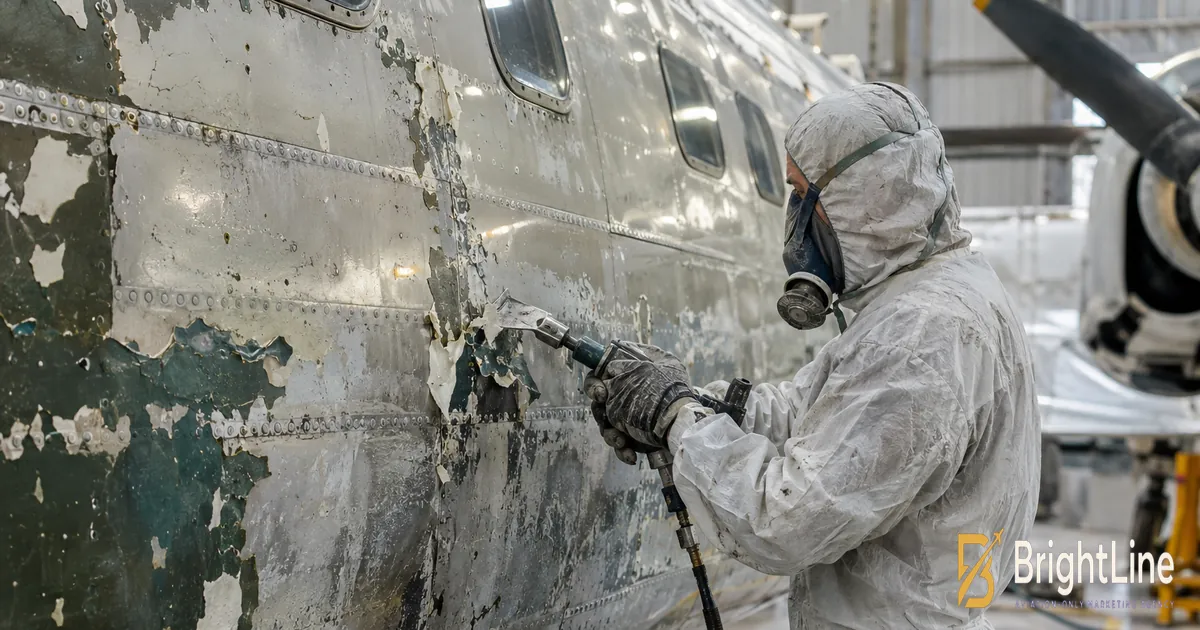


- Strip and prep, step by step. Show the media blast or chemical stripping, the conversion coating and the primer. A buyer who sees the sequence knows whether your prep matches the corrosion control their airframe demands, as set out in the FAA’s corrosion control advisory circular for aircraft.
- Coating system, named. Specify the manufacturer, the product line, and the primer and topcoat pairing. Naming the system lets a director cross-check it against the OEM specification in minutes.
- Inspection and final walkaround. Document the squawk list, the rework loop and the sign-off. Buyers burned by a rushed delivery read this section hardest.
- Finished aircraft, consistent light. Photograph every job under the same rig, angle and backdrop. Repeatable lighting separates a real finish from a flattering one, and makes your gallery read as a record rather than a highlight reel.
These assets compound because they are not website-only. The same strip photos and coating specs feed Google Business Profile posts and paid search landing pages, so one shoot and one write-up serve every channel. Build the proof library once and it keeps selling while the hangar is full.
How to Get More Aircraft Paint Jobs From Search
Search demand for paint work already exists in your market. The problem is that it lands on pages that never mention the buyer’s airframe, so it bounces to a competitor whose page does.
Step 1. Map the queries buyers actually type. Owners and flight departments search combinations, not categories. They type a model and a service together, because the model is the first filter they apply. Pull those combinations from your quote requests, call logs and the search suggestions that appear when you start typing a tail type.
Step 2. Build one page per airframe and service. A single page covering everything ranks for nothing specific and converts nobody. Each page should answer the query it targets and link back to the others. Rewrite existing pages before adding new ones, since thin pages dilute the whole site and Google’s guidance on helpful, people-first content rewards pages written for a specific reader.
Step 3. Add a quote request that qualifies before the call. Ask for tail number, model and target downtime window on the form itself. That structure lets you qualify every paint inquiry before anyone picks up the phone. A form asking only for name and email forces a callback just to learn the aircraft type.
Step 4. Show open capacity with a scheduling path. A calendar link or capacity page removes the buyer’s biggest unknown. When the buyer can see a slot that fits their window, the conversation starts at scheduling instead of introductions.
Step 5. Measure inquiries by airframe, not total traffic. Total traffic hides which pages produce work. Track quote requests per model page and you learn where to invest next. A King Air page pulling steady inquiries deserves more than a Challenger page pulling none.
Work through all five and the site becomes a booking engine that tells you which airframes pay and which pages need work.
The Downtime Trade-Off Buyers Actually Weigh
Two operators call the same shop in the same week, and they want opposite things. The urgent one has an aircraft sitting idle and a revenue problem. The planned one has an inspection date circled and a finish standard to protect.
Urgent operators buy speed. They will pay a premium for a shop that can slot them in without pushing the return date, and they read a page looking for open capacity and a realistic turnaround. What they find instead is a gallery and a phone number, so they call the next shop on the list.
Planned operators buy process. They want the strip method, the coating system and the inspection sequence documented, because the paint has to survive the maintenance relationship it sits inside. Framing paint as part of a broader maintenance package lands well with this buyer. It says nothing to the operator who needs the aircraft back.
Shops write for the planned buyer because that buyer feels more serious. That instinct costs bookings. The urgent operator is often the one holding an open slot, and the shop that never published a turnaround range never entered the conversation.
Publish both paths. Speed is a product, not an apology. A downtime range and a scheduling link capture the urgent buyer; the process page and finish documentation hold the planned one. Shops that publish only the second lose the first by default.
Before and After: From Gallery Site to Booking Engine
The gap between a paint shop with a full calendar and one watching an empty bay is structural, not cosmetic. A gallery site shows what you can do. A booking engine shows when you can do it.


Before: the homepage opens on a rotating gallery, a badge reading decades in business, and a contact form with two fields. A King Air owner fills it out, waits, then calls to ask the only question that matters: can you take the aircraft during the inspection window? The shop answers by email days later. By then the owner has booked elsewhere, and the shop never learns why.
After: the site is organized by airframe and service, with a stated downtime range on each page and the strip and prep sequence documented. The quote form asks for tail number, model and target window, so the shop qualifies before dialing. A scheduling path shows open capacity, and the owner books without a chase.
The contrast reveals what aircraft maintenance marketing actually sells: certainty about timing. Buyers already assume you can paint. They are testing whether you can paint on their schedule.
What Fills Slots When Search Is Slow
The slow months never announce themselves. Organic traffic thins out, the phone goes quiet and the bay sits open. That gap is where aircraft paint shop marketing needs a second engine rather than a louder one.

Google Business Profile is one of the most valuable local assets a paint shop owns, because buyers search location and airframe together. Someone types a paint query with a city and a tail type, and the profile can surface in the map pack. Fill it with airframe photos, service categories and a booking link, not a single hangar shot from years ago. Google’s own tips to improve local ranking point the same way: complete, accurate and active profiles get shown more.
Reviews are the trust layer that turns that profile into a call. A buyer comparing two shops in the same area often reads the reviews before the website. Ask every finished aircraft owner for a review at delivery, when the finish is fresh and the goodwill is high.
Paid search bridges the gap while organic is still maturing. Target the airframe-and-service queries that already convert, and send them to the same pages the SEO work built. Aviation local SEO and Google Business Profile work is built for exactly this combination of profile, reputation and paid bridge.
None of it matters if the calendar isn’t the scoreboard. Traffic that never becomes a booked slot is a vanity number. The shop that fills its slow months measures inquiries by airframe and tracks each one to a signed slot.
Book the Calendar Before the Phone Rings
Visibility gets the credit. Scheduling does the work. Once you see aircraft paint shop marketing as calendar management, every page on your site has a job it either does or fails to do.
Wait for the slow stretch and the fix costs you more than a redesign. An airframe page that goes live before the season means a buyer searching your tail type finds you first, not the shop that built that page last year. The lead time is the whole advantage.
Audit the site this week. Count the airframe-specific pages. Open the quote form and check whether it asks for tail number and target downtime window. Fix those gaps now, while the calendar still has room to fill.
BrightLine Digital builds aviation SEO that puts your paint shop in front of operators planning a downtime slot months ahead. Book a call to map the pages that fill your hangar calendar.
FAQ
Aircraft Paint Shop Marketing Questions Owners Ask
What are the best marketing strategies for a painting business?
For an aircraft paint shop: build airframe-specific pages, publish documented proof of your strip and finish process, and capture tail number and downtime window on every quote request. What separates aircraft paint shop marketing from generic trade marketing is answering the airframe and scheduling questions before the buyer asks.
What is an airplane paint job called?
The design is called a paint scheme or livery, and a full job is usually described as a strip and repaint. A lighter job that sands and recoats over the existing finish is often called a scuff and shoot or overcoat, which is a different scope and price from a full strip.
How do paint shops get found by aircraft owners?
Owners often search by airframe and service together, so a Citation owner types something closer to “Citation paint shop” than “aircraft painting.” A shop with one generic services page competes for broad terms, while a shop with a page per model captures the query that already names the aircraft.
What should an aircraft paint quote request ask for?
Tail number, model, current paint condition and the downtime window the owner can live with. Asking for the target window up front lets the shop quote against real hangar capacity instead of guessing, which shortens the gap between inquiry and signed slot.