
FBO Marketing Ideas: How to Fill Your Hangar in 2026
ℹ️ TL;DR
- Implementing high-ROI FBO marketing ideas requires targeting dispatchers, corporate chief pilots, and flight schedulers rather than passenger traffic.
- Dominate local search rankings for your specific ICAO airport identifier and Jet-A fuel queries to capture transient aircraft stops before chain operators do.
- Segment your marketing strategy cleanly between fast-turn transient fuel buyers and long-term based hangar lease tenants.
- Transform your fuel contracts and co-branded card programs into active acquisition tools using transparent pricing and volume loyalty tiers.
- Optimize your website with direct 24/7 line crew contact paths, GPU availability, and instant hangarage quote request forms.
A dispatcher types KSDL into a trip planning tool, filters by Jet-A price, and books a stop in under a minute. Your FBO never appears in that list, because you rank nowhere for your own identifier.
That gap is where revenue quietly disappears. FBO marketing ideas get pitched as brand campaigns and luxury photography, but the people choosing your ramp are pilots, owner-operators, and dispatchers making fast operational calls. They scan fuel pricing, hangar space, and crew amenities. They do not see your lobby.
This article gives you FBO marketing ideas built around the people who actually choose the stop. You’ll learn how to win local search for your ICAO identifier, segment transient and based traffic, and turn fuel programs into acquisition engines.
The Customer Choosing Your FBO Is Not the Passenger
The FBO buyer is the pilot, owner-operator, or dispatcher who selects your stop, not the passenger who walks through your lobby. That distinction decides which FBO marketing ideas work and which ones quietly burn budget. Most private aviation customers care about location, convenience, and service far more than luxury and glamour, so private aviation customer priorities rarely match the marble-lobby imagery operators keep producing.
Operators misread this constantly. They photograph the lounge, the espresso bar, the courtesy car, then push those assets at an audience that never books the leg. A dispatcher at a Part 135 operation is comparing your ramp access, your quick-turn time, and your after-hours callout against three other fields. She has never seen your lobby.
The passenger is a consequence of the decision, not the decision itself. When you market to the passenger, you’re marketing downstream of the transaction, which is why glossy FBO campaigns produce engagement and no hangar movement. The crew member choosing the stop wants one thing answered fast: can I get in, get fueled, and get out without a delay that cascades through the rest of the day.
Reframe every asset you own against that question. Hangar space becomes schedule reliability. A crew car becomes a shorter overnight. A 24-hour line crew becomes a stop you can book at 11 p.m. without a phone call that goes unanswered.
Get this wrong and you spend a year building brand awareness with people who never touch the routing decision. Get it right and every dollar points at the person holding the trip sheet.
Jet Aviation learned this the hard way at its Teterboro location, where crew feedback drove a redesign of the pilot lounge and ramp flow. The company stopped treating the lobby as the product and started treating turnaround speed as the pitch.
Ask what a dispatcher needs in the ninety seconds before she commits a tail number to your field. Answer that question in your marketing, and the passenger experience sells itself once the aircraft is already on your ramp.
Win the Search Before the Chain Operator Does
Chain operators do not outspend you on local search. They outrank you because they built identifier-specific pages years before your FBO marketing ideas included a single landing page for your own ICAO code. Dispatchers and trip planners route by ICAO identifier and fuel-type search, which means the query that matters is rarely your airport name.
It looks like “KSDL Jet-A price” or “KAPA hangar availability.” Those are transactional searches with a decision attached. If your FBO has no page built to answer them, a national chain’s generic airport page takes the click instead.
The architecture is unglamorous and it works. One page per identifier, one page per service line, both wired into a Google Business Profile that matches the same address and phone number. Local search rewards the operator who claims the identifier first, not the one with the biggest ad budget. That is the whole game in the map pack.
Trust signals decide the click once you rank. Jet-A pricing, ramp fees, hangarage square footage, GPU availability, and crew car access belong on the page, not buried in a PDF. A dispatcher comparing three stops in ninety seconds picks the one that answers the fuel question without a phone call.
Aviation SEO services built for this niche treat each identifier as its own market. A flight school or MRO chasing the same keyword without that structure competes for traffic that was never theirs. BrightLine Digital builds identifier-level page architecture for exactly this reason. Rank for your own code before you spend a dollar on anything else. The chain operator already has.
Counter-argument: the chain has more pages, so it wins by volume. Wrong. Google ranks the page that answers the query, not the operator with the most domains.
Signature Flight Support and Atlantic Aviation dominate because each location page carries its own fuel and service details. Your single FBO can match that depth for one identifier in an afternoon. Depth beats breadth when the query is local.
Transient and Based Tenants Need Different FBO Marketing Ideas
Transient and based tenants look like one market on a fuel report and behave like two entirely different businesses. The FBO marketing ideas that fill a ramp overnight are not the ones that fill a hangar for a decade. Search visibility wins the first group; relationship wins the second.
Transient traffic is won on search visibility, fuel pricing, quick-turn service, and crew amenities. A pilot routing through your region decides in minutes, comparing Jet-A price, ramp access, and whether the crew car is available. Lose that comparison and the stop goes to the next identifier on the list.
Based tenants are won on hangar availability, long-term agreements, and relationship. An owner-operator moving a aircraft into your market cares about whether you have covered space, what the monthly terms look like, and whether the line crew knows their tail number. These decisions take weeks, not seconds.
Treating both groups as one homogeneous market dilutes every channel. A paid search campaign built for transient fuel stops wastes budget on owners who will never click an ad to choose a home base. A relationship-heavy sales push aimed at transient pilots burns time on people who will land once and leave.
The channel mix should diverge cleanly. Transient acquisition lives in local search, fuel-price visibility, and review management. Based tenant acquisition lives in direct outreach, hangar tours, and service agreements that reward commitment. BrightLine Digital builds this segmented search and lead-generation structure for aviation businesses because the two funnels rarely share a landing page.
The offer mix diverges too. Transient offers are transactional: a fuel discount, a waived ramp fee, a fast turn. Based tenant offers are structural: a hangar lease, a fuel contract with volume tiers, a maintenance relationship that keeps the aircraft on your field.
Transient marketing wins when your FBO ranks for its own identifier and fuel-type queries. Based tenant marketing wins when your hangar availability and service terms reach the operators already flying in your region. Run both, but never through the same campaign.
Turn Your Fuel Contract Into a Marketing Engine
An FBO marketing idea that costs nothing to launch is already sitting in your fuel contract. Fuel loyalty and co-branded card programs are acquisition and retention engines, not back-office paperwork. Operators treat them as procurement, then wonder why transient traffic keeps shopping price at the next stop.
- Branded card benefits. Push card perks to transient and based tenants through the same channels you use for hangar news. A pilot who knows your card saves money has a reason to route back.
- Contract terms as math. Frame fuel agreement terms as savings the customer can calculate on their own spreadsheet. A discount a flight department can verify beats a vague promise of partnership every time.
- Loyalty tiers by volume. Reward repeat volume with tiered pricing or service credits that grow with gallons purchased. Flight departments track annual fuel spend closely, and tiers give them a reason to consolidate stops.
- Co-branded promotion. A holistic marketing toolkit turns fuel partnerships into visible campaigns, not buried line items. Media tactics, design, and event presence carry the program to the people who sign the contracts.
- Renewal touchpoints. Trigger outreach before contract expiration, not after. A renewal conversation that opens with last year’s volume and savings is a retention play disguised as customer service.
- Crew-facing education. Brief line staff on card terms so the benefit gets mentioned at the counter. A program the ramp never explains is a program half your customers never hear about.
Read together, these tactics reveal something operators miss: the fuel program is the only marketing asset that pays for itself through volume. Every other channel spends budget to generate demand. A fuel discount nobody knows about is just margin you gave away. Pull your contract terms into your next campaign before you buy another ad.
A fuel contract that never reaches the flight department’s decision-maker is a discount nobody claimed. Push card terms into the same email sequence that carries your hangar availability and crew car updates. The pilot who books the stop is often not the person who signs the fuel agreement.
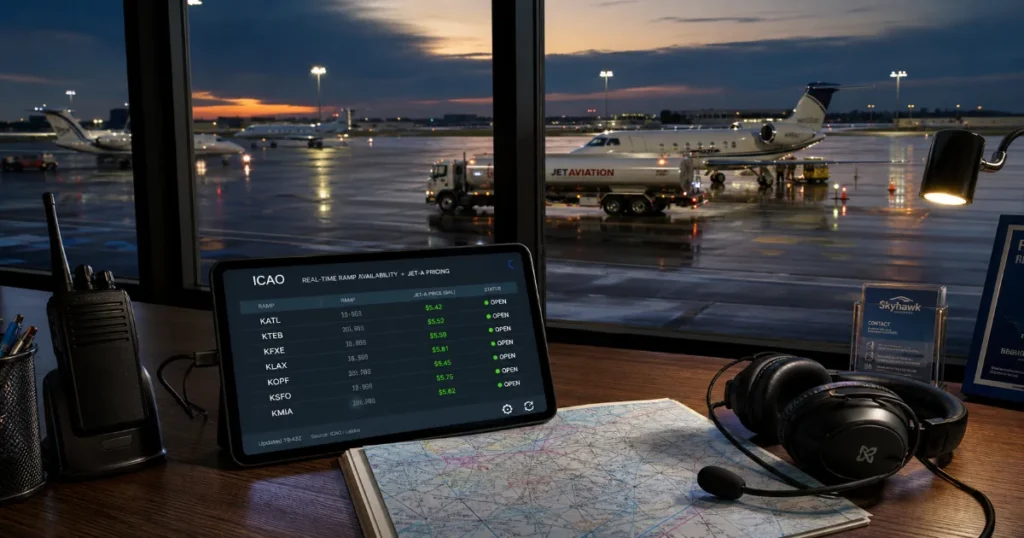
How to Market to Corporate Flight Departments
Reaching corporate flight departments turns fbo marketing ideas into recurring fuel volume, because one signed agreement beats a hundred transient stops. Skipping the identification step is how operators waste a year pitching companies that never route through their airspace.
Step 1. Map every flight department and charter operator within a practical radius of your field. Pull tail numbers from FAA registry data, cross-reference them against your ramp logs, and note who already lands nearby. Without this list, outreach becomes guesswork.
Step 2. Find the person who actually sets the routing, not the receptionist who answers the phone. In smaller departments that’s the chief pilot or director of aviation; in larger ones it’s a scheduler with real authority. Pitch the wrong contact and your proposal dies.
Step 3. Open with a direct call or email that names their aircraft type and typical routes. Offer a specific reason to stop: a fuel price locked for the quarter, guaranteed hangar space, or a crew car reserved on arrival. Generic aviation content marketing gets ignored; a message that references their tail number gets answered.
Step 4. Show up where these decision-makers gather, at NBAA regional events and state aviation conferences. A booth conversation converts faster than cold outreach because the flight department already trusts the room. Skip the circuit and competitors become the familiar face.
Step 5. Put a tailored service agreement in front of them while the relationship is warm. Fuel pricing tiers, after-hours handling, and priority ramp access should be written for their specific fleet. The cornerstone of any FBO marketing plan rests on customer acquisition and retention, and a signed agreement locks in both.
Step 6. Follow up on a fixed cadence after the first stop, because a single visit does not create loyalty. Ask the chief pilot what worked and what fell short, then fix it before the next trip. Departments that feel heard return; departments that feel processed move on.
Completing this process converts one-off diversions into scheduled fuel stops with predictable monthly volume. That predictability lets you staff the ramp, negotiate better fuel contracts, and stop chasing transient traffic.
What an FBO Marketing Budget Should Actually Buy
Every fbo marketing ideas conversation eventually hits the same wall: what should the money actually buy? The answer depends less on total spend than on which tier you’re funding, because a lean local-search foundation and a full automation program produce completely different returns.
| Tier | What It Buys | Primary Return | Best Fit |
|---|---|---|---|
| Lean Foundation | ICAO identifier pages, Google Business Profile, review management | Map-pack visibility for own-identifier searches | Single-location FBOs with no digital presence |
| Mid-Tier Mix | Paid search on fuel-type queries, crew-facing content, reputation | Transient stop volume and review velocity | FBOs competing with chain operators nearby |
| Full Program | Marketing automation, CRM, trade show presence, segmented campaigns | Based-tenant retention and flight department contracts | Multi-service FBOs with hangar capacity to fill |
| Enterprise | Dedicated aviation marketing partner, attribution modeling, full funnel | Cost per acquired tenant tracked against revenue | Operators running multiple locations or high-volume fuel programs |
The tier that wins depends on what you’re trying to fill. A lean foundation wins for the FBO that ranks nowhere for its own identifier and needs map-pack presence before anything else. A full program wins when hangar capacity sits empty and based-tenant retention is the actual problem.
Cost per acquired tenant is the only metric that makes tier comparison honest. Generic aviation marketing advice rarely quantifies spend against tenant outcomes, which is why most operators cannot tell whether their budget is working. BrightLine Digital ties aviation marketing spend directly to measurable lead and tenant results, so the comparison stops being theoretical.
Audit where your current spend sits on that table before adding another dollar. If you cannot name which tier you’re funding and what it’s supposed to return, the budget is buying activity rather than tenants.
Spending on the wrong tier is the quiet killer. A single-location FBO that buys marketing automation before it owns its own ICAO identifier page is paying for plumbing it can’t use yet.
Fix the foundation first. Own the searches that already carry your name, then layer paid spend on top. BrightLine Digital builds that sequence deliberately, because the order of spending matters more than the size of it.
Communicate the Benefits Your Best Customers Value
An FBO that never markets its own service is running the same play as one that markets nothing at all. The best fbo marketing ideas don’t sell the ramp. They sell what happens on it, and they sell it to the people who already know the difference.
Marketing exists to communicate the value you offer, the customer service you provide, and the amenities that go beyond tie-down and refueling. That framing comes from aviation marketing practitioners who work with FBOs directly. A crew that gets a clean quick-turn, a stocked ice machine, and a loaner car without asking remembers the stop. That memory is the product.
reputation management is where that memory gets captured or lost. A pilot who had a good experience won’t write it down unless prompted at the right moment. A pilot who waited forty minutes for fuel will write it down immediately, on every forum that matters. The asymmetry is the problem.
Crew-facing content works differently than passenger-facing content. A blog post about your lobby renovation reaches nobody who routes the trip. A page that names your after-hours phone number, your GPU availability, and your crew car policy reaches exactly the person making the call. Specificity is what earns the recommendation, not polish.
Consistent messaging across every touchpoint compounds the effect. The dispatcher who sees your fuel price on a trip planning tool, your response time on a review site, and your ramp crew’s professionalism in person is building one impression from three sources. Break the pattern at any point and the recommendation dies.
A single stop becomes a recommended stop when the crew has something to say about it. Give them the language, the prompt, and the reason. Without that, you’re relying on memory and goodwill, which is a marketing plan that expires the moment the next FBO opens nearby.
Fill the Hangar by Marketing Where the Decision Happens
FBO marketing ideas only pay off when they reach the dispatcher mid-search, not the passenger mid-lobby. Visibility at the identifier and fuel-type query is the whole game now. Everything else is decoration.
Skip the audit and the cost compounds quietly. A chain operator owns the map pack for your identifier, your fuel program goes unpromoted, and your crew amenities stay invisible to the people booking the stop. Every month you rank second is a month of volume you never see.
Run the audit this week. Search your own ICAO identifier plus Jet-A, then check where you land. Fix that ranking before you spend a dollar anywhere else. BrightLine Digital builds exactly that foundation for aviation operators.
Want FBO marketing ideas that actually fill your hangar in 2026? Visit BrightLine Digital to get an aviation-only strategy built to turn empty bays into booked business.
Ready to Fill Your Ramp and Hangar Space in 2026?
Stop losing transient fuel stops and based tenants to chain operators down the road. BrightLine Digital builds aviation-only marketing strategies that put your ICAO identifier at the top of local search and convert dispatchers into repeat customers.
FBO Marketing Ideas: Questions Operators Ask
How should an FBO split marketing between transient and based tenants?
Split the budget by decision type, not by percentage: search visibility, fuel pricing, and quick-turn service win transient traffic, while hangar availability, long-term agreements, and direct relationship work win based tenants. A transient pilot decides in a trip planning tool within seconds, but a based tenant decides over months of conversations with your line staff and management.
Is a fuel loyalty or co-branded card program worth promoting?
Yes, because an unpromoted fuel program is a discount nobody knows they are getting, which means you surrender margin without earning the repeat volume it was meant to buy. Promoting it changes the math: branded card benefits, calculable contract savings, and tiered rewards give transient and based tenants a reason to route back to your ramp instead of the FBO down the field.
How do you reach corporate flight departments and charter operators?
Identify the flight departments and charter operators that actually route through your region, then open direct outreach to the people who set the routing rather than a general sales inbox. Skipping that identification step is how operators spend a year pitching companies whose aircraft never enter their airspace, which is why a tailored service agreement placed in front of the right dispatcher beats a hundred cold emails.
Where should an FBO spend its first marketing dollars?
Start with local search built around your own ICAO identifier and fuel-type queries, because that is where the routing decision happens and where chain operators currently outrank you. Fixing that foundation before buying paid ads or event sponsorships means every dollar after it lands on a page a dispatcher can actually find.