How to Get an I-20 for Flight School: 7 Steps for 2026 Success
ℹ️ TL;DR
- Learning how to get an I-20 for flight school starts with verifying that the academy holds both FAA Part 141 certification and active SEVIS approval.
- Submit a complete funding file covering full program tuition and living expenses before the Designated School Official (DSO) will generate your form.
- Pay the I-901 SEVIS fee only after the I-20 is issued, because the payment portal requires the unique SEVIS ID printed on the document.
- Check every name spelling and program date against your passport before booking the embassy interview to avoid costly correction delays.
- If switching schools mid-training, confirm the SEVIS record transfer before logging any flight hours at the new academy to protect your legal status.
The DSO email lands weeks after you assumed the hard part was over. A PDF is attached, and that attachment is the moment learning how to get an I-20 for flight school stops being research and becomes a deadline. Until it arrives, you have a deposit receipt and a start date that may not survive the paperwork.
Applicants treat the I-20 as a reward for getting accepted. It is not. The form exists only after a school certified in SEVIS reviews a funding file that covers the entire program, not one semester.
This article walks the full sequence in order, from verifying a school’s certification to the transfer rules that apply if you change programs mid-training. You will see the money you must prove, the money you must pay, and where files stall.
Only SEVIS-Approved Part 141 Schools Can Issue One
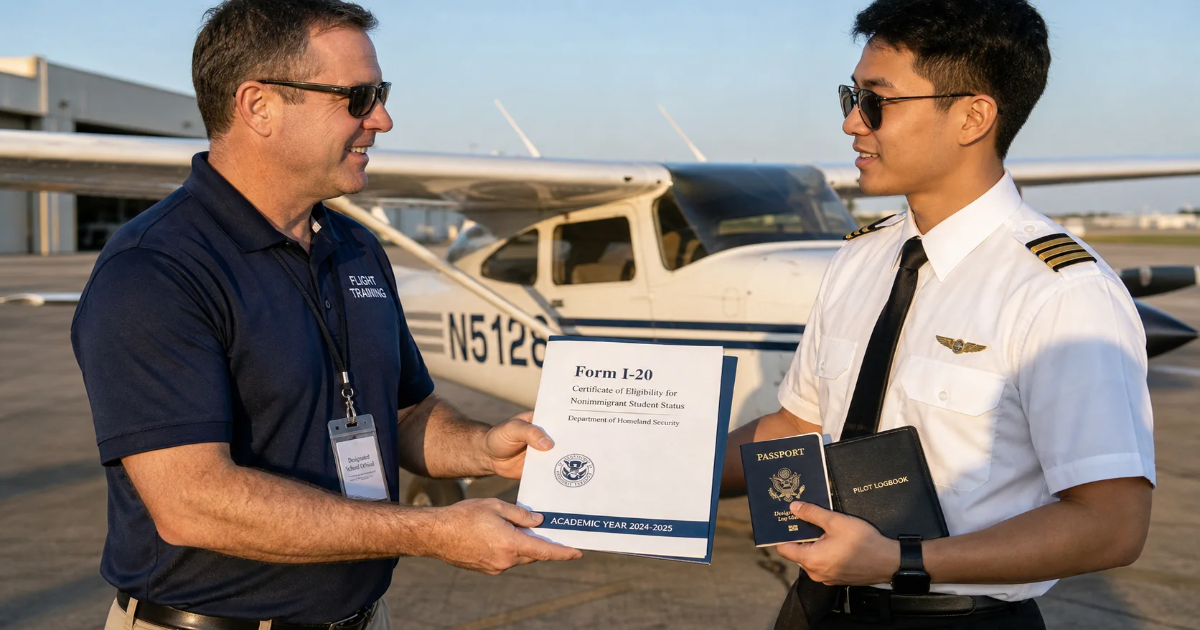
The Form I-20 is the certificate of eligibility a designated school official issues inside SEVIS to confirm you have been accepted into a certified course of study. It is not an admission letter. It is a government record that only exists once the school enters your data into the Student and Exchange Visitor Information System. Understanding how to get an I-20 for flight school starts with recognizing that the document belongs to the school’s certification, not to your application.
A flight school cannot issue an I-20 simply because it teaches people to fly. Only FAA certificated Part 141 schools that are approved and participating in the Student and Exchange Visa Information Service (SEVIS) program are authorized to issue an I-20 form to prospective students upon enrollment. A Part 61 school with a strong safety record and a full fleet still cannot generate the form.
The regulatory split decides your visa class before you apply. Degree-granting colleges issue F-1 I-20s for academic programs. Standalone vocational flight schools typically issue M-1 I-20s, which carry tighter rules on duration, extensions, and employment. Choosing a school without checking which class it issues is how applicants end up with a visa that cannot be extended past their original program window.
Verification takes minutes and most applicants skip it. Ask the school for its SEVIS school code and confirm the status is active, not merely approved. A marketing page claiming “SEVIS certified” proves nothing. schools ranked by visa support publish their code and their Part 141 certificate openly, because they know international admissions depends on it.
Pay the deposit only after the code checks out. A school that cannot produce an active SEVIS record today cannot produce your I-20 tomorrow, no matter how good the training looks on paper.
The Documents and Funds a DSO Reviews First
Learning how to get an I-20 for flight school comes down to a file, not a form. The designated school official opens your documents before they touch SEVIS, and an incomplete file is the reason an I-20 sits unissued for weeks. Nothing moves until every item below is in hand.
- Completed application. The school cannot begin its review without your full academic and personal history on record.
- Passport bio page. The DSO matches your legal name and nationality against the record before issuing anything.
- English proficiency proof. Schools that require it will not process the file until the score or waiver is attached.
- Bank statement or sponsor letter. Funds must cover tuition plus living expenses for the entire program, not one term.
- Non-refundable application fee. Payment clears before the I-20 is generated, and it does not come back if you withdraw.
Flight schools calculate required funds from total program cost, because flight training is billed by flight hour. A DSO must certify the full course of study, and demonstrated financial ability has to hold on a continuous basis. Each applicant submits complete documentation and a non-refundable application fee before the I-20 Form is issued. Funds must be liquid and documented. A sponsor’s letter needs to state the relationship and the exact amount, or the DSO sends the file back.
Build the whole file before you pay the application fee. Ask the international admissions office for its current document checklist in writing, then confirm each item against your visa and funding requirements before submission.
How to Get an I-20 for Flight School: The 7 Steps
Step 1. Confirm the school holds Part 141 certification and active SEVIS approval. Check the school’s SEVIS status on the government’s school search before you send anything. A flight school that teaches well but sits inactive in SEVIS cannot generate your record, no matter how good the training is.
Step 2. Submit the application and pay the non-refundable fee. The fee clears before the school opens your file, so a payment delay is a file delay. Keep the receipt; you will reference it if the DSO asks for proof of submission.
Step 3. Build the proof-of-funds file against the full program cost. Flight training bills by flight hour, so the DSO certifies the entire course of study, not one semester. Bank statements, a sponsor letter naming the relationship and the amount, and living expense coverage all go in together.
Step 4. Let the DSO review the file and issue the I-20 through SEVIS. The document does not exist until the designated school official creates it inside the system. Anything you paid before this point bought you a place in line, not a record.
Step 5. Check every field against your passport before you move on. A misspelled name or wrong program dates forces a corrected I-20 and pushes your interview back. Compare the spelling, the program start and end dates, and the SEVIS ID character by character.
Step 6. Pay the I-901 SEVIS fee using the SEVIS ID printed on the form. You must receive the Form I-20 from a DSO at the school you plan to attend before you can pay the I-901 fee. Attempting payment first leaves you with nothing to enter in the SEVIS ID field.
Step 7. Complete the DS-160 and book the visa interview. Carry the I-20, your fee receipt, and your funding documents to the window. The officer will compare your answers to the numbers your school certified, so know your own file cold.
Finishing all seven steps produces a record the consulate can act on and a start date you can defend. Compare training programs and real costs before you commit, because the funding figure you certify on the I-20 follows you through the interview.
How Long the I-20 Takes, Week by Week
Timeline planning is where applicants lose a semester, and the loss rarely comes from a rejection. It comes from assuming the I-20 arrives in days when the honest answer is weeks. Learning how to get an I-20 for flight school on a real calendar means working backward from your start date.
Step 1. Submit the application and pay the non-refundable fee. Nothing moves until the school has both. A pending payment holds the entire file.
Step 2. The school reviews transcripts and English proficiency. This review runs on the registrar’s schedule, not yours. Ask for the current turnaround in writing.
Step 3. The proof-of-funds review begins. A DSO checks that your bank documentation covers the full program plus living costs. Underfunded files sit untouched until the gap closes.
Step 4. The DSO issues the I-20 in SEVIS. This is the variable applicants underestimate most. Program start dates cluster, and DSO queues lengthen around them.
Step 5. Pay the I-901 SEVIS fee using the SEVIS ID printed on the form. The fee cannot be paid earlier because the ID does not exist until issuance. International flight training admissions at most schools treat this as the handoff to the visa stage.
Step 6. Complete the DS-160 and book the interview. Embassy wait times in your home country can add weeks, and they vary by consulate and season. Check the current wait time before assuming a date works.
Step 7. Attend the interview and wait for passport return. Approval at the window is not the same as a passport in hand. Budget days for courier return, not hours.
Ask the international admissions office for its processing estimate in writing, and compare that number against your intended start date. Embassy interview wait times are the second variable nobody plans for. Schools that publish clear timelines on visa support and real costs convert applicants faster, because the applicant can plan instead of guess. Work backward, and the calendar stops being a surprise.
What It Costs to Show Funds Before the I-20
Understanding how to get an I-20 for flight school means separating two numbers that look identical on paper and behave nothing alike in practice. The money you must prove and the money you must pay come from the same bank account, yet only one of them gets certified on the form. Confusing them is how applicants submit a file that looks funded and still stalls.
The proof column is the one that decides your case. A DSO certifies the full cost of your course of study, not a semester of it, and the consular officer later checks that the same figure appears in your documentation.
| Cost Category | What It Covers | How the DSO Treats It |
|---|---|---|
| Full flight training program | Billed by flight hour across the entire course | Certified on the I-20 as the total program cost |
| Living expenses | Housing, food, transport for the program duration | Added to the certified total, not billed by the school |
| Dependent expenses | Support for a spouse or child accompanying you | Increases the required figure before issuance |
| School application fee | Non-refundable charge to open your file | Paid before the I-20 is generated, never certified |
| I-901 SEVIS fee | Government fee tied to your SEVIS ID | Paid after issuance, separate from proof of funds |
A sponsor can cover the certified total, provided continuous financial ability is documented with the relationship and the amount stated plainly. The proof column is the only one that gets you an I-20. The payment column gets you a receipt.
Applicants who map the costs and visa pathway together before submitting anything avoid the correction cycle entirely. Underfunding the file costs weeks, not dollars. Build the proof column first, then pay.
Switching Flight Schools After Your I-20 Is Issued
The I-20 does not belong to you. It belongs to the school named on it, and that single fact decides everything about how to get an I-20 reissued when you change programs mid-training.
Every I-20 is tied to one school and one course of study. Move to a different flight school and the old form becomes invalid the moment your SEVIS record changes hands. The new school does not inherit your document. It issues a fresh one.
The mechanics run through SEVIS, not through a new application. Your current school’s designated school official releases the record with a transfer-out date. The new school’s DSO then claims it and generates a new I-20. Students traveling to the United States for flight training need to apply for a student visa, and your embassy interview process may need to be revisited if the transfer changes your program level.
Starting flight time at the new school before the transfer clears creates a status violation. The release date matters more than the handshake. You must begin attendance at the receiving school within the window your DSO specifies, or the record goes dormant.
Stopping attendance without a transfer is worse. A student who simply walks away from one school and enrolls at another is out of status, and that status gap follows the record. tracking international applicant records carefully is exactly where schools with structured admissions processes separate themselves from those handling transfers by email thread.
Get the transfer confirmed in SEVIS before you book a single hour of dual instruction. A new school that lets you fly first and paperwork later is putting your status at risk.
Where Applications Stall and How to Unstick Them
Delays in how to get an I-20 for flight school are almost always administrative, not regulatory. A school rarely rejects an applicant outright. It simply waits, because the file is incomplete and nobody told the applicant what was missing.
Step 1. Confirm the school’s SEVIS status before anything else. A school can teach flying for years and still hold no active SEVIS approval. Discovering that after paying a deposit means starting over with a different school.
Step 2. Build the proof-of-funds file around the full program cost. A bank statement covering one semester looks complete to the applicant and incomplete to the DSO. Flight training is billed by flight hour, so the certified figure covers the entire course of study plus living expenses.
Step 3. Make the sponsor letter state the relationship and the exact amount. A letter that pledges vague support gives the DSO nothing to certify. Name the sponsor, name the relationship, name the dollar figure.
Step 4. Match the name on the application to the passport exactly. A middle name dropped or a surname reversed triggers a corrected I-20 and a delayed interview slot. Verification happens before submission, not after.
Step 5. Wait for the I-20 before paying the I-901 fee. The fee requires the SEVIS ID printed on the form. Paying early stalls the record instead of accelerating it.
One missing document can push a start date by weeks, and the seat goes to whoever filed a complete file first. Treat the paperwork as a checklist finished before the school opens its review. Flight schools running structured international admissions support move applicants through faster, which is where BrightLine Digital helps schools convert applicants instead of losing them to a slower competitor.
Start With the School’s SEVIS Status, Not the Application
Verify the school’s Part 141 certification and SEVIS standing before a single dollar leaves your account. A deposit paid to a school that loses its SEVIS status mid-enrollment leaves you scrambling for a transfer. That scramble costs a semester, and sometimes it costs the training hours you already logged.
Confirm the certification today. Build the proof-of-funds file covering your full program before you pay anything. Schools that run structured international admissions processes move applicants through faster, which is where BrightLine Digital helps flight schools convert serious applicants instead of losing them to a slower competitor.
Help More International Students Find Your I-20 Pathway.
Serious pilot candidates search for SEVIS-approved Part 141 schools every day. BrightLine Digital builds aviation-only search and content systems that put your admissions guide in front of funded applicants ready to enroll.
I-20 Questions International Student Pilots Ask Most
Can a flight school issue an I-20 for non-degree flight training?
Yes, but only when the school holds FAA Part 141 certification and carries active SEVIS approval. Knowing how to get an I-20 for flight school starts with that certification check, because vocational flight training is typically issued under an M-1 rather than an F-1.
How much money do I need to show for an I-20?
The figure must cover full program cost plus living expenses for the entire course duration, not a single semester. Liquid funds or a signed sponsor letter both work, provided the sponsor states the relationship and the exact amount.
Can I pay the SEVIS I-901 fee before the I-20?
No. The I-901 payment portal requires the SEVIS ID printed on the form, so the I-20 comes first. Attempting payment early leaves you with nothing to enter in the required field.
What happens to my I-20 if I switch flight schools?
The new school issues a fresh I-20 and the SEVIS record transfers between the two designated school officials. Logging flight time at the new school before that transfer is confirmed creates a status violation that follows your record.