How Much Bank Balance is Required for an M-1 Visa Interview? (2026 Guide)
ℹ️ TL;DR
- There is no fixed minimum bank balance required for an M-1 visa interview: consular officers compare your financial proof directly against your Form I-20 estimate.
- Sudden, unexplained lump-sum deposits read as borrowed funds and frequently lead to a 214(b) visa refusal.
- Six months of consistent bank statements showing regular salary credits or seasoned savings tell a far stronger story than a last-minute large deposit.
- Education loan sanction letters, official scholarships, and sworn sponsor affidavits with relationship proof validate your file without needing massive cash reserves.
- Ensure your financial documentation covers total flight tuition, aircraft rental estimates, living expenses, travel, and SEVIS fees before booking your embassy interview.
You’ve read six Reddit threads, saved three blog posts, and still don’t have a number. There isn’t one. How much bank balance is required for an M-1 visa interview has no published answer, and applicants who get refused usually found a number and built their file around it.
The officer isn’t comparing your statement to a threshold. They’re comparing it to your I-20, then asking whether the money looks like yours. A balance that appeared three weeks before the interview reads as borrowed, and borrowed money is the fastest way to a 214(b) refusal.
This article lays out the framework officers use to judge funds, the documents that survive scrutiny, and the mistakes that sink otherwise qualified flight students. You’ll finish knowing what to fix before you book the appointment.
The Minimum Balance Myth That Sinks M-1 Applicants
Searching for how much bank balance required for M-1 visa interview returns a dozen confident answers and none agree. One forum says a few thousand dollars. Another insists on a full year of tuition. The officer never asked for either number.
What the officer reads is a comparison, not a threshold. Your statement gets held against the cost estimate printed on your I-20, and the only question is whether the two line up. A number from a blog post tells you nothing about that match.
The pattern that sinks applicants looks identical every time. Someone reads that a certain figure works, moves that amount into savings the week before the interview, and walks in with a statement showing one large deposit and no history. Money that appears suddenly reads as borrowed money. A consular officer trained on 214(b) refusals has seen that pattern thousands of times, and it signals one thing: the applicant cannot fund the program.
Origin matters as much as amount. A salary that lands on the same date every month, a savings account that has grown slowly for a year, a fixed deposit that matured on schedule, these tell a story. A lump sum from an uncle’s account two days before the interview tells a different one. The documented balance history is what officers weigh, because it separates money you control from money you borrowed for the appointment.
Flight training makes this harder than a standard degree. Your I-20 cost estimate includes aircraft rental, instructor time, and examiner fees that vary by how fast you progress. A student who shows a balance covering tuition but ignores the flight hour component looks underfunded even with a healthy number. The I-20 total is the target, not a number from a forum.
The question itself is the problem. Asking how much bank balance is required for an M-1 visa interview assumes a published figure exists, and it does not. Ask instead whether your statement, your sponsor’s income, and your I-20 tell one coherent story. That question has an answer you can act on.
What the Officer Actually Reads on Your Statement
Proof of funds is documentary evidence that you can pay for your approved course of study without working in the United States. It includes bank statements, loan sanction letters, scholarship awards, and sponsorship affidavits. It excludes cash you cannot trace, a balance you borrowed last week, and any account whose owner you cannot explain.
Applicants treat the bank statement as a number to maximize. The officer treats it as a document to cross-check against your I-20, your SEVIS record, and your answers at the window. Three things get read: the balance relative to your program’s cost estimate, the age and pattern of the money, and the relationship between you and whoever holds the account.
A modest balance with six months of clean history beats a large balance that appeared last week. Salary credits, recurring transfers, and steady savings tell the officer the money is yours. A single lump sum deposited eleven days before the interview tells a different story, and that story ends in a 214(b) refusal for an M-1 visa for flight school applicant.
Personal and family savings are accepted sources, which surprises applicants who assume only institutional funds count. Proof of funds preparation matters most when the account belongs to a parent. That account needs a signed sponsorship letter and a document proving the relationship, such as a birth certificate or household registration record.
Read your statement the way the officer will. If the balance, the deposit pattern, and the account holder’s identity form one coherent story, you have answered the question before it is asked.
Officers also read for the gap between your stated funding source and the course cost on your I-20. If your flight school’s estimate runs higher than your documented balance, that shortfall is a question you will answer live. Bring a written explanation for any gap rather than improvising one at the window.
A counter-argument worth addressing: some applicants assume a cosigner’s wealth substitutes for their own documentation. It does not. A sponsor’s funds still require the same paper trail, the same relationship proof, and the same consistency check against your file.
How Much Bank Balance Required for M-1 Visa Interview
Three funding profiles reach the M-1 visa interview, and the question of how much bank balance required for M-1 visa interview is answered differently by each. What separates them is not the size of the balance but how well the money can be explained.
A self funded applicant holds a full year of tuition and living costs in an account that has aged quietly. That profile works when the balance has sat untouched for six months and the deposits trace to a salary or business account. The weakness shows when the money appeared in one lump sum three weeks before the interview, because an officer reads that pattern as borrowed, not earned.
A family funded applicant leans on a sponsor whose income supports the number on the I-20. The strength is a documented salary trail running for years, not months. The gap appears when the sponsor’s account holds the money but no relationship proof exists, turning a solid balance into an unverified claim.
A loan backed applicant presents a sanction letter covering the I-20 total, and this route is the strongest of the three. The money is committed, documented, and traceable to an institution rather than a relative. Banks do not issue sanction letters to applicants who cannot repay, so the letter carries weight a personal deposit never will.
Scholarships and fellowships shift the math entirely. An award letter reduces the balance you need to show, because the funding source has already vouched for you. A $15,000 fellowship against a $30,000 program means the officer only needs to see the remaining gap covered.
There are no specific restrictions on the bank balance, though a balance of USD 10,000 is commonly recommended as a baseline funding threshold for student applicants. Treat that figure as a floor, not a target. The loan route wins whenever the I-20 total exceeds what a family can season in an account. Self funding wins when the money has aged and the income trail is clean. Family funding wins when the sponsor’s salary history does the talking. The M-1 versus F-1 visa distinction matters less here than the coherence of the file itself.
Three Months or Six? The Statement Length Question
Six months of statements is the standard worth aiming for, and three months is the floor that only works when the money never moved. The question of how much bank balance required for M-1 visa interview gets answered by the length of your history as much as the size of your balance.
A six month statement reveals the rhythm of an account. Salary credits land on the same date each month. Savings grow in small, regular increments. A three month window hides all of that, which is exactly why a sudden deposit inside it looks suspicious.
Three months can pass, but only under narrow conditions. The balance must sit stable across every month, and the source of funds must be obvious from the entries themselves. Stability is the signal, not the total.
Consider a flight student whose parents transfer tuition in one lump sum two weeks before the interview. The balance looks strong. The history looks empty. An officer reading that statement sees a number with no past, and a documented funding history is what separates a credible file from a thin one.
Flight schools carry part of this responsibility. Schools that coach applicants on documentation before the interview see fewer refusals, and a flight school visa denial often traces back to a funding file assembled in the final week. BrightLine Digital’s content strategy work with flight schools centers on exactly this kind of pre-interview guidance.
Pull your statements now and read them the way an officer will. If the last six months show nothing but a recent deposit, the number on the page will not save you.
Some applicants try to solve a thin history with a bigger number. An officer who sees $40,000 appear in one deposit and nothing before it trusts the file less, not more.
If your funding arrived as a lump sum, document where it came from before the interview. A sale of property, a matured fixed deposit, or a business payout all need a paper trail that connects the money to its source.
Documents That Prove Funds Without a Huge Balance
How much bank balance required for M-1 visa interview is the wrong question, because the strongest applications are built from documents rather than one impressive number. A modest balance with a clean paper trail beats a large balance nobody can explain. Anyone planning to become a pilot in the USA should assemble evidence first and let the total follow.
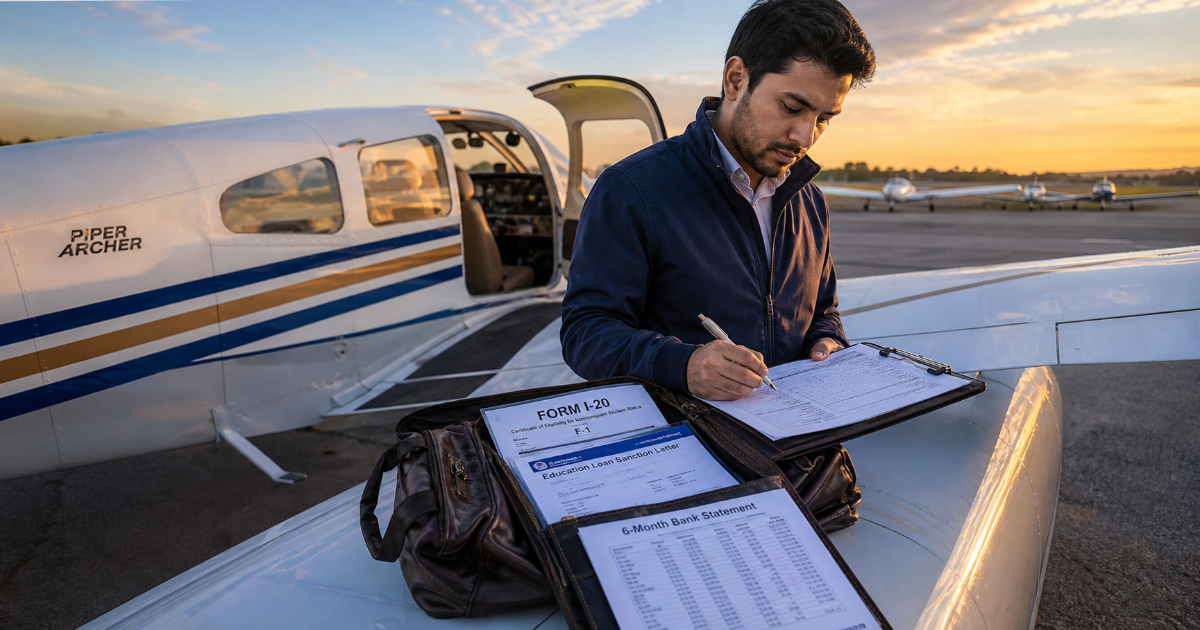
- Personal or family savings. A parent’s account works, but only with a signed sponsorship letter and a document proving the relationship, such as a birth certificate. Without that link, the officer sees a stranger funding you.
- Education loan sanction letters. A bank’s sanction letter carries more weight than a savings balance because the money is committed and traceable. It shows a lender already vetted your ability to repay.
- Scholarships or fellowships. An award letter reduces the balance you need to demonstrate, since the funding source is external and verified. Accepted proof of funds includes these awards alongside your own savings.
- Affidavits of support. A sworn affidavit from a sponsor formalizes the commitment in writing. Pair it with the sponsor’s income documents so the promise has a financial backbone.
- Fixed deposits and provident fund statements. These show long-held assets rather than money moved in for the interview. Their age is the point, not their size.
Read the list as a whole and the pattern is clear: every item answers a question about origin, not amount. A well documented modest balance outperforms an undocumented large one every time. Pull these documents together before you book the interview.
A counter-argument arrives fast: “Won’t a small balance look weak next to a full-pay applicant?” No, because the officer compares your documents to your I-20, not to another student’s file.
Consistency wins that comparison every time. A $12,000 balance that matches your I-20 cost, with a loan letter and a sponsor affidavit behind it, reads stronger than $80,000 with no explanation of where it came from.
How to Build Your Funding File Step by Step
Building a funding file that survives the M-1 interview is a sequence, not a scramble. The order matters because each step depends on the one before it. Skipping ahead leaves gaps the officer will find.
Step 1. Read your I-20 and write down the exact cost total. Your I-20 lists tuition, fees, and estimated living expenses for one full academic year. That number is the target your entire file must hit. Skip this and you’re funding a figure you invented, not the one the school certified.
Step 2. Match that total to a funding source you can document. Pick the source before you touch the money. A seasoned savings account, a parent’s income, a loan sanction letter, or a scholarship award each requires different paperwork. Choosing the source first tells you which documents to gather.
Step 3. Let the money season in the account. A balance that appeared days before the interview reads as borrowed, and borrowed money invites a 214(b) refusal. Leave the funds untouched long enough to show a stable history. This is the step applicants skip most often, and the one officers notice first.
Step 4. Collect the sponsorship letter, relationship proof, and loan or scholarship paperwork. A parent’s account needs a signed letter stating they’ll cover your costs, plus a document proving the relationship. Loan sanction letters and scholarship awards must show the amount and disbursement terms. Missing paperwork turns a strong balance into an unverified one.
Step 5. Rehearse your one sentence answer. When the officer asks how you’ll pay, you need a single clear sentence, not a rambling explanation. Practice it until it’s automatic. A confident answer that matches your documents closes the loop the officer is checking.
Completing these steps produces a file where every number traces to a document. That’s what separates an approval from a refusal, and it’s the same discipline behind strong student visa financial documentation across every category. Applicants who understand Part 141 flight school requirements know the cost structure before they ever book an interview.
What Costs the M-1 Interview Actually Covers
Undercounting living expenses is the quiet failure. A student who funds tuition fully but shows nothing for rent and food looks like someone who will work off the books once they land. The recommended bank balance guidance exists precisely because the officer totals the whole picture, not one line.
Flight schools that publish transparent, itemized cost breakdowns give applicants a real advantage. Schools presenting clear flight training costs in the USA produce applicants whose I-20 totals match their funding story. BrightLine Digital’s aviation SEO management work with flight schools centers on exactly this kind of cost transparency, because vague pricing pages create vague funding files. Forgetting the SEVIS fee is the other unforced error. It signals that you have not read your own paperwork, and that impression carries into every question that follows.
Stop Chasing a Number and Start Building a Record
How much bank balance required for an M-1 visa interview turns out to be the wrong question, and that realization changes everything about how you prepare. The officer was never measuring your account against a threshold. They were measuring your paperwork against your story.
Act now and the interview becomes a formality instead of a gamble. Walk in with a seasoned statement, a sponsorship letter, and a loan sanction that matches your I-20 line for line, and the officer has nothing left to doubt. Wait until the week before, and every deposit you scramble together becomes evidence against you. Pull your last six months of statements today. Match the balance to your I-20 total. Fix the gap before you book the interview, not after.
Getting your funding file right is only half the battle. BrightLine Aviation Marketing Agency helps international students navigate the entire M-1 visa and admissions process, from I-20 paperwork to interview prep. Book a call to get your application on track.
M-1 Visa Bank Balance: Questions Answered
Is a 3 month bank statement enough for a US visa?
Three months is enough only when the balance never dips and the source of every deposit is obvious on the page. A statement that shows a salary credit landing on the same date each month tells a cleaner story than a longer statement with one unexplained transfer.
How much does an M1 visa cost?
The visa application fee runs $185, and the SEVIS I-901 fee for M-1 students is $350, both paid before the interview. Neither fee appears on your I-20 cost estimate, so applicants who budget only for tuition arrive at the consulate short on receipts.
Do I need 6 months of bank statements for my visa application?
Six months is not a published requirement, but it is the length that lets an officer see a pattern instead of a snapshot. A six month history exposes recurring income and stable savings, while a three month window can hide the fact that the money arrived in a single deposit.