
How to Market an MRO Business When Buyers Ignore You
ℹ️ TL;DR
- Learning how to market an MRO business effectively requires shifting from broad public ads to Account-Based Marketing targeted at named procurement directors.
- Position FAA Part 145 approvals, AS9100 certifications, and OEM authorizations prominently as primary pre-qualification assets.
- Publish technical, airframe-specific content that answers precise maintenance and AOG queries rather than generic brand statements.
- Measure marketing performance by tracking qualified RFQ pipeline value instead of top-of-funnel web traffic volume.
- Optimize capability pages with 24/7 AOG response lines, documented turnaround commitments, and detailed RFQ intake forms.
A director of maintenance opens your capability page, scans it for thirty seconds, and closes the tab. Not because the shop is weak. Because the page never proved anything.
That gap is where contracts die, and it’s why learning how to market an MRO business starts with proof, not traffic. Broad campaigns pull clicks from people who will never sign an RFQ. The buyers who matter, procurement managers, fleet directors, parts buyers, are already searching for a shop that can document its turnaround record.
This article gives you a framework for reaching those named buyers directly. You’ll learn how to turn certifications, approvals, and turnaround records into conversion assets that shorten the trust gap before the first quote goes out.
Your Buyer Is a Procurement Manager, Not a Lead
Account-based marketing for MROs is the practice of targeting a named list of procurement managers, fleet directors, and parts buyers instead of broadcasting to a broad audience. It excludes anyone who will never sign a maintenance agreement, no matter how many times they visit your site. The distinction matters because MRO company marketing lives or dies on whether the right twenty people know your shop exists.
Broad campaigns feel productive. They generate traffic, form fills, and dashboard numbers that look healthy in a monthly report. None of it converts, because a regional airline director doesn’t respond to a Facebook ad about aircraft maintenance.
They respond to a capability statement that names their airframe, a turnaround guarantee they can hold you to, and a phone number that works at 2 a.m. during an AOG event. The MRO sales motion is a relationship and RFP motion, not a funnel.
Building the target list starts with operator directories, OEM partner rosters, and corporate flight department contacts. Pull Part 135 operators by region, cross-reference fleet types against your capabilities, and sequence outreach around their buying cycles. A fleet director planning next year’s budget in October doesn’t care about your Q1 campaign calendar.
BrightLine Digital works exclusively with aviation businesses, which means the outreach doesn’t stall while an agency learns what AOG, Part 145, and MEL actually mean. Tailored strategies that align with attracting more operators start with understanding your certifications and the specific needs of your target audience, not a generic B2B playbook. Pick twenty accounts this week. Write down who signs the contract at each one. That list is your marketing plan.
The counter-argument arrives fast: what about the inbound RFQ that lands from a Google search? Good inbound still matters. Treat it as validation, not strategy, because a form fill tells you someone found you, not that they’re ready to buy.
Route every inbound inquiry straight into the named-account list. Check whether the operator matches your fleet capabilities, then decide if they’re worth a call. An RFQ from a fleet type you don’t service is noise wearing a professional email signature.
Proof Beats Promise: Certifications as Conversion Assets
In MRO marketing, the certification is the sales pitch. A procurement manager does not buy your enthusiasm or your About page. They buy documented evidence that your shop can legally and reliably return their aircraft to service. That is why aviation content marketing fails so often for repair stations. The words promise capability while the page hides the proof. Here is what actually moves a buyer.
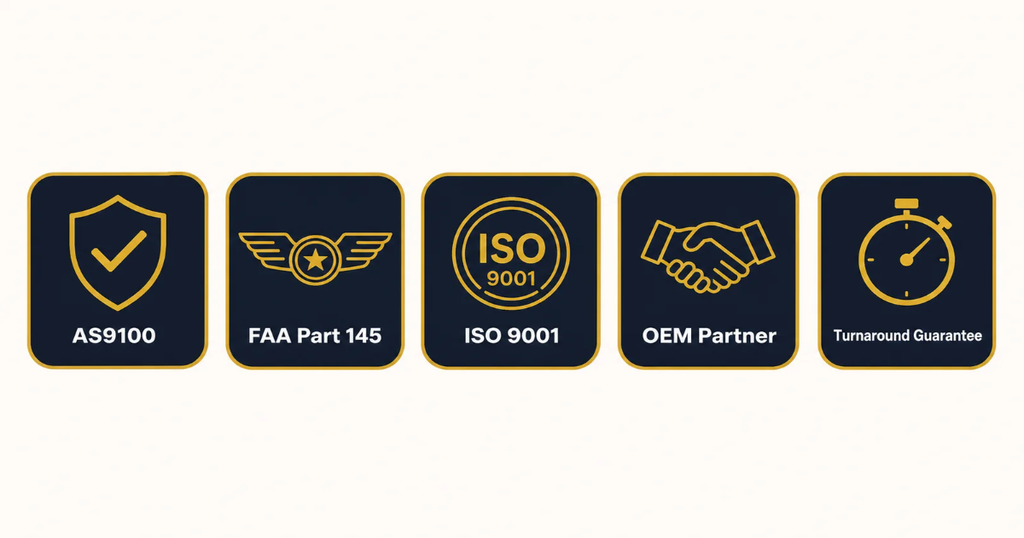
- AS9100 and FAA Part 145 approvals. These are the entry tickets to the shortlist. An operator screening vendors will filter you out before reading a single service description if these are buried on page four.
- ISO registrations. ISO 9001 and AS9110 signal process discipline, not just compliance. Buyers use them to predict whether your shop will document work correctly when a warranty dispute lands.
- OEM partnerships. A factory authorization tells a fleet director you have parts access and technical backing. It converts because it removes the risk of an unauthorized repair on a covered airframe.
- Documented turnaround guarantees. A stated AOG response window is a number a buyer can hold you to. Vague claims of fast service convert nothing because they cannot be compared against your competitor.
- Named case studies with operator type and scope. “Regional airline, heavy check on three CRJ-700s” beats “we serve many clients.” Specificity lets a buyer see their own aircraft in your track record.
As an aviation MRO, you’ll need to comply with industry-specific regulations and certifications regardless of how you market. The gap is that most shops earn the credentials and then treat them as a footer detail.
A capability page without these assets is a brochure. A capability page with them is a pre-qualification document. Place each one above the fold and inside every RFQ response, and you shorten the trust gap that costs you the shortlist.
How to Market an MRO Business in a Niche Vertical
Learning how to market an MRO business in a niche vertical means building content that answers the exact question a director of maintenance types at 6 a.m. before a flight. Skipping that step is why so many shops publish polished pages that rank for nothing and convert no one.
Step 1. Write maintenance guides that solve a specific problem, not general company overviews. A guide on troubleshooting a recurring hydraulic issue earns the search; a page about “our commitment to quality” does not. Operators search for answers, and the shop that provides one gets bookmarked.
Step 2. Build AOG response explainers that state your coverage window, dispatch process, and parts access plainly. When an aircraft is grounded, the buyer is not comparing brand stories. They are scanning for who can move fastest, and a clear explainer wins that scan.
Step 3. Publish capability deep-dives for each airframe and component you actually service. A director of maintenance queries by tail number, engine model, and part number, not by service category. A strong SEO strategy for MRO maps service pages to those exact technical queries.
Step 4. Optimize for local map results around the airports and regions you serve. A shop near a busy regional hub should own the map pack for that field. Buyers often start with geography before they compare capability.
Step 5. Audit your pages against the queries buyers actually type. Generic B2B playbooks built for SaaS chase long, conceptual keywords. MRO buyers type short, technical strings, and the mismatch buries you.
Shops that treat technical content as the inbound engine stop cold-calling for every RFQ. The right aviation SEO services turn your expertise into pages that pull operators in before they ever pick up the phone. Answer the query, and the buyer arrives already trusting you.
Measuring ROI When the Sales Cycle Runs for Months
Two measurement systems sit in front of every MRO director, and only one of them tells the truth about how to market an MRO business. Lead volume counts form fills. Pipeline value counts contracts. The gap between them is where marketing budgets quietly die.
Lead volume is the default because it is easy to pull from a dashboard. A campaign generates inquiries, the number goes up, and the report looks healthy. What it hides is the follow-up problem: raw inquiries from a generic contact form rarely map to a real aircraft, a real operator, or a real timeline. A director of maintenance who downloads a whitepaper out of curiosity counts the same as a fleet manager with a grounded aircraft and a purchase order pending.
Pipeline metrics treat a qualified RFQ as the unit of value, not a form fill. Each RFQ gets tagged to its source, whether that is a technical service page, an AOG explainer, or a direct outreach sequence. A qualified RFQ from a regional airline director carries different weight than a cold inquiry from a broker. Weighting them the same is how an MRO ends up celebrating volume while its close rate collapses.
Attribution is the hard part, and it is where most shops give up. A contract signed in month nine traces back to a component page someone read in month two. Without that thread, the content that started the conversation gets cut from the budget. marketing automation and CRM work exists to hold that thread. BrightLine Digital builds this connection for aviation clients specifically, tagging campaign activity to closed contracts so the source survives the long cycle.
The pipeline system wins whenever the sales cycle outlasts the reporting period. That is every MRO contract worth having. If your deals close in weeks, lead volume is fine. If they close in quarters, lead volume is a distraction dressed as a metric.
Turning Reviews and Referrals into Repeat Contracts
The second contract costs almost nothing to win, which is why how to market an MRO business badly is usually a retention failure dressed up as a lead generation problem. Shops pour budget into cold outreach while a satisfied Part 135 operator sits two hangars away, ready to send the next aircraft without a competitive bid.
Acquisition gets the budget. Retention gets the margin. An operator who already trusts your shop skips the RFQ shortlist and calls your AOG line directly, and that relationship is the cheapest revenue an MRO will ever book.
Ask for the review at the moment the aircraft leaves the floor, not three weeks later. The director of maintenance has just watched a turnaround land on schedule, and that relief is the strongest emotional state you’ll ever catch them in. Send a two-line request with a direct link the same day, and the response rate climbs.
Route every referral from a satisfied operator into the same account-based pipeline you built for cold prospects. A fleet director who names your shop to a peer has pre-qualified you, and that warm introduction should trigger the same sequenced outreach as any named target account. Treating referrals as a separate, informal channel wastes the strongest signal you have.
Reviews compound in ways MROs underestimate. A procurement manager screening three shops for a component overhaul reads your public feedback before opening your capability page. MRO companies that focus on exceptional service and visible reviews build a loyal operator base that drives sustainable growth, and that base shows up as repeat RFQs, not one-time transactions.
The benefits of digital marketing for an MRO show up clearest here, where reputation and relationship do the selling. A shop with forty verified reviews and three named operator references walks into every renewal conversation already ahead. The shop with none starts from zero every time, no matter how good the wrench work is.
Retention marketing is not a soft add-on to your acquisition spend. It is the compounding asset that makes every future contract cheaper to close, and the shops that ignore it pay full price for every job they ever win.
Fixing the Website That Loses the RFQ
Learning how to market an MRO business includes fixing the website that quietly disqualifies you before a buyer ever calls. A procurement manager visits your site with a shortlist in mind, and your page either earns the next click or hands the contract to a competitor. The repairs below are the ones that decide which issues to address.
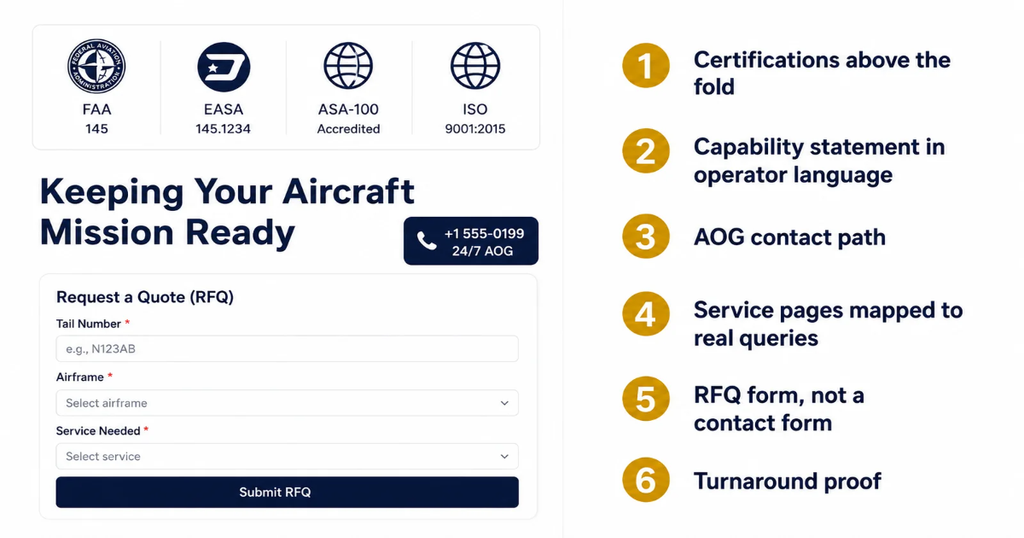
- Capability statements in operator language. Write what you fix, on which airframes, in the terms a director of maintenance uses daily.
- Certification badges above the fold. Place your FAA Part 145 approval, AS9100 registration, and OEM authorizations where a buyer sees them without scrolling.
- AOG contact paths that work at night. A grounded aircraft does not wait for business hours, so your after-hours line must be visible and answered.
- Service pages mapped to real queries. Build a page for each component and airframe your buyers actually search, not one generic services page.
- RFQ forms instead of contact forms. Capture tail number, airframe, and service needed so the inquiry arrives sales-ready.
- Turnaround proof on every service page. Show documented turnaround records next to the capability, because that is what the buyer is really pricing.
Read the list again and notice what it has in common. Every item removes a reason to leave, and none of them are about looking modern. The website is not a brand exercise for an MRO. It is a qualification tool. A buyer who cannot confirm your certifications in seconds assumes you do not have them.
Audit your own site this week against these six points. Open each service page, ask whether a procurement manager could find the proof they need, and fix the gaps before your next RFQ cycle. BrightLine Digital builds aviation website design and conversion work specifically for shops that lose deals this way, and the fix is usually faster than the pipeline it recovers.
Building Credibility Before the First Job Lands
Learning how to market an MRO business before you have a contract list forces you to build proof from positioning rather than history. Shops that wait until they have a portfolio to start marketing lose the first two years to silence.
Step 1. Secure AMO certification and the regulatory approvals procurement managers screen for before you spend a dollar on outreach. Skipping this step means every capability page you publish is a claim you cannot back. AMO certification, strategic airport positioning, and a marketing plan that builds credibility before the first job all start here, aviation MRO launch requirements.
Step 2. Position the shop near the airports and operator types you actually want on your floor. A facility forty minutes from a regional airline hub will fight for every RFQ that a tarmac-adjacent competitor wins by default. Proximity is a proof asset when AOG calls come at 2 a.m.
Step 3. Publish the marketing plan before the first job, not after. Operators researching a new shop read your site the same week they need a quote, so an empty capability page reads as risk. aviation marketing experts build this sequence into launch timelines because retrofitting credibility onto a live site costs more.
Step 4. Document your process and turnaround commitments in writing, even with zero completed contracts. A written standard is a proof asset a procurement manager can evaluate before you have a track record. Shops that skip this step compete on price alone.
Step 5. Get your first two or three operators to agree to a named reference before the ink dries on the work order. A reference call closes the trust gap faster than any brochure. Ask at delivery, not six months later.
Completing this sequence means your first RFQ arrives at a shop that already looks established. The buyers were searching before you were ready to be found.
The Buyers Are Already Looking. Be the Shop They Find.
Marketing an MRO business stops being a visibility problem the moment a procurement manager pulls your shop into a shortlist. The buyer was never waiting to be convinced. They were waiting to be shown.
Capability pages that name your certifications, your turnaround record, and your airframe experience do the qualifying before the call. Pages that don’t lose the RFQ quietly, and you never learn which competitor took it.
Audit your capability pages this week. Check whether a fleet director can find your Part 145 approval and your AOG contact path in one scroll. Fix the proof assets and the targeting that are costing you contracts.
Stop Letting Procurement Managers Skip Your Capability Pages.
Generic agencies burn budget on top-of-funnel clicks from browsers who will never sign an RFQ. BrightLine Digital builds account-based strategies and operator-fluent content that position your Part 145 approvals directly in front of fleet decision-makers.
Questions MRO Directors Ask About Marketing
How do you market an MRO business to procurement managers instead of consumers?
You build a named target list of procurement managers, fleet directors, and parts buyers, then reach them with proof of capability rather than broad brand awareness. That means your outreach names their aircraft type, their route structure, and the specific component or inspection your shop handles best.
What proof do MRO buyers look for before requesting a quote?
Procurement managers screen for AS9100 and FAA Part 145 approvals, OEM partnerships, and documented turnaround performance on airframes like theirs. A capability page that lists certifications without a named operator case study behind them reads as a claim, not evidence.
How should an MRO measure marketing ROI when contracts take months to close?
Track qualified RFQs, cost per opportunity, and contract value attributed back to the content or outreach that started the conversation. A form fill nobody follows up on inflates the dashboard while the pipeline stays empty, which is why lead volume alone misleads an MRO director.
Can content marketing actually generate inbound RFQs for a niche MRO?
Technical content does generate inbound RFQs when it answers the exact query a director of maintenance types, such as an AOG response explainer or a component-specific service page. Generic brand content does not, because it never matches the short, technical searches buyers actually run.