
Aviation Web Design Agency Costs: Where the Budget Goes
TL;DR
- Quotes from an aviation web design agency represent strategic conversion decisions rather than mere page counts.
- Essential budget lines include upfront discovery, quote-request UX, fast development, and SEO groundwork.
- Templates that skip discovery or accessibility create hidden gaps that lead to costly post-launch rebuilds.
- Specific operation types like MROs, FBOs, and flight schools require distinct budget priorities to convert leads.
- Post-launch retainers must cover security, conversion testing, and clear monthly qualified lead reporting.
A quote for an aviation website is not a price. It is a stack of decisions compressed into one number, and the compression is the problem. Every aviation web design agency quote hides the same question: which parts of this build produce inquiries, and which just produce a nice invoice?
Buyers treat the total as the thing to negotiate. They compare two figures, pick the lower one, and never learn what got cut. A fast site with a buried request form and a slow site with a prominent one can cost the same.
This article pulls the budget apart line by line. You’ll see where the money lands, which lines drive bookings, and which are padding dressed up as scope. By the end, you can read a proposal the way the vendor hopes you won’t.
The Quote Is a Stack, Not a Number
An aviation web design agency budget is the combined cost of discovery, design, build, content, and post-launch work, priced as separate decisions rather than one delivered product. It excludes your internal time and the ad spend that follows launch. That distinction matters because a single figure tells you what you’ll pay, not what you’re buying.
Buyers misread the quote as a verdict on quality. A high number reads as thorough, a low number reads as a bargain, and both readings are wrong. The same total can buy a fast, conversion-focused site or a slow brochure with a premium logo, and the invoice looks identical either way.
BrightLine Digital runs every engagement through four named stages: Audit & Discovery, Strategic Roadmap, Surgical Execution, Optimize & Scale. Each stage has its own scope and its own cost, so a buyer can see where the money sits before signing. That structure is the difference between a budget and a guess.
Ask any vendor to break the figure into those stages. If they can’t, the quote is hiding the trade-off you most need to see. Whether you choose a custom or template aviation website, the line items should still be visible. You now have a way to read a proposal that most buyers never use. Pull the number apart before you compare it to anything else.
Where the Money Actually Lands
A quote that reads “website redesign” tells you nothing about what you’re buying. Pull the same aviation web design agency proposal apart line by line and the real trade-offs surface fast. Here is what each budget line buys, and what breaks when it gets cut.
| Budget Line | What It Buys | What Breaks When Cut |
|---|---|---|
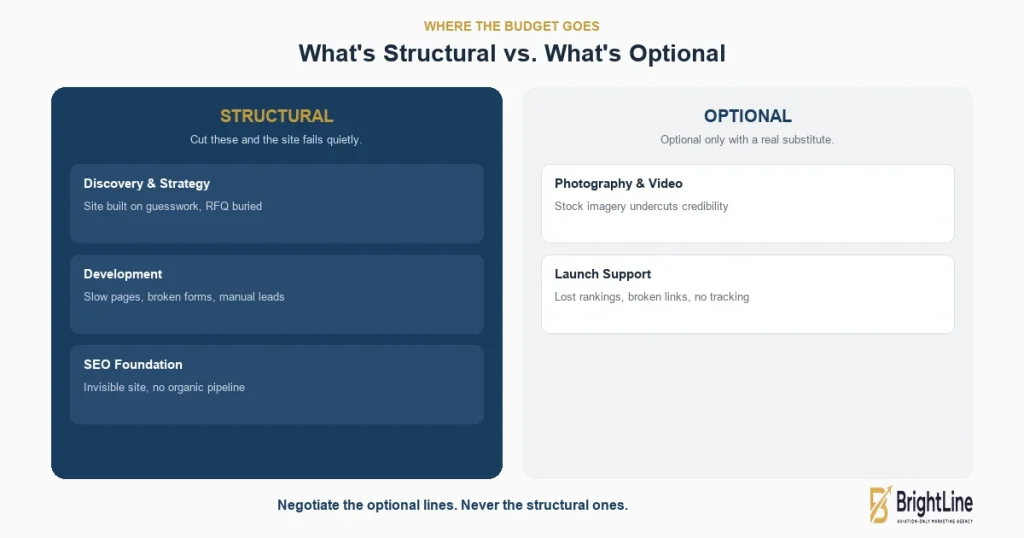
| Discovery and strategy | Buyer research, inquiry flow mapping, page hierarchy | Site built on guesswork, RFQ buried under marketing copy |
| UX and design | Wireframes, mobile layouts, quote-request paths | Desktop-first pages that lose transient crew on phones |
| Development | Fast load times, CMS, form routing, integrations | Slow pages, broken forms, manual lead handling |
| Content and copy | Capability language, service pages, admissions content | Generic copy that reads like every other operator |
| Photography and video | Hangar, aircraft, and facility visuals | Stock imagery that undercuts credibility |
| Accessibility and compliance | Section 508 conformance, keyboard and screen-reader support | Public-facing pages exposed to remediation cost later |
| SEO foundation | Schema, site structure, page titles, internal linking | Invisible site, no organic pipeline for aviation web design that converts |
| Launch support | Redirects, QA, analytics setup, go-live checks | Lost rankings, broken links, untracked inquiries |
Discovery, development, and SEO foundation are structural. Cut them and the site fails quietly. Photography and launch support are optional only when you have a real substitute.
Frame your own budget before you request quotes. The SBA business planning tools help you set project scope and cost expectations first. Vendors then price against your plan, not their template.
Why Cheap Aviation Sites Cost More Later
A template build and a custom aviation web design agency engagement can land at the same invoice total and still be opposites. The difference is when you pay, and what you get for it.
The low-cost template wins on the day you sign. It gets a site live fast, and for a one-aircraft operation with no RFQ pipeline, that may be enough. Then the load times crawl, the request-a-quote form sits three clicks deep, and the schema that would put your capability list in front of a maintenance buyer was never built. None of that shows up as a line item. It shows up as a rebuild, and the rebuild costs more than the original quote ever did.
A custom engagement front-loads the spend into research and structure. That is where bookings are won: the inquiry path is mapped before a single page is designed, the schema is written into the build, and the load time is treated as a budget item rather than an afterthought. You pay now for architecture or you pay later for rescue. The rescue invoice never includes the bookings you lost while the site was slow.
BrightLine Digital’s aviation web design and conversion work is scoped around inquiry flow, not page count. A build scoped around inquiry flow asks where the RFQ lands and works backward. A build scoped around page count asks how many pages you want and stops there.
Choose the template only if your site is a business card. If a single AOG request or discovery flight booking justifies the site’s existence, the cheap build is the expensive one.
The Line Item Most Aviation Agencies Skip
Accessibility vanishes from aviation web design quotes because nobody asks for it. It protects public money, public access, and the operator’s legal footing. Each angle below is a separate decision, not a footnote.
What Section 508 Actually Requires
Section 508 requires federal agencies to procure electronic information technology that people with disabilities can use. That obligation flows to contractors and anyone receiving federal funds. A site without keyboard navigation, alt text, or readable contrast fails before launch.
Why an Aviation Site Falls Inside the Scope
Airports, FBOs, and training providers run public-facing functions: schedules, notices, RFQ forms, and admissions pages. An airport authority accepting federal grant money inherits the obligation. The FAA’s accessibility statement shows how a federal aviation body treats the same standard.
Remediation Costs More After Launch
Building accessibility into design means semantic markup and tested components from the start. Retrofitting means auditing every template, rewriting forms, and re-testing flows after launch. The second path costs more and delays the launch you already paid for.
How to Ask the Vendor
Ask one question in writing: is accessibility scoped as a line item, and against which standard? A vague answer about “best practices” is a refusal. A vendor who can’t name the standard hasn’t built to it. Section508.gov publishes the testing criteria to hold them to.
Operators argue accessibility is expensive and their audience doesn’t need it. Then a grant application stalls on a compliance review, and the fix gets priced under deadline pressure.
Put the line item in the RFP before you collect bids. Require a WCAG 2.1 AA conformance statement and a named testing method in every response. Bids that omit it aren’t cheaper. They’re incomplete.
What an Aviation Web Design Agency Retains
The build is the down payment. The retainer is the real cost of ownership, and it’s where an aviation web design agency either earns its place or quietly coasts. A launch-day site starts decaying the moment it goes live. What the monthly line actually protects comes down to six things.
- Hosting and security. Uptime and patching sound boring until an expired certificate kills your RFQ form on a Monday morning. Cheap shared hosting is how that happens.
- CMS updates. Core and plugin releases close known vulnerabilities. Skip them and you’re running a site that strangers can walk into.
- SEO and content. New capability pages, updated fleet specs, refreshed location content. This is the work behind aviation SEO services that earn their retainer, and it compounds only if it keeps shipping.
- Paid search management. Charter and flight school campaigns drift fast without bid and negative keyword tuning. Unmanaged spend leaks into irrelevant clicks.
- Conversion testing. Small changes to quote forms and discovery flight booking flows, measured against real inquiries. Drop this and the site freezes in whatever shape it launched.
- Reporting. BrightLine Digital publishes monthly reports on traffic, rankings, and qualified leads. That cadence is the standard to demand from any aviation web design agency retainer.
Read the list together and the pattern shows: every dropped line shifts risk onto you, not the vendor. Ask for last month’s report before you sign anything.
MRO, FBO, and Flight School Budgets Differ
One aviation web design agency price tag buys four different websites depending on who signs the check. A repair station and a flight school share almost no budget lines, and a quote that treats them as the same buyer is already mispriced. The budget follows the buyer, not the template.

MROs and Part 145 Repair Stations
Capability lists are the whole site for a repair station. A buyer searching for a specific component repair needs to confirm the shop holds the rating before making contact.
AOG urgency reshapes the budget too. An aircraft on the ground sends people to the phone, so the RFQ flow and the contact path get funded first. MRO company marketing expertise lives or dies on how fast a grounded operator can reach a human.
FBOs and Line Service Operators
Transient crew book against fuel price, hangar space, and what’s open at the desk. Those details change constantly, pushing budget into content management and away from static design. A polished homepage that can’t update fuel pricing nightly is money spent on the wrong line.
Charter and Part 135 Operators
Aircraft pages and empty-leg capture carry the weight here. Empty legs sell on timing, so the site needs a mechanism to surface them fast. Quote requests follow, and they need qualification built in. A generic contact form wastes the inquiry before sales ever sees it.
Flight Schools and Training Centers
International student admissions is the budget line nobody quotes correctly. Visa and admissions content, discovery flight booking, and program pages all swell the content scope. A school recruiting overseas needs a site that answers a nervous applicant’s questions before they email. That’s a different build than a local school filling weekend slots.
How to Read a Proposal Before You Sign
A proposal rewards the buyer who reads it like a contract, not a brochure. Skip the audit and you sign a document that hides exclusions, ownership traps, and a retainer with no accountability.

Step 1. Split the build fee from the monthly retainer on a single sheet. Vendors blend them into one figure to make the retainer feel free. Once separated, you can compare the build against other quotes and judge the retainer on its own merits.
Step 2. Demand a line-item scope that names every deliverable, page type, and integration. A proposal that lists “website design” as one line cannot be audited. You will discover the gaps after launch, when changes cost extra.
Step 3. Ask directly what the quote excludes. Photography, copywriting, and third-party licenses are the usual omissions. An exclusion you find before signing is a budget adjustment. One you find after is a change order.
Step 4. Confirm in writing who owns the site, the domain, the hosting account, and the content. Agencies that retain ownership control your exit. Leaving means rebuilding from zero.
Step 5. Check that accessibility and SEO appear as named line items, not vague promises. If neither is itemized, neither is scoped. The best aviation marketing agencies put both in writing because they expect to be held to them.
Step 6. Require a reporting cadence with named metrics in the retainer terms. A retainer without reporting is a subscription to silence. You pay monthly and learn nothing.
Work through all six and you hold a proposal you can compare, negotiate, and enforce. That is the difference between buying a website and buying a paper trail.
Spend on the Parts That Book the Flight
A quote from an aviation web design agency is a map of where bookings come from, priced line by line. Negotiating the total down without touching the structure just moves money away from the parts that convert. The number was never the point.
Buyers who pull a proposal apart before signing catch the gaps early, while changes are still free. Sign first and those gaps surface as change orders, a stalled launch, or a rebuild. The cheapest signature is the one you read twice.
Open the current or proposed quote and split it into the lines covered here. Hand it back to the vendor and ask them to defend each one. A line nobody can justify is a line you shouldn’t pay for.
FAQ
Aviation Web Design Agency Cost Questions, Answered
What does an aviation web design agency budget actually cover?
An aviation web design agency budget covers discovery, design, development, content, SEO groundwork, and the post-launch retainer that keeps the site running. The line buyers forget is discovery, which is where the agency maps your inquiry flow before a single page gets designed.
Why can two quotes for the same site differ so much?
Two quotes diverge because one vendor prices page count while the other prices research, structure, and conversion paths. A cheap quote usually means discovery was skipped, and you inherit that gap as a rebuild later.
Does accessibility belong in the build budget?
Accessibility belongs in the build budget whenever your site serves the public or touches federal money, because retrofitting it costs far more than building it in. The official Section 508 resource hub spells out what compliance actually requires of your pages.
What should a retainer include after launch?
A retainer should cover hosting and security, CMS updates, SEO and content work, conversion testing, and reporting on traffic and qualified leads. Drop the reporting line and you’re paying monthly for work nobody can prove happened.