
Aviation Search Engine Optimization: 3 Fixes That Fill Empty Seats
TL;DR
- Generic SEO chases vanity traffic, while aviation search engine optimization targets operational terms used by real buyers.
- Fix one replaces broad search phrases with exact part numbers, airframe ratings, and specific visa timelines.
- Fix two structures capability pages so AI engines extract clear claims and cite your operation directly.
- Fix three builds instant credibility by placing named FAA certificates, fleet specs, and personnel on the page.
- Sequence updates on high-value pages first to measure qualified quotes and bookings rather than raw traffic.
A flight school spends months ranking for “learn to fly” and books nothing but tire-kickers. That’s not an SEO failure. It’s a vocabulary failure, and it’s the most expensive kind an aviation business can make.
Aviation search engine optimization is not generic marketing with aviation words pasted on top. The buyers you want, a director of maintenance with an AOG aircraft, a chief pilot sourcing a charter, a student pilot with a deposit ready, search in operational language and judge credibility fast.
This article gives you three fixes, not thirty. Each one earns its place because it changes how a real aviation buyer finds you and decides to trust you. Here’s where to start, and why the order matters.
Why Generic SEO Leaves Aviation Seats Empty
A director of maintenance does not search the way a marketing dashboard assumes. He types a part number, a fault code, or a competitor’s tail number, and he needs an answer before the aircraft moves again. Aviation search engine optimization fails when it treats that person like a shopper browsing categories.
Generic advice optimizes for volume keywords and vanity positions. It chases “aviation services” because the search volume looks healthy, then wonders why the traffic never converts. That phrase attracts students, enthusiasts, and job hunters. None of them book a charter or approve a purchase order.
The aviation buyer is technical and impatient. A chief pilot comparing operators wants to see your fleet type, your crew currency, and your approval status on the page itself. He will open the next tab.
Those tabs are closing. Buyers increasingly ask an AI engine one question and act on the names it returns. The operator whose page states a clear, quotable capability gets cited. The operator whose page reads like a brochure gets skipped.
Technical buyers also arrive already informed. A purchaser researching a component may have read the FAA maintenance technician handbook before he ever reaches your site. He is checking whether you sound like you belong in that world.
The gap between generic SEO and aviation SEO is the gap between traffic and trust. One fills a dashboard. The other fills a seat.
Fix One: Speak the Buyer’s Operational Language
Aviation search engine optimization starts with vocabulary, not tactics. A page wins when it uses the words a director of maintenance, a chief pilot, or a flight school applicant actually types into a search bar. Get the cluster wrong and the traffic still arrives. It just never books anything.
- Aircraft broker and acquisition terms. A buyer searching for a specific make, model year, and engine time is not browsing. They are transacting, and the page that names those specs captures the inquiry.
- AOG and parts sourcing terms. An AOG search carries urgency no generic keyword can match. The operator needs a part number and a phone number, and the page that surfaces both gets the call.
- Charter and empty-leg terms. Route-specific and date-specific searches signal a traveler ready to book. Broad “private jet charter” traffic mostly wants a price they will never pay.
- Flight training and admissions terms. An international applicant searches visa timelines and program start dates, not “learn to fly.” Those searchers convert into enrolled students.
- MRO capability terms. A maintenance director searches by airframe type and rating, not by the word “maintenance.” Capability pages written in that language pre-qualify the inquiry before it lands.
Identifying these aviation-specific terms separates a converting page from a ranked one. Titles, headings, images, and copy all need to carry them, and that is exactly what a real aviation keyword research pass produces.
BrightLine Digital builds these clusters through an aviation content strategy grounded in aviation-only work, so the vocabulary comes from the industry rather than a keyword tool.
Fix Two: Build Pages That Earn the AI Citation
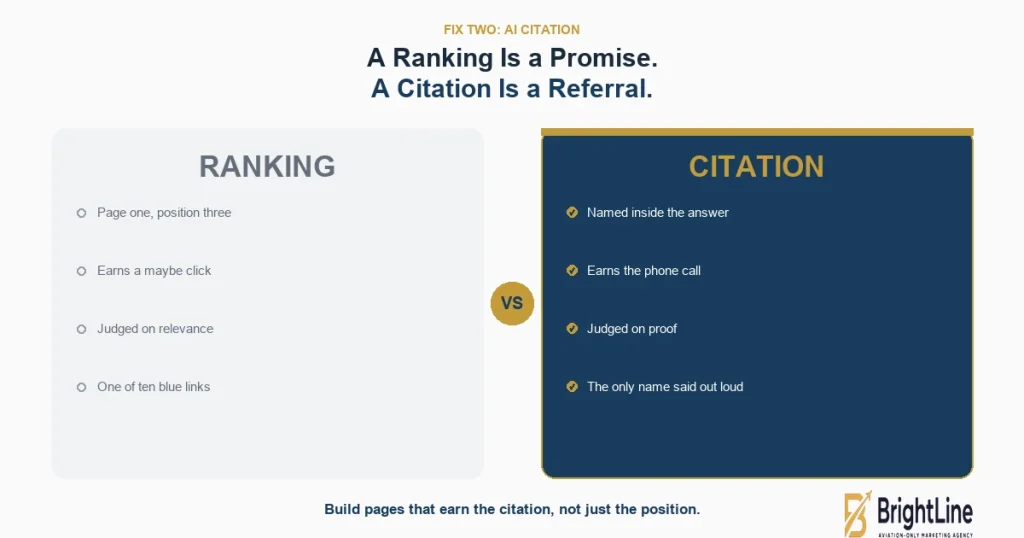
A chief pilot asks one AI engine which shop can turn a King Air 350 around fastest, then calls two of the three names it returns. That behavior is why citation-first structure sits at number two. Ranking on page one gets you considered. Getting quoted inside the answer gets you called.
What an AI engine actually pulls from your page
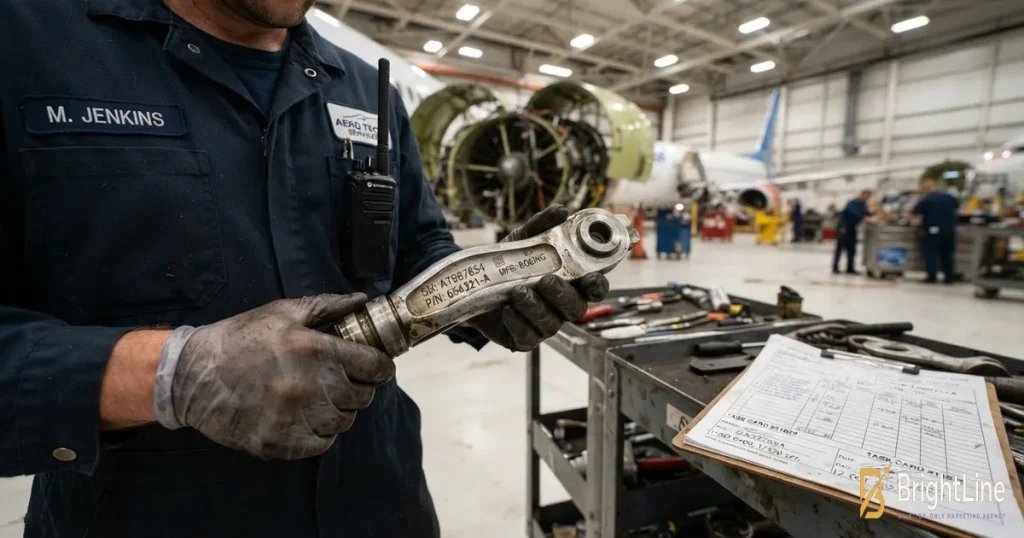
Engines extract three things: a clear claim, a named entity, and a supporting detail. “We hold FAA Part 145 approval for PT6A hot section repairs” gives all three at once. “We deliver quality maintenance solutions” gives none.
Why keyword-stuffed pages rank and never get quoted
A page repeating “aviation search engine optimization” in every heading can still climb the results page. It has nothing an engine can lift into an answer. Citation requires a sentence that survives being pulled out of context.
Structuring a capability page so a claim is quotable
Lead each section with the claim, then the proof, then the scope. State turnaround windows, airframe types, and approval numbers in plain declarative sentences. Engines reward pages that answer cleanly instead of burying the claim in marketing language.
Evidence beats adjectives in every citation
An engine quoting your page is vouching for it. Adjectives give it nothing to vouch for. Specific capability data does, and that’s the structure BrightLine Digital builds through its answer engine optimization work for aviation teams.
A citation is a referral. A ranking is a promise. Only one puts a buyer on the phone, and a monthly retainer that improves site visibility without earning quotes leaves the seats empty.
Fix Three: Prove Technical Credibility on the Page
A chief pilot can spot a stock photo of a hangar from the search results page. Technical buyers discount any page that reads like marketing copy in seconds. Credibility has to sit on the page itself.
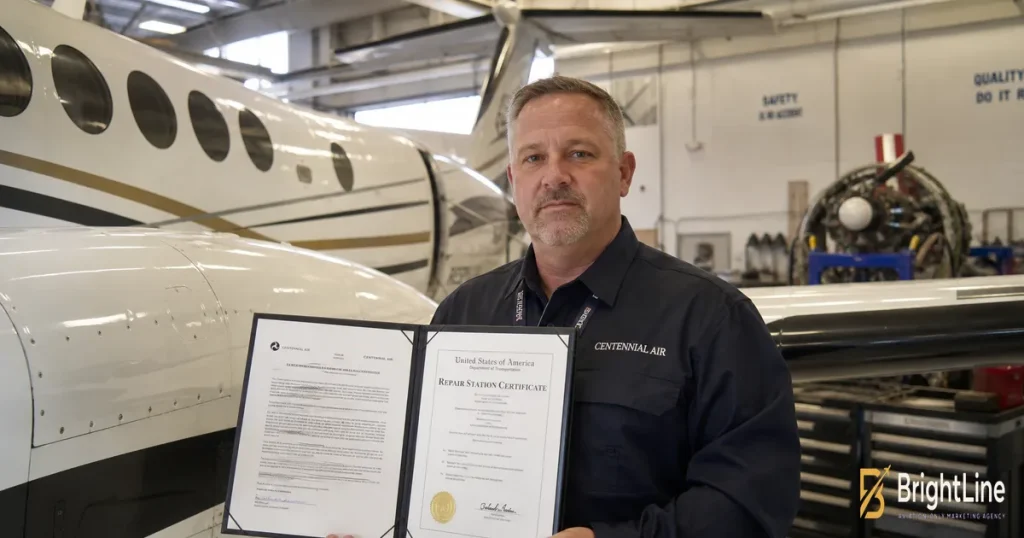
- Named certifications and approvals. List the FAA repair station certificate, the Part 145 rating, or the type ratings your instructors hold.
- Fleet and capability specifics. State the airframes you service, the engine models, and the turnaround windows you can commit to.
- Named personnel and experience. A director of maintenance with a name and a background beats an anonymous “our team” paragraph.
- Real project and training outcomes. Publish a completed inspection, a recovered AOG, or a student who passed a checkride with details attached.
- Clear next-step contact paths. Give a phone number, a form, and a named person so the buyer knows who answers.
Each proof element gives an AI engine a specific, quotable fact, which feeds the citation work from the previous fix. A page with a named certificate number is citable. A page with adjectives is not.
Structure matters as much as substance. Put the proof elements under clear headings, link each claim to the page that backs it up, and give the buyer one obvious way to contact you. That’s what turns scattered proof into a page an engine can parse and a buyer can scan.
Audit one service page this week and count its proof elements. If the answer is zero, the aviation SEO agency results you’re chasing start there, not in a new keyword list.
What Does Not Make the List of Aviation SEO Fixes
Four tactics get sold as aviation search engine optimization every week, and none of them fill a seat. The comparison that matters isn’t price or reporting polish. It’s whether the work can be traced to a qualified inquiry from someone who buys flight hours, maintenance, or parts.
Start with the retainer bundle. A monthly package of line items looks tidy on an invoice, and it keeps a vendor busy. Ask which page produced which inquiry and the trail goes cold. The replacement is the proof fix: every deliverable maps to a capability page a buyer actually reads.
Broad industry keywords feel productive because the volume looks healthy. Terms about aviation careers and general flying draw students, hobbyists, and people who will never sign a contract. A keyword that attracts enthusiasts instead of buyers is a cost, not a ranking. The replacement is the operational language fix, built around part numbers and capability terms.
Generic blog content fails the same way. A post on the history of turbine engines earns a few visits and zero calls. The replacement is citation-first structure, where each page makes one quotable claim.
Local search gets skipped by operators who assume buyers travel. Region is exactly how a charter customer or a flight school applicant narrows a shortlist. BrightLine Digital holds that not all aviation SEO services earn their retainer, and the test is simple. If a tactic can’t be tied to a qualified inquiry, it doesn’t belong on the list.
How to Sequence the Three Fixes Without Stalling
Running all three fixes at once splits attention and produces three half-finished pages. Sequence them and each one feeds the next: vocabulary sharpens the citation, the citation makes the proof quotable, and the proof closes the inquiry.
Step 1. Audit what the site ranks for and which pages AI engines already cite. Skipping this means you rebuild pages that were never the problem. Pull the query report and test your top service pages against a direct AI question.
Step 2. Rebuild the language clusters on the highest-value service pages first. Incorporate relevant aviation keywords naturally into content, meta tags, and headers, then fix the site structure so users and crawlers both read it cleanly. Skip the structure and the new vocabulary lands on a page nobody can find their way around.
Step 3. Restructure those same pages for citation with one quotable claim and hard proof per section. A page rewritten for vocabulary but not for extraction ranks and never gets quoted.
Step 4. Measure qualified inquiries, not sessions. Session counts hide the difference between a student browsing and a chief pilot requesting a quote. Track form fills and calls by source.
BrightLine Digital runs this exact order through Audit & Discovery, Strategic Roadmap, Surgical Execution, then Optimize & Scale. The sequence matters because a citation built on the wrong vocabulary sends the wrong buyer straight to your contact form.
The Aviation SEO Fixes That Fill Seats First
Four operation types, four different starting points. The table below matches each one to the fix that moves fastest, because applying the same sequence to a flight school and a parts supplier wastes months on the wrong page. Pick the row that describes your business. The metric column tells you what to watch before the inquiry count moves.
| Operation | Fastest Fix | Metric to Watch | First Page to Rebuild |
|---|---|---|---|
| Flight school | Operational language | Admissions inquiries | International student page |
| MRO | Technical proof | Quote requests | Capability and approvals page |
| Charter operator | AI citation | Direct booking calls | Empty-leg and route page |
| Parts supplier | Operational language | AOG inquiries | Part-number landing pages |
The fastest win sits where search intent is most operational and the current page carries the least proof. A parts supplier with thin part-number pages gains more from one rebuild than a flight school gains from a full content calendar.
That gap is why an aviation-only agency outpaces a generalist. BrightLine Digital works this market exclusively and reports average organic traffic growth in as little as 180 days. Compare that against the best aviation marketing agencies before signing a retainer built on generic line items.
Parts suppliers sit in that last row, and their fastest fix is the part number itself. A buyer searching an AOG replacement does not browse. They paste a number into Google and call whoever ranks first with it visible.
Build one indexable page per part number and stop routing everything through a single catalog PDF. That PDF is invisible to search engines and to the AI tools that buyers now ask first.
Pick One Fix and Ship It This Month
Three fixes sit in front of you, and the seat count moves when one of them ships. Aviation search engine optimization rewards operators who rebuild one page well over operators who redesign a whole site in a planning document. The vocabulary fix, the citation fix, and the proof fix each stand alone.
Every month a page sits unbuilt, a chief pilot calls the shop that showed up in the AI answer instead. A director of maintenance with an AOG part sources it from whoever ranks and reads credibly. The inquiry you lose never shows up in a report.
Open the comparison table. Pick the row that matches your operation. Rebuild that one page this month with the buyer’s operational language, a quotable claim, and proof a technical reader respects. One page, shipped, beats a strategy deck every time.
FAQ
Aviation Search Engine Optimization Questions Operators Ask
Is SEO still relevant in 2026?
Yes, but the surface it works on has split in two: classic search results and the AI answers that now sit above them. Aviation search engine optimization still earns its keep because a buyer who asks an engine for an AOG parts source acts on the names it returns, not on a page of blue links.
How can I start SEO as a beginner?
Start by writing down the exact phrases your last ten customers used when they first contacted you, then check whether your site says those words anywhere. A flight school that discovers its applicants search “how long to become a commercial pilot” rather than “flight training programs” has already found its first page to rewrite.
What are the 5 best SEO tools?
Tool choice matters far less than whether the tool can show you which queries actually produced inquiries. Google Search Console is free and shows the real queries your pages surface for, and that single report beats a paid rank tracker for an operator deciding what to fix.
What are the 3 C’s of SEO?
The common framing is content, code, and credibility, and for aviation the third one carries the most weight. A maintenance page can rank well and still lose the job if it never names the approvals, airframe types, or turnaround specifics a chief pilot is scanning for.