
Aviation Keyword Research: 3 Steps to Find Buyer Terms
TL;DR
- Aviation keyword research requires prioritizing buyer intent over raw search volume, which frequently pulls in students and hobbyists.
- Build seed lists directly from sales call recordings, quote requests, and technical regulatory phrasing like Part 145 or AOG.
- Categorize terms into research, comparison, and purchase-ready intent stages mapped to specific revenue-generating service lines.
- Cross-check search demand against industry activity data and AI answer engine citations before publishing content.
- Targeting narrow, technical buyer terms turns search traffic into qualified quote requests and signed aviation contracts.
Sort by volume and you’ll spend the year writing for people who will never buy. The top of an aviation keyword research spreadsheet fills up with students, hobbyists, and armchair pilots. The buyer sits three rows down, on a term with a fraction of the searches.
Generic SEO advice makes this worse. They reward reach, and reach in aviation means curiosity, not contracts. A charter query and an MRO query look like neighbors in a tool. They belong to different businesses with different budgets.
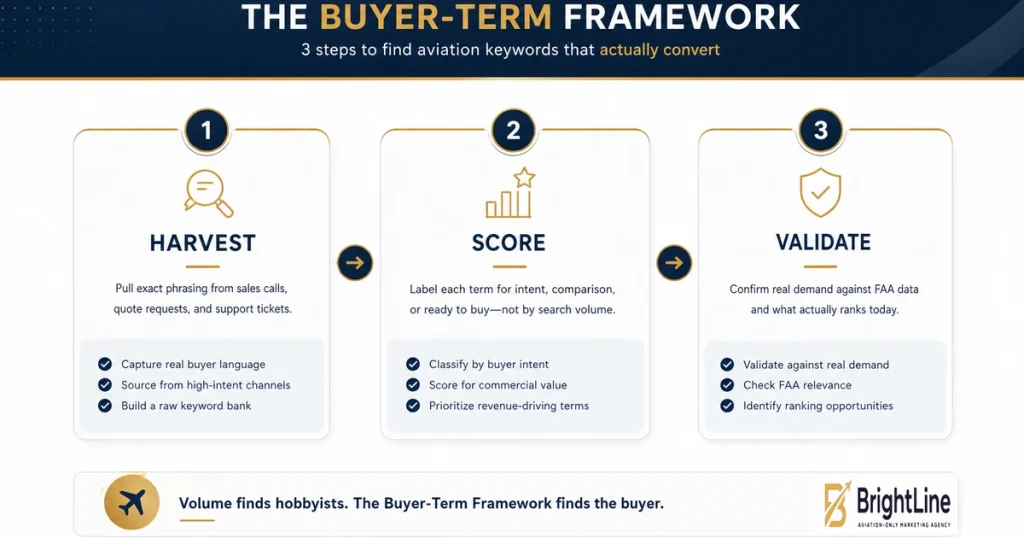
This article gives you a three-step process for aviation keyword research that finds buyer terms. You’ll build a seed list from real buyer language, score it by intent, and validate it before you spend a dollar on content.
Why Generic SEO Advice Fails in Aviation
A charter operator and a flying club can rank for the same phrase and convert none of each other’s customers. That is the first thing that generic B2B SEO playbooks get wrong about aviation. They treat aviation as one market with one vocabulary, and it is at least four.
Most aviation businesses approach aviation keyword research the same way a general contractor would. They open a tool, type in their service, sort by volume, and chase the biggest number. The biggest number is almost always a student or a hobbyist.
Volume is a terrible proxy here because deal sizes are enormous. A single MRO contract or turbine overhaul can dwarf a thousand clicks on a generic term. Low volume does not mean low value in aviation. It usually means the searcher already knows exactly what they need.
The terms that carry real money are technical and legally loaded. A buyer searching for Part 135 operating requirements is not browsing. They are verifying a rule before they sign or dispatch.
BrightLine Digital works only in aviation, and that narrow focus changes the priority order. Fluency in the industry means knowing which query signals a purchase and which signals a term paper. A generalist agency reads the same spreadsheet and sees only the number.
Generic B2B SEO advice was written for software buyers who research for months. Aviation buyers move on grounded aircraft and expiring contracts. The mismatch shows up in the content plan before it ever shows up in rankings.
Map the Buyer Before You Open a Tool
A keyword tool cannot tell you who is typing the query, and in aviation that gap decides whether your content earns revenue. Five buyer types search your service lines every week, each with different language and different urgency.
- Domestic flight school prospects. They search training timelines and cost near a city name, not “flight school.”
- International flight school applicants. They search visa pathways and hour requirements before they ever compare schools.
- Charter customers. They search by route, aircraft type, and departure date, often hours before the flight.
- MRO procurement and directors of maintenance. They search capability, turnaround time, and approved vendor status.
- Parts buyers under AOG pressure. They search a part number and a ship-to deadline, nothing else.
The director of maintenance with a grounded aircraft types one question into an AI engine, not ten browser tabs. Your terms must match that single query, or you are invisible at the exact moment money moves. The aviation maintenance workforce grant listings show how much institutional attention sits behind that buyer’s hiring and capacity decisions. BrightLine Digital’s aviation B2B lead generation work starts by targeting buyers where aviation buyers search, not where a tool ranks them.
Step 1: Build a Seed List From Real Buyer Language
A seed list built from a keyword tool’s suggestion box produces the same generic terms your competitors already target. Building one from buyer language produces the phrases that precede a purchase order. The difference shows up in your aviation content strategy within a quarter.

Step 1. Harvest terms from the conversations that end in revenue. Pull the exact phrasing from recorded sales calls, inbound quote requests, and support tickets. A customer who writes “need a 737NG main landing gear actuator overhauled with 8130-3” has just handed you a keyword, a page brief, and a buyer in one sentence.
Step 2. Pull the technical vocabulary that carries legal weight. Terms like Part 145, AOG, traceability, and approval context are not decoration. They are filters. A searcher using them has already committed to the regulatory framework your service operates inside, and a searcher who skips them is browsing.
Step 3. Split the list by service line. Charter, MRO, flight training, and parts each get their own sheet. A flight school prospect and a director of maintenance share almost no vocabulary, and merging them produces a list that serves neither.
Step 4. Record the qualifiers buyers attach. Location, aircraft type, turnaround time, and certification standard narrow a query into intent. “AOG A320 hydraulic pump Fort Lauderdale” tells you the aircraft is grounded and the buyer is ready now. “Aviation services” tells you nothing about who typed it.
Step 5. Keep the tool out until the list is finished. Run the seed list through a volume checker only after it exists. The tool’s job is sizing, not discovery, and reversing that order is how a list collapses back into generic terms.
Completing all five steps gives you a buyer-language asset no competitor scraped from the same dashboard.
Step 2: Score Terms by Intent, Not Volume
Sorting candidates by search volume is where aviation keyword research quietly collapses. A term can pull traffic for years and never produce one qualified inquiry. Scoring by intent ranks candidates on who is typing the query and how close they sit to a purchase.
Step 1. Write down who is searching each term before you judge it. A phrase like “aircraft maintenance near me” comes from an owner with a grounded plane, not a curious reader. Naming the searcher turns a vague keyword into a profile you can write for.
Step 2. Tag each term with one intent label: research, comparison, or ready to buy. “What is Part 145” is research. “Part 145 repair station quote” is ready to buy. The label tells you what page the searcher needs next.
Step 3. Map the term to a revenue line you actually sell. If a query maps to no service, it belongs in a blog post, not a landing page. This filter alone kills most of the junk on your list.
Step 4. Compare a broad term against a narrow buyer term side by side. “Aviation services” attracts students, hobbyists, and armchair pilots. “AOG engine overhaul” attracts the person signing the purchase order.
Step 5. Kill the term that wins on volume but loses on intent. A modest query with clear purchase intent beats a broad one every time. That call separates aviation SEO services that book work from ones that chase rankings.
Run every candidate through these five filters and your list shrinks fast. What survives is a short set of terms where the searcher has a problem and money to solve it. That shortlist is what you build your pages around.
Step 3: Validate Demand Against Real Data
A tool’s volume estimate is a guess dressed as a fact. Validation is the step that separates a keyword worth funding from a number worth ignoring, and it splits into three checks that catch different failures.
Cross-check the query against activity data
If a term describes a service line, real-world activity should back it up. FAA aviation statistics track operator utilization, airport activity, and delay causes. A query about on-demand charter demand should line up with what those reports show moving.
Search the query the way a buyer would
Type the term into Google and into an AI engine. If the results are forum threads and Wikipedia pages, the query is research-stage, not purchase-stage. Getting cited by AI engines on a buyer term is a stronger demand signal than any volume figure.
Read what ranks and who wrote it
Thin competitor pages ranking for a technical term mean the field is open. A parts query where the top result is a bare directory listing tells you nobody has answered the question properly. That gap is your opening.
Confirm the query maps to a service you sell
A validated keyword still fails if it points at work you don’t do. Score every candidate against your actual service lines before it enters the plan. One tool’s volume number has never funded a content calendar.
Where Aviation Keyword Research Goes Wrong
Four failure modes sink aviation keyword research, and each shares a root cause: the work gets done without knowing who is on the other side of the query. A tool can’t tell you that a director of maintenance is reading your page with a grounded aircraft and a clock running.

- Chasing raw volume. The biggest number in the column attracts students, hobbyists, and armchair pilots. Most aviation businesses sort by volume and target whatever term has the biggest number.
- Dropping the technical vocabulary. Terms like Part 145, AOG, and traceability carry legal weight. Buyers use them because the words map to real approvals and real liability, so a page that skips them reads as amateur.
- Merging service lines. Charter, MRO, flight training, and parts are four separate keyword lists with four separate buyers. One blended list produces pages that speak to nobody in particular.
- Skipping the local layer. Flight schools and FBOs win on city and airport-level queries. A national ranking for a generic term rarely fills a seat or a fuel order.
A director of maintenance skims a landing page and closes the tab the moment the language doesn’t match the shop floor. That judgment takes seconds, and no volume figure survives it. BrightLine Digital’s aviation-only focus catches these failures before a content budget gets spent, which is cheaper than an aviation technical SEO audit six months later. Pull your keyword list and check how many terms name a real buyer.
Turn Buyer Terms Into Pages That Convert
A ranked keyword list produces zero revenue until it becomes a page a buyer lands on and recognizes. The page types below are where that match gets made or broken.
- Service-line landing pages. Each speaks the technical language of a single buyer, so a Part 145 shop never lands on charter copy.
- Location pages for schools and FBOs. Pilots search by city and airport code, and a page that names the field wins the local query.
- Parts pages built around approval context. Traceability, certification, and AOG availability lead, because that is what the buyer checks first.
- Comparison pages for operator shoppers. Buyers weighing two providers want the difference stated plainly, and the page that does it earns the call.
- Maintenance capability pages. A director of maintenance searches by airframe and component, so list what the shop actually services.
- Quote-request pages tied to a specific term. The form sits on the page the query pointed to, not three clicks deeper.
The pattern is the same across every page type. The buyer typed something precise, and the page either confirms you do that exact thing or loses them.
Start with the service line that already generates the most quote requests. Build one page against its sharpest buyer term, then measure inquiries before building the next. Skipping that order is how marketing for aviation parts suppliers ends up as a blog nobody buys from.
Start With One Service Line This Week
Buyer terms beat volume because a buyer term names a problem someone is paying to solve. That single idea rewires how you conduct aviation keyword research from here on. The spreadsheet stops being a traffic forecast and becomes a revenue map.
Delay costs you the queries your competitors are quietly owning. A director of maintenance with a grounded aircraft searches the same phrase every week. Whoever wrote the page that answers it gets the call, and that page compounds while you keep sorting by volume.
Pick one service line. Harvest the seed list from real buyer language, score each term by intent, and validate before writing a word. One sharp page built on a buyer term outperforms a library of broad ones. BrightLine Digital runs this exact sequence for aviation operators, and the first service line usually proves the point fast.
FAQ
Aviation Keyword Research Questions Buyers Actually Ask
What are some good research topics for aviation?
Productive research topics cluster around the operational decisions buyers actually face, such as fleet replacement, maintenance intervals, and route economics. A grounded aircraft owner researching an AOG part carries far more commercial weight than a student reading about the history of aviation.
What are some cool aviation terms?
Terms like squawk, deadhead, and glass cockpit are colorful, but the vocabulary that matters for aviation keyword research is the regulatory and technical language buyers type when they need something fixed. A director of maintenance searching for a Part 145 repair station is using terminology that signals a real transaction, not curiosity.
What is the rule in aviation?
The 51% rule is an FAA amateur-built aircraft regulation requiring the builder to perform the majority of fabrication and assembly work. It matters for keyword research because homebuilders search with highly specific phrasing tied to certification, and that precision is exactly what separates a buyer query from a browsing one.
How do I find buyer keywords for an aviation business?
Harvest terms from your own sales calls, quote requests, and support tickets, then score each one by purchase intent rather than search volume. The phrases your team hears on the phone rarely match what a keyword tool suggests, and that gap is where the qualified leads hide.
Why is search volume misleading in aviation keyword research?
Search volume in aviation tools is often inflated by students, hobbyists, and casual enthusiasts. High-value B2B aviation contracts usually come from narrow, low-volume queries containing part numbers, regulatory certifications, or specific aircraft models.