SEO for MRO Companies: A 4-Part Plan to Win Quote Requests
TL;DR
- Effective SEO for MRO companies builds dedicated pages around specific airframe models, component part numbers, and Part 145 repair station ratings rather than a single generic capability list.
- Write capability pages specifically for maintenance planners and directors holding work orders, leading with turnaround commitments and official certifications.
- Conduct a technical crawl audit before publishing new content to ensure search engine crawlers and AI answer engines can properly index your spec pages.
- Transform certificates, OEM authorizations, and AOG response promises into primary reasons for procurement teams to request a quote.
- Structuring airframe and part pages as clear, checkable facts maximizes visibility in AI search summaries and traditional search results.
Treating search like a marketing channel is how MRO shops end up with a homepage that ranks for nothing and a quote form nobody fills. The buyers you want are typing an airframe model, a part number, or an approval code into a search bar at seven in the morning. That is the premise behind effective SEO for MRO companies.
Generic advice misses this because it optimizes for traffic. Traffic does not schedule a heavy check or authorize a component overhaul. A director of maintenance with a grounded aircraft needs a page that names the exact capability.
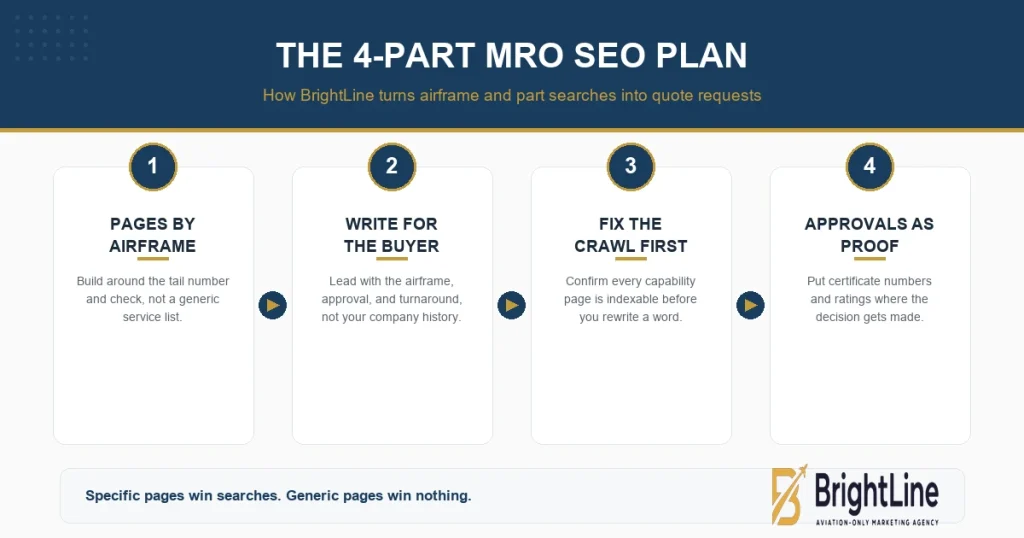
This article lays out a four-part plan: page architecture built by airframe, content written for the person holding the work order, a crawl audit before any new page gets published, and approvals turned into the reason to call.
Your Capability List Is Not a Search Strategy
SEO for MRO companies builds pages around the airframes, components, and approvals a buyer is already searching for. It treats each tail number, part number, and rating as its own entry point. Search rewards the page that matches the query, not the page that describes the shop.
A single capability list page collapses every airframe, rating, and turnaround promise into one undifferentiated block. A director of maintenance scanning it for a specific tail number finds nothing to match against.
Buyers arrive with a spec, a part number, or an approval code in hand. A page that does not name that spec cannot be the page they land on. This is where generic B2B advice fails aviation shops outright. That advice assumes a browsing buyer weighing options. An MRO buyer is not weighing. That buyer is matching.
The same logic applies to the people who staff and certify these shops. A page about becoming an aviation mechanic earns its traffic by naming the certificates and ratings a candidate needs. An MRO page earns its traffic the same way, by naming what the shop is approved to do. Search rewards specificity at the level of the individual component. A shop that lists every rating on one page competes with nobody and wins nothing.
The plan ahead has four parts. Build pages by airframe, write for the person holding the work order, fix the crawl before writing another page, and turn approvals into the reason to call.
Part One: Build Pages by Airframe, Not by Service
A page that says “heavy maintenance and component overhaul” competes with every shop on the planet. A page that says “737NG C-check” competes with almost nobody. Four page types carry the load.
Airframe pages that name the model and the check
A page earns the “A320 heavy check” query only if the airframe and the check type sit in the title and first sentence. State the models you support, the checks you perform, and the bay capacity that constrains scheduling. A capability list collapses all of it into “airframe maintenance” and matches nothing.
Component pages built on part numbers and spec codes
Accessory and component buyers search by part number, overhaul manual reference, or spec code. Build pages around parts, materials, and applications so a planner lands on the exact unit rather than a category. The EASA type certificate library is where those spec references originate, and naming them signals technical fluency.
Approval pages that state what you’re certified to do
Ratings are queries. An airframe rating, an avionics rating, an NDT method: each is a search term a procurement team uses to filter shops. A page that lists the certificate number, the ratings it covers, and the limitations answers the question before it’s asked. Vague approval language loses the buyer who needed a specific rating confirmed.
Location pages for operators searching near a field
Operators search by airport code and region, not by city name alone. A location page must pair the field identifier with the capability available at that site. An address with no capability listed tells the planner nothing about whether the AOG team can reach them.
BrightLine Digital builds aviation content strategy around exactly this page-by-page structure, because the architecture is the strategy.
Part Two: Write for the Person Holding the Work Order
The page that loses the quote request is usually not badly written. It is written for the wrong reader at the wrong moment. A maintenance planner with a tail number and a grounded aircraft does not need your origin story.

Company history feels safe to lead with. It is the easiest thing to write and the hardest to argue with internally. The reasoning breaks the moment a planner forwards your URL to a director who has seconds to decide.
Before: The page opens with a founding year, a hangar square footage figure, and a mission statement about excellence. Turnaround time sits three clicks deep, and the approval status lives in a PDF nobody opens. A planner lands, scans, finds nothing that matches the tail number in hand, and closes the tab. The quote request never happens, and the shop never learns it was in the running.
After: The page leads with the airframe, the check, the approval, and the response window. A planner sees the rating that covers the work and the commitment on turnaround in the first screen. Below that sits the technical detail a planner needs to defend the choice upward, including how the shop tracks compliance against a continuous airworthiness program.
The second version wins because the buyer is rarely the only reader. That page gets forwarded to a director of maintenance who was never part of the original conversation. It has to make the case alone. This is where MRO company marketing quietly succeeds or fails. The page is a document that travels without you. Write it for the person who receives it cold.
Part Three: Fix the Crawl Before You Write Another Page
Rewriting headlines on pages Google cannot reach is the most expensive habit in MRO marketing. The parts catalog that renders only after a filter click, the quote form sitting on a session URL, the twelve location pages fighting over the same airport code: these are crawl failures wearing a content problem’s clothes.
Start the diagnosis at the bottom of the stack. Before a single sentence gets rewritten, confirm the page returns a clean status code, appears in the sitemap, and survives a fetch without JavaScript. A parts page buried behind a faceted filter often never gets indexed at all, which means the airframe query you’re targeting has no page to land on.
Duplicate location pages come next. Two pages for the same field, both naming the same ratings, split whatever authority the shop has earned and hand Google an arbitrary choice. Consolidate to one page per facility with the capability detail intact.
Quote forms deserve the same scrutiny. A form that lives on a URL only reachable after three clicks is invisible to crawlers and easy for a buyer to abandon. Put the request path where a search engine and a director of maintenance can both find it.
BrightLine Digital runs an aviation technical SEO audit as the first step of its four-step process, precisely because this order matters. Fixing crawl access before content is the difference between a rewrite that ranks and one that disappears.
Part Four: Turn Approvals Into the Reason to Call
Certifications and approvals are the strongest trust assets an MRO owns, and the most routinely wasted. A director of maintenance choosing a shop is buying proof, not capability claims. Burying your repair station certificate in a PDF wastes the strongest card in your deck.
- Repair station certificate. State the certificate number and the exact ratings it covers, airframe, powerplant, accessory, or avionics. A buyer scanning for a specific rating will not hunt through a scanned image.
- OEM authorizations. Name each manufacturer authorization and what it permits your shop to perform. An authorized service center designation answers a procurement question before the buyer asks it.
- Quality and safety credentials. List the audit and quality system credentials a procurement team verifies before issuing a purchase order. A page that omits them reads as a gap.
- Turnaround commitments. Publish documented turnaround windows by check type and your AOG response commitment. A stated response window is a promise the buyer can hold you to, which builds trust.
These assets form a procurement file, not a marketing brochure. Each answers a question the buyer is already asking internally. Put that file on the page where the decision happens, not in a downloads folder nobody opens.
Before your next aviation SEO services review, pull every certificate and authorization off the wall and put it where the buyer decides. That turns a credential into a quote request.
Where MRO Search Traffic Goes to Die
The leak in an MRO funnel rarely shows up in analytics, because the buyer who abandons a quote form never registers as a traceable bounce. A director of maintenance with an AOG tail number and a deadline will not fight your site to give you money. Five failure points kill more quote requests than any ranking drop.

- Quote form demands unavailable data. Asking for a work order number or removal date stops a buyer who has neither.
- Contact page routes to a general inbox. A shared address with no named owner means the AOG email sits unread until the aircraft is on another shop’s floor.
- Parts catalog sits behind a login. Gating the catalog blocks the crawler and the first-time buyer confirming you stock the component.
- Location page lists an address only. A city and phone number tell an operator nothing about which airframes you can service at that field.
- Response window the shop cannot staff. Promising a quote within hours you cannot honor trains buyers to distrust every other claim on the page.
These failures share one trait: they demand something from the buyer before the shop has earned it. None look broken in a browser. Each quietly filters out the exact operator ready to send a work order.
Audit your quote path the way a buyer with a grounded aircraft would walk it. Fix the form fields and the inbox owner first, then let aviation website design carry the rest.
What AI Answers Change About MRO Search
A search result hands you ten blue links and a decision. An AI answer hands you a paragraph and, often, no click at all. That difference decides which MRO pages still earn attention.
The classic result rewards a page that ranks. A shop with a well-optimized capability page can sit in position three and collect clicks from directors of maintenance all day. Ranking still matters, but the click is now a prize the engine can withhold.
An AI answer rewards a page that states facts a machine can lift. When a director of maintenance searches with an AOG aircraft and a deadline, the engine assembles a reply from pages that name the airframe, the approval, and the turnaround in plain sentences. A page built as a sales brochure gives the engine nothing to quote. Vague marketing copy is invisible to the citation layer.
The page that wins the citation is the one whose sentences survive being pulled out of context. BrightLine Digital builds answer engine optimization for aviation teams around exactly this citation-first approach, treating every airframe and approval line as a quotable fact.
Citation wins when your buyer is mid-AOG and needs a plain answer fast. The click still wins when a planner is comparing shops and wants to read the whole page. Write for the citation first, and the click follows.
Pick the Airframe Page You Rewrite First
Search stops being a mystery once you see it as a shelf of tail numbers. Every query your buyer types is a request for one specific page, and your job is to make that page exist. SEO for MRO companies works when the catalog of pages matches the catalog of parts.
Skip this and the cost compounds quietly. A competitor publishes the airframe page your shop never built, and that page answers a director of maintenance at the moment of need. The buyer who lands there does not compare you later. They request the quote from the shop that showed up.
Start with one airframe. Pick the model your shop knows cold, the check you can staff without scrambling, and build the page around it this week. Name the airframe, the check, the rating, and the response window. Then watch the quote requests tell you which page to build next.
FAQ
Questions MRO Shops Ask Before They Invest in Search
Is SEO dead now with AI?
No, but the version that chased clicks on generic blog posts is finished. SEO for MRO companies now means publishing pages that state an airframe, an approval code, and a turnaround window plainly enough that an AI answer can quote them.
Who are the largest MRO providers?
Global heavy maintenance is dominated by a handful of independent giants alongside the in-house shops run by large airlines and OEMs. Size rarely decides who wins a quote, because a regional operator with an AOG tail number picks the shop whose site names that airframe and its approval status.
What is the 80/20 rule in SEO?
A small share of pages usually produces most of the qualified traffic, so the work is finding which pages carry that weight. For an MRO, that often means a single airframe page and a single component page outperform the entire service catalog combined.
How do I do SEO for my company?
Start by listing the exact phrases your buyers type: model designations, part numbers, check types, and airport codes. Build one honest page per phrase, confirm it loads and indexes, then track quote requests instead of rankings.
Why is page architecture by airframe critical for SEO for MRO companies?
Maintenance planners search for specific airframe models and check types rather than general maintenance categories. Dedicated airframe pages match exact buyer search queries, improving search engine rankings and increasing qualified quote requests.