
Aviation Blog Writing Services: Why Posts Fail to Rank
TL;DR
- Posts fail when they target broad general topics instead of specific operational questions typed by buyers.
- Professional aviation blog writing services must build briefs around buyer roles, part numbers, and exact queries.
- Answering technical questions immediately in the opening paragraph drives higher rankings and lead conversions.
- Linking posts directly to parts pages, service listings, and schemas ensures search engines index them clearly.
- Regular thirty-day reviews prevent content drift and turn page-three articles into qualified inquiry channels.
An aviation blog post can be published, indexed, and technically clean and still sit on page three forever. The reason is rarely the keyword. It is that the post answers a question no aviation buyer ever typed, and no amount of aviation blog writing services polish fixes a mismatch that starts in the brief.
Marketing teams assume ranking is a volume problem. Publish more, target broader terms, wait for the algorithm to reward the effort. That logic works in software, where buyers search in long editorial phrases. Aviation buyers do not. An AOG coordinator types four words at a parts page and expects an answer.
This article gives you a diagnostic framework for the four places aviation posts break: the brief that never names the reader’s question, the draft that explains instead of answers, the publish step that skips structure, and the review that never happens.
The Query Your Aviation Post Never Answered
Aviation search intent is the specific operational question a buyer types when close to a decision, not the broad subject they browse when they are not. It includes the part number, the interval, the admissions step, the AOG call. It excludes anything a curious outsider would search out of general interest.
Aviation blog writing services tend to build posts around the second category. An MRO director searching for a maintenance interval is not reading your overview of safety culture. That director wants the number and the citation, and will leave in seconds if the page does not have them.
General-topic posts compete with every aviation publisher on the planet. A post built around one operational question competes with almost nobody, and the reader who lands on it is already holding a purchase decision. Search engines reward that specificity because the page matches what the searcher typed.
BrightLine Digital’s aviation content strategy starts from the buyer’s query rather than a keyword list. The keyword list tells you what people search. The query tells you what they need answered before they call.
Take a page on FAA safety management systems guidance. A post that explains the circular to a general audience competes with every safety publication. A post answering one operator’s specific compliance question owns that search. Pull your last five stalled posts and read the titles. If none names the question a buyer would actually type, you have found the problem.
Generic B2B Playbooks Do Not Fly Here
Two kinds of aviation blog writing services show up in every pitch: the generalist agency and the aviation-only shop. The difference that decides your rankings is not effort or tooling. It is vocabulary.

The generalist agency runs a SaaS content approach. It onboards fast, quotes low, and delivers drafts on schedule. Then the writer spends the first months learning what a squawk is on your retainer, and the copy reads like it was written for a software buyer.
The aviation specialist costs more per post and ships fewer of them. That writer already knows a Part 145 repair station from a Part 135 charter operator, and knows a CFI cares about checkride pass rates, not brand awareness. Every post lands in the language your buyer uses.
Generic B2B SEO tactics reward volume and broad themes. Aviation search rewards precision. A post that says “aircraft maintenance best practices” competes with every publisher on earth. A post that answers a specific interval question has almost no competition and a reader ready to act.
The failure is not effort. It is vocabulary. Search engines match the words your buyer typed, and readers trust the writer who uses them correctly. A generalist can learn your world eventually. You just pay for that education in drafts that never rank.
Why Aviation Blog Writing Services Miss the Mark
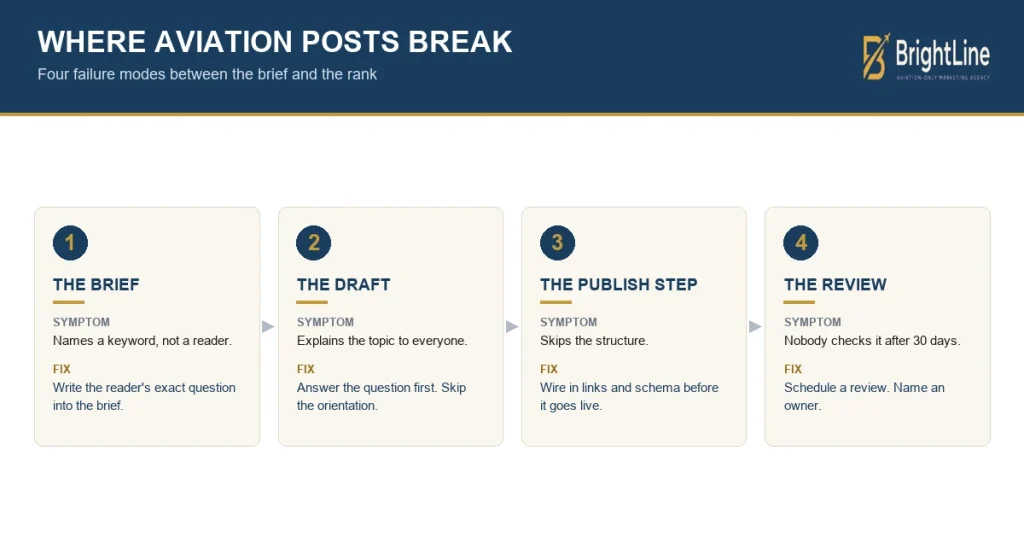
Four failure modes sink a post before it can rank, and none happen at the keyboard. They happen in the brief, the draft, the publish step, and the review. Each is distinct, and each has a specific fix.
The Brief Names a Keyword, Not a Reader
A brief that says “target AOG support” tells a writer nothing about the dispatcher typing it at a grounded gate. The fix is to write the reader’s question into the brief. Name the person, the moment, and the phrase they typed.
The Draft Explains the Topic to Everyone
Writers default to explaining when they don’t know the reader. A post on Part 145 repair station approval that opens with a definition of a repair station has already lost the DOM who runs one. The fix is to answer the operational question in the first paragraph and skip the orientation.
The Publish Step Skips the Structure
A post with no internal links, no schema, and no clear page hierarchy is invisible to a crawler trying to place it. Google’s rater guidelines update reinforces that page quality and purpose matter, not just the words. The fix is to wire the post into your aviation SEO services structure before it goes live.
Nobody Checks the Post After Thirty Days
Publishing is treated as the finish line when it is the starting gun. A post that earned impressions but no clicks has a title problem; one that earned neither has a query problem. The fix is a scheduled review that reads the search console data and assigns a revision owner.
The failure usually lives in the brief and the review, not the writing. BrightLine Digital’s four-step process, from audit and discovery through optimize and scale, exists because that is where the money is lost.
What Aviation Buyers Search Before They Call
Buyers in this industry type short, operational phrases into a search bar. They do not browse long editorial topics. The gap between those two behaviors is where aviation blog writing services lose the ranking and the lead at the same time.
- AOG query. A dispatcher with an aircraft on the ground types the part and the word AOG together. They are trying to get a plane flying tonight.
- Parts number query. A DOM enters an exact part number and a condition. A post that lists the number, the interchangeability, and the lead time answers the question in one screen.
- Flight school admissions query. A prospective international student searches the visa step, the deposit, or the medical timeline. Flight school marketing built around this query reaches the applicant before the deposit decision.
- Maintenance interval query. An owner asks when an inspection is due and what it costs to miss it. The shop that publishes the interval and the consequence earns the call.
- Charter pricing query. A traveler or a broker wants a rough number for a route and a cabin class. A post that explains what drives the quote captures the request before a competitor does.
Each phrase marks a buyer at a different door, and each one converts because the post meets them there. The blog post is not a magazine feature. It is the page that answers the question the buyer typed thirty seconds before picking up the phone.
The Brief That Decides Whether a Post Ranks
A brief is the only document that can save a post before a writer types a word. Get it right and the draft almost writes itself. Get it wrong and the best writer produces a page that answers a question nobody asked.

Step 1. Name the exact query and the person typing it. Write the phrase as it would appear in a search bar, then name the role behind it: a DOM pricing a hot section inspection, a dispatcher hunting a loaner unit. A brief that says “target maintenance keywords” has already failed.
Step 2. List the three questions the reader needs answered before they act. A buyer close to a decision has a short checklist, and the post either clears it or loses them to a competitor. Write those three questions into the brief as the required structure of the draft.
Step 3. Name the internal pages the post must link to, and the pages that must link back. A post on AOG support should point to the parts page, not the about page. The reverse links matter just as much, and they are where aviation AI overview optimization starts to compound across a site.
Step 4. Define success in ninety days, in impressions and qualified sessions. Word count is not an outcome. A brief that measures length tells the writer nothing about whether the page reached the people who matter.
Step 5. Assign the review date and the person who owns the revision. A post with no named owner drifts for a year. Put a date and a name in the brief before the draft is commissioned.
Complete all five and the brief becomes the asset, not the post. Nothing rescues a brief that never named the reader’s question, and that is where aviation blog writing services either earn the retainer or burn it.
What Aviation Blog Writing Services Should Cost
Quoted rates for aviation blog writing services cluster into three models, and the model matters more than the number. A cheap per-post quote and a strategy-led retainer can look similar on an invoice and behave nothing alike when the post stalls on page four.
| Model | What You Receive | Who Owns the Brief | When the Post Does Not Rank |
|---|---|---|---|
| Per-post freelance ($150 to $500 per post) | A finished draft, usually one revision round | You do. The writer takes whatever topic you send | The contract ends. Rework is a new purchase order |
| Monthly retainer ($2,000 to $6,000 per month) | A set post count on a calendar, sometimes with keyword research | Shared. The agency proposes topics, you approve them | The next month’s calendar repeats the same pattern |
| Strategy-led engagement ($5,000 to $12,000 per month) | Brief, draft, internal links, schema, and a scheduled review | The agency, built from query and buyer research | The agency revises and reports on impressions and qualified sessions |
The per-post rate is the most expensive line item once you count rework. A $200 draft that misses the query costs a revision, a rewrite, and a lost quarter of ranking time. Pay for the brief and the review, not the word count. That is where aviation marketing agencies earn the retainer or waste it.
Where AI Fits and Where It Still Fails
A language model can write a fluent paragraph about turbine engine overhaul intervals. It cannot tell you whether the reader asking that question owns the engine or leases it. That gap is the whole ballgame.
Drafting is where AI earns its keep. A model compresses the blank-page problem, turning a rough brief into a structured first pass in minutes instead of hours. For an aviation blog writing services team producing steady volume, that time savings is real.
The part that decides rankings is not drafting. It is choosing which operational question to answer and which internal page the post must support. A model cannot verify a maintenance interval against the current manual. It cannot tell a Part 91 owner from a Part 135 operator, and it will confidently blend the two into a paragraph that reads clean and is wrong.
Internal linking exposes the failure fastest. Ask a generic model where a post on AOG sourcing should link, and it will suggest the about page or the contact page. A human who knows the site sends that link to the parts inventory page, because that is where the stranded operator needs to land next.
BrightLine Digital builds this split into its AI digital marketing services workflow, keeping the brief, the verification, and the link map in human hands while the model handles the first pass. Skip that discipline and the drafts get faster and the rankings do not move. The speed is real. The accountability is what you have to keep.
Fix the Brief Before You Hire Another Writer
Stalled posts rarely trace back to a weak writer. They trace back to a brief that named a keyword and skipped the question behind it. Good aviation blog writing services fix that document before anyone drafts a sentence.
Pull the last five posts that went nowhere. Write the exact query each one owed an answer to, then check three places: the title, the opening paragraph, and one internal link. A post that fails all three was never aimed at a reader. Fix the brief on the next commission and the draft stops guessing.
Run that audit this week, before the next post is ordered. Every stalled post is a brief you can rewrite. Hand your writer a named query, a named reader, and the pages the post must connect to. Then watch what the index does.
FAQ
Aviation Blog Writing Services: Questions Buyers Ask
How much do aviation blog writing services cost?
Expect quotes to land in three shapes: a flat per-post rate, a monthly retainer covering a set number of posts, or a strategy-led engagement that bundles the brief, the writing, and the ranking review. The per-post figure looks cheapest on paper, but it usually excludes the query research and internal linking work that decides whether the post ever earns a click.
What are the best aviation blogs to follow?
The strongest aviation blogs are trade publications and operator-run sites that publish to a specific audience, not general interest magazines covering the whole industry. A blog written for Part 135 charter dispatchers reads differently from one written for flight school applicants, and that narrowness is exactly what makes it worth reading.
Will AI replace aviation blog writers?
AI handles the first draft well and the ranking decision badly, so the writer’s job shifts toward the brief, the verification, and the internal linking. A model will happily produce a fluent paragraph about an inspection interval without knowing whether the reader owns the aircraft or leases it.
Why is my aviation blog post not ranking?
A post fails to rank when it answers a broad industry topic instead of the exact operational question a buyer typed into the search bar. Check the title, the opening paragraph, and the internal links for that query, because a post missing all three is competing with every aviation publisher at once.