
AI Search Optimization for Flight Schools: 3 Steps to Get Cited by AI
TL;DR
- Implementing AI search optimization for flight schools shifts your digital focus from traditional Google rankings to earning direct recommendations inside ChatGPT, Perplexity, and AI Overviews.
- AI engines ignore flight academies that lock tuition pricing, flight hours, and visa requirements inside unreadable PDFs or behind forced contact forms.
- Making your program pages machine-readable requires separate URLs for each rating, plain-language figures, and structured Course and LocalBusiness Schema markup.
- Generative engines lift concise, self-contained answer blocks placed near the top of program pages that directly address student cost, timeline, and visa eligibility.
- Off-domain corroboration from an updated Google Business Profile, consistent NAP listings, and active pilot forum mentions verifies your claims before an engine cites you.
A student in Lagos types one question into ChatGPT: flight schools in your city. Your school is not in the answer. Neither is the academy down the road with the older fleet and the smaller website.
That result is not random. AI search optimization for flight schools is a different discipline than climbing Google, and the schools winning citations treat it that way. They publish what a machine can read, quote, and verify.
The gap is rarely reputation. It is evidence. A polished homepage with program details locked inside a PDF gives an AI engine nothing to extract, so it recommends whoever made extraction easy.
This article gives you three steps: making your school readable to AI, giving it a clean answer to lift, and earning the trust signals that trigger a citation.
Why AI Answers Skip Most Flight Schools
Google ranks pages. AI engines assemble answers, and that difference is where flight schools disappear. A school can hold a top spot on the results page and still never surface when a student asks ChatGPT for a recommendation.
The engine reads what it can extract, verify, and trust. Your homepage hero photo of a Cessna on the ramp tells it nothing. Program details locked inside a downloadable PDF tell it nothing either. An AI engine cannot cite what it cannot parse.
Ask the same question in ChatGPT and Perplexity and you often get different schools. Each engine pulls from a different slice of the web. One leans on structured pages and directory listings, the other weights forum threads and review volume. A school strong in one source and absent from the other gets named by one engine and skipped by the next.
This is the gap that AI search optimization for flight schools closes. The work breaks into three moves: make your program pages machine-readable, give the engine a clean answer it can lift, and build the third-party corroboration it checks before citing you. Skip the first and the other two have nothing to attach to.
BrightLine Digital runs this as an aviation-only practice. The team works from a four-step model: Audit & Discovery, Strategic Roadmap, Surgical Execution, Optimize & Scale. That sequence treats aviation AI overview optimization as a build, not a one-time fix, because engines re-read your pages as they change. Your competitor down the field may already be the answer. Every month your program pages stay unreadable, that position hardens.
Step 1: Make Your School Machine-Readable
An AI engine cannot cite a flight school it cannot parse. Before any content work matters, the machine has to crawl your pages, load them fast, and understand what each one is about without guessing.

Step 1. Open the door to crawlers. Check your robots.txt and firewall rules for blocks that stop AI crawlers from reading program pages. A site that loads in under three seconds and serves clean HTML gives the engine something to work with.
Step 2. Build one canonical page per program. Private pilot, instrument, commercial, and CFI each get their own URL. One page trying to cover four certificates gives the machine four half-answers and no clean source to lift.
Step 3. State the facts in plain language. Put total hours, aircraft types, and prerequisites directly on the page. A prospective student and a language model both need the same thing: the number, stated once, without a PDF in the way.
Step 4. Declare your Part 141 or Part 61 status on the page. Bury that detail in a downloadable packet and the engine treats your certification as unknown. Print it in the program description where a crawler reads it.
Step 5. Add structured data markup. Schema tells the machine exactly what each page represents. Google’s guide to structured data markup properties explains which fields are required, recommended, or optional for search meaning.
Get this foundation right and every later step compounds. The engine can read you, so it can quote you. Skip it, and the best aviation content strategy on the market sits invisible.
Step 2: Give the Machine a Clean Answer to Lift
AI engines lift short, self-contained answers. A page that buries the point under three scrolls of marketing copy gives the machine nothing to quote. The fix is a direct answer block near the top of every program page.
Step 1. Open each program page with a paragraph that answers four questions in plain order: who the program is for, how long it takes, what it costs, and what the student holds at the end. Write it as complete sentences, not bullet fragments. An engine that can lift one clean paragraph will cite it.
Step 2. State cost and timeline in plain figures on the page itself. A private pilot certificate priced at a range tied to aircraft hours beats “affordable training” every time. Students researching how much flight school costs land on pages that answer the question directly, and so do the engines summarizing those pages.
Step 3. Handle the international student question on the page, not in an email reply. Name the visa category, the admissions sequence, and the documents a candidate needs before applying. Schools that leave this to a contact form lose the citation to a school that published it.
Step 4. Build an FAQ block using the exact phrasing students type. “Can I train on an M-1 visa?” and “How long does instrument rating take?” beat “Program Inquiries” as headings. An FAQ written in the school’s internal vocabulary never gets matched to a real question.
BrightLine Digital’s aviation content strategy is built around how aviation buyers actually research, which is the same discipline that earns AI citations. Finish these four steps and every later trust signal has something solid to reinforce.
Step 3: Build the Trust Signals AI Checks
Citations get earned off your own domain, not on it. An engine that finds your program page will look for a second source that agrees with you. Three signal types do that work, and each fails for a different reason.
A Google Business Profile That Looks Operated, Not Claimed
An unclaimed profile with no hours and no photos reads as a dormant business. Upload fleet photos, list your aircraft tail numbers, and post checkride milestones. The flight school Google Business Profile is often the first record an engine cross-checks against your site.
Name, Address, and Phone That Match Everywhere
Your hangar address on your site must match your profile, directory listings, and local chamber page. One stray suite number in an old listing creates a conflict the engine resolves by trusting neither. Audit every directory that carries your school and correct the mismatches.
Mentions You Did Not Write
Forum threads on pilot communities, training directories, and local news coverage count as corroboration. A school named in a Reddit thread about accelerated training carries weight a homepage testimonial never will. Part 141 pilot school certification should be verifiable on the FAA’s own record, not just your brochure.
Review Volume and Recency Together
Twelve reviews from 2019 signal a school that stopped caring. Steady reviews through the current quarter signal one that is flying students now. Recency matters more than raw count, and engines read both. Reputation work and local SEO are now citation work. Treat every review request and directory fix as an input to whether a machine names you.
Where Flight Schools Get AI Search Wrong
The schools that lose AI answers are rarely the weakest. They are the ones whose best material sits behind a download button.
A prospective student asks for a commercial pilot program with costs and a timeline. The engine scans the homepage, finds a hero image and a phone number, and moves to the next school. The information existed. It just wasn’t in a form anything could quote.
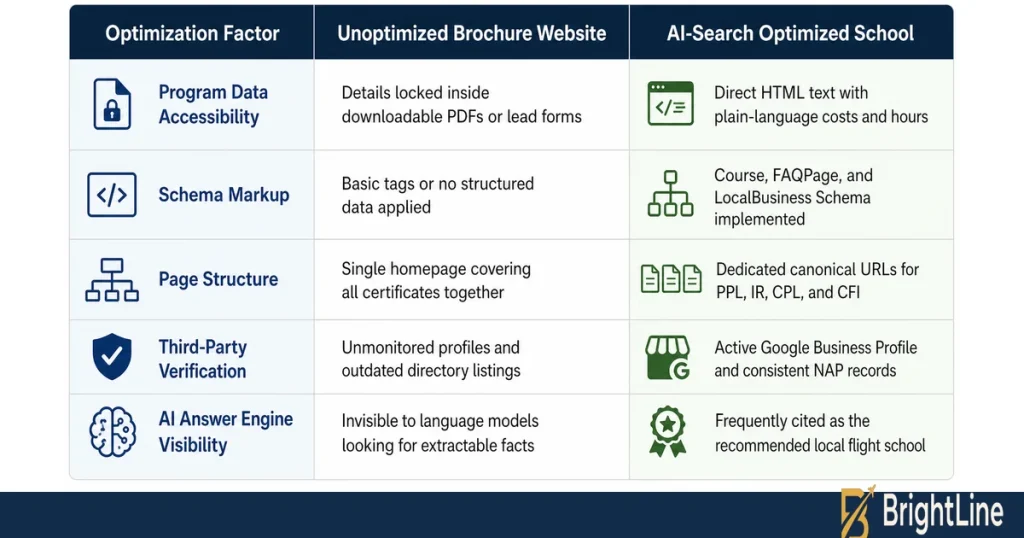
This mistake spreads because the old approach rewarded it. A polished brochure site with a lead form felt professional, and PDFs kept pricing out of competitors’ hands. That logic held while humans did the reading. It collapses the moment a machine does the reading instead.
Before: A school builds a homepage around stock cockpit photos and a tagline about “training the next generation.” Program details live in a downloadable PDF, pricing appears nowhere, and reviews sit on a Facebook page nobody monitors. The Google Business Profile has no hours and no fleet photos. A student who lands there has to call to learn anything, and an engine that lands there has nothing to lift.
After: The same school publishes a crawlable page for each certificate, with hours, aircraft, and costs stated in plain text. Structured data tells the engine what each page is. An answer block sits at the top of every program page, and reviews flow to Google instead of Facebook. Part 141 status is confirmed on the FAA’s own record, not just claimed on the site.
The wrong version is invisible because the machine cannot extract usable evidence, not because the school trains badly. That gap is the whole lesson of AI search optimization for flight schools, and it is the same gap that AEO for aviation businesses exists to close. Fix the extraction problem and the school stops competing on reputation alone. It starts competing on evidence an engine can actually read.
How to Measure AI Search Visibility for Flight Schools
Rank tracking tells you where your pages sit on a results page. It says nothing about whether ChatGPT names your school when a student asks for flight training nearby.
Step 1. Keep your existing Google ranking report, but treat it as one signal among several. Rankings show crawl health and page relevance, and they’ll flag a program page that’s slipped or been deindexed. A school ranking well on Google can still be invisible to an AI engine.
Step 2. Run a fixed set of buyer questions through ChatGPT, Perplexity, and Google AI Overviews on a schedule. Ask what a real student asks: cost of a private pilot license here, which schools accept international students, how long to a commercial certificate. Log which schools get named and whether yours appears.
Step 3. Track Google Business Profile actions separately from site traffic. Calls, direction requests, and photo views reveal local intent the AI answer can’t show you. A spike in calls with no matching inquiry form submission tells you the profile is doing work the website isn’t credited for.
Step 4. Count qualified inquiries by source, not raw form fills. A citation that sends three serious applicants beats a ranking that sends thirty browsers. This ties visibility work to enrollment.
Step 5. Demand monthly reporting on traffic, rankings, and qualified leads from any aviation marketing agencies you work with. BrightLine Digital reports on all three, and that transparency is the standard worth holding every partner to.
Run this loop long enough and you’ll see which engine cites you, which questions you win, and where the gaps sit. That record becomes your baseline for every optimization decision.
What AI Search Cannot Tell You About a Flight School
An engine will repeat whatever a school publishes, and nothing a school keeps quiet. That sounds like an advantage until you notice what it rewards: schools that document their outcomes, not schools that fly well.
Ask ChatGPT whether a given flight school has good instructors and you get a summary of the staff page. Ask about fleet condition and you get the same marketing copy the school wrote about its aircraft. Checkride pass rates, time to certificate, instructor hours flown, aircraft availability during peak training months: none of it surfaces unless the school puts it in text a machine can lift.
This is where flight school marketing becomes an act of disclosure, not promotion. A Part 61 school that publishes its pass rate and average hours to certificate gives an engine two facts it can quote. A larger academy that publishes neither gives it a brochure.
Gaming the gap backfires. Thin pages stuffed with keywords and review counts that don’t match the profiles behind them get cross-checked against directories, forums, and the school’s own Google Business Profile. Engines compare sources, and a contradiction costs more trust than silence.
The durable play is publishing real outcomes and keeping them current. Pass rates, instructor tenure, fleet size, and dispatch reliability become the facts the machine repeats to every student who asks. Citations follow evidence, and evidence has to be written down.
None of that replaces the three steps. It extends them, because a school that publishes honestly still needs pages an engine can read and corroboration it can trust.
Start With the Questions Students Ask AI
Open ChatGPT and Perplexity today. Type the five questions a prospective student would ask about flight training in your city, then write down every school the engines name. That list is your baseline, and it tells you exactly where AI search optimization for flight schools stands for your brand right now.
Run the three steps in order. Machine readability comes first because nothing else works until the engine can read your program pages. A school that skips ahead to reviews while its course details stay locked in a PDF gets cited by nobody. Citations compound the way rankings do, so the schools that start now hold the position later.
Check the baseline again in a month. Watch which schools move and which stay absent, then fix the gap the engines keep exposing. BrightLine Digital builds that audit into every aviation engagement, and the schools that act first own the answer.
FAQ
AI Search Optimization for Flight Schools: Common Questions
How long does it take to see AI citations?
Expect a crawl-and-index lag before any engine quotes your pages, because a model has to discover the content first. Watching your server logs for AI crawler hits tells you more about readiness than refreshing ChatGPT daily.
Are SEO and AI search optimization the same work?
They overlap heavily on crawlability, page structure, and authority, but they produce different outputs. Traditional SEO earns a position on a results page, while AI search optimization for flight schools earns a named mention inside a generated answer.
Can a small Part 61 school compete with a large Part 141 academy?
Yes, and the advantage sits in specificity rather than fleet size. A Part 61 school that publishes exact aircraft types, instructor hours, and honest checkride outcomes gives an engine quotable facts a bigger academy buries in a brochure.
What structured data should a flight school add first?
Start with Organization and LocalBusiness to anchor your identity, then add Course and FAQPage markup to your program pages. Course markup is the one most schools skip, and it is the property that tells an engine your private pilot program is an actual offering.
Do paid ads affect AI answers?
No, because engines build citations from organic sources they can read and cross-check, not from ad spend. A school that buys Google Ads for “flight training near me” still needs crawlable program pages and third-party corroboration to appear in a generated answer.