
Aviation AI Chatbot: What to Check Before You Buy One
TL;DR · The short answer5 key points
- Don’t grade an aviation AI chatbot on how much it answers. Grade it on what it does when it doesn’t know.
- Get six things in writing: integrations, handoff rules, lead fields, escalation triggers, pricing definition and data ownership.
- Anything with a tail number, a deadline or money on the line must go to a human.
- Flight schools need admissions qualification, FBOs need after-hours and multilingual reception, MROs need structured AOG and RFQ intake.
- Bring your own list of hard questions and make every vendor run it live.
A student in Manila messages your flight school at 2 a.m. your time, asking whether her budget covers the full private pilot certificate. The reply she gets in the next ten minutes decides whether she books a discovery flight or enrolls somewhere else.
That reply is where an aviation AI chatbot proves what it is capable of. Vendors demo these tools by showing how much they answer. The better question is what happens when the bot does not know.
This article gives you a vendor checklist built for the operator’s side of the desk, not the sales deck. You’ll get segment-specific tests for flight schools, FBOs, and MROs, and a clear standard for judging an aviation AI chatbot before you sign anything.
The Demo Answers Everything. That Is the Problem.
Ask about a Cessna 172 rate, a hangar waitlist, or a turbine overhaul window in a vendor demo and the answer arrives polished and instant. That fluency is the sales pitch, and it is the wrong thing to grade.
Breadth of answers is easy to fake in a scripted demo. A vendor picks the questions, rehearses the paths, and hides the seams. In aviation, a bot that answers everything confidently is a liability dressed as a feature.
Picture the failure. A transient crew asks whether you have hangar space tonight, and the bot says yes because it read a facilities page. They land expecting a slot you never had. Or a caller asks for an AOG timeline on a grounded King Air, and the bot quotes a generic turnaround that your shop cannot meet.
Those errors cost a relationship, not a click. A student who gets a wrong price on a discovery flight tells the flying club. An operator who gets a wrong AOG promise calls the next MRO on the list.
The real test is what happens when the answer is not in the system. Does the bot say so plainly, capture the tail number or the timeline, and hand it to a person who can actually respond? That handoff is the product.
This is where routing beats answering. A front desk that knows its limits and escalates fast protects the relationship. When you scope what an aviation AI agency builds, the routing logic matters more than the answer library.
So stop buying an answer machine. You are buying a triage system that decides which inquiries reach a human and how fast. The next question is whether the vendor can prove that routing works under pressure.
The Vendor Checklist That Survives a Real Inquiry

Six checks separate a front desk from a demo toy, and every one of them gets answered in writing before a contract is signed. Skip any single check and you are buying a chat window that looks impressive on a screen share.
- Integrations with your systems. The bot has to read and write to your scheduling platform, your CRM, and your dispatch board. A bot that captures a name but cannot see whether the aircraft is booked is guessing at the answer that matters most.
- Human handoff speed and rules. Ask what triggers a transfer, who receives it, and how fast a live person picks up. The rule set should be visible to you, not buried in the vendor’s configuration.
- Lead capture and qualification fields. Confirm exactly which fields the bot collects and where they land. A transcript with no structured fields is a conversation you cannot act on.
- Accuracy boundaries and escalation triggers. The vendor should show you where the bot stops answering and starts routing. If they cannot point to that line, it does not exist.
- Pricing structure and conversation definition. Per-conversation, per-seat, flat monthly, and setup-plus-retainer models each punish a different behavior. Know what counts as a billable conversation before volume climbs.
- Data ownership and transcript location. Ask who owns the transcripts, where they are stored, and whether they train the vendor’s model. Get the export terms in writing.
Any vendor who cannot answer all six in writing is selling a demo, not a receptionist. A captured inquiry only becomes revenue when it reaches a human who can act on it. That routing layer is where aviation business automation earns its keep, and it is the piece most chatbot pitches leave out.
What an Aviation AI Chatbot Must Never Guess
Two kinds of questions land in an aviation inbox, and the gap decides whether your chatbot is an asset or a liability. One set is safe to answer freely. The other must escalate to a human, every time. The line between them is drawn by consequence, not by topic.
Safe territory covers questions where a wrong answer costs nothing but a correction: hours, location, program pages, document checklists, and general pricing ranges, as long as those ranges are kept current and labeled as estimates. A prospective student asking what a private pilot certificate involves should get a straight answer at any hour. A bot that deflects those to a human is just an expensive phone tree.
Escalate territory is everything with a tail number, a deadline, or money on the line: aircraft availability and scheduling, fuel and hangar requests, AOG and RFQ intake.
The FAA’s thinking on AI in aircraft systems is worth borrowing here, even though it was written for a different job. Its roadmap for AI safety assurance builds in verification instead of taking a system’s output on trust. Apply the same posture to a front-desk bot: confident is not the same as correct.
A vendor who cannot show you where that line sits in their configuration is hiding something. Ask to see the escalation triggers, the fallback message, and the routing rule for an AOG inquiry. If the answer is a shrug, the demo was the product.
The harder test is the inquiry that sounds routine but is not. A student asking about instrument training at night is a scheduling question in disguise. A pilot asking if you have a hangar for a transient aircraft is a fuel sale waiting on a human. Write your escalation list before your demo script. Hand it to the vendor and watch whether their tool can honor it.
The Flight School Test: Admissions, Not Answers
A flight school does not need a chatbot that recites the private pilot syllabus. It needs one that recognizes an admissions decision forming in real time and moves that person toward a human before the interest cools.
Prospective students arrive with a timeline, a budget ceiling, a citizenship status, and a medical question they are afraid to ask directly. Those four variables decide whether they enroll, not the aircraft fleet page. An aviation AI chatbot that only answers program questions answers the easy half and drops the half that pays tuition.
Watch what the bot does with a message like “I’m from Brazil, about a year, and I take medication for ADHD.” That single line carries an international admissions path, a schedule constraint, and a medical eligibility question that no bot should resolve alone. The right system captures all three, flags the medical item for a human, and routes the applicant to the international admissions track with the right document checklist attached.
A qualified inquiry dropped into a shared inbox with no owner is wasted. A contact form could have done that. The test is whether the bot names the admissions lead, sets a response expectation, and pushes the record into your CRM with the fields intact.
Accuracy upstream matters. A bot trained on stale program pages will quote a cost structure the school changed last quarter, and the applicant will hold you to it. BrightLine Digital’s aviation content strategy work keeps program, pricing, and admissions pages current enough that the bot has something true to say.
Run one live test before you sign. Type a messy international inquiry into the demo and watch whether the bot qualifies or just replies. The answer tells you whether you are buying an admissions filter or a brochure with a chat window.
The FBO Test: After-Hours Reception and Language



An FBO lives or dies on the front desk, and the front desk cannot be staffed in every time zone. That gap is where an aviation AI chatbot proves its worth fastest, because inquiries arriving at 3 a.m. are fuel, hangar, and transient crew requests from aircraft already airborne.
Test the bot on four things: after-hours reception, transient crew handling, whether it hands a live request to the duty manager, and how it copes with a crew that does not speak English.
After-Hours Reception Is the Whole Job
A crew planning a fuel stop at dawn does not care that your office opens at eight. They need a yes or a no before they file. A bot that answers with office hours has told them to call somewhere else.
Transient Crews Want a Person, Not a Form
Transient requests carry urgency a contact form cannot hold. A diverted crew needs a ramp, a van, and a hotel, and they need confirmation, not a ticket number. The bot should recognize the request as live and escalate it, not file it into a queue read at shift change.
Does the Request Reach the Duty Manager?
Handoff separates a receptionist from a suggestion box. A bot that captures a hangar request but never rings the duty manager has done nothing for the customer. Confirm the escalation path exists, who it wakes, and how fast. The page, call, or dispatch alert behind that escalation is automation work, and without it the chatbot is a polite dead end.
One Language Is a Receptionist Who Clocks Out
International crews arrive speaking Portuguese, Mandarin, French, and Arabic. A bot locked to English greets them with a wall. Multilingual handling is not a nice-to-have at an international field. It is the difference between a fuel stop and a missed one.
The MRO Test: AOG Speed and RFQ Intake
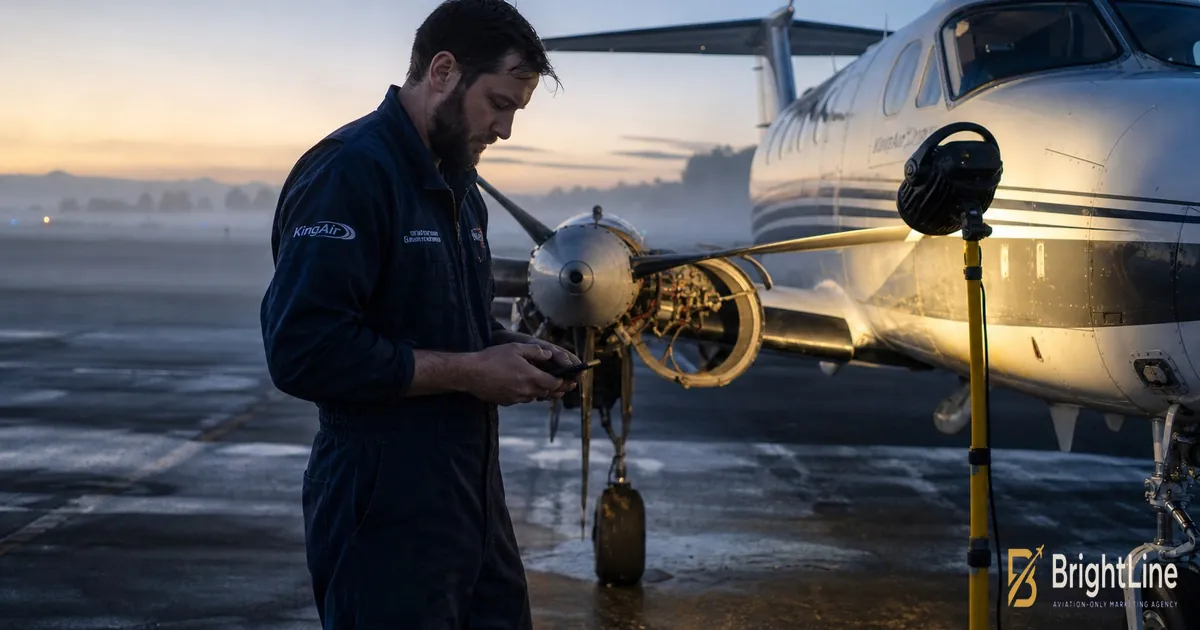

An MRO buyer does not care how politely your aviation AI chatbot says hello. The buyer cares whether it knows what an AOG means at 5 a.m. and whether it can get a tail number, a part number, and a deadline in front of a human who can quote before the aircraft sits another hour on the ramp. Most bots fail this test badly. They greet the operator, recite the capability page, and ask how they can help today. That is manners. An AOG is minutes.
The real use case is RFQ intake, not conversation. A working bot recognizes the shape of an AOG inquiry the moment it lands, pulls the tail number and part number into structured fields, asks for the deadline if it is missing, and routes the whole package to a human who can price it. A bot that cannot structure an RFQ is a chat window with a logo.
Many vendors miss MRO buyers because they automate page views instead of buying signals. They build flows around brochure downloads, when the signal that matters is a part number typed at dawn by a line mechanic with a grounded aircraft. Treat that string as the highest-priority event in the system, not a message to be answered later.
BrightLine Digital builds aviation business automation around exactly that priority, so a captured RFQ reaches a person who can quote instead of a queue that sleeps until Monday.
Test the bot live with a real AOG scenario. Type a tail number, a part number and a deadline, then watch where it goes. If it files the inquiry instead of escalating it, you have your answer about what the vendor built.
Pricing, Data Ownership, and the Exit Clause
Four pricing models show up in aviation AI chatbot proposals, and each one punishes a different kind of buyer. Read the table as a trap map, not a price list.
| Model | What It Rewards | What It Punishes |
|---|---|---|
| Per-conversation | High inquiry volume, seasonal peaks | A bot that chats too long or loops on a confused student |
| Per-seat | Small teams with one admissions lead | Adding a second dispatcher or duty manager |
| Flat monthly | Predictable budgets, steady front-desk load | Vendors who quietly cap message volume |
| Setup plus retainer | Deep integration with scheduling and dispatch | Buyers who never read the cancellation terms |
Per-conversation pricing looks cheapest until your bot starts clarifying a Manila student’s budget question across a dozen messages. Ask what counts as one conversation before you compare anything.
The clause buyers skip is data ownership. Who owns the transcripts, where they physically sit, and whether your student inquiries train the vendor’s model are all open questions. An FBO’s hangar request and an MRO’s RFQ contain pricing intelligence you cannot hand over casually.
Export rights decide the exit. A vendor who cannot hand you a clean transcript export on day one is telling you they expect you to stay. The safer setup sends every captured inquiry into your own CRM, so the data lives where you can keep it. Ask who owns the transcript data after cancellation. If the answer is “we do,” you are renting your own inquiry history.
Get the exit clause in writing before you sign. A thirty-day termination window and a full data export in CSV format should be non-negotiable.
Run the Unknown Test Before You Sign Anything
Every vendor will show you an aviation AI chatbot that answers well. The buying decision lives in the moment it cannot. Grading a bot on coverage is grading a pilot on the questions they got right on the written exam.
Skip this test and the failure surfaces on a Sunday, in front of a transient crew with a fuel request and a credit card. The inquiry goes unanswered, the crew calls the FBO down the field, and the relationship is gone before Monday. One missed AOG call can cost more than a year of the chatbot.
Build the list this week. Write down the questions your front desk actually fumbles: the tail number at dawn, the international student asking about medical certification, the hangar request nobody logged. Hand that list to every vendor and make them run it live. Watch the handoff, not the demo.
BrightLine Digital sets up aviation business automation that handles the questions your chatbot should never guess at. Book a call to map where automation fits your operation before you sign with any vendor.
FAQ
Aviation AI Chatbot Questions Buyers Actually Ask
What is the best AI for aviation?
There is no single best model, because the aviation AI chatbot that wins is the one wired into your scheduling, CRM, and dispatch systems rather than the one with the largest answer library. The deciding detail is configuration: a generic model tuned to your program pages and escalation rules beats a stronger model left to improvise.
Is the FAA using AI?
Yes. The FAA runs a technical discipline for AI and machine learning and has published a roadmap for assuring AI safety in aircraft systems. Its approach treats AI output as something to verify, not trust, which is a useful standard for any chatbot answering aviation customers.
What should an aviation AI chatbot do when it does not know the answer?
It should say so plainly, capture the inquiry with the details already gathered, and hand it to a named human within minutes rather than hours. The detail buyers miss is that the handoff transcript matters as much as the handoff itself, because the person picking it up needs the tail number or timeline without re-asking.
How do I test an aviation AI chatbot before buying?
Bring your own list of questions your front desk fumbles, and make the vendor run them live in front of you instead of showing a scripted demo. The tell is what happens after the bot admits it does not know, since a vendor who cannot show the routing step has not built one.