
Flight School SEO Guide: How Search Brings You More Students
ℹ️ TL;DR
- Executing an effective flight school SEO guide strategy requires dominating Google Maps, organic rankings, and conversion-focused landing pages simultaneously.
- Generic SEO agencies fail by measuring web traffic sessions instead of booked discovery flights and enrolled student seats.
- Winning the local map pack relies heavily on selecting flight-specific GBP categories, keeping NAP details consistent, and maintaining steady review recency.
- Match keyword intent accurately by pairing pricing queries with transparent rate calculators and career queries with in-depth training guides.
- Implement structured Course and LocalBusiness schema markup while publishing seasonal content well before peak student enrollment windows.
A flight school SEO guide is not a list of tactics borrowed from retail marketing. It is a system for appearing at the exact moment a prospective student decides which school to call. That moment is brutal. Search “flight school near me” in any metro area and you’re competing against every school within driving distance for the same slot.
This article breaks down how search actually fills seats, from winning the Google Maps local pack to building the pages that turn a discovery flight inquiry into a Part 141 enrollment. A Part 61 school in Phoenix with ten aircraft can outrank a Part 141 academy with forty if the smaller operation owns its local search presence.
What Flight School SEO Actually Means
Flight school SEO is the practice of making your school the visible answer when a prospective student searches for pilot training in your area. It is not website maintenance with better keywords. The distinction matters because it changes who owns the work, what gets measured, and how fast you see a return on the spend.
Schools treat this as a website project. They hire a web developer, redesign the site, and wait for traffic that never converts. That framing misses the real battlefield, which spans three surfaces at once: Google Maps, the organic results, and the pages that turn a click into a booked discovery flight. A flight school SEO guide that only covers on-page optimization is solving a third of the problem.
The student searching “flight school near me” is not browsing. They are choosing. They have a budget, a schedule, and two or three schools already open in other tabs. The school that appears first in the local pack captures the inquiry, and the others get a phone call only if the first one fails to answer. That is the entire contest, and it happens before your homepage ever loads.
Generic agencies miss this because they optimize for sessions, not seats. Aviation search behavior bends around geography, weather, airspace, and regulation in ways retail SEO never accounts for. A student in Arizona searches differently than one weighing a move to Florida for year-round flying. BrightLine Digital treats this as an aviation-specific discipline, which is why the work starts with how students actually search rather than a keyword tool export. The technical and local foundation comes after that, not before.
Get the definition right and the budget follows the right work. A flight school marketing strategy built on visibility across all three surfaces compounds. One built on a redesign alone stalls in month four, when the owner asks why the phone still isn’t ringing.
Why Generic SEO Fails Aviation Businesses
Flight school SEO guide advice written for retail breaks the moment it touches an aviation business. An agency that ranks a dentist in three months will rank your school too, then hand you a dashboard full of traffic that never books a discovery flight. The problem is not effort. It is vocabulary.
Generic agencies optimize for sessions because sessions are what their contracts measure. A flight school needs a different number: seats filled. An inquiry from a parent comparing Part 141 timelines is not the same lead as a retiree pricing a discovery flight. Generic reporting cannot tell those two people apart, so it treats both as wins.
Aviation search behavior bends around geography and weather in ways retail never accounts for. Students tend to choose schools within driving distance or favorable weather states, which means a Phoenix school and a Seattle school are not competing for the same searcher. Airspace class, seasonal cloud cover, and local DPE availability all shape what a student types into Google.
Then there is regulation. A prospective international student searches for M-1 visa support and TSA clearance timelines, not just flight hours. An agency that has never written about I-20 paperwork will build pages that answer none of it. BrightLine Digital treats this as an aviation content strategy problem, not a keyword problem, because the intent sits inside the regulation.
Retail SEO also assumes a short conversion path. Someone searches, clicks, buys. Flight training runs on a longer arc: discovery flight, logbook, checkride, certificate. The search that starts it might be “how much does flight school cost” typed by a high school junior whose parents hold the checkbook. marketing that fills classes has to speak to both.
So schools pay for rankings that look healthy and enroll nobody. The traffic arrives, the bounce rate climbs, and the owner concludes SEO does not work for aviation. What failed was the assumption that SEO is SEO.
Winning the Local Pack for Flight School Searches
Flight school SEO advice usually buries the most valuable real estate on the page: the Google Maps local pack. When a prospective student types “flight school near me,” the three map results above the organic links absorb the majority of clicks. Your Google Business Profile ranking signals decide whether you’re one of them.
Proximity drives that ranking, but it is not a wall. Google weighs controllable signals that let a school twenty minutes away outrank the one down the street.
- Flight-specific GBP categories. Listing yourself as a generic “education center” buries you under tutoring services and test prep. Select “Flight School” as your primary category so Google matches you to aviation queries.
- review velocity and recency. A steady flow of recent reviews outranks a pile of old ones, because Google reads freshness as an active, trustworthy business. Ask every solo student to leave one the week they fly.
- Service-area landing pages. A dedicated page for each city you recruit from gives Google a reason to rank you beyond your physical radius. A school near a metro edge can capture the whole metro this way.
- Consistent NAP data. Your name, address, and phone must match exactly across your site, GBP, and every directory listing. A stray suite number or old phone line splits your signals and drops your rank.
- Geo-tagged photos and posts. Weekly GBP posts and photos tagged to your airfield keep the profile active. Dormant profiles lose ground to competitors who post.
Read together, these signals reveal something the individual tips hide: proximity is a starting input, not a ceiling. The school that builds categories, reviews, and location pages outranks closer competitors who never touched their profile. Audit your pack position for your top city today, then fix the weakest signal.
Proximity is the signal you cannot change. The other four you control completely, and that is where the ranking gets won or lost. Schools that treat their GBP like a set-and-forget listing lose the pack to competitors posting weekly. Treat it as a living asset instead.
Matching Keyword Intent to the Right Page
Two keyword families drive nearly all flight school search traffic, and sending both to the same page is the quiet reason your inquiry form stays empty. The comparison that matters is not which keyword gets more volume. It is which page each keyword demands.
Commercial terms like how much flight school costs carry a buyer, not a browser. A searcher typing that phrase has already decided to train and is pricing the decision. The right page is a transparent cost breakdown or calculator that answers the number fast and offers a discovery flight before they leave. Bury that figure behind a contact form and they bounce to the next school in the results.
Informational terms like “how to become a pilot” pull a different person entirely. This searcher is months from booking and often years from enrolling, weighing a career change against a mortgage. A career guide that walks through certificates, timelines, and earning potential earns their trust and their return visit. Push a hard sell here and you lose them before the relationship starts.
Schools that route both queries to the homepage convert neither. The cost searcher hunts for a number that is not there. The career searcher gets a sales pitch instead of an answer. A mapped keyword intent strategy fixes this by assigning each term to the page built for it. BrightLine Digital runs this mapping as a core part of its aviation content strategy, pairing each keyword family with the page type that converts it.
The cost page wins when the searcher is ready to book and needs a number. The career guide wins when the searcher is deciding whether to start at all. Build both, and stop expecting one page to do two jobs.
Consider what happens when a Part 61 school runs a single “pilot training” landing page. The cost searcher lands there, finds no pricing, and calls the school down the road instead. Split the pages and the same traffic behaves differently. The cost page captures the price shopper, the career guide captures the undecided, and each page does one job well.
Structured Data That Helps Flight Schools Rank
Schema markup is the part of a flight school SEO guide that most owners skip, and it is also the cheapest ranking signal you can install.
Course Schema for Discovery Flights and PPL Programs
Course schema tells Google that a page describes a structured training program, not a blog post. Mark up your discovery flight and private pilot packages with name, provider, and duration fields so the listing renders with program details.
LocalBusiness Schema Tied to Your Airfield
LocalBusiness schema anchors your school to a physical address, which is what proximity ranking reads. Include the airport identifier, street address, and phone number and match them exactly to your Google Business Profile. Mismatched data between the two sources splits your local signal.
FAQ Schema for Pre-Enrollment Questions
Students ask the same questions before they call: financing, medical requirements, how long training takes. FAQ schema pulls those answers into an expandable block under your listing, capturing the click before a competitor does.
Review Schema and the Ratings You Can’t Fake
Review schema surfaces your star rating directly in search results, and reputation management for flight schools depends on it. Only mark up reviews you can verify, because fabricated ratings trigger manual penalties that take months to clear.
Part 141 Versus Part 61 as a Schema Decision
Part 141 versus Part 61 programs attract different searches, so they need different schema. A university-track student searches for degree pathways and VA funding. A working adult searches for flexible scheduling and self-paced hours. Tag each program page with the correct course type and eligibility fields. Schema that describes the wrong program type sends the wrong student to the wrong page.
Malformed JSON-LD Breaks More Than Rankings
A single missing comma in your JSON-LD block can invalidate the entire markup and, in some themes, break page rendering. Validate every schema block before it goes live. Structured data rewards precision, not volume. Four clean schema types beat twelve broken ones, and Google ignores what it cannot parse.
Content That Ranks for Seasonal Flight Searches
A flight school SEO guide that ignores the calendar is written for the wrong industry. Demand for pilot training swings with weather, school breaks, and hiring cycles, yet the average school publishes content whenever someone remembers the blog exists.
Publishing late is the same as not publishing. Students research months before they book, so a summer camp page that goes live in June misses every family already deciding in March.
- Summer camp pages. Publish before spring break so parents searching for youth aviation programs find you first.
- Accelerated training pages. Target students in slow-weather states who want to finish a rating fast in your climate.
- location landing pages. Build one for every city you draw students from, since “flight school near me” resolves to a place name.
- Career outcome content. Answer what a graduate earns and where they fly, because parents and counselors read it before students do.
- Winter ground school pages. Capture cold-month searches from students who want written exam prep while flying slows.
- International admissions pages. Serve the visa and housing questions that drive overseas inquiries toward U.S. schools.
The pattern underneath these six items is timing, not topic. Search volume for aviation training peaks before the season it serves, not during it. A page published in the off-month ranks by the time demand arrives.
Seasonal content also compounds. Pages published a year early have twelve months of authority before the next cycle, which is why aviation content strategy treats the editorial calendar as an enrollment tool.
Audit what your school published last year and when. If the summer camp page went live in May, move it to February and watch the inquiry window shift with it.
Counter the objection that seasonal pages go stale. A summer camp page still ranks the following March if you refresh the dates and photos. Update the page in the off-month, not the peak. Change the year, swap the testimonials, and confirm the enrollment link works. That single edit keeps the page earning its position.
Measuring Whether Search Fills Seats
Rankings are the metric flight school owners brag about and the one that pays no bills. A school can hold the top spot on Google Maps for years while its discovery flight calendar stays half empty, because visibility and enrollment are two different systems that most operators never connect. A flight school SEO guide earns its keep only when the final number on the report is seats filled.
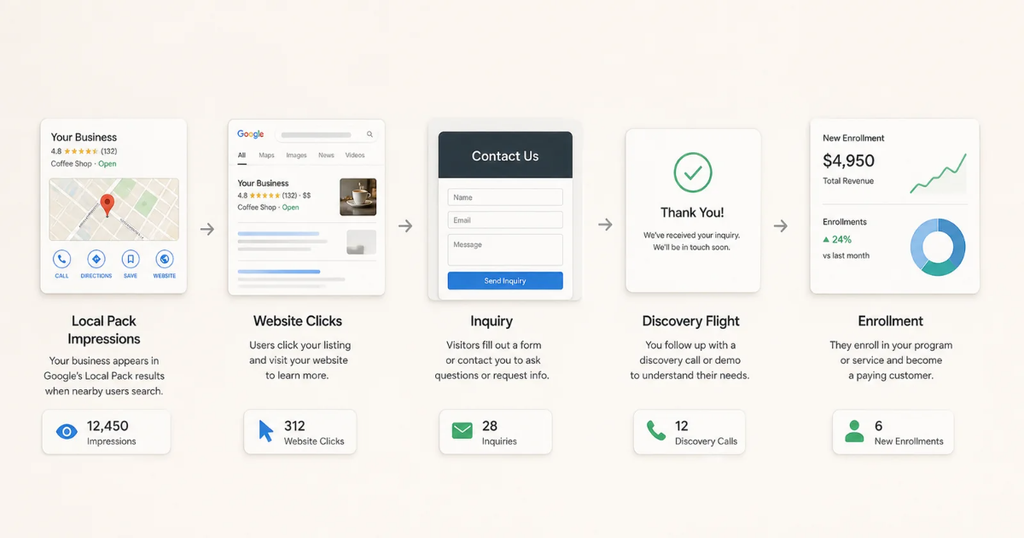
The measurement chain runs through five links: local pack impressions, clicks to your site, form fills and calls, discovery flights booked, and enrollments closed. Break the chain anywhere and the data stops meaning anything. Track the first four and ignore the fifth, and you’re optimizing a funnel that leaks at the bottom.
Most schools lose the thread between the inquiry and the enrollment. A form fill lands in an inbox, someone calls back two days later, and nobody logs whether that lead ever booked a discovery flight. Without a CRM tying search data to the enrollment record, you can’t tell a $40,000 private pilot student from a tire-kicker who filled out three forms. Aviation businesses that pair hyper-local search visibility with reputation signals see the gap close faster, because the leads arriving are already qualified by proximity and intent.
BrightLine Digital builds the reporting around metrics that matter to the owner: cost per enrollment, not cost per click. That means connecting Google Search Console and your Google Business Profile insights directly to the CRM, so a spike in “flight school near me” impressions maps to a specific number of discovery flights and a specific number of signed students. Anything less is a dashboard nobody reads.
The uncomfortable part: a school ranking first with a broken inquiry-to-enrollment handoff will lose to a school ranking fourth with a tight one. Fix the measurement chain before you chase another ranking position.
Turn Search Visibility Into Enrolled Students
A flight school SEO guide only pays off when visibility and conversion run as one system. The school that ranks for “flight school near me” then hands the inquiry to a slow front desk loses to the school ranked third with a same-day callback.
Audit where your school appears for “flight school near me” and the cost searches in your market. Then walk the path a student takes: the Maps listing, the landing page, the form, the phone call, the discovery flight. Every gap between a ranking page and a converting page is a seat someone else fills. Fix the handoff before you chase another ranking.
Start with one city and one query. Check the local pack, check the page it points to, check what happens after the inquiry lands. BrightLine Digital builds that full chain for aviation operators. Close the gap, and search stops being traffic and starts being enrollment.
Ready to Put This Flight School SEO Guide Into Action?
Stop losing prospective student pilots to competing schools down the road. BrightLine Digital builds aviation-only search campaigns that put your school at the top of Google Maps and convert local searchers into booked discovery flights.
Flight School SEO Questions Owners Ask
How long does it take to rank a flight school website?
Expect meaningful movement in local results within a few months, with stable rankings for competitive terms taking considerably longer. The variable that decides the timeline is review velocity, not publishing volume, because a school collecting fresh reviews every week moves faster than one posting blog articles nobody links to.
Do I need a separate page for each city I recruit from?
Yes, if you draw students from multiple metros, each city needs its own landing page with genuinely local content. A page that swaps the city name into identical copy gets filtered out, while one naming the actual airports, drive times, and nearby high schools earns the ranking.
What is the difference between ranking in Maps and ranking in organic results?
Maps rankings depend heavily on proximity, your Google Business Profile, and review signals, while organic rankings depend on page content and links. A school can hold the top Maps slot for its own zip code and still lose the organic listing to a competitor with stronger pages.
How do I compete with a larger flight school in my city?
Compete on specificity rather than budget, because a flight school SEO guide built around your actual programs beats a bigger school’s generic pages. Own the narrow searches the large operator ignores, such as accelerated training, tailwheel endorsements, or a specific career track.
Should I target international students with SEO?
Yes, because international student searches carry high intent and low competition compared to domestic terms. Build dedicated pages covering visa support, housing, and M-1 documentation, since these prospects research for months before contacting any school.