
Aviation Conversion Funnel vs. Paid Search: Where Leads Stall
TL;DR
- Paid search buys immediate visibility at the top, but a broken aviation conversion funnel is why qualified inquiries fail to close.
- Evaluating marketing purely on cost per lead misleads operators; track cost per enrolled student or signed service contract instead.
- Aviation leads stall due to long decision cycles, unassigned next touches, multi-stakeholder approvals, and improper follow-up cadences.
- Repairing conversion friction, CRM inquiry routing, and same-week follow-ups generates higher returns than buying more search clicks.
- Combine paid search with funnel optimization: use ads when conversion paths are proven, and repair the funnel when inquiries stall.
Treating paid search and the aviation conversion funnel as rival line items is the wrong argument. The ad budget keeps producing clicks. The pipeline keeps producing the same stalled names, month after month.
Paid search buys volume at the top. The funnel decides whether that volume ever becomes a discovery flight, an enrollment, or a signed maintenance contract. Operators keep funding the first and ignoring the second, then blame the market when inquiries go quiet.
This article gives you a way to diagnose which side is actually broken. You’ll learn where aviation leads stall, what each fix genuinely buys, and how to trace a single inquiry from first click to signed contract so the next dollar lands where it counts.
The Criteria That Decide Where Budget Belongs
Cost per lead is the most misleading number in aviation marketing. It rewards the operator who buys cheap clicks and punishes the one who pays more for a prospect who actually enrolls, so the metric quietly funds the wrong side of the business.
Track cost per enrolled student or signed contract instead. A flight school comparing a discovery-flight inquiry against a completed private pilot enrollment sees two very different economics, and only the second one pays rent. An MRO weighing a parts inquiry against a service contract hits the same wall.
Time to conversion is the second filter. Aviation buying cycles run long and uneven, so a lead that looks dead this month may close after a budget cycle turns over. Paid search is a volume lever; the aviation conversion funnel is a conversion lever. Confusing the two is how operators end up buying more of what already fails to close.
Lead quality versus lead volume splits the same way. Paid search delivers intent at the moment of search, which is genuine value, but it cannot tell you whether that intent survives contact with your follow-up. Survey data on student pilots shows how much of the training decision hinges on the school’s responsiveness, not the ad that found it.
The real question is which lever is currently constraining growth. A bottleneck at the top means spend; a bottleneck in the middle means repair. Answer that before the next budget meeting, because the wrong lever just makes the same problem bigger.
What Paid Search Actually Buys in Aviation
Search ads purchase one thing: a position in front of someone already typing. That position is worth real money. It is also the entire transaction, and aviation operators keep billing it as if it were the whole sale.

A flight school bidding on discovery-flight terms is buying a warm body at the exact moment curiosity peaks. The ad wins that moment cheaply compared to cold outreach. What it cannot do is schedule the flight, confirm the slot, or stop the prospect from booking with a school closer to home.
An MRO bidding on service and parts queries buys the same thing in a different costume. A maintenance director searching for a specific overhaul capability is a genuine intent signal. The ad delivers the inquiry. It does not deliver the approved vendor form, the purchase order, or the second signature.
Reading intent correctly is the whole skill here, and Google’s guide to audience intent frames it as the difference between research and readiness. A search tells you which one you caught.
The category error is treating a click as a pipeline stage. Search sits at the top of the aviation conversion funnel and stops there by design. Every inquiry it produces still needs qualification, follow-up, and a next touch someone owns. Operators who skip that middle layer are not running a funnel. They are running an expensive inquiry generator.
Budget belongs in search when the middle already converts and volume is the constraint. When inquiries arrive and stall, more spend just buys more names for the same holding pattern. Aviation B2B lead generation lives or dies in that gap.
Why Aviation Leads Stall in the Holding Pattern
Deals in aviation rarely die from a clean no. They die in the gap between first interest and a buying decision, where nobody is quite saying yes and nobody is saying stop. That gap is where the aviation conversion funnel does its quietest damage. Five patterns account for most of it.
- Not yet, not no. A prospect who says the timing isn’t right is still live, but most teams file that answer as a soft rejection and stop working it. The lead stays warm for months and gets worked by nobody.
- A cycle longer than the cadence. A standard drip sequence runs out of touches well before a charter buyer’s budget cycle closes. When the emails stop, the relationship stops with them.
- Several approvers, one contact. An MRO service contract or a charter agreement passes through maintenance, finance, and operations. A single point of contact stalls the moment the decision leaves their desk.
- Visa and funding timing. An international applicant is waiting on a student visa interview slot and proof of funds. Their silence reflects a calendar, not a lost interest.
- Nobody owns the next touch. An inquiry arrives, gets answered once, and then sits. Without an assigned owner and a scheduled follow-up, the aviation sales funnel simply leaks.
Read together, these patterns share one trait: they all look like nothing on a dashboard. A stalled middle produces the same flat inquiry graph as weak demand, so operators misread it and buy more ads into a funnel that was never the problem.
Where the Aviation Conversion Funnel Leaks
The leaks that kill aviation deals are structural, and they live between the inquiry and the signature.
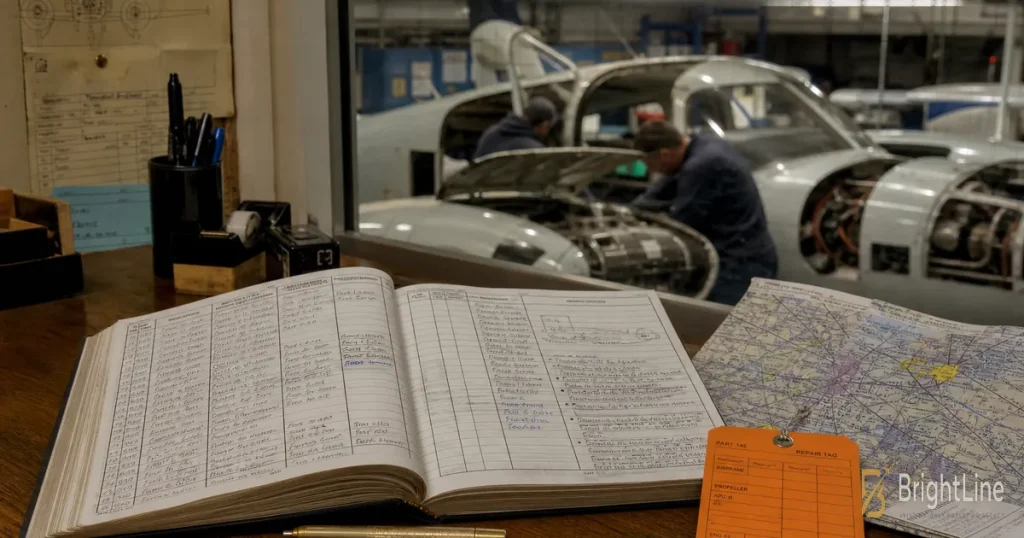
- Discovery flight with no same-week follow-up. A prospect who just flew a plane is at peak interest, and a follow-up next month reads as indifference.
- Inquiry landing in an inbox, not a CRM. A shared inbox buries leads in a scroll of vendor emails, and nobody can prove who was contacted.
- Quote sent with no scheduled next contact. The quote becomes the last word instead of the opening of a decision.
- International applicant handed a brochure. A visa and funding applicant needs admissions guidance, and a PDF answers none of the questions keeping them awake.
- Website that collects a form and nothing else. The submission disappears into a notification email with no routing, no owner, and no next step.
None of these leaks happen at the top of the funnel, and none get fixed by bidding on a better keyword. They happen after the click, in the handoff between interest and action.
BrightLine Digital builds aviation web design and conversion work and marketing automation around exactly these leak points, since the fix is structural rather than a better ad.
Trace one recent inquiry through your process and mark where it went quiet. That mark is where flight school lead generation stalls, and it is the first place to spend time.
Paid Search vs. Funnel Repair, Side by Side
Set the two options in the same frame and the choice stops being philosophical. One buys reach at the moment of search. The other decides what happens after the click, and that second half is where the aviation conversion funnel either holds a prospect or loses them. The table below strips both down to what they actually deliver, where they act, and what each one leaves untouched.
| Dimension | Paid Search | Aviation Conversion Funnel Repair |
|---|---|---|
| What it buys | Position in front of active searchers | A path from inquiry to signed contract |
| Where it acts | Top of the pipeline | The middle, between interest and decision |
| Time to visible result | Immediate traffic, slower proof of quality | Build time, then compounding returns |
| What it fixes | Thin inquiry volume | Stalled follow-up, dropped quotes, cold applicants |
| What it cannot fix | A middle that leaks every lead | A market nobody is searching for |
| Who it suits | Operators with a conversion path that already closes | Operators with steady inquiries and a stalling middle |
Run together, the two compound. Paid search feeds a repaired funnel, and the repaired funnel raises the return on every click, which is the whole logic behind flight school enrollment marketing done as one system rather than two budgets.
BrightLine Digital runs Google Ads and paid search alongside aviation SEO and conversion work so both are measured against enrolled students and signed contracts, not clicks. Repair the middle first when inquiries already arrive. Buy volume first only when the path behind it converts.
Match Follow-Up Cadence to How Aviation Buys
A discovery-flight prospect who books a Saturday slot and hears nothing until Tuesday has already talked to another school. The cadence that wins that prospect is measured in hours, and it looks nothing like the sequence that keeps an international applicant warm for months.
Generic drip schedules fail because aviation buyers move at wildly different speeds. A weekend discovery flight converts on momentum and a fast callback. A charter or MRO contract moves through budget cycles and multiple approvers who each need their own touch. One cadence can’t serve both without stalling one of them.
Cadence is a funnel design decision, not a marketing preference. Someone has to own the next touch, name the trigger that fires it, and log it where the team can see it. When that ownership lives in one person’s memory, the follow-up dies the week they take vacation.
Aviation CRM software is where cadence becomes visible and repeatable. A flight school can tag a discovery-flight lead for a same-day call and a next-day text. An MRO can route a quote to a scheduled contact that fires whether or not the rep remembers. The record shows who touched the lead and when they touched it.
The test is simple. Pull a stalled inquiry and ask who owned the next touch. If the answer is a shrug, the cadence was never designed. It was improvised, and improvised follow-up is where the aviation conversion funnel quietly loses the deal.
Which Fix Fits Your Operation Right Now
Three situations cover nearly every aviation business, each pointing to a different first move. The signal separating them is not budget size. It is where the last twenty inquiries stopped.
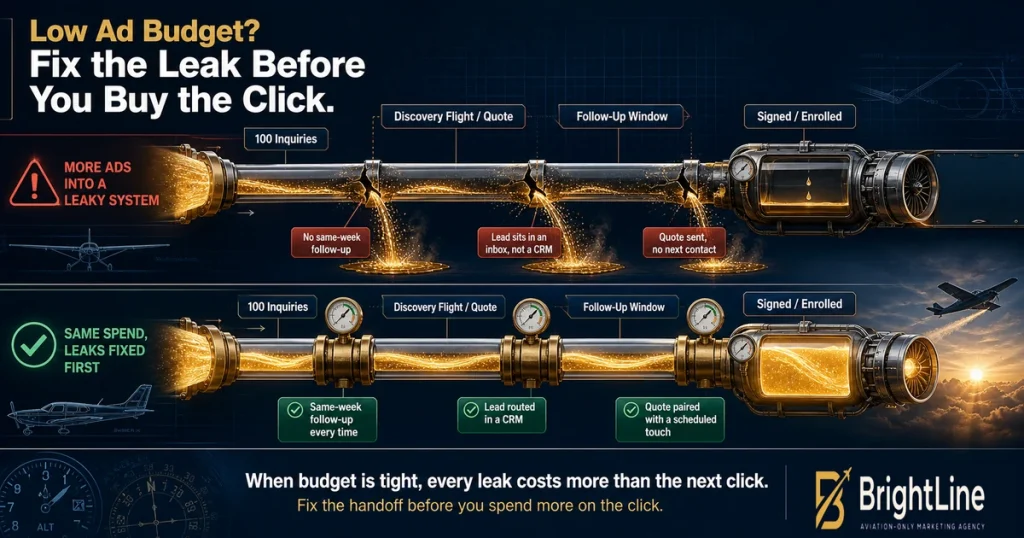
Steady inquiry volume with a stalling middle is the most common case, and the fix is funnel repair before new spend. A flight school fielding discovery-flight requests weekly but enrolling few has demand, not a visibility problem. More ads just widen the top of a pipe that narrows further down. The signal: inquiry count holds flat while enrollments drift down.
Thin top-of-funnel with a healthy conversion path is the opposite case, and here paid search earns its budget. An MRO that closes most quotes but receives too few has a working middle and a quiet top. Search ads put your name in front of buyers already typing parts and service queries. The signal is a high close rate on a small inquiry pool; the risk is spending before confirming the middle can absorb the volume.
Having neither a steady inquiry flow nor a reliable close rate means the website and follow-up come first. Ads into a leaking funnel buy more leaks, and the cost compounds with every click. A form that collects a submission and nothing else is the first thing to fix. Flight school marketing that ignores same-week follow-up wastes every dollar spent above it.
Read the pattern of your last twenty inquiries before moving budget. BrightLine Digital’s audit and discovery step exists to name which of these three situations a business is actually in. That diagnosis comes before any spend decision, not after it.
Find the Leak Before You Buy Another Click
Two budgets, one system. The aviation conversion funnel doesn’t compete with paid search for funding; it determines whether that funding ever returns anything. A click is a door opening. What happens after the door is the whole business.
Trace one inquiry. Pick a real one from last month, follow it from the first ad click to the signed contract or the enrollment, and write down every point where it went quiet. That list is your budget map. Every gap on it is cheaper to close than the next click you buy.
Do the trace this week, before the next campaign review. The names sitting cold in your inbox already paid for themselves once. They will not pay again unless someone owns the next touch.
Download the Aviation Lead Trace Worksheet to run this exercise on paper, one page, the three situations plus a blank inquiry log.
FAQ
Aviation Conversion Funnel Questions Operators Ask
What is a conversion funnel?
A conversion funnel maps the stages a prospect passes through between first contact and a completed purchase or enrollment. In an aviation conversion funnel, a discovery flight request and a signed training contract sit at opposite ends of that path, with several touches in between.
What is a good funnel conversion rate?
A good conversion rate is whatever your own historical baseline says is achievable, measured stage by stage rather than as one blended figure. For a flight school, the discovery flight to enrollment rate matters far more than total inquiries, because it exposes where the middle actually leaks.
What are the 5 stages of the sales funnel?
The five stages are awareness, interest, consideration, intent, and purchase or commitment. An MRO quote request moves through consideration and intent slowly, since a maintenance director often needs budget approval before committing.
How does paid search interact with an aviation conversion funnel?
Paid search captures immediate, high-intent demand at the top of the funnel. However, without a repaired middle funnel to route, qualify, and follow up with those inquiries, paid search clicks fail to convert into signed contracts or enrolled students.