
Flight School Enrollment Marketing: 3 Steps to Fill Your Next Class
TL;DR
- Successful flight school enrollment marketing relies on a three-stage pipeline: capturing high-intent search demand, converting interest into booked discovery flights, and providing proof that drives long-term student commitment.
- Most flight school marketing fails at conversion handoffs due to buried booking buttons, slow inquiry response times, or frictionless online scheduling gaps.
- Capturing search demand requires fully optimized Google Business Profiles, localized course pages, and clear answers to pre-call student questions.
- Treating the discovery flight as the central enrollment event with instant confirmation and post-flight debriefs turns curious visitors into enrolled students.
- Transparent cost breakdowns, instructor stability metrics, and documented graduate career outcomes build the proof necessary to secure deposits.
Someone types “flight school near me” into a phone at a kitchen table, taps the first result, and lands on a page that lists a course catalog and a contact form. That page answers a question the searcher never asked. Flight school enrollment marketing fails here more often than anywhere else, and the failure has nothing to do with traffic.
The pipeline has three stages: capture high-intent search, convert curiosity into a booked discovery flight, then make the school feel worth the commitment. Schools break it at the handoffs. A prospect searches, finds the school, then waits two days for a reply while a competitor calls back in an hour. This article walks through all three stages with the specific fix for each.
Why Enrollment Stalls Before the First Call
Traffic is rarely the problem. A flight school can rank for every search term in its metro and still watch discovery flight bookings flatline, because the leak sits between the click and the call. The handoff is where enrollment dies, not the top of the funnel.
Awareness marketing sells a brand. Enrollment marketing moves a named person from curiosity to a booked seat, and those are different jobs. A school that runs generic ads and posts aircraft photos attracts browsers who never intend to commit. The proof sits in the regulations themselves. Eligibility rules for private pilot certification enrollment are specific and procedural, and a prospect who never sees that detail has no reason to trust your process.
BrightLine Digital works only in aviation, which matters here. The four-step process runs Audit & Discovery, Strategic Roadmap, Surgical Execution, then Optimize & Scale. That sequence exists to find the leaking stage before spending a dollar fixing the wrong one.
A school with strong rankings and weak bookings is not a marketing failure. It is a conversion failure wearing a marketing costume, and the next two stages show you how to strip it off.
Step 1: Capture High-Intent Search Demand
Search demand is where flight school enrollment marketing starts. A prospective student typing “flight school near me” is not browsing. They are choosing between the options in front of them, and the school that never appears never enters the decision.
Step 1. Claim and complete the Google Business Profile. An unclaimed or half-filled profile drops the school out of the map pack for local searches. Fill in the aircraft, the certifications offered, the hours, and recent photos, because Google weighs profile completeness when it decides which schools to surface.
Step 2. Build course pages that match the exact search. A page titled “Private Pilot License” competes with every school in the country. A page built around “private pilot training near [city]” competes with the schools a searcher can actually drive to. Match the page to the phrase, and the page earns the click.
Step 3. Publish answers to the pre-call questions. Cost, time to solo, medical requirements, and financing are what prospects search before they ever dial. A school with no content on those questions hands the search to a competitor who wrote the answer.
Step 4. Mark up the location data properly. Search engines read structured data for local businesses to understand a school’s address, hours, and services. Skipping the markup leaves the listing half-legible to the crawler that decides local rankings.
Step 5. Choose the channel deliberately. The local SEO versus paid ads decision comes down to speed against compounding demand. Paid search buys visibility this week; organic capture keeps paying after the spend stops.
BrightLine Digital’s Aviation Local SEO & Google Business Profile and Aviation SEO Services are built for this exact stage. Get this stage right and the pipeline fills with searchers who already want to fly. The next problem is turning that attention into a booked seat.
Step 2: Turn Curiosity Into a Booked Flight
A curious visitor becomes a student in the seat of an aircraft, not on a contact form. The conversion stage is where your flight school’s website either earns the booking or loses it, and it collapses when the discovery flight sits buried as one option among many.

Step 1. Make the discovery flight the single primary call to action on every page. A school that offers “book a flight,” “request info,” and “download our catalog” with equal weight gives the visitor nothing to do. One action, repeated everywhere, moves people forward.
Step 2. Strip the booking path down to a few taps. If a student has to call during office hours to reserve a seat, the school has handed the decision back to a busy person who will forget by dinner. Online scheduling that confirms instantly keeps the momentum alive.
Step 3. Follow up on every inquiry the same day. The prospect who fills out a form at lunch is calling the school across town by evening. A same-day call or text catches them while the idea is still warm and before a competitor answers first.
Step 4. Send a confirmation that tells them exactly what to bring and expect. The gap between booking and arriving is where nerves build. A clear note on weather, paperwork, and what the flight includes removes the doubt that cancels appointments.
Step 5. Treat the discovery flight as the enrollment event, not a courtesy ride. The instructor who debriefs afterward with a clear path to the next lesson converts the experience into a decision. A school that treats the flight as a low-priority add-on loses the student at the exact moment they were ready to commit.
Get this stage right and the pipeline stops leaking at its widest seam. The visitor who searched, clicked, and booked arrives already sold on the school, and the commitment conversation starts from yes.
Step 3: Make the School Worth Committing To
Commitment is where flight school enrollment marketing quietly fails, and it fails after the win. The prospect has flown, loved it, and now explains to a parent or spouse why this costs what it costs. What they need is proof, not another brochure. Four proof points do the work, each answering a different fear.

Outcomes and career placement
Show where graduates actually went. A page listing airlines, charter operators, and CFI pipelines by name beats any claim about “industry connections,” because the prospect can picture themselves in a specific cockpit.
Fleet and instructor stability
A student is buying years of access to aircraft and people. Name the fleet size, the maintenance cadence, and how long instructors tend to stay. Schools that hide instructor turnover get found out by current students on Reddit.
Transparent cost breakdowns
Publish the real total, including checkride fees, headset, and the extra hours most students need. A school that shows the full number earns trust the moment a competitor’s estimate balloons mid-training.
Reviews that describe the student experience
Reviews about the aircraft tell a prospect nothing. Reviews about a CFI who stayed late before a solo, or a dispatcher who fixed a scheduling mess, tell them everything. This is where flight school review management turns into an enrollment asset.
Commitment-stage content is what separates schools with waitlists from schools still chasing inquiries. BrightLine Digital builds that proof through Reputation & Review Management and Aviation Content Strategy, because the school worth choosing has to look worth choosing before the deposit clears.
Where International Students Fit in the Pipeline
The international student is the segment most flight schools chase hardest and serve worst. A domestic prospect decides on a weekend. An international prospect decides across time zones, and every stage of flight school enrollment marketing has to answer a different fear.
The search stage shifts almost entirely to visa and cost questions. A prospective student in Mumbai or São Paulo types “F-1 visa flight school” and “how much does it cost to become a pilot in the USA” long before they look at your fleet. Schools that publish only domestic-facing course pages never appear for those queries. The fix is content that answers the visa and total-cost questions directly.
The discovery flight rarely happens in person on the first pass. It happens remotely, through a video walkthrough of the campus and a conversation with an admissions contact who understands the applicant’s timeline. A school that only offers a local discovery flight has no path for a student who cannot visit. The booking step has to work across time zones and currencies.
Commitment is where international enrollment lives or dies. The prospect has to justify a deposit, housing, medical certification, and visa timing to themselves and their family, often with no prior exposure to US aviation. Uncertainty at this stage kills more deals than price does. BrightLine Digital’s International Flight School Admissions packaging exists to remove that uncertainty before the applicant hesitates.
Schools that treat international recruiting as a separate campaign miss the point. The same three-stage pipeline applies, but the content at each stage has to speak to a student planning to become a pilot in the USA from abroad.
The Enrollment Marketing Budget Breakdown
Dollars spread evenly across the three stages produce a school that ranks well, converts poorly, and loses students after the discovery flight. The split matters more than the total. A budget that funds the wrong stage buys traffic a school cannot close.
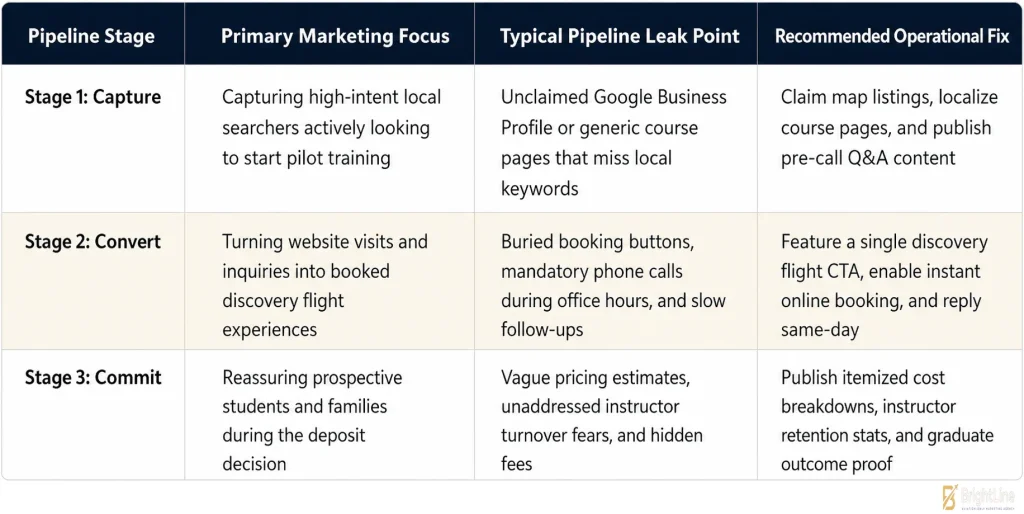
Paid search buys speed. SEO buys compounding demand. Conversion work decides whether either one pays off, and a school that skips it wastes both.
Fund conversion and follow-up before adding spend elsewhere. A school with a leaky booking path and slow replies turns every new dollar into a lost student. That is the trap behind flight school marketing that fills classes on paper and leaves empty seats in the aircraft.
Who This Enrollment Approach Is Built For
A flight school enrollment marketing pipeline rewards schools built to absorb demand and punishes schools that buy attention they cannot convert.
- Part 61 and Part 141 schools with a live discovery flight program. The pipeline assumes a bookable intro flight exists and runs consistently, since that is the enrollment event everything feeds.
- Schools in a metro with real competition. Map pack placement and rating-specific course pages only pay off when a searcher has three or four nearby options to compare.
- Schools recruiting international students. Visa timing and deposit risk demand admissions packaging, and a generic funnel leaves that segment unserved.
- Schools with instructor capacity to grow. A pipeline that delivers booked discovery flights is worthless if the schedule cannot hold another student.
- Schools treating certification paths as products. Understanding pilot certification regulations lets you build pages that answer real eligibility questions instead of generic course blurbs.
Three exclusions matter just as much. A school losing instructors to a nearby regional carrier has a retention problem, and marketing spend will not fix it. A school with no capacity to absorb new students will convert demand into waitlist frustration. Anyone shopping for a single campaign rather than a pipeline should look elsewhere. Schools that know how to choose a flight school from a student’s seat convert better, because they market the decision the prospect is actually making.
Diagnose your school with one question. Pull last month’s inquiries and count how many became booked discovery flights. If the ratio is healthy and the roster is full, you are a capacity school. If inquiries are plentiful and bookings are thin, the pipeline is leaking and this approach fits.
Book the Audit Before Your Next Class Starts
The pipeline framing matters because it changes what you fix first. A school that sees enrollment as a single campaign keeps buying traffic. A school that sees three stages starts hunting for the seam that leaks.
Every week the leak stays open, a prospect who typed your name into a phone books somewhere else. The seat fills. The inquiry list grows colder. Finding the leaking handoff this week costs nothing but an afternoon. Pull last month’s inquiries and discovery flight bookings. Map each one against the three stages. Fix the handoff losing the most students before your next class starts.
FAQ
Flight School Enrollment Marketing Questions, Answered
Is it true that 80% of flight students quit?
That figure gets repeated far more often than it gets sourced, and it conflates students who quit with students who pause training for reasons of money or weather. The real pattern is a stall after solo, when the hourly costs of cross-country time collide with a full-time job and the school goes quiet.
What is enrollment marketing?
Enrollment marketing is the work of moving a prospective student from first search to first flight lesson, then keeping them committed through certification. Flight school enrollment marketing adds a layer most generic marketing advice misses: the discovery flight functions as the actual buying decision, so the booking path matters more than the brochure.
What are some effective marketing strategies for increasing student enrollment?
Put the discovery flight in front of every visitor as the single action you want them to take, then answer the inquiry the same day it arrives. A prospect who calls two schools on a Saturday books with whichever one responds first, and the slower school never learns it lost.
What are some effective marketing strategies for airlines?
Airline marketing sells seats to travelers and runs on route networks, fare classes, and loyalty programs, which has almost nothing in common with recruiting a student pilot. Skip airline tactics entirely and study how flight schools fill a class instead.
What is the single biggest conversion lever in flight school enrollment marketing?
The single biggest lever is streamlining the discovery flight booking process with instant online scheduling and same-day follow-up. Removing friction between initial curiosity and getting the student into the cockpit converts search traffic far more effectively than extra ad spend.