
3 Signs You Need an MRO Marketing Consultant (and 1 to Wait)
TL;DR · The short answer5 key points
- An MRO marketing consultant translates Part 145 capabilities, airframe ratings, and AOG response into qualified work package inquiries.
- Hire when capability pages read like generic brochures, AOG calls rely solely on referrals, or cost per work package is unknown.
- Wait to hire if your shop cannot clearly define its Part 145 scope, airframe approvals, and turnaround intervals, or lacks hangar capacity.
- Vet potential consultants on Part 145 fluency, AOG routing tactics, and monthly reporting that tracks qualified leads over vanity traffic.
- A 180-day engagement delivers capability audits, airframe keyword roadmaps, search-optimized pages, and transparent lead attribution.
The dashboard says the site got traffic last quarter. The shop owner cannot name a single work package that came from it. That gap is usually when an MRO marketing consultant enters the conversation, and it should be a diagnostic decision, not a panic hire.
Plenty of agencies will sell a Part 145 shop a retainer and spend the first months learning what AOG means. That delay costs money. The harder problem is knowing whether marketing is even the right spend now.
This article gives you three operational signals that justify hiring a specialist, one condition that says wait, and how to read the difference. You’ll have a framework to apply to your own shop before you take a single sales call.
What an MRO Marketing Consultant Actually Does
An MRO marketing consultant is a specialist who turns Part 145 capability, airframe ratings, and AOG response into search visibility and qualified work package inquiries. The job is translation, not general promotion. A shop’s real assets live in its repair station certificate and its ops team’s heads, and the consultant’s work is getting those assets into a form a director of maintenance can find and trust.
Generalist agencies learn this industry on your retainer. They spend the first months asking what AOG means and what an airframe rating covers, and you pay for that education. A specialist arrives already fluent, which changes the questions asked in week one.
The work splits into four streams. Capability communication puts your approvals and turnaround intervals into plain language on the page. Airframe and approval search builds the paths operators use to find shops by type. AOG routing answers the grounded-aircraft query before a competitor does. Lead qualification filters tire-kickers from operators with a real work package.
Sign One: Your Capability Page Reads Like a Brochure
A director of maintenance does not read your capability page for reassurance. They read it to disqualify shops fast, and a page full of values statements gives them nothing to work with.

The page that kills the inquiry is the one that says safety comes first and quality is a tradition. Every competitor says the same thing, so the reader treats it as noise and moves on. What the operator needs is airframe ratings, engine types, OEM authorizations, and turnaround intervals.
Before routing a work package, that director verifies three things: your Part 145 scope, whether the airframe fits your approval, and how fast you can move on an AOG. The people who perform the work are only as good as the scope that authorizes them. If your site cannot confirm those facts, you are invisible at the exact moment a shortlist forms.
This is where aviation content marketing fails quietly. The copy is polished, the photos are clean, and the page never answers the one question that decides the call. Three shops get shortlisted. Yours is not one of them.
A brochure page tells the reader who you are. A capability page tells them whether you can take the job. Those are different documents, and only one of them produces work packages.
Sign Two: AOG Calls Come From Referrals Only
A shop whose phone rings only from people who already know it has a visibility problem, not a reputation problem.
Reputation is what happens after an operator finds you. Visibility is whether they find you at all. When every inbound call traces back to a relationship, the second one is broken.
- No AOG desk routing. A grounded aircraft needs a path to a human fast, and a site that buries contact behind a general form sends that operator to the next shop.
- No airframe plus interval search path. Buyers arrive with a tail number and a turnaround window, not a browsing mood.
- No urgent-query page. Nothing answers the grounded-aircraft question directly, so the search engine hands the query to a competitor who wrote it down.
- No one-minute capability check. A new operator wants to confirm Part 145 scope and airframe fit in under a minute. If that takes a phone call, you have already lost the comparison.
AOG buyers search with a part number and a deadline. The shop that answers that query wins the call, and the shop that does not never learns the call happened.
Referrals cap growth at the size of your network. Aviation SEO services exist to break that ceiling by putting capability in front of operators who have never met you. BrightLine Digital builds that visibility around urgent queries, which is where MRO company marketing either earns its keep or does not. Safety management maturity means nothing to a buyer who cannot find your shop. The SMS advisory circular guidance covers how operators run safety systems, and those same operators expect that discipline to show up in how you present capability.
Sign Three: You Cannot Name Your Cost Per Work Package
Ask a shop owner what marketing cost last year and you get a number. Ask what it produced and the room goes quiet. That silence is the third sign, and it is the most expensive one because it hides every other mistake.
The table below shows what a typical MRO can measure today against what a functioning MRO marketing consultant should put in front of you. Read it as a gap analysis, not a scorecard.
Closing that gap is the actual deliverable. A consultant earns the retainer by reporting monthly on traffic, rankings, and qualified leads, which is the same trio that lets you compare an aviation digital marketing agency cost against what it returns. BrightLine Digital reports on all three every month as part of its engagement model. If a proposal offers anything less, the gap stays open.
The One Sign That Says Wait Before You Hire
A capability gap is the one condition where an MRO marketing consultant cannot help you, because the problem sits in operations, not in search. If your team cannot state Part 145 scope, airframe ratings, and AOG response time without three internal emails, stop shopping for a consultant.
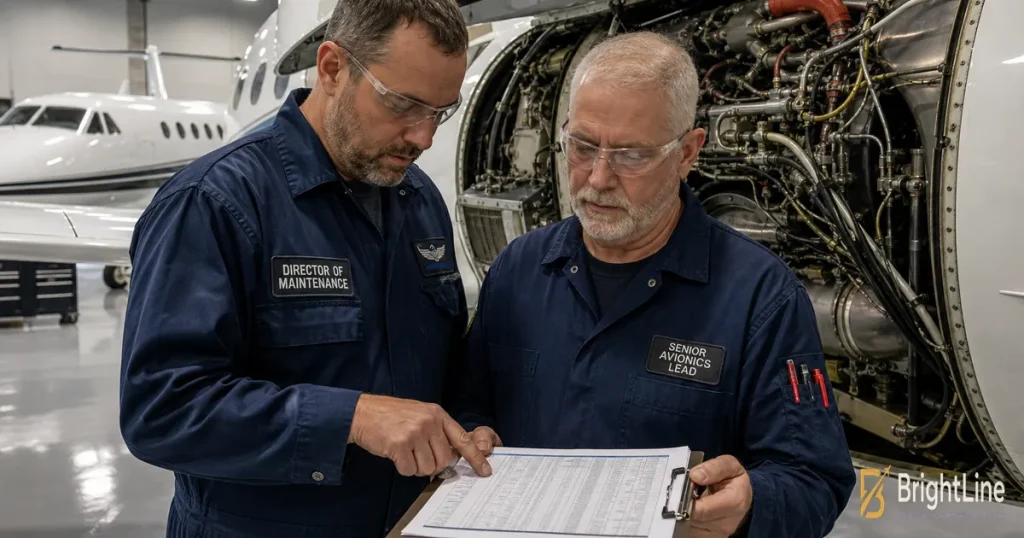
Marketing amplifies what already exists. A shop that answers “what do you actually approve” with a shrug has nothing for a specialist to translate into capability pages or airframe search paths.
A consultant who accepts a retainer before your scope is defined is selling activity, not outcomes. The right response is to send you back to operations with a list: ratings by airframe, engine authorizations, turnaround intervals, AOG desk hours. That work belongs to your director of maintenance, not to a retainer.
The second wait condition is capacity. A shop whose hangar is full through the next heavy check season should fix throughput before buying demand. Pouring aviation PPC management spend into a backlog produces frustrated operators and wasted budget, not growth.
Treat the wait as sequencing, not rejection. Define the capability, confirm the capacity, then hire. Shops that skip the order pay a consultant to market a version of themselves that does not exist yet.
How to Vet an MRO Marketing Consultant
Proposal decks are built to impress, not to reveal. These questions expose whether the person across the table has worked inside aviation or is learning it on your budget.
Step 1. Ask them to explain Part 145 scope and airframe ratings without a briefing document. A specialist answers in plain language and asks which airframes you hold approvals for. A generalist stalls, then emails a follow-up question they should have asked on the call.
Step 2. Ask how they route AOG inquiries. The right answer describes a search path built for grounded-aircraft urgency, with pages that confirm capability fast. The wrong answer is a homepage redesign and a blog calendar.
Step 3. Ask what lands in the monthly report. Traffic, rankings, and qualified leads belong in that report. Impressions and follower counts do not. A consultant who cannot name the lead metric before signing will not name it after.
Step 4. Ask which aviation businesses they have worked with, and call one. Shops that rank among the best aviation marketing agencies will hand over a reference without flinching. Hesitation is the answer.
Step 5. Ask what they would fix first and why. A specialist names a capability page or an airframe search gap. A generalist names a brand refresh.
Run these questions and the shortlist collapses fast. What remains is a consultant who can market your scope because they already understand it.
What a Specialist Consultant Delivers in the First 180 Days
A real engagement produces visible artifacts, not a strategy deck you file and forget. Each stage hands the shop something it can inspect.
Audit and Discovery Builds the Baseline
Discovery starts with a capability inventory: every airframe rating, engine type, OEM authorization, and turnaround interval the shop can support. The consultant then scans competitors ranking for the same airframe queries and records where the shop sits on traffic and rankings. Without that baseline, no later report can prove anything moved.
The Roadmap Names Which Airframes Come First
Targeting everything at once spreads thin resources across queries that never convert. A specialist sequences by revenue weight: the airframe families with the strongest demand, the approvals that differentiate the shop, and the AOG queries where urgency outweighs price. The roadmap is a ranked list, not a wish list.
Surgical Execution Ships the Pages That Answer Queries
Execution means capability pages rewritten around scope and fit, search paths that let an operator filter by airframe and interval, and paid search pointed only at high-intent queries. Every asset maps to a query an operator actually types under pressure.
Optimize and Scale Reads the Monthly Report
Reporting covers traffic, rankings, and qualified leads, and the shop should see all three every month. Expansion into adjacent airframes follows only once the first set proves it converts. BrightLine Digital runs this exact four-step process as an aviation marketing agency built only for aviation, and cites average organic traffic growth in as little as 180 days.
Read Your Own Signals Before You Read a Proposal
The three signals are operational evidence, and evidence does not care whether you are ready to hear it. A shop that treats them as a sales pitch will keep buying activity. A shop that reads them as a diagnosis will fix the thing that is actually broken.
The wait condition carries equal weight. A capability gap marketed hard produces inquiries your operation cannot answer, and a lost AOG call does not come back. Fix the scope, the ratings, and the response time first, then let an MRO marketing consultant build demand against a capability you can actually deliver.
Write your Part 145 scope, airframe ratings, and AOG response time on a single page. Set it beside your website. If the two do not match, you have your answer, and the mismatch is the work.
FAQ
Questions MRO Owners Ask Before Hiring a Consultant
What is MRO in marketing?
MRO stands for maintenance, repair, and overhaul, and in marketing the term describes the work of turning a Part 145 shop’s capabilities into search visibility and qualified work package inquiries. The confusion usually clears up fast once you realize the marketing job is translation, not promotion.
Who are the biggest MRO providers?
The largest names in the sector are the global heavy maintenance and engine overhaul houses that operate across multiple airframe families and hold broad OEM authorizations. Benchmarking against them is useful for one reason only: their capability pages show you exactly how scope and approvals should be presented to a buyer.
When should an MRO wait before hiring a marketing consultant?
A shop should wait when it cannot yet state its Part 145 scope, airframe ratings, and AOG response time in plain language. An MRO marketing consultant cannot market capability that operations has not defined, so fix the definition first and hire second.