Aerospace B2B SEO: How Suppliers Get Found by Engineers and Buyers
TL;DR · The short answer5 key points
- Aerospace buyers search by part number, airframe and certification, not by broad terms like “aerospace components”.
- Build one page per part family or airframe, with the part number in the title and the certification named in the opening lines.
- Put traceability details (8130-3, PMA status, OEM source) on the page, not in a PDF.
- Map pages to four searchers: the engineer, the procurement lead, the program manager and the AOG buyer.
- Judge the program on quote requests by part family, not on sessions.
A grounded aircraft does not wait for a brand campaign. The director of maintenance types a part number into Google, scans the first result that confirms the part and the paperwork, and calls that supplier. Aerospace B2B SEO is the discipline of being that result.
Suppliers lose this moment constantly. They build one capabilities page, stuff it with phrases like precision machining and aviation supplier, and wonder why the traffic never turns into a purchase order. The buyer never saw their part number.
This article shows how aerospace B2B SEO works when it’s built around part numbers, airframes, and certifications instead of broad industry terms. You’ll learn the page architecture that ranks, the certification signals that convert, and the metrics that prove the program is producing quote requests. It is part of our wider guide to aviation supplier marketing.
Why Aerospace Buyers Search Differently
Aerospace B2B SEO is the discipline of ranking for the exact part numbers, certifications, and airframe references that engineers and procurement teams type when an aircraft is grounded and a deadline is running.
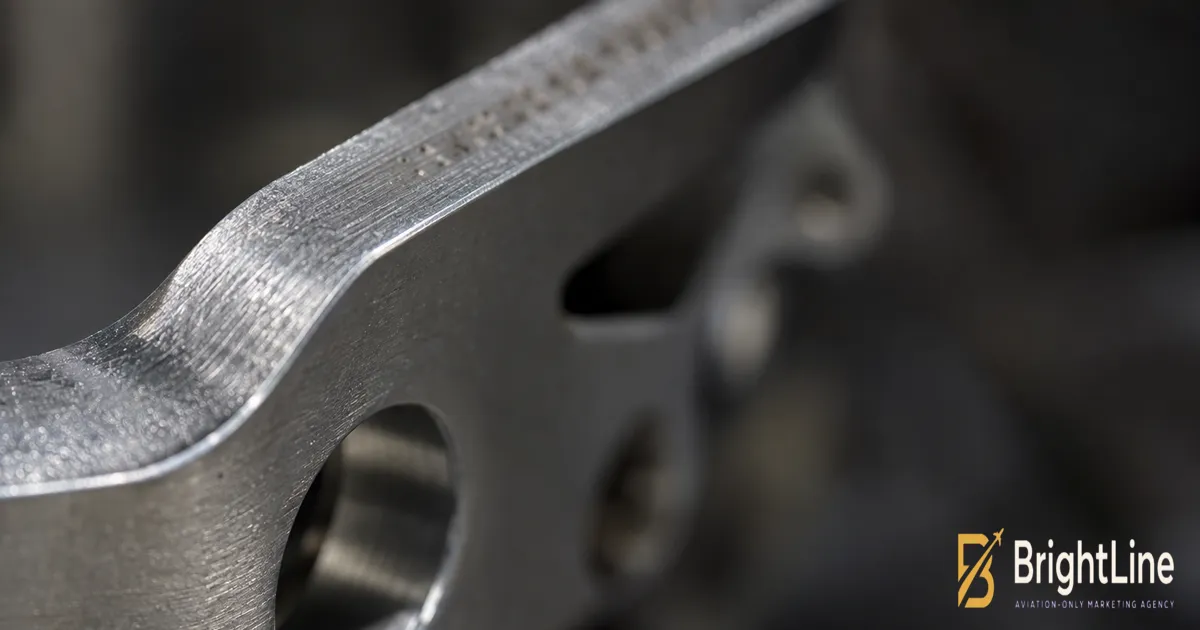

Generic B2B search behavior looks nothing like this. A software buyer comparing vendors over weeks reads reviews, books demos, and circles back. An aerospace buyer is matching a part to a spec sheet, and the tab closes the moment the page fails to confirm fit.
The person typing is often a director of maintenance or a supply chain lead working against an AOG clock. They need the part, the traceability paperwork, and the approval status visible on the first screen. A page that buries the spec under a mission statement loses the inquiry before the second scroll. The FAA’s Parts Manufacturer Approval rules matter here because buyers filter on whether a replacement part carries the right approval.
The ranking problem is a vocabulary gap, not a content volume problem. Suppliers write in the language of their own capabilities. Buyers search in the language of part numbers and airframe applications. That mismatch is where aviation search engine optimization decides who gets the call.
The Keyword Gap That Sinks Aerospace Manufacturer SEO
Broad industry terms are the default. Suppliers target “aerospace components,” “precision machining,” and “aviation supplier” because those phrases show obvious volume in keyword tools. The problem is who types them: engineering students, job seekers, and competing suppliers running their own research.
Technical queries look smaller and convert harder. A buyer searching a specific part number, an AS9100-certified supplier for a bracket, or a PMA replacement for a named component is not browsing. That query is a procurement step.
Keyword research has to center on technical terms, certifications, and niche applications rather than category labels. A phrase like “AS9100-certified supplier” tells you the buyer has already filtered for quality.
Generic approaches fail here because they optimize for the category, not the part, which is also why most aviation content marketing fails. A supplier site usually has one capabilities page trying to rank for everything, and it ranks for nothing a buyer actually types.
If the site has no page for the exact query, the supplier does not exist in that search.
Build Pages Around Part Numbers and Airframes
Aerospace B2B SEO produces quote requests only when the site has a page for the exact query a buyer types. Building that page set starts with a full inventory, the step nearly every supplier skips.

Step 1. List every part number, airframe, and certification the business can support. Treat each line as a page candidate.
Step 2. Build one page per part family or airframe application. Put the part number in the title, the spec in the first paragraph, and the certification by name. A page without the part number in the title rarely ranks for it.
Step 3. Add the traceability and paperwork details a procurement lead checks before calling. Name the 8130-3, the PMA status, and the OEM source on the page itself. Bury that in a PDF and the buyer leaves.
Step 4. Link related parts and airframes so the site reads as a catalog. A buyer sourcing a bracket wants to see the hardware that fits it. Isolated pages strand the visit.
Step 5. Keep the RFQ action within one click of every part page. A page without that path wastes the visit, and the buyer calls a competitor instead.
Finish the architecture and the site starts ranking for the queries that matter, then converting them. That catalog structure is the foundation of any serious marketing for aviation parts suppliers.
Certifications Are Ranking Signals and Trust Signals
A procurement lead who types AS9100 into a search bar is not shopping for a logo. They are checking whether your quality system covers the part on their desk. That distinction decides which supplier pages convert.
The certification phrase carries commercial weight because it filters, not because it decorates. The IAQG 9100 quality standard sets quality management system requirements for aviation, space, and defense organizations across the supply chain. Buyers search the phrase to narrow the field before opening a quote form.
Name the certification, the scope, and the certificate number directly on the part page. A scanned PDF buried behind a footer link does nothing for a buyer comparing three tabs at once.
Scope is where suppliers lose the inquiry. A certificate that covers machining but not surface treatment tells a buyer nothing about the bracket they need. State what the system covers in plain language, next to the part it applies to.
We work with aviation businesses only, so the certification vocabulary needs no translation. A team that already speaks AS9100, PMA, and 8130-3 skips the ramp-up a generalist agency bills for.
How Engineers and Buyers Actually Search
Four people land on your site from four search intents, each needing a different page. Treat them as one audience and the site serves none well.
The Engineer Confirming Fit and Function
An engineer types a part number plus a spec qualifier, often a dash number and a pressure rating. That page needs interchange data, dimensions, and material callout visible without scrolling.
The Procurement Lead Vetting a Certified Supplier
Procurement searches for a certified source with capacity, not a product. The query reads like a standard and a part category together. Your page must name the certificate, scope, and lead time before the buyer calls.
The Program Manager Mapping a Platform
Program managers search by airframe and platform, hunting a supplier who can support a build for years. A page listing every airframe you’ve supported, with parts tied to each, answers that. Pages that list capabilities in the abstract answer nothing, a mistake we also see in SEO for MRO companies.
The AOG Buyer Under the Clock
An AOG buyer searches for stock and shippability, with urgency language. That buyer needs a page confirming the part is on the shelf and trace paperwork is ready. One homepage cannot serve all four of these buyers.

What Aerospace B2B SEO Costs and What It Returns
Three routes sit in front of every aerospace supplier, and the invoice is the least useful way to compare them. The real cost hides in vocabulary the team has to learn before it can rank a single part number.
A generalist agency bills for strategy and then spends the first months learning what MRO, AOG, and Part 145 actually mean. You pay for that learning curve whether or not it shows up on the invoice. The table compares the routes on what drives cost and speed, since prices vary widely with catalog size.
| Route | Main cost driver | Time to first ranking movement | Knows certification and part-number vocabulary | What you manage internally |
|---|---|---|---|---|
| In-house marketing hire | Salary, tools and training | Slow, one person learning SEO and aviation | Partial, depends on background | Training, tools, and all execution |
| Generalist B2B agency | Retainer plus onboarding time | Delayed by onboarding on MRO and AOG terms | No, learns on your budget | Correcting misread part data |
| Aviation-focused SEO partner | Retainer scaled to page count | Faster, starts on part-number pages | Yes, from day one | Approving specs and RFQ flow |
An aviation-focused partner suits a supplier with a real catalog and a long buyer cycle. We report monthly on traffic, rankings, and qualified leads, which is the accountability that matters when quote volume is the true metric. Our aviation SEO services break down what that work covers, so an in-house team can see which parts it can run itself.
Measure Quote Requests, Not Sessions
Traffic dashboards flatter aerospace B2B SEO programs that are quietly failing. A supplier can double sessions and still book fewer RFQs, because the buyer cycle runs long and search volume on a single part number is thin. Judge the program on quote requests instead.
- Quote forms by part family. Segment submissions by the part family the buyer asked about, not by total form fills. A spike in bracket inquiries tells you which pages earn their keep.
- Calls from procurement leads. Track inbound calls and tag the ones where the caller names a part or airframe. Those calls are pipeline, and they rarely show up in a form report.
- RFQ value by source page. Tie each request to the landing page that produced it. A part page generating steady low-value quotes may matter less than one airframe page landing a platform contract.
- Ranking movement on technical queries. Watch part-number and certification terms, not head terms. A climb on a specific part query signals a buyer can now find you.
- Inquiries naming a part or airframe. Count the share of new inquiries that arrive with a part number or airframe already in hand. That share is also a sign AI assistants are citing your pages, which is the goal of answer engine optimization for aviation.
The Suppliers Who Get Found Are the Ones Who Named the Part
The supplier who wins the search is not the biggest name in the category. It is the one whose page says the part number, the airframe, and the certificate before the buyer has to ask. That is what aerospace B2B SEO actually rewards.
Every grounded aircraft is a deadline someone else is racing. The supplier with the named part already in the index gets the call, the RFQ, and the relationship.
Pull your catalog. Pick the part families with real demand. Build the first page this week, with the number in the title and the certification in the opening line. Then build the next one.
Our aviation supplier marketing team builds aerospace B2B SEO around your part numbers, airframes, and certifications so engineers and buyers find you first. Book a call to get a technical audit of your current rankings and page architecture.
FAQ
Aerospace B2B SEO Questions Buyers and Suppliers Ask
What are the top 5 SEO strategies?
For an aerospace supplier, the highest-return strategies are part-number pages, airframe-specific landing pages, explicit certification content, traceability documentation on the page, and a quote action within one click of every part. The fifth one is the one suppliers skip, and it turns a ranking into a phone call instead of a bounce.
How much does an SEO service cost?
Cost depends mostly on page count, because each part family needs its own spec, certification, and RFQ path. A focused build around a few part families costs far less than a full catalog architecture with ongoing content production, so ask for a quote scoped to your catalog.
Is SEO dead or evolving in 2026?
Search is evolving, and the change favors suppliers who publish exact technical detail rather than broad category pages. A buyer asking an AI assistant for a PMA replacement for a named component gets an answer built from whichever supplier actually documented that part on a page.
How long before an aerospace supplier sees ranking movement?
Part-number and certification queries often move faster than broad industry terms because competition on those exact phrases is thin. A well-built part-family page can start pulling impressions within weeks, while a competitive airframe term takes far longer to climb.