Marketing for Aviation Parts Suppliers: What Wins MRO Contracts
TL;DR
- Effective marketing for aviation parts suppliers focuses on proving airworthiness documentation, traceability, and AOG responsiveness directly on the page before an RFQ is submitted.
- MRO buyers treat part pages as risk assessments: state part condition, 8130-3 tag issuance, and approval basis (PMA vs. OEM) plainly to convert traffic into quotes.
- Structure your site into three distinct landing page types to capture different buyer intents: part-number pages for transactional speed, platform pages for technical research, and AOG pages for immediate emergencies.
- Address supply chain disruptions directly by publishing real lead times, approved PMA alternatives, and transparent receiving/quarantine quality procedures.
- Expand visibility beyond traditional ILS marketplaces by optimizing part pages for search engine indexing and AI summary citations.
A director of maintenance has a grounded aircraft, a part number, and a browser tab open. Your listing shows the item in stock. So does the other supplier’s. The contract goes to the one whose site answers the question underneath the question: is this part documented, approved, and will anyone pick up the phone right now?
Marketing for aviation parts suppliers is not catalog distribution. It is proving, on the page, that your paperwork survives an audit and your AOG line gets answered. Buyers qualify you long before the RFQ leaves their desk.
This article breaks down how to turn part pages, approval documentation, and AOG response into contract-winning assets. You’ll get a framework for the exact proof an MRO buyer checks, and where your current site fails it.
The Buyer Is Qualifying You Before the RFQ
Supplier qualification is the pre-RFQ research a maintenance buyer runs to decide whether a parts supplier is worth contacting at all. It happens in browser tabs and phone calls, long before a purchase order exists. For marketing for aviation parts suppliers, that research window is the whole game.
Catalog distribution assumes the buyer arrives ready to compare line items. The director of maintenance arrives running a risk assessment instead. They are asking whether your traceability paperwork survives an audit and whether you pick up when an aircraft is grounded in Tulsa.
That distinction reframes everything. A part page that lists a price but hides condition and approval basis answers the wrong question. The buyer moves to the next tab and never tells you why. The winning supplier makes the decision easy on the page. Condition stated plainly. Approval basis named. A phone number that reaches a human during an AOG event.
BrightLine Digital builds supplier marketing around how sourcing teams actually qualify vendors, not around generic B2B SEO playbooks. The difference shows up in what a buyer can confirm without sending an email.
Audit your own part pages against that test this week. If a buyer cannot verify documentation and response capability from the page alone, you are losing RFQs you never hear about.
Documentation Is the Product MRO Buyers Search For
Buyers searching for a part are often searching for a document. The part number gets them to your page; the paperwork question decides whether they stay, and each documentation angle below answers a different fear.
Traceability and the 8130-3 Tag
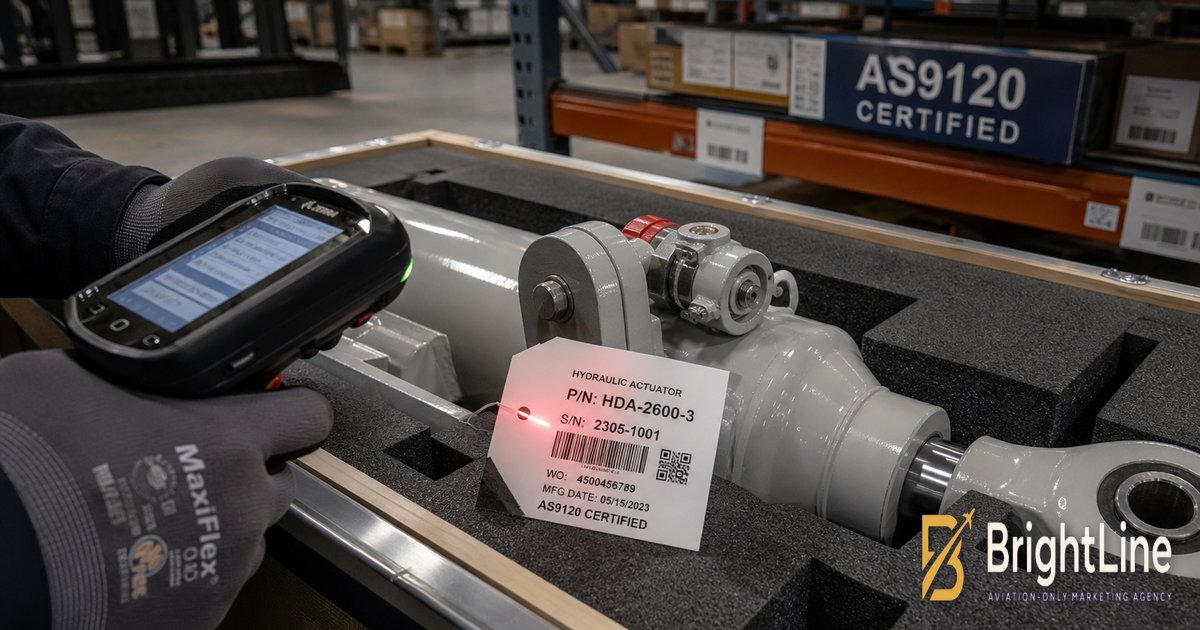
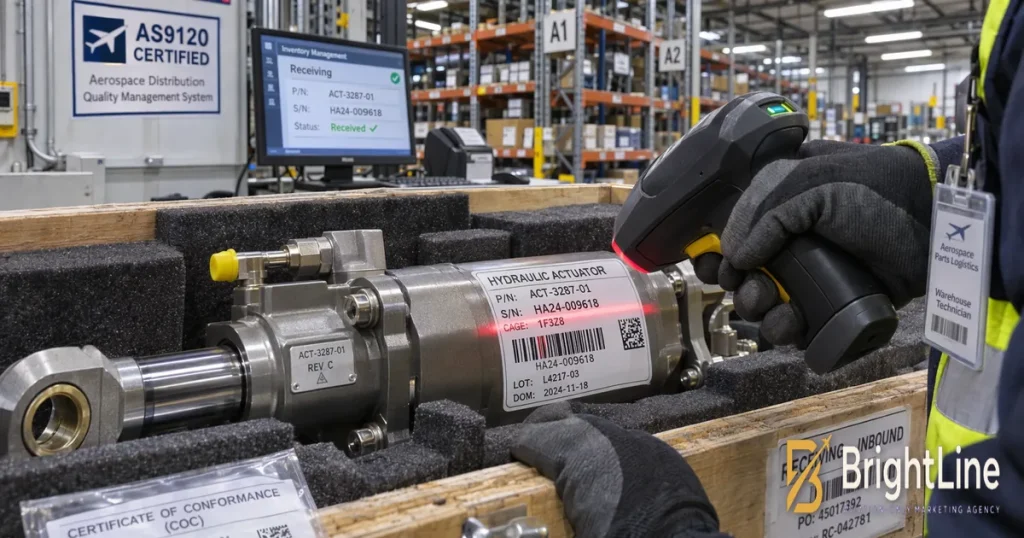
An airworthiness tag is the first thing a maintenance buyer looks for, and the second is who issued it. State on the part page that the unit ships with an 8130-3, name the issuing repair station, and link to its certificate. A buyer who has to email you to confirm traceability is already pricing your competitor.
PMA Versus OEM Approval Context
Buyers comparing a PMA alternative to an OEM part need the approval basis spelled out, not implied. Name the holder of the parts manufacturer approval, the eligibility list it covers, and the aircraft and engine models it applies to. Vague approval language reads as risk, not flexibility.
Suspected Unapproved Parts Exposure
Sourcing teams screen every new supplier for suspected unapproved parts exposure before they commit an order. Address it head-on: describe your receiving inspection, your quarantine process, and how you handle a part with a broken chain of custody. A supplier who names the risk openly signals a quality system that already manages it.
Distributor Accreditation and Your Quality Standard
The voluntary FAA distributor accreditation program gives buyers a recognized benchmark to check you against. Publish your accreditation status and the quality standard you operate under, such as AS9120, on the page itself. The FAA distributor accreditation standards give buyers a checklist; make sure your site answers it without a phone call. A buyer building an audit trail needs your quality system named in writing.
Part, Platform, and AOG Searches Need Different Pages
Three search behaviors feed a parts supplier’s pipeline, and they want opposite things from the page they land on. A part-number query wants speed. A platform query wants context. An urgency query wants a phone number. Treat them as one audience and you serve none.

A part-number search is the closest thing to a purchase signal you’ll get. The buyer already has the NSN or manufacturer part number and wants availability, condition, and price without a scavenger hunt. Put the number in the title, the stock status above the fold, and the price or a lead time where the eye lands first. Hide any of that behind a form and the buyer clicks the next result.
Platform searches carry the research phase. Someone typing a specific aircraft type wants to know what fits, what interchanges, and whether an approved alternative exists. That page needs fitment context and interchangeability notes, not a wall of part numbers with no relationship to the airframe.
Urgency searches are their own animal. An aircraft on ground situation compresses the decision to minutes, and the buyer calls whoever loads fastest with a visible phone number and live stock status. A slow AOG page loses the call before the buyer reads a single spec.
One generic catalog page fails all three. It buries the part number in a filter, skips fitment context, and puts the phone number in a footer. Distinct pages per intent capture the RFQ at the exact moment the buyer decides. BrightLine Digital’s aviation SEO services are built around this split, so each page earns its own citation when buyers ask AI. Part-number pages win the transactional buyer. Platform pages win the researcher. AOG pages win the grounded aircraft.
What Most Aviation Parts Marketing Gets Wrong
The standard B2B approach optimizes for traffic when MRO buyers are running a qualification test. Sessions climb, RFQs stay flat, and nobody can explain the gap. The gap is the approach itself.
Traffic metrics feel safe because they’re easy to report. A marketing dashboard full of visits looks like progress until a director of maintenance bounces off a page that never answered the one question that mattered.
Before: A supplier publishes a thin catalog with part numbers and little else. Pricing and lead times sit behind a contact form, and certification language hides in a downloadable PDF. The team celebrates a jump in sessions while qualified RFQs stay flat, because the buyer who needed an approval basis found nothing to trust.
After: The same supplier publishes availability and condition up front, states approval status plainly on the part page, and splits routine RFQs from urgent ones with separate response paths. Success gets measured in qualified RFQs, not visits. The buyer who lands at midnight finds proof instead of a form.
The contrast exposes what the page is actually for. A catalog page exists to show inventory. A proof page exists to survive the buyer’s audit before the first call. Suppliers who stay fluent in Part 145 buyers build the second kind.
Marketing for aviation parts suppliers succeeds when the page answers the qualification question, not when it ranks for a keyword. The supplier who treats the page as promotion loses to the one who treats it as evidence.
Marketing for Aviation Parts Suppliers in a Disrupted Chain
A backordered OEM part is a marketing moment, not just a procurement delay. How a supplier behaves when the shelf is empty decides whether the buyer comes back when it isn’t.
- Publish real lead times. A buyer can plan around a stated date. A vague “contact us for availability” sends the RFQ to a competitor who committed.
- Offer approved alternatives. When the OEM part is months out, name the PMA equivalent and explain its approval basis on the page. The buyer still needs a defensible answer for the audit trail.
- Keep AOG reachable. A grounded aircraft does not wait for a web form. The AOG phone line and stock status have to be visible and answered by someone who can quote.
- Use ILS without ghosting. Marketplace listings extend reach, but stale inventory erodes trust fast. A buyer who calls on a listed part and finds it gone does not return.
- Update existing accounts first. Proactive status notes to current customers cost nothing and protect the relationship when new buyers are getting the same bad news.
Every move trades a short-term advantage for a long-term one. Hiding a delay might keep one order alive this week. Naming it keeps the account for years.
The supplier who told the truth when parts were scarce is the one the buyer calls when they aren’t. That reputation is built through targeting MRO buyers where they search, and it compounds long after the shortage ends.
Where Buyers Find Parts Distributors Now
A distributor with a strong ILS storefront and nothing else is renting its pipeline from a platform it does not control. Sourcing has split into three channels, each rewarding a different kind of visibility.
Marketplace platforms remain the comparison layer. On ILS, a buyer lines up inventory, condition, and price across several distributors in one screen, making the listing a price check as much as a discovery tool. Useful for reach. Dangerous as a foundation.
Search engines capture the buyer who already has a part number or an aircraft type in hand. That query lands on a page, not a marketplace, and the supplier whose page answers it owns the click without paying a platform for the introduction.
AI assistants are the newest channel and the least forgiving. A director of maintenance asks one plain question and receives a short list of shop names, drawn from whatever the model can find and trust. Being absent from that answer is the same as not existing.
Marketing for aviation parts suppliers has to cover all three surfaces at once. BrightLine Digital treats aviation AI overview optimization as the discipline of earning the AI citation through structured, verifiable page content, not luck. The supplier cited in that short list gets the call. Marketplace visibility can be bought this quarter. Search and AI visibility compound, and the supplier who starts building it now becomes the default answer before competitors notice the channel moved.
Turning Qualified RFQs Into Repeat MRO Contracts
Winning the RFQ is the easy half. The supplier who treats the quote as the end of the sale loses the account to whoever handles the follow-through better.
Step 1. Answer inside the buyer’s urgency window. An AOG buyer awards to whoever replies first with a real answer, not a promise to check stock. A reply naming the part, condition, and ship time wins.
Step 2. Attach the documentation package with the quote. Send the 8130-3 tag, traceability chain, and approval basis in the same email. Buyers who ask for paperwork twice wonder what else you’re holding back.
Step 3. State condition, approval basis, and warranty terms plainly. New, overhauled, serviceable, or as-removed belongs in the first line, not a footnote. Ambiguity reads as risk, and risk gets priced against you.
Step 4. Follow up with a reason to consolidate. Offer standing quotes, stock visibility on recurring part numbers, or a scheduled availability report. A buyer juggling four suppliers will consolidate with the one who makes their week simpler.
Step 5. Capture the buyer in a CRM before the next call. Log the part numbers, the aircraft platform, and the contact’s urgency pattern. When their next AOG hits, your team already knows what they fly and how fast they need it.
A solid aviation content strategy feeds this loop, because every page that proves your documentation and response speed shortens the next qualification cycle. The first contract is won on proof. The second is won on reliability.
Build the Page That Survives the Buyer’s Audit
A buyer’s audit does not happen in a conference room. It happens on your part page, in the gap between what the buyer needs to verify and what you bothered to publish. Marketing for aviation parts suppliers is that gap, closed. Close it and the RFQ arrives pre-qualified, with the buyer already half-convinced. Leave it open and you compete on price against suppliers who did the work you skipped.
Run the audit this week. Take your top part page and your top platform page. Check them against the four things a maintenance buyer verifies: traceability, approval basis, unapproved-parts controls, and AOG reachability. Fix the weakest one first. Then fix the next.
FAQ
Questions Parts Suppliers Ask About Winning MRO Work
Where can I find distributors of aviation parts?
Sourcing teams locate parts distributors through three channels: marketplace platforms where inventory and price sit side by side, search engines where a buyer types a part number or aircraft type, and AI assistants that return a short list of supplier names. The channel that surprises suppliers is the third one, because an assistant citing your competitor’s part page never shows the buyer your listing at all.
What are some effective marketing strategies for aviation businesses?
Effective marketing for aviation parts suppliers centers on publishing documentation, approval status, and availability directly on part and platform pages instead of hiding them behind a contact form. A buyer comparing two suppliers will trust the one whose page states condition and approval basis without a follow-up email, even when the other supplier quotes lower.
What do MRO buyers check before they send an RFQ?
Buyers verify four things before an RFQ leaves their desk: airworthiness documentation, approval basis, quality system accreditation, and whether the supplier answers an urgent inquiry. The check that eliminates the most suppliers is the last one, since a page with no visible after-hours contact path reads as a supplier who disappears when an aircraft is grounded.
How should a parts supplier handle AOG inquiries online?
An AOG inquiry needs a dedicated response path with a phone number and current stock status visible on the landing page, separate from the routine quote form. Routing urgent requests into the same queue as standard RFQs is how suppliers lose the call, because the buyer dials whoever answers first and stops there.