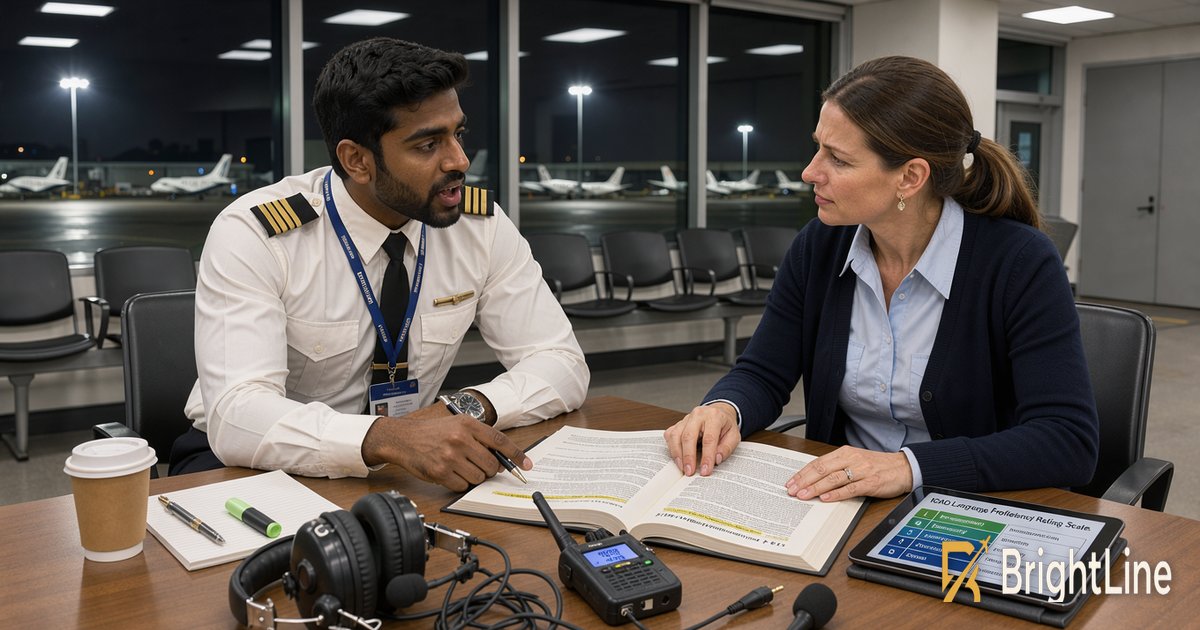
English Proficiency Requirement for Flight School: ICAO Level 4 vs. Airline Minimums
TL;DR
- The English proficiency requirement for flight school is a functional baseline checked during practical checkrides, not a formal academic paper test.
- Three distinct standards govern your path: the FAA functional bar (14 CFR 61.153), ICAO Level 4 (international licensing floor), and airline hiring minimums.
- ICAO Level 4 rates six specific areas including pronunciation and comprehension, whereas airline recruiters evaluate radio discipline and crew communication under pressure.
- Weak English inflates total flight training costs by delaying checkride oral exams, extending ground school, and causing repeated flight briefings.
- Train toward the specific bar your final career goal enforces rather than assuming an FAA certificate clearance automatically satisfies airline recruiters or foreign licensing bodies.
A passed English test at a flight school admissions desk means almost nothing at an airline interview. The English proficiency requirement for flight school is the first bar a student clears, and it is the lowest one they will ever face. Applicants treat that clearance as a finish line. It is a starting gate, and the gap between it and an airline’s hiring standard is where careers quietly stall.
Three separate authorities set three separate bars. Each one measures something different, and clearing one tells you nothing about the others. This article breaks down all three, shows what each actually tests, and gives you a way to decide which bar governs your path before you spend money chasing the wrong one.
Three English Bars, One Pilot Career
Chasing the highest English standard you can find is how applicants waste a year. The smarter move is identifying which of three bars your career goal requires, then training to that one.
Each bar answers to a different authority. The FAA certificate standard sits under federal pilot certification rules and governs whether you can legally fly a US-registered aircraft. ICAO Level 4 governs international licensing and foreign conversions, set by a body with no say over your US certificate.
Airline hiring minimums sit above both, and no regulator controls them. A recruiter at a regional carrier screens for radio discipline and crew communication under pressure, a behavioral read, not a certificate check.
Clearing one bar does not clear the others. A student who passes the FAA practical standard with a designated examiner can still fail an airline assessment day on phraseology. The three standards measure different things, and passing one tells you nothing about the next.
This is where flight school admission requirements get misread. A school states its English policy, the applicant treats that policy as the full standard, and the gap between what the school enforces and what the airline expects stays invisible until hiring season.
Figure out your end goal first. A US-only private certificate points at the FAA bar. A foreign license conversion points at ICAO. A cockpit job at a scheduled carrier points at the hiring bar, the highest and least documented of the three. Aiming above your goal costs time and money you did not need to spend. Aiming below it costs a rating, or an assessment day you cannot get back.
What the FAA Actually Requires of You
The FAA Aviation English Language Standard is the ability to read, speak, write, and understand English well enough to operate an aircraft safely. It is a functional bar, not a linguistic one. The regulation behind it, 14 CFR § 61.153(b), asks whether you can communicate in a cockpit, not whether you can write an essay.
Applicants misread this as a medical hurdle. It is not. The FAA’s advisory circular on the Aviation English Language Standard places the requirement under Flight Standards, so your aviation medical examiner has no authority over it. A student can walk out with a valid medical certificate and still fail to meet the English proficiency requirement for flight school.
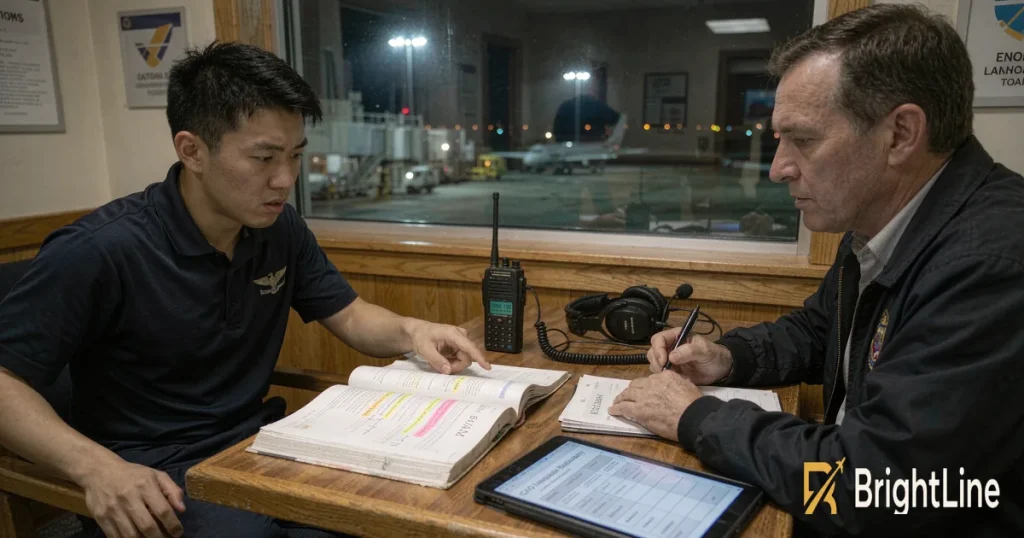
The assessment happens in the room, not on paper. A designated pilot examiner listens to you brief a maneuver, read back a clearance, and answer questions during the oral portion of a checkride. Grammar errors rarely sink anyone. A student who says “cleared for takeoff runway two seven” with a thick accent passes. A student who cannot understand the examiner’s question about density altitude does not.
That distinction changes how you prepare. Memorizing vocabulary lists wastes weeks. Flying with an instructor who speaks only English, taking radio calls yourself from the first lesson, and reading the FAR/AIM aloud builds the exact skill the examiner tests. Functional comprehension beats formal study every time. Know which bar you’re clearing before you book a discovery flight. The FAA wants a pilot who understands instructions. Nothing more.
ICAO Level 4: The Licensing Bar Explained
ICAO Level 4 is the floor for flying internationally, and it is a working level, not a fluency badge. The English proficiency requirement for flight school in the US never touches it. A student can pass every FAA checkride and still fail a foreign license conversion on this bar alone. ICAO splits language ability into six scored areas. Each is rated separately, and the lowest score caps your overall level.
- Pronunciation. A controller has to understand you on the first transmission, in noise, without asking you to repeat. Accent is fine. Unclear delivery is not.
- Structure. Basic grammar has to hold up under pressure. You do not need perfect tense, but a scrambled sentence during an emergency readback gets flagged.
- Vocabulary. Standard phraseology covers routine calls. Level 4 also expects plain-language words for the non-routine situation nobody scripted.
- Fluency. You cannot stall mid-sentence hunting for a word. Pauses that break communication count against you.
- Comprehension. Understanding a fast, accented controller matters more than speaking well. This is where strong students get caught.
- Interactions. The examiner checks whether you can keep a two-way exchange moving. A pilot who only reads back scripts fails here.
Overall effective implementation of these language proficiency requirements has varied across ICAO member states, which is part of why the assessment can feel inconsistent from one country to the next. Level 4 also expires and must be revalidated on a cycle, so a rating earned once is not a rating held forever.
The trap is assuming FAA compliance travels. A pilot planning an FAA to GACA conversion will likely face a formal ICAO language proficiency assessment the FAA never required. Confirm the licensing authority’s testing rule before you book the conversion.
Where Airline Minimums Sit Above Both
A regulator certifies you to fly. An airline decides whether you can fly its airplane, its routes, its passengers. Those are different tests, and the second is where most international cadets discover the gap.

The FAA bar is a floor you clear once and rarely revisit. An examiner listens to you brief a maneuver and answer questions, then signs the certificate. Nobody re-tests your English at the next rating unless something goes visibly wrong.
ICAO Level 4 works the same way. A language assessment confirms you can handle routine and non-routine radiotelephony, then your license carries the endorsement. It measures operational survival against a published scale, and it sits above the FAA’s own baseline standard that every US certificate holder already meets.
Airline hiring flips the logic. Recruiters watch how you handle a stressed captain, a garbled clearance, a diversion call at the end of a long duty day. They want radio discipline that sounds native to the frequency, not merely correct. A pilot with a clean certificate and a valid Level 4 can still walk out of an assessment day without a job offer.
None of this is codified in a regulation. Airlines build their own simulators, group exercises, and interview panels. The standard lives in the heads of the people running the day, and it shifts with the market.
Train toward the airline bar if a cockpit job is the goal. The certificate and the license are entry tickets. Communication under pressure is what gets you hired, and it is the only one of the three bars nobody hands you a syllabus for.
ICAO Level 4 vs. Airline Minimums Side by Side
Three standards govern a pilot’s English, and they are not graded on the same scale. One is a pass/fail floor, one is a licensing tier, and one is a hiring preference with no public rubric. The comparison below shows where each bar is set and who enforces it.
| Standard | Governing Body | Primary Focus | Assessment Method | Cost of Falling Short |
|---|---|---|---|---|
| FAA Certificate Standard | FAA Flight Standards | Functional cockpit safety (read, speak, write, understand) | Instructor review and DPE checkride oral exam | Certificate withheld until standard is met |
| ICAO Level 4 | ICAO Member States | Licensing floor across 6 core linguistic areas | Formal language proficiency examination | Foreign rating conversion restricted or denied |
| Airline Hiring Minimums | Individual Airlines | Crew interaction and radio discipline under stress | Interview panels, simulator assessments, group drills | Not hired with no appeal process |
Regulators test a floor. Airlines test a ceiling. A pilot can hold a valid certificate and a current Level 4 and still lose an assessment day on radio discipline. English proficiency is a Flight Standards matter, not a medical one, per FAA medical certification guidance. Clearing the certificate bar says nothing about the hiring bar.
The table hides the part that costs money. Airline minimums are not published as a number, so recruiters screen accents and radio fluency in the interview itself. You can pass ICAO Level 4 and still lose the job at the sim assessment.
Treat the airline bar as the target from day one. Train your radio calls until they are automatic, because a hiring captain listens for hesitation on frequency, not a certificate in your folder.
Can You Train With Weak English?
Weak English rarely stops a student from starting. It taxes every stage of training after the first flight lesson, and the bill arrives in repeated lessons and delayed checkrides. The costs cluster in five places, and each one compounds the next.
- Ground school comprehension. Written exams assume you can parse dense regulatory language quickly, and slow reading turns a six-week course into a semester.
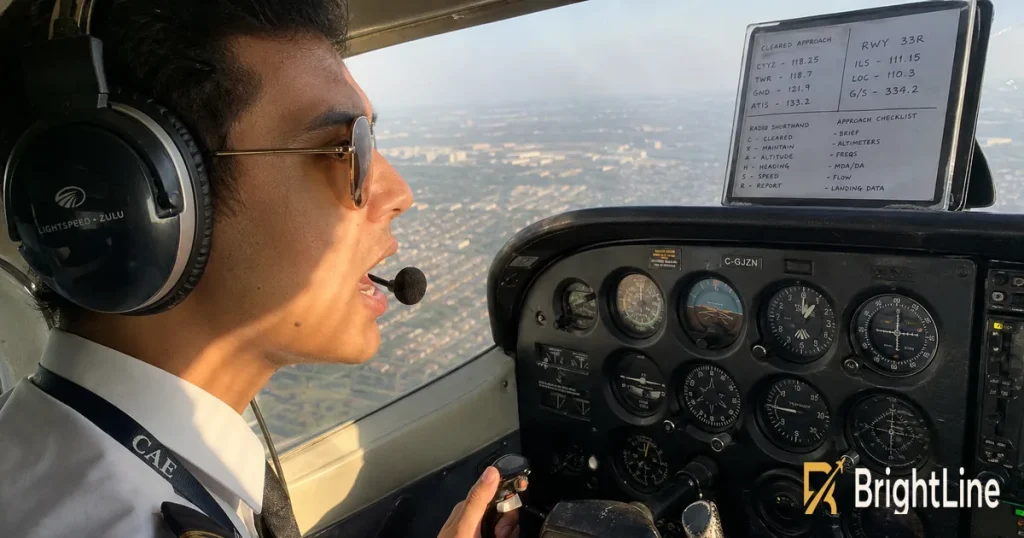
- Radio calls with ATC. Controllers speak fast and expect readback the first time, so a student who hesitates loses clearance and airspace confidence.
- Checkride oral exams. Designated examiners question you live, and a weak answer on regulations reads as weak knowledge, not weak language.
- Instructor debriefs. Post-flight feedback moves quickly, so a student who misses nuance repeats the same error on the next sortie.
- Written test instructions. Miss a qualifier in a question stem and you answer the wrong question correctly.
The hidden cost is repetition. Every misunderstood brief adds a flight hour, the most expensive line on the invoice.
Nearly every school training foreign nationals is certificated under 14 CFR 141 because immigration rules require foreign students to attend accredited providers. Many schools now require a Level 4 English Language Certification before enrollment, per FAASTeam foreign student guidance. Arriving with weak English and hoping to improve in-country is the expensive path. Schools handling international flight school admissions see this pattern constantly.
Which English Bar Should You Train For?
Aiming higher than your goal requires is its own mistake. Students who grind toward airline-level English before a private certificate burn months they could have spent flying.
Match your training to the bar your end goal enforces. If a US certificate is the plan, the FAA standard is your target. If you intend to convert to a foreign license, add ICAO Level 4 preparation. If a cockpit job at a scheduled carrier is the goal, train toward airline minimums from day one.
Aiming too low costs a rating or a failed assessment day. A student who clears the FAA bar, converts a license abroad, then discovers the foreign authority wants a formal Level 4 endorsement pays for that gap in retesting and delay. The reverse error is quieter. A private pilot who spends a year on airline-style communication drills before soloing has delayed a certificate they could already hold.
Flight schools carry part of this burden. When admissions pages blur the FAA, ICAO, and airline standards into one vague “English required” line, international applicants guess wrong. BrightLine Digital’s admissions packaging work exists to fix exactly that, presenting each standard on its own terms so applicants arrive knowing which bar they’re clearing.
Harmonized oversight guidance for language proficiency testing treats assessment consistency across countries as the core problem, not the standard itself. Before you commit to a school, ask which standard its admissions process checks. The answer tells you whether you’re preparing for a certificate, a conversion, or a career.
Pick Your Bar Before You Pick a School
The English proficiency requirement for flight school is a filter you apply to schools, not a formality you clear on the way in. Ask which standard a program actually enforces before a deposit leaves your account.
Skip that question and you buy a seat that leads nowhere. A school prepping students for a US certificate alone will not build the ICAO assessment file a foreign license conversion demands. One phone call now beats a wasted rating later.
Call the admissions office and the recruiting desk at your target airline in the same week. Ask each to name the standard in writing. Then choose the school that trains to the higher of the two.
FAQ
English Proficiency Questions Pilots Ask Most
What are the FAA requirements for English proficiency?
An applicant for a pilot certificate must be able to read, speak, write, and understand English well enough to operate safely. That standard is assessed during practical interaction with instructors and examiners, not through a standalone language exam at most schools.
Can I be a pilot if I’m bad at English?
Weak English won’t block a certificate outright, but it raises the risk of failing a checkride oral exam or misreading a clearance. A student who can’t parse a controller’s rapid instruction in a busy pattern is a safety problem, not just a slow learner.
Do you need to speak English to become a pilot?
Yes, English is mandatory for any FAA certificate and for international operations under ICAO rules. Radio communications worldwide default to English, so a pilot who can’t speak it can’t legally or practically fly most routes.
How does ICAO Level 4 differ from an airline’s English minimum?
ICAO Level 4 is a licensing floor that proves you can communicate in routine and non-routine situations. An airline’s minimum sits higher, screening for clear crew interaction and radio discipline under real pressure, which no regulator formally tests.