
How to Get Cited by ChatGPT as an Aviation Brand When Buyers Ask Before They Call
TL;DR
- Learning how to get cited by ChatGPT as an aviation brand is a pre-call sales priority because buyers qualify MROs, flight schools, and charter operators via generative AI before making contact.
- Standard ChatGPT relies on static training data and brand associations, whereas ChatGPT Search retrieves live, crawlable web pages in real time.
- Generative AI systems heavily weight third-party corroboration (trade press, directory listings, association profiles) over claims made on owned homepages.
- Citability happens at the passage level: clear, self-contained, fact-dense claims are far easier for models to extract than generic marketing copy.
- Citation success manifests as higher-quality inquiries and improved sales conversion rates rather than traditional website traffic metrics.
Treating ChatGPT citation as a content marketing metric will cost an aviation brand real RFQs. How to get cited by ChatGPT as an aviation brand belongs to sales, not the blog calendar, because the answer arrives before the buyer reaches your site.
A director of maintenance with an aircraft on the ground asks a chatbot which shops can turn an AOG around. Two names come back. Yours is not among them, and no form submission tells you the lead existed. That gap sits upstream of every funnel report you own.
This article shows how the retrieval layer picks winners and the exact sequence that puts an aviation brand inside the answer. You’ll finish knowing what to fix first and how to measure a win your analytics will never show.
The Buyer Who Never Fills Out Your Form
A director of maintenance is standing on a ramp with an AOG aircraft and a passenger list. He types one question into ChatGPT: who can turn this part around fastest. Three shop names come back. Yours is not one of them.
That answer just eliminated you from a deal you never knew existed. The aviation buying cycle has moved earlier, before the phone call, before the RFQ, before the website visit. A survey of 632 B2B buyers conducted in August through September 2024 found most buyers prefer to carry out independent research through digital channels rather than talking to a rep. Aviation compresses that shift. A charter buyer comparing operators on a Tuesday is not browsing. They are qualifying, and the shortlist forms in minutes.
Citation is a pre-call sales problem. Treat it as a content vanity metric and you will keep publishing blog posts while the shortlist closes without you. The question a buyer types is the first sales conversation, and a model is answering it.
This is why the problem looks different in aviation. Route authority, AOG response windows, international student approvals, PMA parts eligibility. These are narrow, technical, high-stakes questions with a small set of credible answers. A generalist agency optimizing a flight school the way it optimizes a SaaS brand will miss every one of them. BrightLine Digital works aviation only, the difference between guessing at the questions and knowing them.
ChatGPT Search and Standard ChatGPT Are Not the Same
Two systems sit behind the same chat box, pulling from completely different sources. Standard ChatGPT answers from static training data. ChatGPT Search retrieves live pages from the web. An MRO that treats these as one channel will optimize for the wrong one and wonder why nothing changes.
Standard ChatGPT draws on training data, which encodes which brands are associated with which topics based on how often and how authoritatively they appear across the web. It rewards years of accumulated presence: trade press mentions, association listings, consistent naming across directories. It cannot see a capability page you published last month. If your brand was never strongly associated with a topic during training, no amount of fresh content fixes that quickly.
ChatGPT Search retrieves pages at the moment of the query, so a page published this week can earn a citation today. That matters for an MRO that just added a new engine line, or a flight school that just earned a new international approval. The catch: retrieval rewards pages that are technically accessible and cleanly quotable. A live page with the right answer buried in paragraph six still loses.
For a brand with a new capability and no training-data footprint, Search is the faster path. For a brand with deep industry presence but thin on-site content, standard ChatGPT already knows you. The work splits accordingly: retrieval optimization for the first, corroboration for the second. Get the sequence wrong and you spend a year on the wrong system.
Why Your Own Website Rarely Wins the Citation
Your homepage is the least persuasive document in the room. Aviation brands spend heavily on owned pages and almost nothing on the independent confirmation that generative systems actually weigh. Publishing more content on your own site is not, by itself, a reliable path to ChatGPT Search citations.
Generative search systems favor an answer they can corroborate. A brand-owned page is one voice making a claim about itself. A trade publication profile, an industry association listing, or coverage in an outlet the brand does not control is a second, independent voice confirming the same claim. A system weighing which answer to trust has a reason to prefer the second kind.
The mechanism is simpler than the algorithm. A model assembling an answer needs independent confirmation that your brand belongs in it. A page you wrote about yourself is a claim. An AOPA feature, a trade publication profile, or an industry association listing is corroboration. One carries weight. The other reads like a press release.
Flight schools feel this most sharply. A school with a strong international admissions page but no third-party coverage loses the citation to a competitor with thinner content and a directory presence. The model is not grading your prose. It is checking whether anyone else vouches for you.
This is where AEO for aviation businesses diverges from generic SEO advice. Directory listings, association memberships, and trade press mentions are not vanity items. They are the citation layer. Third-party corroboration does more citation work than any page you own.
Skip that layer and you can publish weekly for a year without entering a single answer. The work happens off your domain, and most aviation marketing budgets have no line item for it.
How to Get Cited by ChatGPT as an Aviation Brand
Four moves separate an aviation brand that gets named from one that stays invisible. The sequence matters, because skipping a step breaks the chain that leads to a citation. Here is the order, with the cost of each shortcut spelled out.
Step 1. Make your site retrievable before anything else. AI crawlers hit the same walls that block search bots: blocked scripts, login-gated pages, and content that only renders after a click. Fix the technical access first, because a page no crawler can read cannot be quoted no matter how good the writing is.
Step 2. Write passages that answer one aviation question completely. A model extracts a self-contained block, not a page. If your international student answer sits in paragraph six behind a mission statement, it never gets lifted.
Build each section as a standalone answer a reader could quote without context.
Step 3. Build off-site corroboration through trade press and directories. Independent confirmation carries weight a homepage cannot. Skipping this leaves the model with only your own claims to weigh, and it discounts them.
Step 4. Publish operational detail worth citing. Real turnaround windows, capability specifics, and approval status beat marketing copy every time. The practical path to earning ChatGPT citations runs through these four parts, and steps 2 and 4 are where most aviation brands stall.
BrightLine Digital’s aviation content strategy service handles those two steps without a learning curve. Finish the sequence and your brand enters answers it was absent from, before the buyer ever calls.
Citability Lives at the Claim Level, Not the Page Level
A page can rank, read well, and still be invisible to a model that never finds a sentence worth lifting. Extraction happens at the passage level. The model pulls a paragraph, not a page, and judges that paragraph alone.
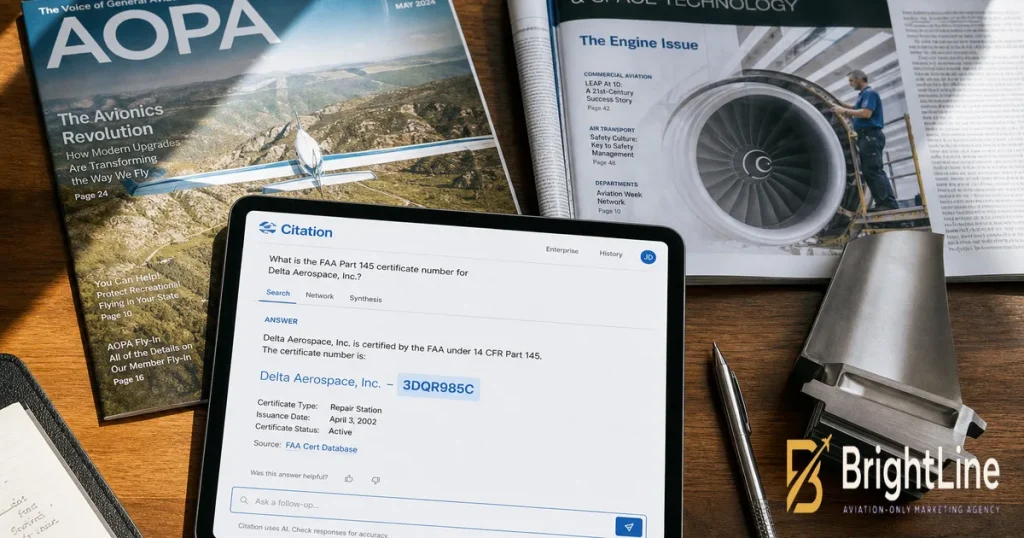
Mission statements feel safe to write. They commit to nothing, offend no one, and pass a brand review in minutes. That safety is the problem, because a paragraph with no fact gives the model nothing to quote.
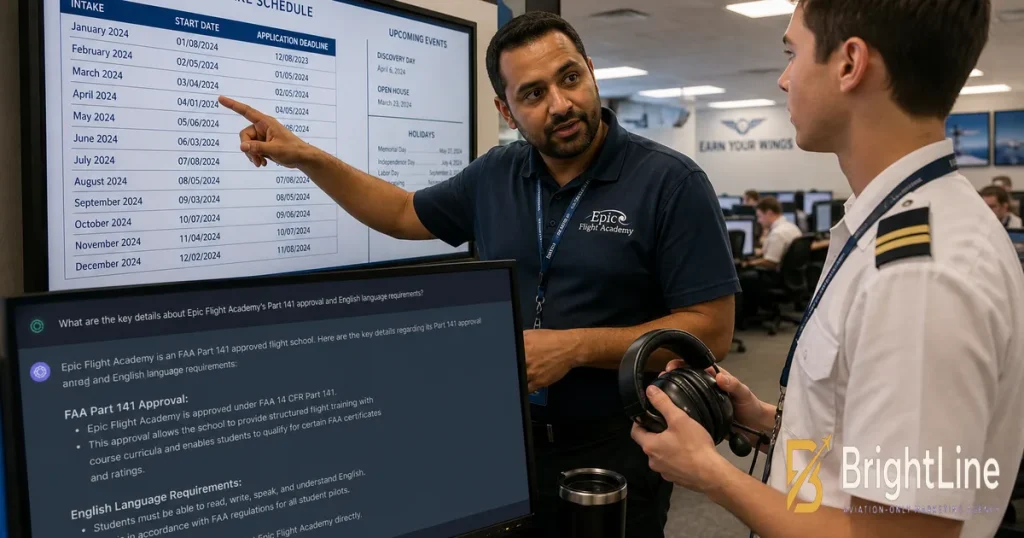
Before: A flight school homepage opens with a paragraph about passion for aviation and a future in the skies. The international student answer sits in paragraph six, under a vague heading, with no tuition figure and no start date. A model scanning that page finds no self-contained claim to extract, so it cites a competitor instead.
After: The same page leads each section with one question and answers it completely in a single block. The international student section names the school, states the approval it holds, and gives the intake months plainly. A model can lift that block whole. One strong passage can win the citation even when the rest of the page stays weak, which is why AI search optimization for flight schools starts with paragraph surgery, not a redesign.
Consistent naming carries the same weight. Models build an entity association from repeated, identical naming, and mixing a full name with an abbreviation splits that signal. Pick one canonical name and hold it across every page. A page is a container. The claim inside it is the asset.
Freshness and Retrieval Decide Who Gets Quoted
A stale page loses to a current one even when the stale page is better written. Retrieval systems rank on recency signals, so a sharp 2021 capability page gets beaten by a thinner page updated last month. Aviation makes this brutal because the underlying facts move constantly. Rules change, fleets change, approvals change. A page that was accurate when published can quietly become wrong.
- Regulatory currency. Advisory circulars and rule updates get revised, and pages citing old guidance read as outdated. Safety management guidance such as aviation safety management systems evolves, and your content should track it.
- Live fleet and capability pages. An MRO that added a new airframe rating needs that fact visible and dated. A capability page frozen two years back tells a model you cannot do the work.
- Recent third-party coverage. A trade press mention from this quarter carries more retrieval weight than a feature from years ago. Fresh corroboration signals an active operation.
- Consistent entity details. Your name, location, and certifications must match across every listing. A model that finds three versions of your address trusts none of them.
- Visible update dates. A page with no date gives a retrieval system no reason to prefer it. Stamp real revision dates on operational pages.
Citation decays. Every month a page sits untouched, it loses ground to a competitor who refreshed theirs. Treat citation as scheduled maintenance, not a launch event, and put a review calendar behind your most-quoted pages.
Measuring Citations You Cannot See in Analytics
Citation wins show up as silence in your dashboard. A buyer asks ChatGPT which shop handles PT6A hot section overhauls, gets your name, calls you first, and Google Analytics records nothing. Traffic reports measure the wrong layer of the buying journey.
Track the questions instead. Write down the exact prompts your buyers type, the AOG turnaround question, the international student question, the charter route question, and run them on a fixed schedule. Log every brand named in the answer. A spreadsheet beats a dashboard here.
Watch for entry, not rank. The signal that matters is your name appearing in an answer where it was absent before, especially for prompts tied to a capability you just added. That shift means the retrieval layer picked up your new page or a fresh third-party mention.
Lead quality tells the rest. A caller who already knows your name and capability arrives warmer than a cold search click, and the sales team feels that in the first minute. Citation work shows up in close rate before it shows up in sessions.
BrightLine Digital reports traffic, rankings, and qualified leads monthly, putting visible and invisible metrics in the same review. Without that discipline, an aviation brand can win citations and never know it.
The harder question is what to do when your name appears in an answer that describes you wrong. That problem sits in the source pages the model pulled from, not in your analytics.
Answer the Question Before the Phone Rings
Buyers now arrive at the first call already holding an answer. Getting cited by ChatGPT as an aviation brand is how you become that answer instead of the shop the buyer has to be talked out of. The work is sales infrastructure, and it sits upstream of every quote your team sends.
Skip it and the loss stays invisible. No form abandonment, no missed call, no dropped lead in the CRM. A competitor gets named, the buyer calls them, and the deal closes before your name enters the conversation. Silence in the pipeline is the most expensive kind.
Pick one question your buyers actually type. An AOG turnaround, an international student intake, a route approval. Ask it in ChatGPT today, write down who gets named, then fix the gap. Run that check on a schedule, not once. The brands that answer first keep answering.
FAQ
Questions Aviation Brands Ask About ChatGPT Citations
Can I use ChatGPT to create citations?
You can, but the citations it produces are unreliable unless you verify every source against the original document. The tool will sometimes invent a plausible-looking FAA order number or misattribute a quote to the wrong advisory circular.
Is ChatGPT reliable for generating citations?
Treat it as a first draft tool, not a source of record, because language models can fabricate references that read perfectly. A citation that looks correct but points to a document that does not exist will damage your credibility faster than no citation at all.
How to get cited by AI?
Getting cited by AI platforms starts with publishing clear, self-contained passages that answer one specific question completely. The detail most brands miss is that the model extracts individual sentences, not whole pages, so a single quotable paragraph can earn the citation even when the surrounding content is thin.