
Aviation Paid Search Marketing vs. Trade Show Booths: Where Budget Wins
TL;DR · The short answer4 key points
- Compare aviation paid search marketing and trade show booths in the same unit: cost per qualified conversation, not cost per badge scan.
- A booth’s real cost includes floor space, the build, freight, travel, and staff days off the ramp, and it leaves no asset behind when the hall closes.
- Paid search catches buyers mid-question (charter routes, AOG, part numbers, flight training near an airport) and keeps the search data you build on.
- Fund one or two shows for relationships and recruiting, let search carry demand capture, and fix the follow-up gap that kills booth ROI.
The booth deposit clears in March. The Google Ads retainer drafts again on the first of the month. Both invoices land on the same desk, and only one of them is buying you a position in front of a buyer who is searching right now.
Aviation paid search marketing does not compete with the show floor on glamour. It competes on a colder question: which line item puts your name in front of a charter traveler typing a city pair at 11pm?
What follows is a side-by-side of what each channel actually buys, how to measure them in the same unit, and which one deserves the bigger share of your budget depending on whether you run a flight school, an MRO, a charter operator, or a parts house.
The Metrics That Actually Decide This
Two channels can both look expensive and both look cheap, depending on which unit you count. A booth invoice arrives as one number that hides everything that made the show happen. A search campaign arrives as a monthly drip, so it feels like a subscription instead of an asset.
The first metric is cost per qualified conversation, not cost per badge scan. A scan proves someone walked past. A qualified conversation means the person had a reason to stop and a problem you solve.
Time to first lead splits the two cleanly. A booth delivers its entire lead volume inside a few days, then goes quiet until the next show. Paid search delivers leads on the days buyers search, including the weeks nobody is staffing a table.
Intent separates the numbers further. Booth traffic is often people who already know you. Search traffic is a stranger typing a question with no idea who you are, which is what new demand looks like.
The last criterion is whether the spend leaves anything behind. A booth lease expires when the hall closes. A campaign leaves keyword data, negative keyword lists, and conversion history you keep and build on.
Compare badge scans to form fills and the math collapses. The units have to match before the budget can.
What a Booth Really Buys You
The booth invoice is the cheapest part of the booth. Add floor space, the build, freight, staff days off the ramp, and travel, and the real number lands far above the deposit. That gap is where paid search starts looking less expensive.

A trade show booth concentrates attention into a few days and then vanishes when the hall closes. NBAA, Heli-Expo, and MRO Americas all deliver that same burst: a dense room, a short window, and a floor plan that resets to nothing the moment the crates ship out. The spend leaves no asset behind, only a stack of scans.
Booth leads also skew toward people already in your network. A customer who owes you a handshake stops by. A prospect you have never met walks past because your sign did not match the question in their head. Relationship maintenance is real work, but it is not new demand.
The exhibitors who get value from shows budget the whole cycle, not just the floor days: pre-show outreach to book meetings, and post-show follow-up within days. Most aviation exhibitors leave both off the spreadsheet.
The booth wins when the job is physical presence: a handshake with an OEM procurement lead, a dealer signing, a new STC shown to press. For demand capture, it loses. Budget it as relationship spend, not lead generation.
How Aviation Paid Search Marketing Captures Demand
Paid search wins because it reaches a buyer mid-question. The ad shows up in the exact second someone types what they need.
Aviation paid search campaigns work because the search query is the buyer telling you their problem before they know your name. Each intent bucket needs its own ad copy and landing page.
- Charter route searches. A traveler types a specific city pair or airport code looking for a jet that flies it. That query names the route and the urgency in one line.
- Flight school proximity queries. Someone searches for flight training near a named airport because they’ve already picked where they want to learn. The radius matters more than the brand.
- AOG and MRO urgency. An aircraft is grounded and a maintenance controller is searching for a shop that can take it today. This buyer is not browsing.
- Part number lookups. A mechanic or procurement officer types an exact part number into Google. If your catalog page doesn’t surface, your competitor’s does.
- Jet card and aircraft-fit research. A buyer is comparing fractional ownership against a jet card against a whole aircraft. The research stage is where the shortlist gets built.
Every one of these is a person with a live problem and a keyboard. BrightLine Digital builds Google Ads campaigns around these exact intent buckets for flight schools, MROs, charter operators, and FBOs, so the structure follows the buyer, not the show calendar.
Cost per Lead: Booth vs. Paid Search Side by Side
The two channels spend money on completely different schedules, which is why a side-by-side comparison exposes what a single invoice hides. A booth asks for the whole commitment before you learn anything. Paid search asks for a slice each month and reports back on what it bought.
The booth front-loads cost and back-loads uncertainty. Search spreads cost and reports weekly, which is why the aviation marketing agency cost conversation should start with reporting cadence, not retainer size. Monthly reporting on traffic, rankings, and qualified leads is the visibility a booth receipt never provides.
Where Booths Still Earn Their Space
Booths fail at demand capture and succeed at something else. The jobs below are real and worth funding, but they belong to a different budget line than lead generation.
- Dealer and distributor signings. A handshake closes territory agreements no landing page can carry.
- OEM procurement face time. Program managers walk the floor looking for suppliers; a search ad cannot schedule that conversation.
- Airframe and STC launches. Press, competitors, and customers see the reveal in the same room.
- Pilot and technician recruiting. Candidates already attend, so your booth becomes a hiring desk.
- Competitive intelligence. You learn what rivals are pricing and promising by walking past their displays.
- Regulator and association access. FAA and trade group staff appear at these events, and those relationships rarely start through a form fill.
- Trust building with skeptical buyers. A buyer can size up your operation in person before committing.
None of these is a stranger typing into a search bar. These are relationship and recruiting jobs wearing a marketing label.
Budget them from the presence line. Keep one or two shows where the relationships live, cap the spend, and let paid search carry demand capture. Fund the booth for who you need to know, not for who might walk past.
The Follow-Up Gap That Kills Booth ROI
The show floor isn’t where booth money dies. It dies in the gap between a badge scan and the first phone call, and that gap is longer than anyone budgets for.

Picture the Monday after NBAA. Your sales lead is back on the ramp answering an AOG call, and the badge scans sit in a shared spreadsheet nobody owns. By the time someone opens it, the prospect has already talked to a competitor.
Search leads arrive with the query attached. A charter inquiry for a specific airport pair lands with the exact search term, the ad group, and the landing page logged. That context routes straight into a CRM sequence without anyone having to decode a business card. The booth’s real weakness is the handoff, not the show. A warm conversation on the floor becomes a cold record in a week. The lead quality was never the problem.
BrightLine Digital’s marketing automation and CRM work exists for exactly this failure: leads from either channel get scored, sequenced, and assigned instead of parked, so the aviation conversion funnel stays intact from first touch to booked meeting. Fix the handoff and the booth math changes. Leave it broken and every channel looks expensive.
Which Channel Fits Your Operation
Flight schools and charter operators should weight paid search heavily, because their buyer is typing a question tonight and booking within the week. A discovery flight inquiry near a specific airport has a shelf life measured in days. An ad that catches it does what no booth can do from a convention floor.
MROs and parts suppliers run a split. Search handles the AOG and part-number urgency, where a grounded aircraft creates a same-day search and a phone call. One or two shows a year still earn their keep for procurement relationships that only form across a table. The FAA’s General Aviation and Part 135 Activity Surveys show how large and spread out that operator base is, which is why search coverage beats booth geography.
Aerospace manufacturers with a handful of named accounts should invert the mix. Their buyer is not searching, because the buyer already knows who you are. Face time at a show moves those deals; a keyword campaign mostly pays for clicks from people who already know your name.
The split should follow where the buyer researches, not where the industry gathers. Pair the paid campaign with aviation SEO services so the organic result backs the paid one. Operators who fund the booth out of habit keep paying for a room they already left.
Move the Budget to Where the Buyer Is Searching
The booth and the campaign are not rivals. One buys presence, the other buys intent, and the operator who wins stops funding the booth out of habit. Habit is the most expensive line item in aviation marketing.
Act on the comparison and next year’s budget stops being a guess. You will know which channel produced qualified conversations and which produced a stack of badge scans nobody called. That knowledge builds with every cycle after it.
Pull last year’s booth total. Include floor space, shipping, travel, and the staff days your team spent off the ramp. Set it against the cost per qualified lead from your paid search campaign. Let the arithmetic pick the next budget.
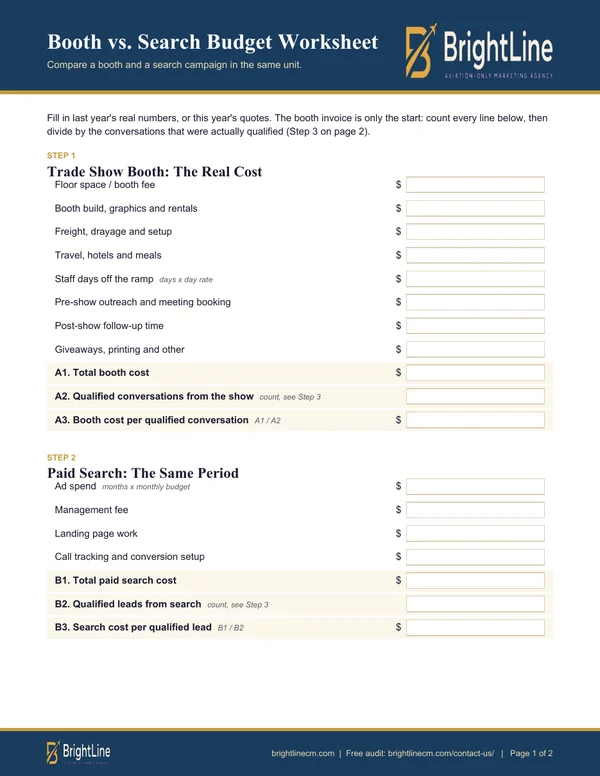
Free Worksheet
Booth vs. Search Budget Worksheet
- Add up the real cost of your last trade show, line by line
- Compare cost per qualified conversation against paid search
- Decide which shows still earn a place in next year’s budget
FAQ
Aviation Paid Search Marketing Questions Operators Ask
Is paid search still worth it for aviation businesses?
Yes. It remains one of the few channels where you pay only when a buyer clicks with intent already formed. Bidding now leans on conversion signals, so an operator that tracks real calls and booked flights from its ads wins more of the right auctions than a rival chasing raw clicks.
What is aviation marketing?
Aviation marketing is the practice of reaching the specific buyers inside a narrow, credential-heavy industry: flight schools, MROs, charter operators, FBOs, and parts suppliers. What separates it from general marketing is vocabulary, because a campaign that misuses terms like AOG, STC, or Part 135 loses credibility with the buyer in the first line of ad copy.
What is paid search marketing?
Paid search places your listing at the top of a search engine results page for queries you bid on, and you’re charged per click rather than per impression. The detail that trips up newcomers is negative keywords: a flight school bidding on “pilot license” without excluding “license renewal” or “drone license” pays for traffic it can never convert.
How should an aviation business split budget between trade shows and paid search?
Fund one or two anchor shows from a presence budget for relationships, recruiting, and launches, and let paid search carry demand capture year-round. Flight schools and charter operators should weight search heavily; MROs and parts suppliers run a split; manufacturers with a few named accounts lean toward shows. Measure both by cost per qualified conversation.