
Google Ads for MRO Companies: Why Parts Buyers Click Away
TL;DR · The short answer4 key points
- Google Ads for MRO companies usually fails after the click, not in the bidding: the page answers a question the buyer never asked.
- Parts buyers check three things in seconds: availability, approved capability for their airframe, and a fast way to reach a human for AOG.
- Bid on part-number and airframe-specific searches instead of broad industrial terms, and give each search type its own ad group and landing page.
- Read the search terms report like a buyer, and fix the landing page before you raise the budget.
A buyer types a part number into Google, clicks your ad, and hits the back button before the page finishes loading. The targeting worked. The click happened. Something on the other side of that click told them this wasn’t the vendor they needed.
Paid search for MRO and parts suppliers fails on that side of the click far more often than on the bidding side. Most MRO campaigns answer a question the buyer never asked. The ad sells capability. The buyer wants availability, airframe fit, and a traceability answer.
This article gives you a diagnostic framework for the click-away. You’ll learn what each search type demands, which page signals buyers check first, and how to fix the page before you touch the budget.
What Google Ads for MRO Companies Actually Buys
Paid search for aviation maintenance buyers is ad space bought against searches where the part, the airframe, or the grounding deadline is already known. It excludes the browsing buyer. Google Ads for MRO companies targets the searcher who arrives mid-decision, often mid-crisis, and needs confirmation rather than introduction.
That distinction gets lost in most MRO company marketing. Teams treat a campaign like a billboard and write it for a general industrial procurement officer. The buyer typing a part number into Google is a maintenance controller staring at an aircraft that cannot fly.
The ad buys a position in a search that is already late. By the time the query is typed, the buyer has a work order number and a deadline. Google’s own guidance on improving ad relevance and landing page quality points at the same mechanic: the ad and the page must match the query’s intent, or the platform and the buyer both penalize you. MRO demand is triggered, not cultivated. A work order opens. An aircraft goes on ground. The searcher is now comparing response time and traceability, not brand story.
The mismatch is structural, not creative. Ads written for a general industrial buyer land on a homepage that lists shop capabilities. The buyer wanted availability, airframe fit, and a phone number that reaches a human who can confirm AOG status. They got a brochure. If the page cannot confirm fit and availability in the first screen, the click was wasted before the bid mattered.
Why the Click Dies Before the Quote Request
The buyer who leaves your page is not unconvinced. They are unconfirmed. They arrived with a part number and an airframe already in their head, and the page answered neither question.
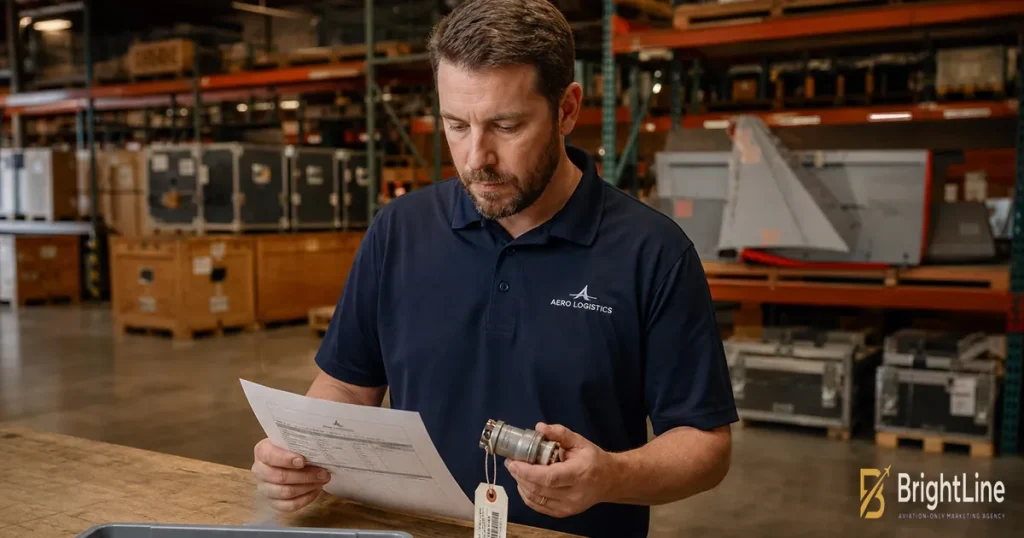
Three signals get checked in the first seconds, in order. Availability comes first: is this part in stock, on the shelf, or sourced. Approved capability for that specific airframe comes second, because a Boeing 737NG component and an A320 component are not interchangeable to the person buying. The third signal is a way to reach a human who can confirm AOG status right now.
A generic industrial landing page fails all three at once. It shows a hero image of a warehouse, a paragraph about decades of experience, and a contact form that asks for a company name. The buyer has to hunt for the part number field. Hunting is the moment they hit back.
The cost of a click is small. The cost of a click that lands on a page built for the wrong buyer is the whole campaign, because it trains the buyer to skip your ad next time. B2B buying research keeps pointing at the same thing: the decision forms in the self-serve window, long before anyone talks to sales.
So the click that dies is rarely a targeting failure. It is a page that made the buyer do the work. The next question is what the page should have said instead.
The Misconception That Sinks MRO Ad Budgets
Widening a stalled campaign feels like progress. Broader match types, more keywords, a bigger net. The comparison that matters is between that instinct and the narrow alternative, and it exposes why so much MRO ad spend produces bounces instead of quote requests.
The broad-reach approach casts industrial terms like “aircraft parts supplier” or “aviation components” into phrase and broad match. The problem is who arrives: procurement clerks pricing a catalog, students hunting a bolt, hobbyists who will never issue a purchase order. Volume is not the same as intent.
The part-number and airframe-specific approach bids on what a buyer types when a work order is already open. Queries naming a specific component or airframe pull in people comparing availability and approved fit. Every impression carries a live deadline behind it, which is exactly the traffic an MRO wants to pay for.
Match type governs who sees the ad. It does nothing about whether the page earns the click. Widening the net before the page is fixed just buys more expensive bounces. Tighten the query first, then fix the page. Pair that discipline with proper SEO for MRO companies and the two channels reinforce each other.
The Ad Copy That Survives an AOG Search
An AOG search is a buyer with an aircraft on the ground and a clock running. That buyer scans the headline for response time and airframe fit, not for a company history. Ads that lead with “trusted partner since” lose to ads that lead with “AOG support, answered now.”
- Part or airframe in the headline. The buyer searched a specific number or a specific airframe. Echo it back in the first line and the click feels like a match instead of a guess.
- Approved capability, named plainly. State the rating or approval in the buyer’s language. “FAA Part 145 repair station” tells them you can legally work on the part; “quality you can trust” tells them nothing.
- Response commitment without hype. Say what happens after the click: a quote, a call back, a stocked answer. Vague urgency reads as noise to a buyer who has been burned before.
- A landing page promise the page keeps. If the ad says same-day quote, the page must show the form and the phone number that deliver it. The ad and the page are one promise, split across two clicks.
Read the four together and the pattern is a single idea: the ad is a contract, and the page is the fulfillment. Buyers reward vendors who answer the question they actually asked. An ad that overpromises response time trains the buyer to distrust the next click, so make the ad and the page say the same thing. That discipline is the core of solid aviation PPC management.
Landing Pages Built for Part Numbers, Not Pitches
A parts buyer lands on your page holding two facts: the part number and the airframe. Your landing page has one job: confirm both before the buyer’s hand drifts back to the browser bar. Five elements decide whether the page holds the click or loses it.
- Part number above the fold. The buyer searched a specific item, so the page must echo it back before any scrolling.
- Approved capability in plain terms. Name the airframes and platforms you are approved for, not certifications in the abstract.
- Traceability within one click. A buyer checking a supplier’s paperwork wants the 8130-3 tags and approval documents visible, not buried in a menu.
- Quote form that asks the right question. Request the part number and the deadline; a generic contact form tells the buyer you don’t understand their urgency.
- Direct phone path for AOG. Grounded aircraft don’t wait for form submissions, so the number needs to be a tap away, staffed, and labeled as AOG.
Buyers think in part numbers and approvals, while most MRO pages speak in capabilities and company history. That gap is where MRO ad budgets quietly leak.
BrightLine Digital builds aviation landing pages and conversion paths for MROs and parts suppliers, starting with an audit of where buyers drop off. Pair that with aviation business automation so quote requests route to the right desk instead of a shared inbox. Open your top ad group and its landing page side by side, then ask whether the page answers the query that earned the click.
Where MRO Buyers Search Before They Click
The click is the last move in a search that started hours or days earlier. The query tells you which stage, and the stage tells you what the ad and page must prove.

The part-number search is an availability check
A buyer typing a specific part number has already decided what to buy. Your ad must name the part or the stock status, not your company name.
The airframe search is a fit check
Queries pairing a component with an airframe, like a 737NG or an A320, are buyers verifying approved capability. The page has to show the approval in the buyer’s language. A capability page that buries the airframe in a PDF loses to the competitor who states it in the headline.
The AOG search is a clock check
A grounded aircraft changes the ranking of every variable. Response time outranks price, and a buyer scanning results wants a phone number and a stated commitment. Ad copy that leads with company history reads as a vendor who has never worked an AOG desk.
The comparison search is a shortlist check
Buyers weighing suppliers against each other are looking for proof, not persuasion, and most build the shortlist before they ever make contact. Traceability documentation and certification links do more work here than any headline.
Four search types, four proof requirements. Each one needs its own ad group and its own landing page, because a single page cannot answer four questions at once. Budget follows the query that names a part or an airframe. The rest is noise.
Reading the Search Terms Report Like a Buyer
Your campaign’s most honest feedback sits in a table nobody opens. The search terms report shows the actual phrases buyers typed before your ad appeared, and that list reads closer to a buyer’s internal monologue than any persona document.
Sort every query into two piles. One names a part number, an airframe, or a specific component. The other names a general industrial need, the language of a catalog rather than a hangar. Budget belongs to the first pile.
The second pile is where money leaks. A query like “aircraft hardware supplier” pulls in students, hobbyists, and procurement staff who never intend to request a quote. Add those phrases as negative keywords and the same spend reaches buyers with a part in hand.
The report also tells you which landing pages should exist. When five queries mention a specific airframe and your ad sends all five to a homepage, that’s a page gap, not a bidding problem. BrightLine Digital runs paid search for MROs and parts suppliers and reports on qualified leads rather than clicks, which keeps this review tied to pipeline instead of vanity metrics.
Run this review every month and the search terms report stops being a chore. It becomes the document that tells you what to build next. Read it as a buyer would, then ask whether the page behind each query answers what was typed.
Fix the Page Before You Raise the Budget
Budget increases amplify whatever the page already does. If that page sends parts buyers back to the search results, more spend buys more of the same exit. The diagnostic work comes first, and it costs nothing but an afternoon.
Open the search terms report beside the landing page that query triggered. Then read the buyer’s phrase and ask whether the page confirms the part, the airframe, and the AOG path in that order. Where the page goes silent, the buyer goes back. Fixing that silence protects every dollar already committed and every dollar added later.
Pull the top queries. Match each one to its landing page. Rewrite the page that fails the test before touching a bid, a budget cap, or a match type. The page is the campaign. Treat it that way and the clicks start holding.
FAQ
Google Ads for MRO Companies: Common Questions
Which Google Ads campaign type works best for MRO companies?
Search. Google’s current campaign types are Search, Performance Max, Demand Gen, Display, Shopping, Video, App, and Smart, and Search is the only one where the buyer types the part number or airframe first. Start there, and add other types only once Search is converting cleanly.
Should an MRO bid on part numbers?
Yes, for the parts you can actually supply or repair. A part-number search comes from a buyer who already knows what they need, so the click is close to a quote request. Send each part-number ad group to a page that confirms the part, the approved airframes, and stock or lead time.
How do I know if the landing page is the problem, not the bids?
Look at what happens after the click. If ads earn clicks on part-number and airframe searches but few quote requests or calls follow, the page is failing the buyer. Check whether the first screen shows the part, the approved airframe, and an AOG phone number before you change a single bid.