
Google Reviews for Flight Schools: What Students Check
TL;DR · The short answer4 key points
- Evaluating Google reviews for flight schools measures student customer experience rather than fleet airworthiness or pass rates.
- A flawless five-star rating can mask underlying operational bottlenecks if generated primarily from intro flights or gated requests.
- Critical reviews expose recurring operational patterns such as maintenance delays, instructor turnover, and unexpected fee surcharges.
- Prospective pilots should analyze recent review trends while independently verifying Part 141 FAA certifications and physical maintenance logs.
A deposit wired to the wrong school buys a broken fleet and a scheduling desk that never answers. That outcome is decided long before the first lesson, usually in twenty minutes of reading.
Google reviews for flight schools are the first thing applicants scan and the last thing they should trust at face value. A five-star average can sit on top of a grounded aircraft and a billing mess. A three-star average can belong to a program turning out sharp pilots.
Stars measure satisfaction, not airworthiness, and the gap between those two things is where deposits disappear. This article hands you a reading method instead of a ranking. You’ll learn which signals matter, which complaints repeat, and how to verify what Google reviews for flight schools cannot show you.
What Google Reviews Actually Measure at a Flight School
Google reviews for flight schools are public, student-authored accounts of a training experience, filtered through Google’s ranking and moderation systems. They measure satisfaction with the relationship, not the quality of the certificate. That gap is where most prospective students misread them.
A review captures what a student lived through: scheduling friction, aircraft availability, instructor chemistry, billing surprises at the counter. It does not capture the FAA’s view of the curriculum. Those are two different questions, and the review score answers only the first.
Readers misapply this constantly. They treat a four-point-eight average as evidence the school produces competent pilots, when it only proves the front desk was pleasant and the planes mostly flew. A school can score high on both while its checkride pass rate sags.
Part 141 approval status is a separate question entirely. FAA-approved pilot schools are certificated under Title 14, Code of Federal Regulations part 141, and that certification is verified through the FAA’s overview of approved pilot schools, not through a star rating. A school with a perfect review score and no Part 141 certificate is a different institution than its reviews suggest.
The score tells you how students felt about the experience. The certificate tells you what the curriculum is legally approved to deliver. Confusing the two is how deposits go to schools that were never the right fit. Read the reviews for the relationship. Verify the certificate somewhere else. That separation is the whole skill.
The Signals Students Read Before They Book a Discovery Flight
Star counts reward volume, not honesty. Students who read Google reviews for flight schools scan for patterns, and the pattern that matters most is what the reviews reveal about daily operations. A school with a mediocre average and detailed complaints tells you more than a flawless wall of praise.

- Recency of activity. A steady trickle of recent reviews signals a school that is actually flying students today. A burst of praise from years ago followed by silence usually means the operation has stalled.
- Reviewer specificity. Reviews that name an instructor, cite a tail number, or reference a checkride date are harder to fabricate than vague praise. Specificity is the closest thing to a credibility test a review offers.
- Response behavior. How a school answers a critical review tells you its temperament. Replies that cite facts and offer a fix suggest a school that manages problems; defensive replies suggest one that manages its image.
- Training versus intro-flight mix. A school collecting mostly one-hour discovery flight reviews may not be a serious career operation. Look for reviews from students who stayed long enough to finish a rating.
Read together, these signals expose what the average conceals: whether a school is running, who is talking, and how it behaves under criticism. Schools that practice real flight school review management answer these signals in public, which makes them easier to judge. Read the patterns, not the score.
Why a Five-Star Average Can Still Hide a Broken Program
A perfect rating is easier to manufacture than a working airplane, which is why the star score deserves suspicion.
Review gating is the first mechanism. A school emails only its happiest graduates a review link, filtering out everyone who quit after three lessons. The average climbs while the dropout rate stays flat.
Discovery-flight reviews inflate scores a second way. A one-hour intro flight is a sales demo, not training. Schools collecting dozens of glowing reviews from first-timers can look excellent while their career program goes unexamined.
Small samples make the problem worse. A school with a dozen reviews reads as more certain than it is, because a handful of five-star entries can produce a flawless average. Statistical confidence and star averages are not the same thing.
The regulatory picture changed in August 2024. The FTC finalized a rule that lets the agency strengthen enforcement, seek civil penalties against violators, and deter AI-generated fake reviews, per the FTC’s fake review rule. A school that buys reviews, posts fake ones, or hides negative ones while implying its page shows them all now faces federal penalties, not just a marketing edge. Uniformity is the tell. Real flight training produces friction: weather cancellations, maintenance delays, instructor changes. A review page with none of that friction describes a school that doesn’t exist.
The Complaint Patterns That Should Change Your Decision
Praise tells you a student finished. Complaints tell you what it cost them. The useful signal in Google reviews for flight schools lives in negative reviews, sharpening when the same failure keeps surfacing. Five patterns are worth acting on before you pay anything.
- Aircraft down for maintenance. Repeated mentions of grounded planes signal a fleet stretched thin, pushing lessons into a queue.
- Scheduling delays and instructor turnover. Weeks of waiting or a third CFI in as many months describe a school that cannot hold its own staff.
- Surprise charges beyond the quoted rate. Fuel surcharges, examiner fees, and headset rentals at billing time mean the advertised hourly rate was never the real price.
- Weather and dispatch policies that cost money. A cancellation policy charging students for a dispatch decision protects the school, not the learner.
- Deposits that vanish after a withdrawal. Reviewers who lost money walking away reveal how the school treats anyone who stops being a customer.
What the list hides is arithmetic. One furious reviewer is noise, often a student who failed a checkride. Independent reviewers describing the same operational failure is a pattern. Count the names, not the stars.
Then ask the school directly. A school that keeps its flight school Google Business Profile current, and replies to its complaints there, has nothing to hide when you raise them.
How International Students Should Read Reviews Differently
The checklist a domestic student runs on Google reviews for flight schools breaks the moment the reader is an F-1 applicant. A domestic student is buying flight hours. An international student is buying a visa-supported pathway, housing, and a commitment measured in years. Domestic readers can afford to skim for aircraft availability and instructor chemistry. Their downside is a wasted month and a transfer to another field. The stakes stay local and reversible.
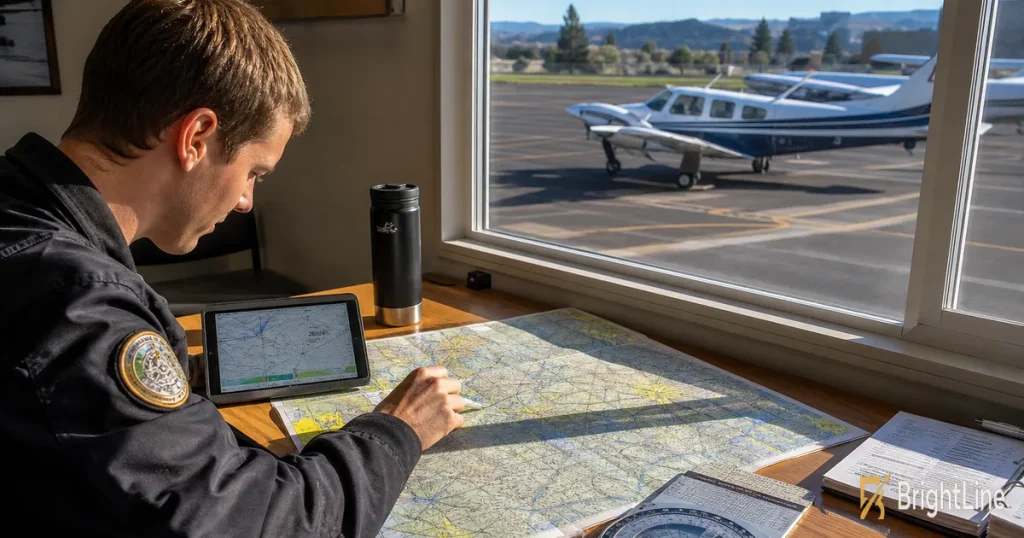
International readers carry a heavier load. Reviews that mention admissions communication, TSA processing, and housing arrangements outrank any review about a single discovery flight. Those three details decide whether enrollment survives contact with the process.
A school with strong domestic reviews can still be a poor fit for an F-1 applicant. If no reviewer mentions the international process at all, the silence is the finding. Absence of evidence about admissions support is evidence worth weighing.
One enrollment question reviews cannot answer sits outside the review page entirely. Learn how a TSA background check for foreign students works before wiring a deposit. That process runs on its own timeline, and no star rating tells you whether your file clears it. The international reader wins by filtering for process reviews first, then reading domestic reviews second. When a school’s reviews never touch visas or housing, call admissions and ask why.
What Reviews Cannot Tell You About a Flight School
The maintenance logbook never gets a star rating. Neither does the checkride pass rate, the fuel surcharge buried in the enrollment agreement, or the school’s accident history. Those four items decide whether your money buys a certificate or a cautionary tale, and reviews are structurally blind to all of them.
A student can only review what a student experienced. Nobody sits in the shop while an annual inspection runs over budget. Nobody sees the airworthiness directive that grounds the only complex aircraft for three weeks. The fleet condition a reviewer describes is a snapshot of the airplane they flew, not the fleet you’ll train in.
Cost structure is the same blind spot. Reviews quote the hourly rate because that’s what the brochure quoted. Surcharges, examiner fees, and checkride retest costs surface months later, and by then the deposit is spent.
Curriculum approval is verifiable, and it’s verifiable somewhere other than Google. The FAA Part 141 certification process documents how a school earns and keeps its approval. Approval status and review score answer two different questions, and only one is about training quality.
Safety data lives at the industry level, not the school level. The NTSB’s aviation accident statistics show what fails and why across US civil aviation. They won’t name your school, but they’ll tell you which failure modes to ask about directly. Reviews tell you how a school feels. Verification tells you how it operates.
Reading Google Reviews for Flight Schools Like a Buyer
A buyer’s read of Google reviews for flight schools produces a decision, not a mood. It runs in a fixed order, treats recency as the first filter, and ends with a shortlist of questions the school must answer before money moves.
Step 1. Sort by newest and read the recent window first. A school’s current operation matters more than its history, and a strong rating built on old reviews tells you what the school was. Read the last six months before you touch the average.
Step 2. Read every one-star and two-star review in full. Look for the same operational complaint from different reviewers, because a repeated failure is a system problem and a single angry post is usually a bad day.
Step 3. Check how the school answers criticism. A reply naming the aircraft, the scheduling fix, or the refund policy reads as a school that owns problems. A reply that argues with the student previews your own dispute.
Step 4. Cross-check the claims against the published cost and fleet pages. When a review contradicts the brochure, one is stale. The contradiction itself is the finding, and it tells you which source to trust.
Twenty minutes of this replaces the star average as your decision input. Schools that invest in flight school marketing that fills classes also tend to keep their review presence current, but the method still comes first.
Read the Reviews, Then Verify What They Cannot Show
Google reviews for flight schools work as a diagnostic, and the reader who treats them that way walks into a discovery flight with better questions than the reader who trusts the average. The difference shows up in the first conversation.
A student who arrives with a shortlist of specific complaints gets specific answers. Ask the chief instructor why three reviewers described the same scheduling desk problem. Ask what happens to your money when weather cancels a lesson. Schools answer the questions you actually bring.
Deposits are hard to recover once training starts. Take the patterns you found and put them to the school directly, by phone or in person, before any money moves. Verification is the step reviews cannot do for you.
FAQ
Google Reviews for Flight Schools: Common Questions
What are the top 5 flight schools in the US?
No fixed national ranking exists, because the best school depends on your certificate goal, your budget, and whether you need F-1 visa support. Published rankings rarely show fleet size, instructor turnover, or how a school treats international students, which is exactly what a careful read of its reviews reveals.
Is it true that 80% of flight students quit?
The 80% figure is widely repeated in flight training, but there is no current official national dropout rate behind it. Attrition is genuinely high, and reviews from students who quit are worth reading for why: cost overruns, scheduling delays, and instructor turnover come up far more often than aptitude.
What are the best flight schools in Houston?
Houston has a deep bench of Part 61 and Part 141 operators, and the right pick hinges on how many aircraft the school keeps dispatch-ready during summer thunderstorms. Ask any Houston school how many training days it lost to weather last quarter before you compare hourly rates.
What are the best flight schools in Fort Lauderdale?
South Florida schools attract a large international cohort, so the strongest ones for an F-1 applicant are those with dedicated admissions staff and housing arrangements in place. A school with excellent local reviews and no international pipeline can still leave a visa student stranded mid-enrollment.