Flight Schools in California for International Students: Visa Rules That Decide Your Enrollment
TL;DR · The short answer4 key points
- Only SEVP-certified flight schools in California for international students can issue the Form I-20 your visa interview requires.
- Three gates decide enrollment: SEVP certification, I-20 issuance timing, and TSA Security Threat Assessment clearance.
- Match F-1 to academic or degree-linked programs and M-1 to vocational Part 141 training before you pay a deposit.
- Verify certification in the federal SEVP database, then request a written cost and I-20 timeline tied to your certificate.
A California flight school can look flawless on paper and still be legally unable to enroll you. The flight schools in California for international students that can issue your paperwork are a smaller group than the ones with glossy brochures.
Three gates decide whether you get in. SEVP certification lets the school issue an I-20. The I-20 is what your visa interview is built around. TSA clearance has to land before anyone lets you near a cockpit. Skip any one and the deposit refunds, the start date slips, and your airfare buys nothing. Cost and location are tiebreakers, not filters.
This article gives you a way to read every California school through those three gates. You’ll learn what to verify before you email anyone, and which questions separate a school that enrolls international students from one that just says it does.
What Makes a California Flight School Enrollable
SEVP certification is the federal approval a flight school must hold before it can issue the Form I-20 an international student needs for a student visa. Without it, the school cannot enroll you no matter how good its fleet looks. This is the first filter for flight schools in California for international students, and it runs before cost, location, or pass rates.
Applicants treat certification as paperwork. It is the gate. A school can run a spotless operation with newer aircraft than anyone nearby and still be legally unable to enroll a non-citizen, because enrollment authority lives in a federal database, not a brochure. The SEVP school certification requirements settle this: flight schools must hold FAA Part 141 or Part 142 certification to qualify.
That link is worth sitting with. The same credential that signals a structured, FAA-audited syllabus unlocks international enrollment. School quality and visa eligibility ride on one certificate, so a Part 61 operation running excellent informal training can be a great school and a dead end for you.
Verify certification before you read another page of any California school’s site. Pull the school up in the SEVP certified schools database, confirm the Part 141 or Part 142 status, then move on to flight school admission requirements. Skipping this step is how applicants lose deposits on programs that never had the authority to enroll them.
The I-20 Is the Real Acceptance Letter
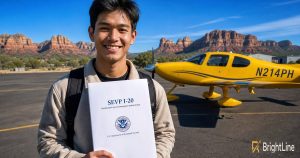
An acceptance email costs a school nothing to send. The Form I-20 actually moves your case forward, and until it lands in your inbox, you have a promise rather than a visa pathway.

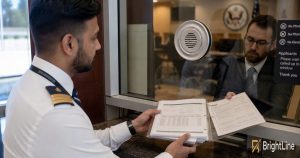
The certificate of eligibility is what the consular officer reads before the interview even starts. It carries your program start date, your funding figures, and your school’s certification code. Without it, the student visa for pilot training interview has no foundation.
Only a certified school can generate that form. Once SEVP certifies a school, it can issue Forms I-20 to the F and M students it admits, which ties your acceptance letter directly to the school’s federal standing. A school that lost certification cannot issue one, no matter what its admissions team promised.
The school verifies your funding documents, enters your record into SEVIS, and issues the form with a program start date it can defend. Your side is the paperwork that feeds it: bank statements, sponsor letters, passport copy, and transcripts. Gaps in either direction stall the form, and a stalled form costs you a cohort seat.
Timing is where applicants get quietly squeezed out. A school that admits you in June but issues the I-20 in September has burned your interview window and your start date together. Ask for the issuance timeline in writing before you pay a deposit. One question separates serious programs from hopeful ones: how many days pass between admission and I-20 issuance? A school that cannot answer that has never tracked it.
F-1 or M-1: The Choice That Shapes Your Training
The visa category isn’t a preference you pick at the application stage. It’s determined by the program structure the school runs, and getting it wrong can void a training plan you’ve already paid for.
An F-1 fits academic and university-linked flight programs, the kind attached to a college degree or a structured collegiate curriculum. It gives you a longer runway and more flexibility if you later want to add ratings or extend your stay. Where it falls short: not every California flight school runs an academic program, so an F-1 may simply not be available at the school you want.
An M-1 fits vocational flight training, which describes most standalone flight schools. It’s built for a defined training goal, and that focus is its strength. The catch is the instruction load. M-1 postsecondary enrollment rules require 18 clock hours per week when the majority is classroom instruction, or 22 clock hours otherwise, and the rules name flight training as a 22-hour program. That minimum reshapes how your schedule gets built around weather and aircraft availability.
Match the visa to the program the school actually runs. If the school offers a degree-linked track, ask directly whether it issues an F-1 visa for flight training. If it’s a standalone Part 141 school, plan for M-1 and its clock-hour floor. The simpler-sounding visa is the one that fits your program, not the one with fewer rules. Ask each school which form it issues before you commit a deposit.
TSA Clearance Comes Before Your First Lesson
No California flight school can put a non-citizen in a cockpit until TSA clears that trainee, regardless of how clean the visa file looks. The gate sits outside the school’s admissions office and outside your control. Plan for it as a fixed stage of flight training in the USA, not an afterthought.
- The Security Threat Assessment. All non-citizen flight trainees are subject to a Security Threat Assessment, a background check run across federal databases. Training cannot begin until that check clears.
- Who it covers. The rule applies to every non-citizen trainee, whether you hold an F-1, an M-1, or a green card. Citizenship is the trigger, not visa category.
- What you submit. You apply through TSA’s Flight Training Security Program and pay a one-time fee. A positive result gives you a Certificate of Eligibility that covers five years of training, as long as you stay eligible. Missing passport details or a mismatched name stalls the application before TSA reviews it.
- Why the clock isn’t yours. Processing time depends on TSA’s workload, not your start date. A school promising a lesson next week has not accounted for this step.
The visa and the TSA check run on separate clocks that both must finish before your first flight hour. Start the TSA application the same week you accept your I-20. Waiting until the visa stamp lands is how a confirmed seat turns into a deferred start.
Why the Quit Rate Story Misleads You
The claim that most flight students quit gets repeated like a fixed law of physics. It is not. It is a borrowed statistic with no current official source, no agreed definition of who counts as a student, and no accounting for the visa and funding conditions that actually end training.
Ask where the figure comes from and the trail goes cold. Was the student someone who took one discovery flight and never returned? Someone who ran out of money mid-instrument rating? Someone whose M-1 status lapsed before solo? Those are completely different failures, and lumping them together produces a number that tells you nothing about your own odds.
Treating attrition as destiny is the expensive mistake. The real risks for an international student are structural, not motivational. Visa timing that slips past a cohort start, a funding gap at the commercial rating, a school whose certification lapses mid-program. Each is plannable. None is a personality flaw.
Compare two applicants at the same California school. One budgets for the full certificate path and confirms the I-20 timeline before paying a deposit. The other arrives with tuition for the private pilot license and hope. The second is the statistic. The first understood that the flight school process rewards planning over optimism.
What Flight Training in California Really Costs
Cost follows the license path, not the school’s brochure. A private pilot certificate and a commercial license with an instrument rating are different financial animals, and the visa route changes the total again. Ask for a written estimate tied to the exact certificate you want.
- Tuition and aircraft time. Hourly wet rates and instructor fees stack up fastest when your schedule stalls.
- Living costs in California. Rent near a busy training airport runs high, and it accrues every month you stay.
- SEVIS fee and visa costs. These are fixed government charges paid before your interview.
- TSA processing. The security threat assessment carries a one-time fee that covers five years of training eligibility.
- Schedule delay reserve. Weather, aircraft maintenance, and instructor availability push the total up, so budget a cushion.
- Program length differences. An M-1 vocational route and an F-1 academic route carry different weekly instruction loads, which changes how long you pay rent.
The line items look manageable in isolation. Together they compound, because every extra month of training adds living costs on top of flight hours. The reserve for delays is the line most applicants underestimate.
Treat any quote without a written breakdown as incomplete. Compare how much flight school costs across schools only after each one ties its estimate to a specific certificate and a realistic timeline.
How to Vet Flight Schools in California for International Students
Four questions separate a school that can enroll you from one that just sounds eager. Skip any and you risk a deposit on a program that can’t issue your paperwork.
Step 1. Confirm SEVP certification and Part 141 status before you discuss anything else. A school that hesitates is telling you something. The FAA Part 141 certification process ties school approval and visa eligibility to the same credential, so a clean answer names both.
Step 2. Ask how and when the school issues the I-20 after admission. A good answer gives a timeline and a named contact. A vague one says “once you’re accepted.”
Step 3. Confirm the school knows the TSA process for non-citizens cold. Schools that enroll international students answer in one sentence. Schools that don’t hand you a link and wish you luck.
Step 4. Request a written cost and timeline tied to your specific certificate. The number that matters is the one tied to a named license, not a brochure range. If you’re still weighing whether you can become a pilot in the USA at all, this estimate is where the answer becomes real.
Schools serious about international enrollment make all four answers easy to find. BrightLine Admissions’ international flight school admissions work exists because so many don’t. Finish this vetting and you have a shortlist you can trust.
Read the Visa Gate Before You Read the Brochure
Certification is the spine of every decision you make from here. A school with a stunning fleet and a runway view means nothing if it cannot issue your Form I-20 or run your TSA check. The flight schools in California for international students that survive that filter are the only ones worth your deposit.
Skip the filter and the failure is expensive. You pay tuition, book housing near the airport, and then discover the school never held Part 141 status. Every dollar spent before verification is a dollar at risk.
Start with the federal SEVP school list. Cross-check each name against FAA Part 141 certification. Then, and only then, compare cost, location, and fleet among the survivors. That shortlist is your real starting line.
FAQ
Flight Schools in California for International Students: Common Questions
Can an international student become a pilot in the USA?
Yes, and the route runs through a school certified to issue you a Form I-20, which is what lets you apply for an F-1 or M-1 visa. The part most applicants miss is that the school’s certification, not your passport, decides whether that paperwork can exist at all.
How much does pilot training cost for international students in the USA?
Total cost depends on the certificate you’re chasing and the visa route you’re on, because program length and weekly instruction minimums change the bill. Budget beyond tuition and aircraft time to cover living costs, the SEVIS fee, visa fees, and TSA processing.
How much does it cost to go to pilot school in California?
California adds a higher living-cost layer on top of flight training, so the same certificate usually runs more here than in a lower-cost state. Ask each school for a written estimate tied to your specific certificate, then add a reserve for weather and scheduling delays.
Is it true that 80% of flight students quit?
The 80% figure is widely repeated, but there is no current official national dropout rate behind it, no fixed definition of who counts as a student, and no accounting for visa and funding conditions. Treat it as a borrowed claim rather than a prediction about your own odds.