
Aviation Sales Automation Services vs. Hiring More Reps: Which Wins?
TL;DR · The short answer5 key points
- The real question isn’t software versus headcount. It’s which inquiries your team fails to answer.
- Judge each sales motion on four criteria: response speed, coverage, cost per covered opportunity and deal complexity.
- Automation wins where the first reply wins: flight school inquiries, FBO requests and AOG parts orders.
- Reps win multi-stakeholder MRO and OEM contracts, where trust and negotiation close the deal.
- Audit last quarter’s inquiries first. If misses cluster after hours and at handoffs, automate; if they cluster on complex deals, hire.
Adding a rep to fix a leaking aviation pipeline is the most expensive way to avoid a diagnosis. The better question isn’t headcount versus software. It’s which inquiries your team fails to answer, and whether aviation sales automation services or another body on the phone closes that gap faster.
The usual mistake is treating this as a technology preference. Sales leaders pick automation because it feels modern, or hire because it feels safe, without measuring what each covers. Charter quotes, MRO RFQs, parts orders, and flight school enrollment each leak differently.
This article gives you a framework built on four criteria: response speed, pipeline coverage, cost per covered opportunity, and deal complexity. You’ll see where automation wins on coverage and speed, where reps win on judgment and trust, and why the honest answer is usually both.
The Criteria That Decide This Choice

Aviation sales teams lose deals to the wrong competitor: the one who answered first. That fact reshapes the headcount question, because a rep brilliant on a complex MRO contract may be the wrong hire for a parts desk needing coverage at odd hours.
Aviation sales is not one motion. A charter quote, an MRO request for quotation, a parts order, and a flight school enrollment each move at a different tempo and reward a different investment. Treating them as one pipeline is where most hiring and software decisions go wrong.
Four dimensions settle the choice. Response speed decides the low-complexity, high-volume motions. Coverage asks whether anyone is watching every channel at every hour, and aviation business automation is built for exactly that gap.
Cost per covered opportunity forces an honest comparison. A rep’s salary buys judgment across a working day; a system buys reach across every hour. The two are not priced on the same axis.
Deal complexity is the final filter. Multi-stakeholder contracts reward negotiation and trust, and no workflow replaces that. Run each of your sales motions against these four filters before committing budget. The answer will rarely be uniform across your operation.
What Aviation Sales Automation Services Actually Do
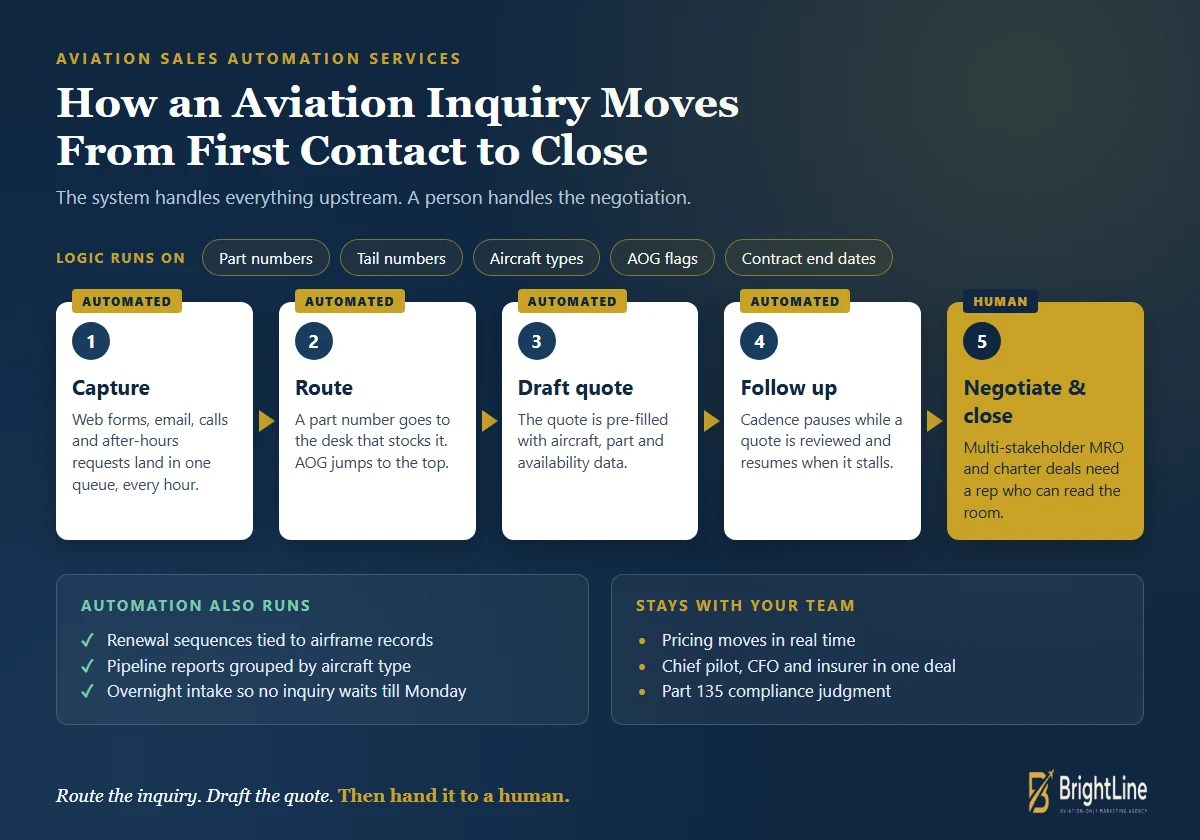
Aviation sales automation services are systems that capture, route, quote, and follow up on aviation inquiries without a human touching each step. The category excludes generic email blasts dressed up as sales tooling. What separates it is the data model underneath: part numbers, tail numbers, aircraft types, and AOG flags drive the logic, not a contact’s job title.
Teams hear “automation” and picture a drip campaign that sends the same brochure to a flight school prospect and an MRO buyer. Real aviation CRM automation services read the inquiry itself. A request for a specific part number routes to the desk that stocks it, with the quote draft pre-filled and the AOG flag escalated above everything else in the queue.
That routing layer is where the work happens. Renewal sequences fire off contract end dates tied to airframe records. Follow-up cadences pause when a quote is under review and resume when it stalls. Pipeline reporting groups opportunities by aircraft type so a sales director can see which fleet segment is converting.
Automation stops at the negotiation table. A multi-stakeholder MRO contract or a charter deal with a chief pilot, a CFO, and an insurance carrier in the room needs a person who can read the silence. Charter sales also sit inside Part 135 operating requirements, which a workflow builder cannot interpret on its own. Route the inquiry, draft the quote, then hand it to a human.
What Hiring More Reps Really Costs You
Salary is the smallest line on the rep invoice. The BLS wage data for wholesale and manufacturing sales reps puts the May 2025 median at $72,080 a year for general products and $104,920 for technical and scientific products, the group most aviation parts and MRO reps fall into. That is base pay alone. Add benefits, ramp time, and management overhead and the real number climbs fast.
| Dimension | Adding a Rep | Automation Engagement |
|---|---|---|
| Upfront cost | Recruiting fees, signing bonus, onboarding | Setup fee plus integration work |
| Ongoing cost | $72,080 to $104,920 median base, plus benefits and management | Monthly fee that rarely scales with inquiry volume |
| Time to productivity | Months of aircraft and part-number learning | Live within weeks of configuration |
| After-hours coverage | None, unless you pay for a second shift | Every hour, every channel |
| Scalability | Linear: each new market needs a new hire | Marginal: new rules, not new salaries |
| Judgment and relationships | Strong: negotiation, trust, multi-party deals | Weak: routes and drafts, cannot close |
The rep wins on judgment and relationship depth. Automation wins on cost per covered opportunity. Hiring first makes sense when qualified demand already exceeds what your team can work. When the leak is unanswered inquiries, a new hire inherits the same leak at a higher price.
Recruiting costs also land before the rep sells anything, and much of a new rep’s week goes to inbound qualification and follow-up, not negotiation. That routine work is exactly what a system can take off their desk.
Where Reps Still Beat Any Automation Stack
Software and salespeople are not competing for the same deals. The comparison that matters is where each one closes business the other cannot, and the honest answer puts reps ahead on a narrow but expensive slice of the pipeline.
High-value charter and aircraft transactions belong to people. A buyer committing to a multi-million-dollar airframe or a seasonal charter contract wants a name, a voice, and someone who can move on price in real time. Automation can schedule the demo and draft the term sheet, but it cannot read the room when the buyer’s CFO balks at the deposit structure.
MRO contracts with several decision-makers punish self-service. Maintenance directors, procurement, and flight departments all sign off, and each one needs a different argument. A rep tracking those threads in aviation CRM software keeps the deal from stalling at the third signature. An automated sequence sends the same email to all three and waits.
Trust and negotiation close deals that no workflow can. When the buyer is choosing between two shops with similar turnaround times, the relationship decides it. Software has no relationship to spend.
Automation earns its place beneath those deals: routing, quoting, follow-up, and the after-hours inquiry a rep would see the next morning. A rep freed from data entry is worth more than a rep buried in it. That is the argument for pairing the two, not for picking one.
Give the complex, high-ticket, multi-stakeholder work to a person. Hand everything upstream to the system. The boundary is deal complexity, and it is usually obvious once you look at your own pipeline.
The Hidden Cost of Slow Response in Aviation Sales



Response speed is the variable aviation sales teams underinvest in most, and it quietly decides the most deals. A late quote is not a slower quote. It is a lost one, and the loss rarely shows up in a report.
- After-hours charter inquiries. A passenger stranded at a regional airport at night calls every operator on their list. The one who answers with a tail number and a price wins before the others check voicemail.
- AOG parts requests. An aircraft on the ground burns money by the hour. The first vendor to confirm stock and ship time gets the order, and the second never learns they were in the running. That speed is why aircraft parts lead generation only pays off when someone answers fast.
- Discovery flight inquiries. A prospective student fills out a form on a Saturday. By Monday they have called two competing flight schools, and your callback lands third.
- Quotes that sit unsigned. A charter quote goes out and nothing follows it. The client books elsewhere while your team assumes silence means disinterest.
Every loss happens at a moment no single rep can staff. No reasonable headcount covers every hour of every channel.
That gap is where aviation marketing automation earns its place. It answers the inquiry, routes the lead, and follows up on the unsigned quote without waiting for someone to check a phone. Fix the response layer first, then measure what it recovers.
Head-to-Head: Automation vs. Headcount by Segment
Six aviation segments share a sales vocabulary and almost nothing else. The same aviation sales automation services that rescue a parts distributor will frustrate an MRO account manager chasing a multi-year maintenance contract. The table below names where each model wins.
| Segment | Dominant Sales Motion | Where the Pipeline Leaks | Faster Fix | Starting Move |
|---|---|---|---|---|
| Flight school | High-volume discovery inquiries | Unreturned intro calls | Automation | Auto-reply and booking link |
| FBO | Fuel, hangar, and ramp requests | After-hours voicemail | Automation | Overnight intake routing |
| Charter operator | Quote-and-negotiate trips | Slow quote turnaround | Both | Draft quotes, rep closes |
| MRO | Multi-stakeholder contracts | Stalled approvals | Headcount | Hire a closer |
| Parts distributor | AOG and catalog orders | Slow stock and price confirmation | Automation | Instant stock replies |
| OEM aftermarket | Long-cycle fleet contracts | Fragmented account data | Headcount | Dedicated account owner |
Automation wins wherever the deal is decided by who answers first. Flight schools fielding weekend discovery-flight inquiries and parts desks fielding AOG calls both live or die on response time, which is why flight school admissions automation usually pays back first. Hire for MRO and OEM work, where trust and negotiation carry the close.
Segments with short deal cycles and thin margins lose revenue to slow first contact, so automation pays back fastest there. Segments with long cycles and high contract value lose revenue to shallow coverage instead.
An MRO chasing a maintenance agreement needs a rep who knows the airframe history and the buyer’s fleet plans. Automation can flag the renewal window and prep the briefing. It cannot read the room when the customer hints at a budget freeze.
How to Choose Between the Two


This audit takes an afternoon and settles a debate that otherwise drags on for quarters. Teams skip it because the answer feels obvious from the inside, and the inside view is usually wrong.
Step 1. Pull every inbound inquiry from the last quarter and timestamp the first human reply. The gap between arrival and response is where your money leaks, and most operators have never measured it.
Step 2. Flag inquiries that arrived outside business hours. If a meaningful share sat until Monday, automation earns its place before any hire does.
Step 3. Map every handoff between capture, quoting, and follow-up, the same stages you would lay out to build an aviation sales funnel. A pipeline that stalls at handoffs is a routing problem, and adding a rep just adds another stalled handoff.
Step 4. Count the deals that genuinely need negotiation across multiple stakeholders. If that number is high, headcount wins and no automation stack changes it.
Step 5. Check whether your team is already capacity-constrained on qualified opportunities. Reps drowning in unqualified inquiries need filtering, not reinforcements.
Step 6. Score the results honestly, then resist the urge to pick one side. Automate the coverage and follow-up layer first, then hire reps to work the qualified pipeline it produces.
Completing the audit gives you a defensible answer instead of a gut call. The gap you find in Step 1 usually decides it.
Pick the Model That Fits Your Pipeline
The capacity question has an answer now, and it is rarely the one the budget line suggests. Aviation sales automation services cover the hours and channels no reasonable headcount can staff, while reps close the deals that hinge on trust and negotiation. Staffing both against their strengths is the strategy.
Waiting to decide costs more than deciding wrong. Every week of unanswered after-hours inquiries hands qualified demand to whichever competitor replies first, and that demand does not come back. The pipeline you fail to cover now becomes next quarter’s revenue gap.
Run the audit this week. Pull every inbound inquiry from the last quarter and mark which ones went unanswered or answered late. Let that gap decide the first investment. If the misses cluster after hours and at handoffs, start with automation. If they cluster on complex deals, hire. Then fix the other layer.
FAQ
Aviation Sales Automation Services: Common Questions
What is automation in aviation?
Automation in aviation covers any system that completes a task without a person driving each step, from flight deck autopilot to software that routes a charter inquiry to the right desk. On the sales side, it means capturing, routing and following up on inquiries automatically, which matters because a single unanswered AOG request can cost a parts distributor the order and the customer.
What is the best sales automation software?
There is no single best tool. General CRMs such as HubSpot and Salesforce handle sequences and pipeline tracking well, but they need configuring around aviation signals. The right setup reads part numbers, tail numbers and aircraft types so an inquiry is routed before a rep opens the email.
What is the best ERP software for the aviation industry?
It depends on the operation. Common aviation ERP and maintenance systems include IFS, Ramco Aviation, AMOS, TRAX and Quantum Control. Pick the one that ties maintenance, inventory and sales records together, because an ERP that cannot see real-time parts availability forces reps to quote blind.