Best Time of Year to Start Flight School and Why Weather Sets Your Timeline
TL;DR · The short answer4 key points
- Determining the best time of year to start flight school depends on your target certificate goal, climate, and aircraft availability.
- Weather dictates your training schedule by creating visual flight cancellations, which can extend your overall checkride timeline.
- Spring and summer deliver longer daylight hours for training, whereas fall and winter offer smoother air and open aircraft slots.
- Match your start date to your specific license type: private pilot students need clear skies while instrument students benefit from low clouds.
Ask a flight school when to start and you’ll get the same answer every time: whenever you’re ready. That advice is useless. The best time of year to start flight school depends on which certificate you’re chasing and what the sky does over your airport in March versus September.
A start date is really a bet on flyable days. Pick a month that fights your local weather and you’ll spend weeks rescheduling lessons, paying for repeat instruction, and watching skills fade between flights.
This article gives you a season-by-season framework for choosing a start date. You’ll see how weather, fleet availability, and your certificate goal converge on one window, and how to protect both your budget and your checkride timeline before you put down a deposit.
What the Best Time of Year Actually Means
Flyable-day yield is the count of training flights you can realistically complete before weather, maintenance, or scheduling wipes them off the calendar. It is not the number of days the sun shines. It is the number of days your school has a plane, an instructor, and legal visual conditions at the same time.
Prospective students treat the best time of year to start flight school as a date on a brochure. That framing comes from schools in mild climates, where the calendar barely matters. A student in Seattle and a student in Phoenix inherit completely different seasons from the same advice. The FAA rules on VFR flight set the ceiling and visibility minimums that decide whether your lesson happens. Cloud cover below those minimums grounds the flight.
A start date is a bet on how many lessons you finish before the first weather interruption. Start in a wet season and the bet pays out slowly. Each cancellation pushes the next lesson back, and your skills cool between flights.
Fleet scheduling compounds the problem. A school with a full summer roster may have every aircraft booked by the time you call. The same school in November has open slots and instructors hunting for students.
Daylight hours finish the equation. Evening lessons after work only exist when the sun cooperates. A winter start in the upper Midwest can mean flying in darkness or not flying at all. Weather, fleet capacity, and daylight all point at the same decision. Pick the season where those three align with your certificate goal, not the season someone else picked for you.
Why Weather Sets Your Training Timeline
Flight training runs on visual flight rules, and VFR is a weather permission slip the sky can revoke without notice. Students who plan a start date around the calendar instead of the climate discover this the hard way: the same flight hours stretch across far more weeks, and the checkride date drifts.

Step 1. Read the school’s cancellation log for your target month before you read its brochure. Ask how many lessons got scrubbed for ceilings, visibility, or icing last season. A school that can’t produce that log is telling you something about its recordkeeping.
Step 2. Identify which weather kills your specific lessons. Low ceilings block pattern work and solo flights. Icing grounds everything, including cross-country. Know which one your region delivers most.
Step 3. Map your certificate’s lesson sequence against the season. Early lessons need calm air and clear skies. Instrument work thrives in the murk that grounds everyone else.
Step 4. Count the calendar weeks, not the flight hours. A missed lesson pushes the next one back, and the backlog compounds faster than students expect. Skill decay creeps in during long gaps between flights.
Step 5. Check the school’s dispatch policy for marginal days. Some schools fly in conditions others won’t, and that difference shapes your real timeline. Weather is the dominant operational constraint in general aviation, which the weather accident data analysis makes plain.
Completing this process gives you a realistic checkride window instead of a hopeful one. You’ll know which months protect your budget and which ones quietly drain it.
Spring and Summer: Long Days, Busy Skies
Spring and summer both hand you daylight, but only one hands you an airplane. The trade-off between a spring start and a summer start is daylight versus fleet access. That variable decides which season moves your training forward.
Spring delivers the gentler version of everything summer promises. Temperatures stay mild for comfortable preflights, and daylight stretches late enough to fly after a full workday. A student with a day job can book a six o’clock lesson and land before dark. The catch is that spring weather swings hard, with gusty fronts and unsettled air that scrub lessons without warning.
Summer offers the longest flying days of the year and the most reliable visual conditions on paper. Long evenings let a working student log serious hours without touching a weekend. Then the afternoon builds, the cumulus towers, and thunderstorms shut the field down by mid-afternoon. Haze thickens the air, and every other student wants the same aircraft on the same clear morning.
The scheduling squeeze is the part nobody warns you about. Flight schools fill summer seats first because demand peaks and marketing pushes hardest. A late spring inquiry often finds the fleet already committed through the sunny months. That gap is where flight school marketing shapes who flies and who waits.
Choose summer if you can fly early mornings and book weeks ahead. Choose spring if you need evening slots and can tolerate a few weather scrubs. For the working student, spring wins on flexibility. For the full-time student chasing maximum hours, summer’s long days still edge it out.
Fall and Winter: Smoother Air, Thinner Fleets
Cold months get dismissed as the worst time to begin training, and that dismissal costs students the easiest scheduling window of the year. The best time to start flight school for a motivated student is often the season everyone else avoids.

- Dense air, better climb. Cold air packs more molecules into the cylinder, so the aircraft performs better on takeoff and climb. A trainer that feels sluggish on a humid August afternoon climbs with authority in January.
- Thinner competition for aircraft. Students who paused for the holidays leave gaps in the schedule. You book the same airframe twice a week instead of fighting for a weekend slot.
- Instructor attention widens. Fewer active students means your CFI isn’t juggling six schedules. That translates into more consistent debriefs and less waiting for a sign-off.
- Off-season rates. Some schools trim hourly rates or bundle discounts during the slow months to keep aircraft flying. Ask directly whether winter pricing differs from peak season.
- Clearer skies after the storms. Once the summer convective pattern breaks, many regions settle into stable, high-visibility days. The flying is often smoother and the horizons cleaner.
A winter start can compress a private pilot timeline, but only under two conditions. You need to handle cold-weather preflights without losing enthusiasm, and the school needs deicing or heated hangar access so frost doesn’t eat your lesson. Verify both before you commit, and factor the season into your flight school cost planning rather than assuming the cheapest month is the warmest one.
Match Your Start Date to Your Certificate Goal
Your certificate decides your season. A private pilot student and an instrument student need opposite weather.
Private Pilot: Chase Reliable Visual Conditions
The private certificate runs on visual flight rules, so you want the season with the most clear-sky mornings and the longest daylight. Late spring and early fall hit that mark in most of the country. Read the federal private pilot requirements before you pick a month, because the hour and cross-country minimums shape how much calendar time you need.
Instrument Rating: You Want the Clouds
Instrument training inverts the logic. You need actual instrument meteorological conditions to practice in, and a student who starts in a fair-weather season logs simulated hours under a view-limiting device instead. A winter or early-spring start in a region with low ceilings gives you real approaches and holds.
Commercial Certificate: Build Time Through the Slow Season
Commercial students are hour-builders, and hour-building rewards aircraft access over perfect skies. Starting in the off-season means the Cessna you need is sitting on the ramp instead of booked solid. Pair that with a school that keeps its fleet flying through winter and your time-building pace holds steady.
Career Track: Sync With the Cohort and the Hiring Cycle
Airline hiring runs in cycles, and a career program’s cohort schedule rarely bends. Work backward from the regional hiring window you’re targeting, then confirm the school’s next cohort date fits. A start date that misses the cohort by weeks can cost you a full cycle.
The Myth That One Season Fits Every Student
Seasonal advice travels badly. A start date that works in Florida gets repeated to students in Oregon and Minnesota as if climate were a national constant. It isn’t, and treating it that way is how students end up fighting weather their school never warned them about.
The spring-and-summer recommendation comes from schools in mild climates where winter means a jacket, not a grounded fleet. Move that advice to the Pacific Northwest and you’re starting in the wettest stretch of the year. Move it to the desert Southwest and a summer start puts you on the ramp in triple-digit heat, where density altitude thins performance and afternoon thermals make early solo work miserable.
Upper Midwest students face the inverse problem. A Minnesota winter start buys you empty aircraft and available instructors, but only if the school has heated hangars and a plan for cold-weather cancellations. Local fleet capacity decides more than the calendar does. NTSB research on weather-related GA accident risk factors makes clear that weather judgment is a trained skill, and a student who trains through real local conditions builds it faster.
Prospective students rarely see this before they commit. BrightLine Digital works with flight schools on aviation SEO and Google Business Profile strategy, which is how accurate local scheduling and seasonal availability reach students researching how to choose a flight school. A school that publishes its real cancellation patterns saves applicants from a bad guess.
One honest question settles it faster than any seasonal rule. Ask the school’s chief instructor which month their aircraft sit idle and which month they’re overbooked. The answer will contradict at least one piece of advice you’ve already read.
Build a Start Date Around Your Budget and Schedule
A start date is a financial commitment disguised as a calendar choice. The month you pick determines how many weeks of dual instruction you pay for before your first solo, and how many get eaten by weather. Turn the season decision into a date with these checks.
- Aircraft and instructor availability. Confirm both for your target month, not just the month you tour the school.
- Last season’s cancellation log. Ask how many lessons weather scrubbed, then compare it to your target season.
- Seasonal rate changes. Some schools adjust hourly rates in slow months, which changes your total certificate cost.
- Financing runway. Verify your savings or loan covers the full certificate, not just the first block of hours.
- Twice-a-week minimum. Pick a start date that lets you fly at least twice weekly through the whole course.
- Admission paperwork lead time. Review flight school admission requirements early, since documentation gaps can delay your first lesson.
Consistency beats the calendar. A student flying twice a week through a mediocre season finishes faster than one flying monthly through perfect weather.
Call two or three schools and run this list against each one before you pay a deposit. BrightLine Digital helps flight schools present accurate cost and scheduling information through aviation web design and conversion work, so students can plan a start date without guessing. Cross-check any school’s published details against the FAA regulations index before you commit.
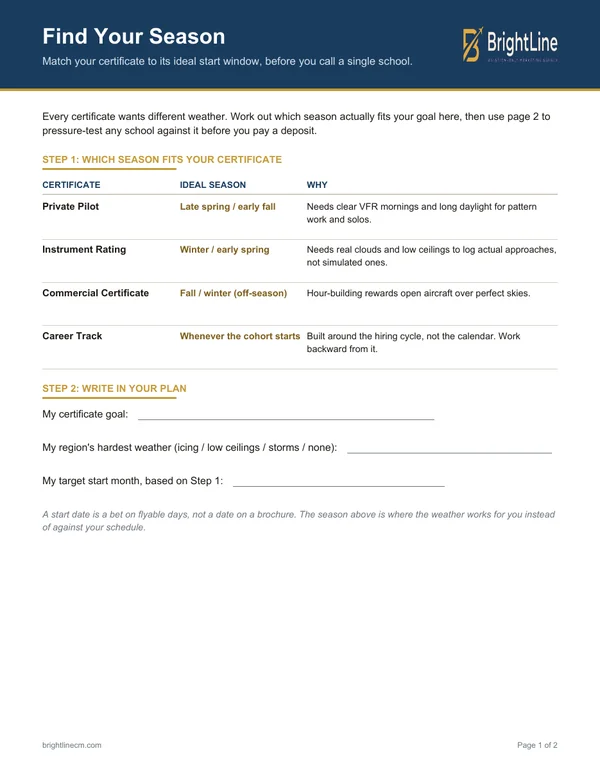
Free Worksheet
Find Your Season Worksheet
- Match your certificate to its ideal start season
- Write in your goal, your region’s weather, and a target month
- Six questions to ask every school before you pay a deposit
Pick the Season That Fits Your Goal, Then Commit
Choosing the best time of year to start flight school comes down to three variables you already control: your certificate, your climate, and your weekly calendar. Line those up and the start date stops being a guess.
A student who waits for a perfect month that never arrives loses more than a season. Skills fade between lessons, and a checkride pushed back once tends to slide again. Commit to a date that fits your life and the weather will follow.
Before any deposit changes hands, call two or three local schools. Ask one question: how many aircraft and instructors are free in your target month, and how many lessons did weather cancel last season? That answer tells you more than any brochure could. Then book the date and start flying.
FAQ
Flight School Start Date Questions, Answered
When should you start flight school?
Start when your weekly schedule can support at least two flights a week and your target season matches your certificate goal. A student who commits to a winter start in a cold climate often gets more aircraft access than a summer starter, because the fleet sits idle while everyone else competes for it.
Is it true that 80% of flight students quit?
The dropout rate is real and high, but the cause is usually momentum loss rather than talent or money. Students who let long gaps build between lessons after weather cancellations are the ones who stall out, so protecting your flying frequency matters more than picking a perfect month.
Does starting in winter slow down flight training?
Winter can slow training in regions with icing and low ceilings, but it often speeds it up elsewhere through better aircraft availability and denser air. A school with heated hangar access and a flexible instructor bench can keep a winter student flying while summer students wait on thunderstorms.