
3 Content Strategy for Flight Schools Moves That Fill Discovery Flights
TL;DR · The short answer4 key points
- A clear content strategy for flight schools focuses on answering prospective student questions before they attempt to book a flight.
- Prioritize itemized training cost breakdowns, dedicated rating pages, and optimized discovery flight booking pages.
- Eliminate generic aviation history posts and unlinked social content that fail to guide prospects into the enrollment funnel.
- Measure content performance by booked discovery flights and qualified enrollment leads rather than vanity pageviews.
A prospect types “how much does flight school cost” into a phone at a kitchen table. The school that answers first, in plain language, gets the discovery flight booking. That is why content strategy for flight schools lives or dies on sequencing.
Flight school sites usually fail at the opposite end. They publish fleet descriptions and campus tours for a reader who has not yet decided whether flying is affordable. The prospect leaves, and a forum thread answers instead.
This article names three content moves that carry enrollment: a cost answer, rating-specific course pages, and a discovery flight page built to book. It also names pages worth deleting. A working content strategy for flight schools starts with subtraction.
Why Most Flight School Content Never Books a Flight
Flight school sites are built like catalogs and read like them. The prospect who lands there is mid-decision, and the page answers a question they passed three clicks ago.
A prospect searches how much flight training costs or whether they can qualify with a medical condition. They land on a page listing the fleet, the hangar address, and the school’s founding year. Nothing on that page touches the question they typed, so they hit back and try the next result. The catalog isn’t wrong. It’s early. Course descriptions and aircraft inventories answer questions the prospect asks after they’ve decided to train, not before they’ve booked a discovery flight.
Regulation pages sit in the same trap. A prospect wants to know what the aeronautical experience requirements mean for their timeline. A page that dumps the legal text without translation loses them to a forum thread that explains it in plain English.
The fix is sequencing, not volume. Adding more pages to a catalog-shaped site just gives the prospect more places to leave. Content strategy for flight schools works when each page matches the decision the prospect is making at that moment.
That gap is where flight school marketing that fills classes is won or lost. The school that answers the pre-booking question earns the click. The school that describes its fleet earns a bounce.
The Three Content Moves That Fill Discovery Flights
Three pages carry the enrollment weight of an entire site. Everything else is support. A flight school that builds these three well will out-book a school publishing weekly posts that answer nothing a prospect is deciding on.
- Cost and eligibility answers. A prospect searching what training costs or whether they qualify needs a page that answers in plain terms. Land them on a tuition page that says costs vary and they leave for a forum.
- Rating-specific course pages. A private pilot search and an instrument rating search are different buyers. One page cannot serve both, and a generic course list ranks for neither.
- A discovery flight page built to book. This page converts or leaks. It states the price, what the flight includes, and puts the booking action above the fold.
The three core pages work together in a sequence. Cost answers stop the search. Rating pages narrow the choice. The discovery flight page closes it. Break any link and the prospect drops out before booking.
That sequencing is the whole game in flight school enrollment marketing. BrightLine Digital builds content strategy around these decision points rather than a publishing calendar. Audit your three pages this week and rewrite the weakest one first.
Answer the Cost Question Before They Ask It
Two tuition pages sit on two flight school sites, and only one of them keeps the prospect on the page. The vague page says costs vary and invites a call. The itemized page names what drives the total and lets the prospect do the math. The itemized page wins because it answers the question the prospect actually typed.

A vague tuition page feels safe to write. It protects the school from quoting a figure that shifts with fuel, aircraft availability, and instructor rates. That instinct is understandable, but it costs bookings anyway, because the prospect who wanted a ballpark reads “costs vary” as evasion and opens a new tab.
An honest breakdown page does the opposite work. It separates the private pilot certificate from the commercial path, then explains what moves each total: aircraft rental rates, instructor time, checkride fees, and how often a student flies. Naming those variables signals the school has nothing to hide. It also gives the prospect a reason to call with a specific question instead of a vague one.
The honest page wins whenever the prospect is serious enough to compare schools. That reader is already searching for how much flight school costs and will find a real answer somewhere. BrightLine Digital builds this kind of aviation content strategy so the breakdown reads like guidance, not a price list, and the discovery flight button sits right under the total.
Rating-Specific Pages Beat One Generic Course List
A course catalog page tries to serve every prospect at once and ends up serving none. Each rating path answers a different search, a different fear, and a different booking decision.
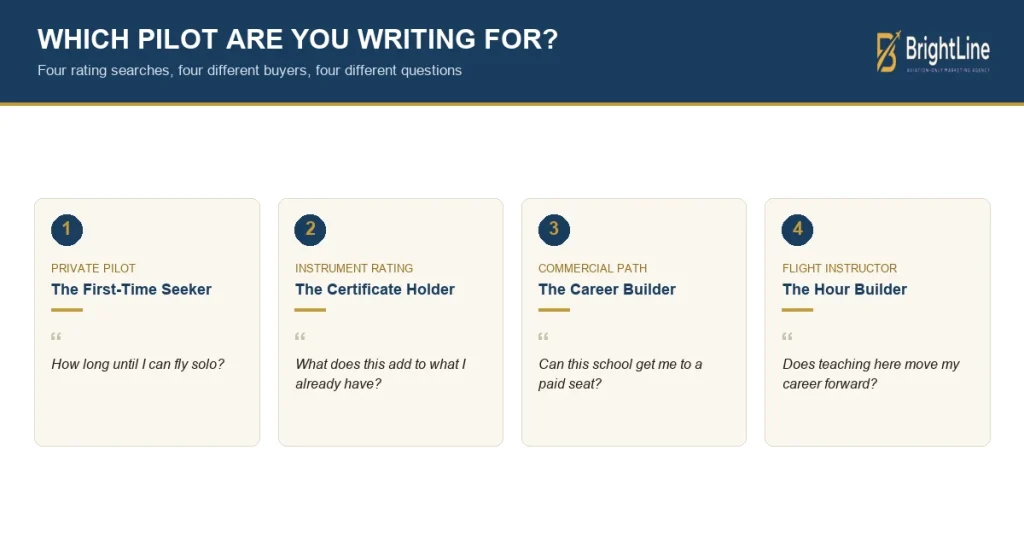
Private Pilot: The First-Time Seeker
This page answers the searcher who has never touched a logbook and does not know what a medical certificate is. It must state eligibility plainly and explain what the FAA hourly requirements mean in practice, not just cite them. The question it earns the booking on: how long until I can fly solo?
Instrument Rating: The Certificate Holder
Someone who already holds a private certificate is not shopping for a school the way a beginner is. This page must answer what changes for a rated pilot and why the rating matters for real weather flying. The question it earns the booking on: what does this add to what I already have?
Commercial Path: The Career Builder
Commercial prospects are buying an outcome, not a course. This page must name the flying jobs the certificate opens and the timeline a career changer should expect. The question it earns the booking on: can this school actually get me to a paid seat?
Flight Instructor: The Hour Builder
CFI prospects are pilots chasing hours toward an airline job. This page must explain how instructing builds time while it builds skill. The question it earns the booking on: does teaching here move my career forward?
Four pages, four distinct searches, four different booking decisions. A single catalog page competes for none of them, and flight school website design that treats ratings as one lump loses the prospect who searched a specific path.
The Discovery Flight Page Is Your Real Landing Page
Traffic lands on the homepage and wanders. The discovery flight page is where a content strategy for flight schools converts or leaks, and most schools bury it two clicks deep. A prospect who reaches that page has already decided to consider flying. Every missing detail is a reason to close the tab.
- What the flight includes. State the aircraft, the instructor time, and the total duration.
- Price stated up front. A hidden price reads as a bait-and-switch.
- Booking action above the fold. Visible without scrolling, on mobile first.
- Safety and nerves answered. Explain what happens on the ground before takeoff and who flies with them.
- A path for the unsure prospect. Offer a callback or a downloadable guide.
- One clear next step. Competing calls to action stall the decision.
None of these items describe the school, the fleet, or the history. Each one removes a specific reason to leave, which is the entire job of a page built to book.
BrightLine Digital’s aviation web design and conversion work treats that page as the conversion surface, not the homepage. The same discipline applies to local SEO versus paid ads: send the right traffic to a page that closes.
Open your discovery flight page on a phone. Find the price, the booking button, and the safety answer without scrolling past the first screen. Fix whatever is missing before writing another blog post.
Content That Does Not Make the Cut, and Why
Cutting content feels like losing ground, so schools keep publishing pages that were never going to book a flight. Every hour spent on a post nobody books from is an hour not spent on the cost page or the discovery flight page. The cut is the strategy.

- Generic aviation history posts. A piece on the Wright brothers or the physics of lift pulls in readers who are curious, not committed. They read, they leave, and they never had a reason to book.
- Social posts with no booking path. A photo of a cockpit at sunset earns likes from people who already fly. Without a link to the discovery flight page, the post ends where it started.
- Blog archives built for volume. Publishing daily to look active produces pages that answer nothing a prospect is deciding on. A thin archive also drags down the pages that do convert.
- International student pages too early. Writing for visa applicants before the school can actually support the process sends prospects into a dead end. It also invites flight school review management problems when expectations break.
Read the list again and the pattern is the same in every item. Each one attracts attention without a decision attached, and attention that never converts is a cost, not an asset. Pick the weakest page on the site this week and either rewrite it toward a booking or take it down.
Measure Content by Booked Flights, Not Pageviews
A page with heavy traffic and no bookings is a liability wearing a success costume. Pageviews reward a flight school for being interesting. Bookings reward it for being useful. A content strategy for flight schools that confuses them will keep publishing pages that flatter the dashboard and starve the schedule.
Time on page is the worst offender. A prospect who lingers on a tuition page for minutes may be confused, not convinced. They are scrolling for a figure the page refuses to give. High dwell time on a vague page is a symptom of a problem, not proof of engagement.
The mechanism that fixes this is unglamorous. Tag the discovery flight booking action in Google Analytics or your CRM, then trace which pages a prospect touched before that booking. A cost page in the path of booked flights is earning its keep. A history post that draws readers who never touch the booking flow is not.
Judging pages by bookings changes what gets written next. A page that pulls traffic but no bookings gets rewritten around the questions that precede a booking, or it gets cut. That discipline separates a flight school local SEO company from a content vendor that reports impressions and calls that a win.
BrightLine Digital reports monthly on traffic, rankings, and qualified leads, the standard any flight school should demand. Ask a partner what a page booked, not how many people read it. The answer reshapes the whole calendar.
Pick One Move and Ship It This Month
Content strategy for flight schools comes down to a short list of pages that do the enrollment work. You now know which pages carry that weight and which ones were never going to book a flight.
Waiting costs you prospects. Every week your cost page dodges the tuition question, a serious applicant books a discovery flight somewhere else. Fixing that page is the highest-return work on your site right now. Open your cost page and your discovery flight page side by side. Read them as a prospect would. Rewrite the weaker one before you publish anything new.
FAQ
Questions Flight School Owners Ask About Content
Is it true that 80% of flight students quit?
No published FAA figure supports that exact number, though student pilot attrition is genuinely high and every school feels it. The content lever is expectation-setting: a cost page that names the real total and a discovery flight page that describes the first lesson honestly lose the wrong prospect early and keep the right one enrolled.
How long before a new content page starts booking discovery flights?
A rewritten cost or discovery flight page can start producing bookings within weeks because it targets people already searching for that answer. A brand new rating page sits longer, since search engines need time to trust it and rank it against established competitors.
Should a flight school blog about aviation news or about training questions?
Training questions win, because the person searching how long a private certificate takes is closer to booking than someone reading about an airline merger. Aviation news pulls a broad audience that rarely converts, and it competes with national outlets that will always outrank a local school.
Does content strategy for flight schools work for a small school with one location?
It works better for a single-location school, because local search intent is narrow and a well-built cost page can own it without a large content budget. A small school’s advantage is specificity: naming its actual airport, its actual instructors, and its actual aircraft beats a generic national site every time.