7 Flight School Admission Requirements for International Students
ℹ️ TL;DR
- Navigating flight school admission requirements for international students involves clearing seven separate gates controlled by distinct regulatory and government authorities.
- Select the proper visa type (M-1 for vocational flight training or F-1 for degree tracks) and submit your TSA Alien Flight Student Program (AFSP) application as early as possible.
- Obtain your FAA Medical Certificate from a designated Aviation Medical Examiner in your home country before paying non-refundable tuition deposits.
- Prepare financial statements and notarized sponsor letters that show liquid funds for both full flight training tuition and living expenses.
- Verify spoken aviation English proficiency and confirm academic transcript equivalency with your chosen Part 141 flight academy before booking your embassy interview.
Seven authorities decide whether you fly. The school is only one, and holds the least power.
Flight school admission requirements for international students get flattened into a single checklist by nearly every guide online. That framing is wrong. A passport office, a consular officer, a TSA analyst, an English examiner, a medical examiner, a bank, and a credential evaluator each control a separate gate.
Here you’ll find each gate walked in the order it blocks you, from passport and visa through TSA clearance, English, medical, funds, and academics. One gate failing stalls every gate behind it. Each gate has its own clock. A passport renewal can take longer than a visa interview slot stays open, and a medical certificate expires before a cohort starts.
Why Admission Is Seven Gates, Not One Checklist
Flight school admission requirements for international students are not a list you work through at your own pace. They are a stack of gates, each one controlled by a different authority, and the gate you don’t control decides whether the others matter at all.
Schools control the easy ones. They review your transcripts, your English evidence, your bank statements, and they issue the paperwork that lets you apply for everything else. The US government controls the hard ones: your visa category, your TSA security threat assessment, and the entry decision at the border. A designated aviation medical examiner controls the gate that can end the whole plan. A school acceptance letter carries no legal weight with any of them.
That distinction explains why applicants with strong files still lose semesters. They treat a school offer as the finish line, pay a deposit, book flights, then discover the TSA assessment runs on its own clock and hasn’t been started. One stalled government gate freezes every gate behind it, including the ones the school already cleared.
Sequence matters more than speed here. Starting your medical in your home country while your visa paperwork sits in a queue costs you nothing. Waiting until you land to schedule it can cost you a cohort start.
Seeing all seven gates upfront is the cheapest protection you have. Applicants who map every gate before paying a deposit rarely end up asking for a refund.
The seven gates are passport and visa, TSA clearance, English proficiency, medical certification, proof of funds, academic equivalency, and the school’s own enrollment review. They do not run in parallel. They run in the order the slowest one allows.
Use the free tracker below to mark where you stand on each gate. It shows how ready you are, names your slowest gate, and gives you a personal checklist you can download as a PDF.
 Free Interactive Tool
The BrightLine 7-Gate Admission Tracker
Mark where you are on each gate. You will see how ready you are, which gate to start first, and you can download your personal checklist as a PDF.
Start by marking each gate below.
Download Your Admission Checklist (PDF)
Your gate results, the documents still missing, and the order to tackle them. We will also email you a copy.
A free tool by BrightLine Admissions, built for international student pilots.
Passport, Visa Type, and the TSA Clearance Nobody Mentions
Flight school admission requirements for international students start with two documents you cannot substitute. A passport proves who you are. A visa category decides what you’re allowed to train toward. Then there’s a third approval most guides never print, and it runs on its own clock whether you’re ready or not.
Passport Validity
Your passport must stay valid through your entire training period, not just your arrival date. A passport expiring mid-program creates a renewal problem in a foreign country, which stalls your flight hours while you wait on paperwork. Check the expiration date before you apply anywhere. Renewing at home takes weeks you won’t have once you’re enrolled.
Choosing Between M-1 and F-1
Department of Homeland Security (DHS) regulations require most foreign students to attend aviation flight training on M-1 student visas, built for vocational programs. Some schools hold authorization for both categories. Phoenix East Aviation operates as one of only four flight schools in the U.S. offering both the F-1 and M-1 visa to international students, which matters if your long-term plan includes a degree pathway alongside your ratings. Confirm which category your school can issue before you build a timeline around it.
The TSA AFSP Step
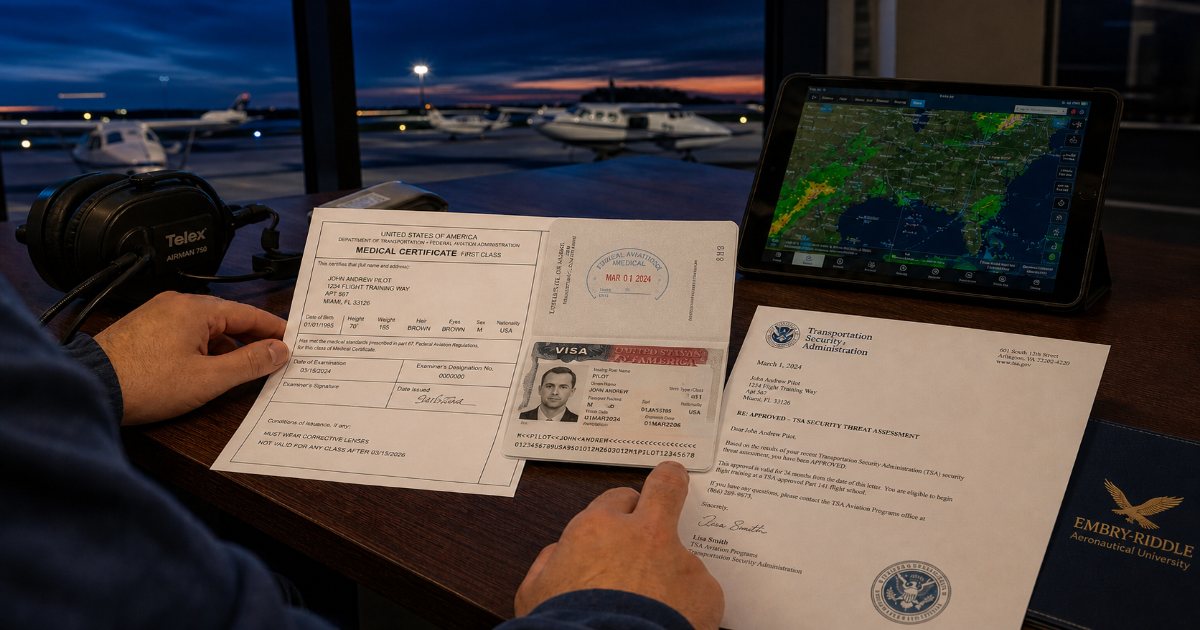
The TSA Alien Flight Student Program security threat assessment is a separate government approval, not the same thing as your visa. A school acceptance letter means nothing until this clears, and it can invalidate that acceptance if you start it too late. Training cannot begin until the assessment is approved, so treat it as the gate with the longest fuse. Verify current processing expectations directly, since these timelines shift.
Sequence these three correctly and the rest of your application moves. Get the order wrong and you’ll be rebooking interviews while your cohort start date passes. Schools that publish clear visa and TSA requirements upfront save applicants from discovering this at the worst possible moment.
Late AFSP submissions are the quiet killer of start dates. A student who books a flight, pays a deposit, and lands in Florida before the assessment clears sits grounded for weeks. The visa was approved. The school was ready. The TSA was not.
Start the AFSP application the same week your school issues your acceptance. Verify current processing times directly with the TSA before you book anything nonrefundable, because that window moves and no third-party guide tracks it accurately.
English Proficiency: The Gate That Fails Quietly
English proficiency for pilots is the requirement applicants assume they already meet, and the one that stalls them after arrival. A written test score proves you can read a manual. It says nothing about whether you can hear a controller through cockpit noise and answer in three seconds. Schools screen this gate three ways.
- Standard test scores. TOEFL or IELTS results satisfy the paperwork side of admission. They measure reading, writing, and listening comprehension, which is why a strong score can still leave oral fluency unverified.
- Aviation oral interview. An aviation-specific oral proficiency interview, often the OPI, puts you in a live spoken exchange. This test exposes applicants who studied for a written exam instead of practicing speech.
- Intensive English course. A conditional path lets you enroll in an intensive fluency course and satisfy the requirement with a passing grade. It buys time, not a guarantee.
- Retake after the course. Upon passing the Intensive English Fluency course with a grade of B or higher, the student must demonstrate improved oral language proficiency by retaking the admissions tests. The course can be repeated until the level is met.
- Pre-document screening. Schools increasingly test spoken fluency before issuing an I-20 or acceptance letter. Failing here costs you a semester, not a flight lesson.
Every path routes back to spoken performance. A 110 TOEFL score clears the written bar and still leaves you exposed at the oral interview. Written fluency and cockpit fluency are separate skills, and only one of them keeps you flying. Confirm which oral test your target school accepts before you book anything. Then practice speaking aviation English out loud, not reading it silently.
FAA regulations require a certain level of English for any pilot certificate. The practical test standards demand you read, speak, and understand English on the checkride. An examiner can discontinue a practical test if communication breaks down.
Practice spoken aviation English before you leave home. Listen to live ATC feeds. Repeat clearances out loud until the phrasing feels automatic. The written score gets you admitted; the spoken word gets you certificated.
Medical Certification You Can Start Before You Fly
International students treat the medical certificate as something that happens after arrival. That instinct is backwards, and it costs them seats. The FAA medical certificate is the one admission requirement for international students that you can complete from your home country before you ever board a plane.
Designated aviation medical examiners operate worldwide, and the FAA maintains a searchable directory of them by country. An applicant in Lagos, Manila, or São Paulo can book the exam locally and hold a decision before the school issues documents. Waiting until you land in Florida or Arizona means you’ve already paid tuition and rent on a training path you might not be cleared to fly.
The class of medical you need depends entirely on the career you’re chasing. A Third-Class certificate covers private pilot privileges. A Second-Class is required to exercise commercial pilot privileges. A First-Class is what airline track training demands, and it carries stricter vision and cardiovascular standards. Holding the wrong class doesn’t block training outright, but it caps the certificates you can earn, which is a problem you discover late.
A medical deferral is the hardest gate to reverse. Unlike a visa refusal, which you can answer with corrected evidence, a deferred medical often requires specialist evaluations, months of waiting, and a decision that may not go your way. Resolve it before you wire a deposit, not after.
Ask your school for its medical guidance in writing, and arrive with a medical decision in hand instead of a question mark. Start the exam now, before the deposit, before the I-20, before the visa interview. The gate you clear first is the one that never blocks the others.
Proof of Funds: What International Bank Statements Must Show
A bank balance that satisfies the tuition number can still fail review, because flight school admission requirements for international students treat money as a paper trail, not a total. Proof of financial means to fund pilot training is a stated requirement at most international programs, and the officer reading your file wants the documents to match each other. Here is what a clean financial file actually contains.
- Statement in your name. The account holder must match the applicant or the named sponsor, with no third party in between.
- Notarized sponsor letter. It states the relationship and the exact amount committed, so the officer can trace the money to a person.
- Escrow or blocked account. Families who prefer staged releases use this to show committed funds without handing over everything at once.
- Statement date inside the window. A statement dated months before your interview reads as stale and invites a request for fresh documents.
- Currency stated plainly. Convert to US dollars and label the conversion, so nobody has to guess what the balance is worth.
- Consistent numbers across forms. The figure on your I-20, your bank letter, and your visa application must be the same figure.
The trap is that proof of funds documentation fails on mismatches, not shortfalls. A sponsor letter naming one amount while the bank statement shows another stalls a file that had enough money the whole time.
Pull your proof of financial means together before you request any school document, and check the date and currency against the school’s written instructions. Send what they asked for, not what the bank printed.
The counter-argument sounds reasonable: a larger balance should override a messy paper trail. It does not. Officers approve files they can verify, not files that impress them.
Fix the mismatch before you submit anything. Ask the sponsor to reissue the letter with the exact figure on the bank statement, then confirm the I-20 carries that same number. Three documents, one number, no questions.
Academic Records and the Equivalency Trap
Two schools can read the same transcript and reach opposite verdicts, which is why flight school admission requirements for international students stall hardest at the academic gate. One school judges your credential equivalent on sight. Another demands a third-party report before issuing a single document. The difference decides your timeline, not your grades.
Direct evaluation is the faster path. A school that accepts a certificate from any country once judged equivalent to a US high school diploma or GED keeps the process in-house. Your registrar reads the file, makes the call, and moves you forward. That works when your credential maps cleanly and your school trusts its own judgment.
Third-party evaluation is the slower path, and it exists for a reason. Schools requiring a formal report from an evaluation service are protecting themselves from credentials they cannot verify. Your national exam result does not automatically map to the US standard. A strong grade in a rigorous system can still land short of equivalency once a service converts it, and that gap surfaces only after you have paid the fee and waited.
A clean submission looks identical in both cases. Certified translations of every document, transcripts sealed by the issuing institution, and an evaluation service report if the school asks. The certificate of secondary education can come from any country, but the paperwork must arrive in the format the school specified.
Confirm the equivalency standard before you order anything. Ask the admissions office: do you evaluate credentials in-house, or require a third-party report? That answer tells you whether you need translations this week or an evaluation service with a multi-week queue. Ordering the wrong version costs weeks you cannot recover before a cohort start date.
Schools that publish their academic enrollment standards clearly save applicants that wasted cycle. The ones that bury the requirement behind a generic admissions page are the ones whose applicants discover the trap after the deposit clears.
What Does Not Count as an Admission Requirement
Applicants routinely hand a flight school credit for progress the government never granted. A discovery flight, a warm email from a recruiter, a deposit receipt, none of these touch the international admissions process in any binding way. The authorities that control your entry do not read your inbox.
- A discovery flight booking. Sitting in a cockpit for an hour feels like a commitment. It generates no document, no record, and no standing with a consular officer or a medical examiner.
- A recruiter’s verbal promise. “You’re a strong candidate” is a sales line, not an admission decision. Unless the school issues a written acceptance or an I-20, nothing has happened.
- A current student’s social post. A photo from the ramp at a flight school tells you the weather was good that day. It carries zero weight with the TSA, the embassy, or the FAA.
- A deposit paid too early. Wiring tuition before the government-side gates clear is the most expensive mistake on this list. A deposit does not accelerate a visa interview or a security assessment.
- A verbal medical assurance. A staff member saying “you’ll pass” is not a certificate. Only a designated aviation medical examiner issues that, and only after an actual examination.
Read the list again and the pattern is obvious. Every item on it is something you did, not something an authority granted. Progress in this process is measured by documents with signatures, dates, and reference numbers, nothing else.
Track written confirmations from the school and the government agencies, and treat everything else as noise. If a school cannot show you its binding requirements in writing, ask for them before you pay. The BrightLine admissions team maps every gate with you, so you plan around the slowest one instead of paying a deposit and waiting.
Build Your Application Around the Slowest Gate
Flight school admission requirements for international students do not carry equal weight, and the gate with the longest clock should own your calendar. A school deposit deadline is a marketing date. A TSA assessment or a medical deferral runs on its own schedule, and it does not care when your cohort starts.
Applicants who start the slow gate first protect their seat. Applicants who pay a deposit to feel committed, then begin the government paperwork, watch a start date slide by a full term while their money sits with the school.
Money paid before the slowest gate clears buys nothing but anxiety. Name your slowest gate with the 7-gate tracker above. Start it this week. Get written confirmation from the school and the agency that controls it before you send a single dollar.
International Flight School Admission Questions, Answered
Which visa do most international students need for flight training?
The M-1 student visa covers most foreign students enrolled in aviation flight training programs in the United States. A small number of schools hold authorization to issue both the F-1 and the M-1, which matters because the two categories carry different rules on duration of stay and employment.
Is the TSA security assessment separate from the student visa?
Yes, and it runs on its own clock entirely. The Alien Flight Student Program assessment is a Department of Homeland Security process that a school cannot approve, waive, or speed up on your behalf, so a visa in hand does not mean you are cleared to begin training.
Can an FAA medical certificate be obtained in the applicant’s home country?
It can, provided you book with a designated aviation medical examiner who holds FAA authorization. That examiner may sit in another country entirely, which means the medical gate is the one admission requirement you can close before you ever board a plane to the United States.
What proof of funds does a flight school accept from an international bank?
A bank statement in your name or your sponsor’s name, paired with a notarized sponsor letter stating the relationship and the amount committed. Some families use an escrow or blocked account instead, releasing funds in stages as training progresses rather than handing the school a lump sum upfront.