M-1 Visa Interview Questions for Flight School: Prep vs. Panic
TL;DR
- M-1 visa interview questions for flight school test your file consistency and intent to return rather than technical aviation knowledge.
- Consular officers evaluate whether your vocal answers directly align with your official I-20 form and financial documentation.
- Explain the specific source and paper trail behind your bank balance to satisfy officer financial scrutiny without hesitation.
- Demonstrate strong ties to your home country by providing concrete career destinations like prospective airline employers or family businesses.
- Practice fluent, conversational answers instead of memorized scripts so you can navigate unexpected follow-up questions calmly.
The interview invitation arrives, and the applicant starts memorizing answers from a forum. Then the officer asks something different, and the script collapses.
That gap between rehearsal and real preparation is where M-1 visa interview questions for flight school trip up qualified applicants. The officer is not testing aviation knowledge. They are testing whether your story holds together. Most guides hand you generic student visa questions. That fails because it treats the interview as a quiz instead of a consistency check.
This article breaks the M-1 flight school interview into two parts: proving you understand the vocational training path, and proving you have a reason to leave when it ends. Here you’ll find the question categories that decide cases, and how to answer without sounding rehearsed.
What the Officer Is Actually Scoring
The M-1 visa interview questions for flight school trip up applicants who studied aviation facts instead of their own paperwork. The officer behind the glass does not care how a carburetor works. That officer is scoring two things, and neither one is technical knowledge.
First, whether your flight school plan is genuine and specific. Second, whether you have a credible reason to leave the US when the training ends. Everything else in the interview is evidence for those two questions.
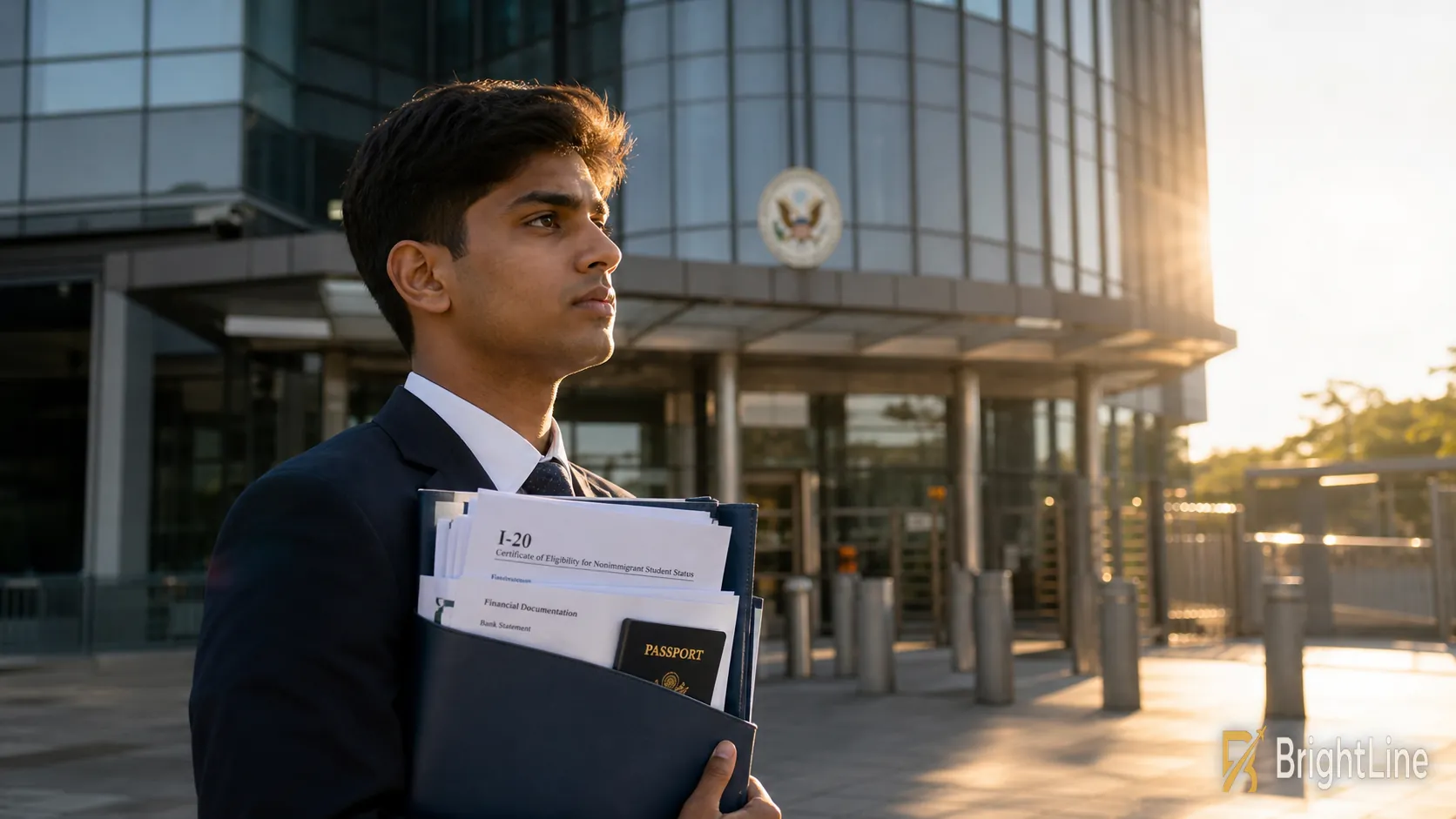
A consular officer reads your file as one story, not as separate documents. Your I-20 lists a program and a start date. Your bank statement names a funding source. Your verbal answers either match that story or contradict it. The official guidance on preparing for a visa interview frames the conversation as a chance to explain your intent, not to recite facts.
This is why a memorized answer to a common question collapses. You can deliver a polished line about loving aviation and still fail, because that line connects to nothing in your file. The officer hears a script. A script signals rehearsal, and rehearsal signals something to hide.
Answers that hold up are the ones that trace back to a document the officer is already holding. Name the school on your I-20. Name the person funding the training. Name the job waiting at home. Each answer should feel like a page from the same story.
Flight schools that treat interview prep as an afterthought pay for it later. BrightLine Digital works with international flight school admissions teams to prepare applicants before the interview, not after a denial forces a second attempt. The M-1 visa for flight school rewards applicants who understand what is being measured. Walk in knowing the two questions the officer is actually asking. The applicant who can answer both, using the documents in the file, never needs a script.
The Questions That Decide Your M-1 Case
The M-1 visa interview questions for flight school that sink applicants are not the exotic ones. They are the predictable ones answered badly, usually because the applicant rehearsed a sentence instead of building a position. Officers ask the same five things in nearly every window, and the file behind the answer is what gets scored.
- Why this school. The officer is testing whether the choice was researched or inherited. A friend’s recommendation is not a reason. A Part 141 syllabus, a fleet, and a start date you can name are.
- Why this program. This separates applicants who understand the training path from those who bought a product. You should be able to explain what the certificate qualifies you to do and how long the syllabus runs.
- What happens after training. The officer wants a destination, not an aspiration. Name the role, the employer type, and the country where you intend to use the certificate.
- Who is paying. Funding questions test traceability, not generosity. You should be able to describe the source of the money and how it was accumulated without reading from a note.
- What ties you home. This is the intent-to-return question wearing different clothes. A family business, a pending job offer, or a national carrier pipeline all work. A general statement about loving your country does not.
Read the five together and the pattern is obvious. Each answer has to line up with the student visa interview guidance schools hand out, your DS-160 form for M-1 visa entries, your I-20, and your bank documents. One contradiction between what you say and what the paperwork shows is enough to end the interview.
Consistency across the whole file is the actual test, not any single answer. An officer who hears a polished answer that does not match the I-20 start date learns something worse than ignorance. They learn the applicant is performing.
Before the interview, read your own documents as a stranger would. If any answer you plan to give cannot be traced to a line in that file, rewrite the answer, not the document.
Why This School, Why This Program
Two applicants walk into the same window with the same M-1 visa interview questions for flight school ahead of them. One picked a school because tuition was cheap or a friend trained there. The other can explain why a Part 141 program fits a specific goal and timeline. The officer hears the difference in the first thirty seconds.
The cheap-school applicant answers “why this school” with a shrug and a price. That answer tells the officer the training decision was financial, not vocational, and that a financial decision is easy to abandon. When the follow-up lands, the applicant has nothing to point to except a friend’s recommendation.
The Part 141 applicant answers with structure. A Part 141 school runs a syllabus approved under FAA-approved pilot school standards, which means the program has a defined sequence, a stated hour requirement, and a completion timeline. That gives the applicant a concrete answer about how long training takes and what the certificate requires. The certification is a fact the applicant points to, not a claim they have to sell.
This matters more than most applicants realize. A Part 61 instructor can teach anyone who pays, on a schedule that drifts. A Part 141 syllabus locks the school to a curriculum the FAA has reviewed. If you plan to become a pilot in the USA and return home with a commercial certificate, that structure is the difference between a defensible timeline and a vague promise.
Choose the Part 141 program when your goal is a certificate on a fixed schedule and your funding depends on a known end date. Choose a Part 61 path only when you can explain the flexibility as a deliberate advantage, not a fallback. The officer is not grading your taste in schools. They are checking whether your plan survives one follow-up question.
Funding Answers That Hold Up Under Pressure
Money questions expose the gap between an applicant who understands their own file and one who memorized a script about family support. The officer is not auditing your bank balance for an M-1 visa. They are testing whether the money has a name, a source, and a paper trail you can describe out loud.
Funds that exist on a statement but cannot be explained in conversation read as borrowed for the interview. Here is what you need to speak to without glancing at a note.
- Who is paying. Name the person or account, and state their relationship to you plainly.
- What the funder does. A salaried engineer, a business owner, a retired officer, each carries a different story.
- How the money accumulated. Savings, property sale, business income, or a dedicated education account.
- What the program cost covers. Tuition, aircraft rental, instructor hours, exams, and living expenses separately.
- Where the shortfall sits. If the total exceeds the balance, explain the plan for the remainder.
- Who else depends on these funds. A shared account with siblings or a spouse changes how the officer reads it.
- What happens if training runs long. Weather delays and checkride retakes extend cost, so show a buffer.
Read together, these items build a single narrative the officer can verify against your documents. A vague answer about family support collapses that narrative even when the statement is solid, because the officer cannot trace the money to a person who will actually pay.
DHS guidance on M-1 vocational student requirements treats financial evidence as part of the same credibility file as your I-20. Prepare the funding story before the interview, not during it, and rehearse it until the details arrive without hesitation.
Intent to Return: The Hardest Question
M-1 visa interview questions for flight school get harder the moment the officer stops asking about training and starts asking what happens after it. A commercial pilot certificate reads to a consular officer as a work credential, not a hobby.
An academic student can lean on a four-year degree and a vague plan to return. Flight training gives you no such cushion. The program is short, the credential is job-focused, and the officer knows a licensed pilot can walk into a cockpit anywhere. Your job is to show why that cockpit is in your home country.
Concrete ties beat sentiment every time. A standing job offer from a regional carrier, a family aviation business waiting for a second pilot, or a national airline cadet pipeline you were accepted into all work. So does a documented FAA to GACA license conversion path, because it proves you researched how your new certificate functions at home.
Country-specific detail separates a credible answer from a rehearsed one. A Filipino applicant can name the Philippine Airlines cadet program and its bond terms. A Nigerian applicant can point to a charter operator in Lagos that employs two of his cousins.
Rules around vocational students and their obligations are published through the SEVIS student guidance, and knowing them helps you speak about your status without hesitation. Hesitation reads as doubt. Doubt reads as a hidden immigration plan.
Here is the trap. An applicant with a strong job offer at home can still fail by delivering it like a memorized line. The officer will interrupt, ask for the company name, ask who owns it, ask what the salary is. If the answer wobbles, the offer sounds invented.
Rehearse the specifics until they sound like facts you live with. A return plan with names, companies, and dates survives follow-up questioning. A return plan built on emotion does not. The officer is not testing your patriotism. The officer is testing whether your story holds when pushed.
M-1 vs F-1: Which Interview You Are Facing
| Dimension | M-1 Vocational | F-1 Academic |
|---|---|---|
| What the visa covers | Flight training toward a certificate or rating | Degree coursework at a college or university |
| Training type | Vocational, job-focused, short duration | Academic, semester-based, multi-year |
| Intent-to-return framing | Certificate reads as a work credential | Degree reads as an education milestone |
| Post-training plan | Specific job, carrier, or license conversion | Career path tied to the degree field |
| SEVIS school role | Certifies vocational program and hours | Certifies academic program and enrollment |
The M-1 wins on speed and cost for a career-changer chasing a commercial certificate. The F-1 wins when the goal is a degree that opens doors beyond the cockpit. Pick the visa that matches the outcome you can actually defend.
Questions overlap between the two interviews. Framing does not. An applicant who rehearsed F-1 answers about a four-year degree walks into an M-1 window and describes a program the officer knows is short and vocational. The mismatch is instant.
Schools that get this right prepare applicants before the interview is booked, not after a refusal. BrightLine Digital’s international flight school admissions work helps schools route applicants toward the correct visa category from the start. The SEVIS school certification rules make that routing a school responsibility, not an applicant guess. Understanding the M-1 visa vs F-1 visa distinction is the first decision, not the last. Get the category wrong and every answer after it is built on sand.
Flight schools running both programs see this split constantly. A student admitted to a university aviation degree faces F-1 questions about their major and academic progress. A student enrolled purely for a commercial pilot certificate faces M-1 questions about the job waiting back home. Ask your school whether your I-20 is issued for F-1 or M-1 status. That single line determines which framing the officer applies before you say a word.
How to Impress Without Sounding Rehearsed
Building answers that survive interruption is the difference between an applicant who sounds coached and one who sounds certain. Rehearsal collapses the moment an officer rephrases a question, and that collapse is what turns a strong file into a flight school student visa denial.
Step 1. Write your full story in plain language, from the first reason aviation pulled you in to the specific job waiting at home. Read it back and cut every phrase you would not say out loud to a friend. This gives you raw material instead of a script.
Step 2. Match every answer against your I-20 and funding documents until nothing contradicts. A start date you cannot defend, or a sponsor whose name you stumble over, is the gap an officer probes hardest. Fix the paperwork before you fix the wording.
Step 3. Practice out loud with someone instructed to interrupt you mid-sentence. Officers cut in, redirect and revisit earlier answers. An answer that only works in sequence falls apart under that pressure. Ask your practice partner to challenge your weakest claim twice.
Step 4. Prepare the follow-up, not just the first answer. The opening response rarely decides the case; the second and third questions expose whether you actually understand your own plan. Rehearse the why behind each answer, not the answer alone.
Step 5. Know your TSA clearance status before the interview, since flight training sits under a separate security layer. The flight training security program rule governs how candidates clear before training begins, and an officer may ask where you stand. A confident, specific answer here signals you understand the whole process.
Fluency beats memorization because fluency adapts. An applicant who understands their own plan can answer a question they never anticipated, and that flexibility is what reads as credible. Schools that prepare candidates this way, rather than reacting after a refusal, send stronger applicants into every window. Preparation you can think through will always outperform preparation you can only recite.
Walk In Prepared, Not Scripted
Treating M-1 visa interview questions for flight school as a memory test guarantees the wrong outcome. The officer is reading your file as one story, and every answer either confirms it or breaks it.
Walk in with a story you can defend from any angle, and the follow-up questions stop being threats. Walk in with a script, and the first unexpected question exposes the gap between what you memorized and what your I-20 actually says. That gap is what ends cases.
Write your story in plain language tonight. Match it against your documents tomorrow. Then find someone who will interrupt you and practice until the answers come out fluent, not recited.
FAQ
M-1 Visa Interview Questions for Flight School: Your Questions Answered
What are the most common F1 visa interview questions?
The F-1 interview centers on academic intent: which degree program you chose, how you will pay for it, and what you plan to do after graduation. An M-1 visa interview for flight school swaps that academic frame for a vocational one, so the officer expects you to name a specific certificate rather than a major.
What are some common questions I’m asked during a student visa interview?
Expect questions about your school choice, your funding source, your ties to your home country, and your plans once training ends. The follow-up matters more than the opening question, because a consular officer will push on whichever answer sounds thin until it either holds or breaks.
What are the key differences between the F-1 and M-1 student visa programs?
The F-1 covers academic study at a college or university, while the M-1 covers vocational training like flight instruction at a Part 141 school. That vocational label changes how the officer reads your intent-to-return answer, since a commercial pilot certificate functions as a work credential in most countries.
How to impress a US visa officer?
Answer with specifics that match your paperwork, and let your story stay consistent from the first question to the last. An officer notices when your funding answer names a real source and your post-training plan names a real employer, because that combination is hard to fake under pressure.