SEVP-Approved Flight Schools List: How to Read It Right for F-1
TL;DR
- The official SEVP-approved flight schools list records federal eligibility to issue Form I-20, not flight school quality or ranking.
- Confirm specific F-1 or M-1 visa designations, as federal certification is granted per visa type rather than broadly across the school.
- Verify the flight training education level flag on a school’s federal profile to ensure they are approved for cockpit instruction.
- SEVP certification does not guarantee TSA security clearance, aircraft availability, or completion timelines.
- Check current SEVP certification standing via the federal search tool immediately prior to placing non-refundable deposits.
A flight school can appear on the federal SEVP-approved flight schools list and still be unable to enroll you. That gap between certification and eligibility is where international students lose deposits, semesters, and visa interviews they cannot get back.
The list everyone links to gets read like a ranking. It is not one. It is a compliance record, and the entries carry flags and category codes that determine whether a school can issue you a Form I-20 for the training you want.
This article shows you how to read the SEVP-approved flight schools list the way a school’s designated official reads it. You will learn which column decides your eligibility, why F-1 and M-1 change the answer, and how to confirm a school before you wire a deposit.
What the SEVP-Approved Flight Schools List Actually Certifies
SEVP certification is a federal approval that lets a school enroll nonimmigrant students in the United States. It is not a ranking, a recommendation, or a quality score. The SEVP-approved flight schools list is simply the record of who holds that approval, and reading it as anything more is the first mistake applicants make.
Certification happens at the school level, not the program level. A flight school can hold full SEVP certification and still have a specific course that is not approved for F-1 enrollment. The institution passed federal review. The course you want may not have. Applicants who assume the two travel together pay deposits on programs they cannot legally attend.
Only schools certified by the Student and Exchange Visitor Program can enroll F or M nonimmigrant students. A school earns that status by completing the Form I-17 petition online, and the federal school certification process is the gate every institution passes through. No certification means no Form I-20. No Form I-20 means no visa interview.
So what is SEVP approved, in plain terms? It means the school cleared a federal eligibility check to issue immigration documents. That is the entire promise. It says nothing about whether the school has working aircraft, available instructors, or a schedule that fits your timeline.
Certification can also be withdrawn. A school that appears on the list today may lose its status before your cohort starts, which makes the list a snapshot rather than a permanent guarantee. Verify the school’s current standing close to your enrollment date, not months before it.
Treat certification as the entry ticket, not the destination. It confirms the school can issue your I-20. Whether that I-20 covers flight training, and whether the school can actually finish your training, are separate questions you have to answer yourself.
Why F-1 and M-1 Change How You Read the List
Two students open the same SEVP-approved flight schools list, find the same school, and walk away with opposite answers about whether they can enroll. The difference sits in a single letter on their visa paperwork. Reading that letter wrong costs deposits, seat holds, and sometimes an entire intake cycle.
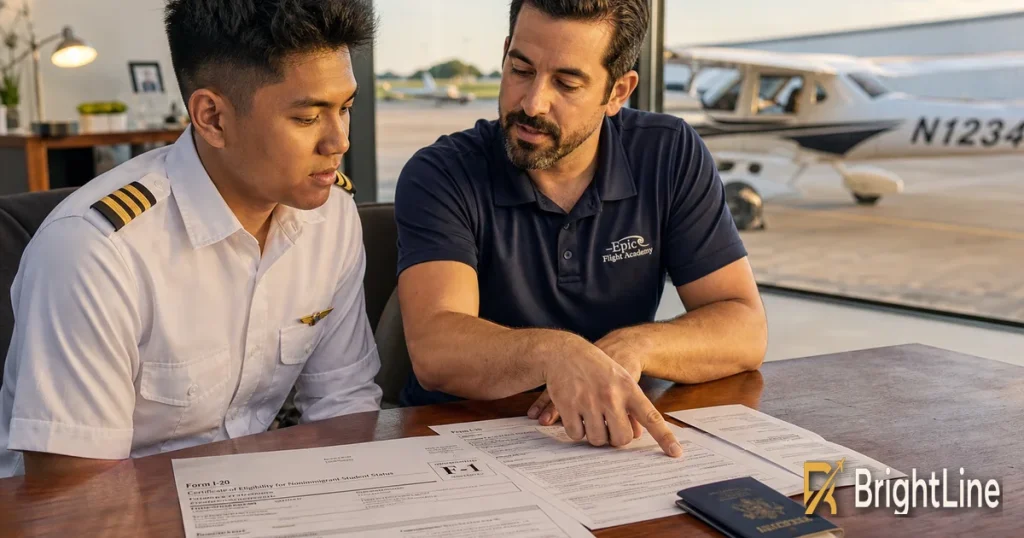
F-1 status covers academic study, tied to a degree-granting institution or recognized academic program. A university flight program, a four-year aviation degree with flight labs, or a community college aviation track typically routes through F-1. The course of study and type of school determine whether they need an F-1 visa (academic) or an M-1 visa (nonacademic, vocational), as laid out in the Foreign Affairs Manual on student visas. F-1 also carries longer authorized stay and clearer paths to practical training after graduation.
M-1 status covers vocational training, where standalone flight instruction usually lands. A Part 141 school teaching a private pilot certificate on its own, with no degree attached, reads as vocational to a consular officer. M-1 works well for that purpose, but comes with a fixed completion date and far less flexibility to extend training or add ratings later.
Here is the part that trips people up. A school can hold SEVP certification for M-1 enrollment only, and its name still appears on the list. Nothing warns you that your F-1 application will stall. The reverse happens too: a school certified for F-1 academic programs may not be approved to enroll M-1 vocational students at all.
Certification covers specific visa categories, not the school as a blanket approval. That single design choice is why the M-1 versus F-1 visa question has to be answered before you shortlist anything, not after.
F-1 wins if your goal includes a degree, a longer runway, or optional practical training after you finish. M-1 wins if you want focused vocational flight training and nothing else. Match the visa category to the training you actually want, then confirm the school carries that exact certification before you send money.
How to Search the Official List Without Getting Lost
The federal search tool is the only version of the SEVP-approved flight schools list that carries legal weight, and nearly everyone uses it wrong. They type a school name they heard from a friend or an agent, see it appear, and assume the search is finished. Name searches confirm existence. They don’t confirm eligibility.
Step 1. Filter by location first, not by name. Enter the state or metro area where you can realistically live and train for the length of your program. A school that matches your budget but sits three hours from your housing falls apart by month two.
Step 2. Set the education level filter to match your training goal. A university flight program and a standalone Part 141 school sit at different education levels in the same database. Getting this wrong returns results that look right and aren’t.
Step 3. Select your visa type before you read a single result. The School Search Map filters let you isolate schools certified for F-1, M-1, or both. This one filter eliminates most of the schools that would waste your application.
Step 4. Read the visa type shown on each result. A school certified only for F-1, or only for M-1, cannot enroll you under the other visa, no matter what its website claims.
Step 5. Cross-check the flight training flag on the school’s detail entry. Certification to enroll international students is separate from certification to enroll them specifically for flight training. Skipping this check is how deposits get paid on programs that can’t issue you a valid I-20.
The visa type is the part people skip because it looks like a minor detail. It isn’t. It’s the fastest eligibility read on the page, and for anyone researching becoming a pilot as an international student, it’s the difference between a shortlist and a wasted application cycle.
Run all five filters before you contact a single school. What you end up with is a verified shortlist, not a wish list, and every name on it can legally enroll you.
The Flight Training Column Most Applicants Never Check
A school can sit on the SEVP-approved flight schools list, hold full certification, and still be barred from enrolling you for flight training. The federal list carries a dedicated flight training level flag, and plenty of certified schools do not have it. Miss that column and your deposit buys you nothing.
Every SEVP-certified school gets a profile with education level flags attached. The published state certification records show the full set: private elementary, private middle, private high, public high, vocational technical, and flight training. A school certified only for vocational technical education can enroll M-1 students in ground courses. It cannot enroll you in the cockpit.
The flight training flag is a separate federal approval, not a bonus attached to general certification. A school has to petition for that specific education level, and the flag reflects what the government approved, not what the school advertises. Flight schools that added training programs after certification often carry a stale profile.
F-1 applicants feel this hardest. Flight training under an F-1 visa for flight training sits in a gray zone between academic and vocational categories, and a school flagged only for vocational technical education may not issue the I-20 you need. M-1 applicants face the reverse problem with schools flagged academic only.
Confirm the flag before any money moves. Pull the school’s profile on the official search tool, check the education level section, and ask the designated school official to confirm in writing that the flag covers your specific program. A school that hesitates on that request is telling you something.
The flag can change. Schools lose education level approvals during recertification reviews, and the list updates on its own schedule. What you verified last month may not hold by the time your I-20 is issued.
How a School Gets on the List and How It Falls Off
A school lands on the SEVP-approved flight schools list through a federal petition, a review, and a site visit. Applicants rarely trace that path, which is why they treat the list as permanent when it is closer to a snapshot.
Step 1. The school files Form I-17, the Petition for Approval of School for Attendance by Nonimmigrant Student, online. That petition is the school’s formal request to enroll F and M students, and nothing moves until it clears.
Step 2. SEVP reviews the petition against its governing regulations for school certification, found in the federal school certification rules. A petition that misses a regulatory requirement stalls before any student is ever named.
Step 3. A site visit confirms the school operates as described. Officials verify facilities, staff, and record-keeping, so a school that overstated its capacity gets caught here rather than after you enroll.
Step 4. SEVP grants certification and the school appears on the list. That approval is tied to specific education levels, not to the school’s reputation. A flight training flag is separate from general certification.
Step 5. The school recertifies on a recurring cycle to stay listed. Skip that cycle and the school drops off, which is why a list you saved last year may already be stale.
Step 6. SEVP can withdraw certification outright for regulatory violations or a failed review. A school removed mid-program leaves enrolled students scrambling for a transfer. That risk is real, not theoretical.
Reading the list correctly means treating it as a dated federal record, not a fixed guarantee. Confirm a school’s current certification and flight training flag before you commit a deposit, because the entry you found six months ago may no longer hold.
A school that loses certification mid-program forces its international students into a narrow window. You have limited time to transfer to another SEVP-approved flight school or risk falling out of F-1 status. That is the real cost of a stale list. Check the school’s certification date before you commit. Ask the admissions office when their next recertification cycle falls. A school that cannot answer clearly is telling you something.
What the List Does Not Tell You About a Flight School
Federal approval answers one question: can this school enroll a nonimmigrant student? It says nothing about whether the school can take you from zero hours to a commercial certificate.

Certification is not accreditation
A school can hold SEVP certification and carry no recognized accreditation at all. Accreditation comes from accrediting agencies recognized by the U.S. Department of Education, and it’s what makes your training transferable and your credentials defensible. Check both.
Certification does not clear you for flight training security
Your school’s federal approval has no bearing on your own TSA clearance. Flight training candidates must clear the Flight Training Security Program before a single lesson begins. A school can be fully certified and still turn you away at the ramp if your clearance never came through.
Certification says nothing about aircraft or instructors
A school with the right flags and a valid I-20 can still have two airworthy trainers and one CFI. That school cannot finish your instrument rating on your timeline. Ask about fleet count, instructor-to-student ratio, and dispatch reliability before you compare real flight school costs.
Certification does not guarantee your schedule survives
Weather, maintenance, and instructor turnover eat training calendars. Ask current students how often aircraft go down and how the school handles rescheduling. The list is a starting filter, not a decision. Use it to eliminate schools that legally cannot enroll you, then vet the ones that can.
Ask the school for its current pass rate on the checkride, not its marketing page. A certified school with a weak first-attempt rate will cost you retest fees and weeks of repeat training.
Verify the school’s certification status directly in the SEVP portal before you pay a deposit. The list updates, and a school that lost its certification won’t advertise that fact on its homepage.
Turning the SEVP-Approved Flight Schools List Into a Shortlist
A name on the federal list is a starting point, not a shortlist. The gap between those two things is where applicants waste weeks emailing schools that were never going to work for their visa category or their timeline. Five filters close that gap.
- Confirm the flight training flag. A school certified for general enrollment may not carry the flight training level flag you need.
- Confirm the visa category. Check whether the school is approved for F-1, M-1, or both before you assume it fits your case.
- Confirm Form I-20 issuance. A school must issue the I-20 for your specific program, not just hold general certification.
- Confirm the DSO responds. A designated school official who answers questions quickly signals a school that handles international students well.
- Confirm training capacity. Aircraft availability, instructor count, and scheduling all determine whether you finish on your timeline.
These filters work together, not in isolation. A school can carry the flight training flag and still have no DSO who responds to emails, or hold F-1 approval while running a schedule that stretches a certificate program across years. The list confirms federal eligibility. It says nothing about whether the school can actually deliver your training on the timeline you need.
BrightLine Digital builds admission packaging for international student pilots, and the flight schools that present this information clearly on their own websites save applicants a round of guesswork. A school that states its visa category, flight training flag, and I-20 process upfront filters itself in or out before you ever send an email.
Once your shortlist is tight, the next question is what happens after enrollment. USCIS guidance on student employment covers what F-1 and M-1 students can and cannot do while training, and it shapes decisions about how you fund the flight school process from start to finish.
Read the List Like a Filter, Not a Ranking
The federal record answers one question: can this school legally enroll you. Everything else, quality, aircraft availability, instructor depth, completion rates, lives outside that answer. Treating the list as a ranking is how students end up committed to a school that cannot finish their training.
Act on this before money moves. A deposit wired to a school that lacks the flight training flag or the right visa category is money you fight to recover. Verifying both takes minutes and costs nothing. Pull up your shortlist tonight. Check the flight training flag and the visa category for every school on it. Then pay. That sequence protects your investment.
FAQ
SEVP-Approved Flight Schools List Questions, Answered
Which schools in the USA are SEVP approved?
Every school on the SEVP-approved flight schools list holds federal certification to enroll nonimmigrant students, and that list is searchable through the official School Search tool rather than a downloadable ranking. Each entry also carries flags for education level, so a school certified for vocational training may show no flight training approval at all.
Which schools in New Jersey are SEVP-approved?
Filtering the federal School Search tool by state returns every certified institution in New Jersey, from universities to standalone flight academies. The state filter alone won’t tell you which of those schools can enroll you for flight training, because that requires reading the flight training flag on each individual entry.
What is SEVP approved?
SEVP approval means the Student and Exchange Visitor Program has certified a school to issue Form I-20 and enroll F or M nonimmigrant students. Certification is granted to the school, not to individual courses, so a school can hold approval while a specific program remains ineligible for your visa category.
How does a school become SEVP certified?
A school petitions the federal government through Form I-17, submits to a site visit and regulatory review, and must recertify on a recurring cycle to keep its standing. Certification can be withdrawn at any point, which means a school’s presence on the list reflects its status at the time of publication, not a permanent guarantee.