Flight School Visa Interview Sample Answers That Avoid Denial
TL;DR
- Reviewing authentic flight school visa interview sample answers helps applicants understand the core reasoning consular officers test during embassy appointments.
- Consular officers cross-check vocal answers against your DS-160, I-20, and financial documentation for consistency.
- Explain school choice using specific Part 141 syllabus details and fleet capabilities rather than generic praise.
- Establish non-immigrant intent by connecting flight training to a specific career role in your home country.
- Rehearse logical reasoning instead of memorizing scripted responses to handle unexpected follow-up questions smoothly.
The officer looks up from the DS-160 and asks why you chose this school. Your memorized paragraph about loving aviation dies in your throat, because the question was never about passion. Flight school visa interview sample answers only help when you understand the concern each one is built to neutralize.
Applicants collect answers from forums and rehearse them like lines. The officer has heard every one of those lines before, and a follow-up question exposes the gap between a script and actual reasoning.
This article pairs each model response with the officer concern behind the question and the follow-up it invites. You’ll learn to adapt the reasoning instead of reciting the words, so your answers hold up when the officer pushes further.
What a Sample Answer Actually Proves
A flight school visa interview sample answer is a model response that demonstrates the reasoning an officer is testing, not a line to memorize. It shows the logic behind a credible answer, so you can rebuild that logic in your own words when the officer changes the question. A sample answer copied verbatim from a forum gives you words without the reasoning, and the reasoning is the only part the officer is scoring.
Copying collapses the moment a follow-up arrives. You deliver the polished paragraph about loving aviation, the officer nods, then asks which aircraft in the school’s fleet you’ll train in first. The script has no answer. Officers ask follow-ups specifically to find out whether the first answer was yours.
Three things get scored: credibility, consistency, and intent to return. A strong sample answer satisfies one of those, and you need to know which. The school-choice answer proves credibility. The funding answer proves consistency against your documents. The return-plan answer proves intent. An answer that tries to prove all three at once proves none of them.
That’s why the samples ahead are organized by the concern each one addresses. Each pairs a model response with the officer’s underlying worry and the follow-up it invites. Official guidance on preparing for your visa interview treats the interview as a credibility check, not a recitation. Read each sample for the reasoning, then answer the questions that decide your case in your own words.
A sample answer also proves what the officer should not hear. Read enough and you notice the phrases that trigger doubt: vague funding talk, rehearsed enthusiasm, a school name dropped without a reason. Those phrases aren’t wrong on their own. They’re wrong when nothing behind them holds up. Use the samples as a filter, not a script. Mark which parts you could defend under pressure, then discard the rest. What survives is your answer.
Why This School, Why This Program
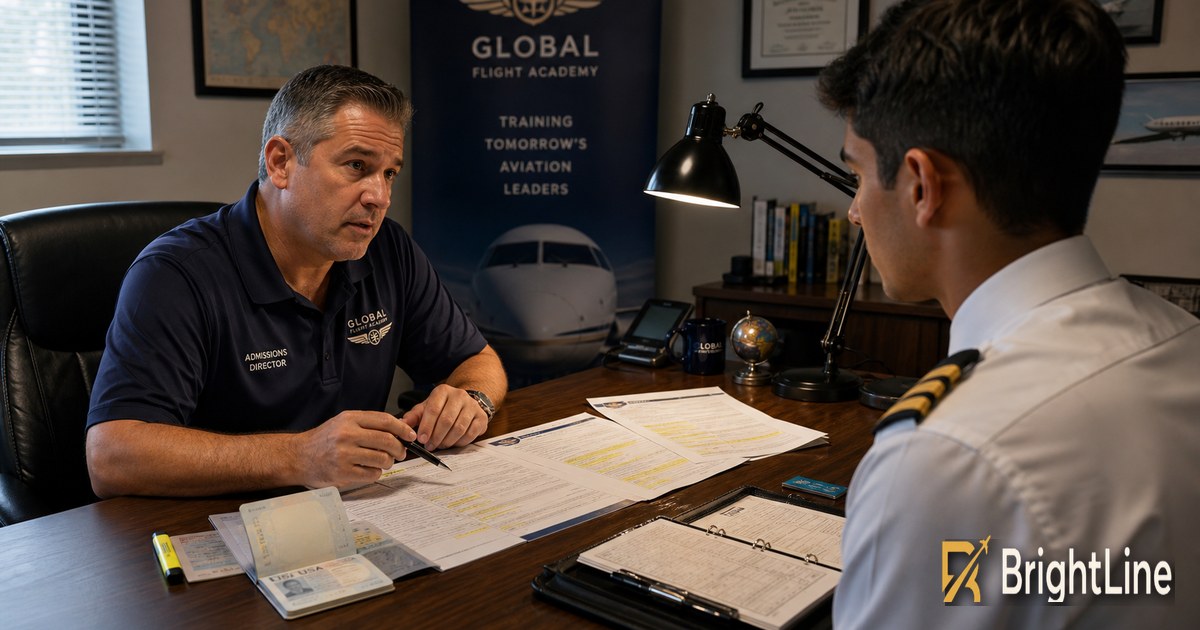
The officer asks why this school because the answer exposes whether you researched a program or bought the first I-20 in your inbox. A flight school visa interview sample answer separates applicants who can name a fleet from those who can only name a price.
A weak answer leans on cost or familiarity. The applicant says the school was affordable, or that a friend trained there, or that it was the first acceptance letter to arrive. Each tells the officer no real decision was made, and the school is interchangeable.
A strong answer ties the school to a specific program. It names the certificate path, the fleet the applicant will actually fly, and whether the school holds Part 141 approval. That approval matters because it changes training hour requirements and how progress gets tracked.
Consider a model response. “I chose this school for its Part 141 instrument rating program and its fleet of Cessna 172s with G1000 avionics, because I need glass-cockpit hours before I apply to a regional airline back home.” That answer names the school, the certificate, and one concrete career reason.
The follow-up is where memorized answers break. The officer will ask how the applicant found the program, or what the total training timeline looks like, or why a competing school with the same fleet was rejected. An applicant who researched the program can answer those follow-ups without pausing.
Applicants who skip this research often discover the mismatch late. The interview tests whether the applicant’s stated intent matches the school’s actual offering. Choosing a Part 141 school without knowing its approval status leaves that gap wide open.
BrightLine Digital’s international flight school admissions work helps schools package a program match that holds up under this exact line of questioning. The school that can hand an applicant the fleet details, the certificate path, and the approval status gives them an answer the officer cannot poke holes in.
A cheap I-20 with no program logic is the fastest route to a refusal. The school that fits the applicant’s career plan is the one worth naming, and the one worth defending.
Funding Answers That Hold Up Under Pressure
Funding questions are where well-prepared applicants still lose, because the officer is testing whether the money is real, liquid, and legitimately yours. A polished flight school visa interview sample answer on funding fails the moment the numbers don’t line up with the I-20. Your job is to confirm your documents out loud, not to perform.

- Source of funds. Name where the money came from: savings, a business, a salary, or a property sale. “My father’s business income” beats “family savings” because it gives the officer something to match against the bank statement.
- Account holder. State whose name sits on the account before the officer asks. If the funds sit in a parent’s account, say so and connect that person to you in the same breath.
- Amount versus the I-20. The figure you quote should cover the tuition and living costs listed on the form. A balance below the I-20 total invites a refusal, and the official US student visa rules make financial capacity a core requirement, not a formality.
- Sponsor relationship. Explain who the sponsor is to you and why they’re funding the training. “My uncle, who runs a charter operation and wants me flying for him” answers the relationship and the intent question at once.
- Liquidity. Officers want funds already available, not tied up in property or a future inheritance. If the money is in a fixed deposit, say when it matures and whether it’s accessible now.
- Consistency with paperwork. Every figure you speak should match the documents already submitted. A mismatch reads as fabrication, even when the money is genuine.
A confident funding answer is short, specific, and already reflected in the paperwork: “My father is sponsoring me. He’s a commercial pilot, and the funds are in his account, available now.” Notice it names the sponsor, the relationship, and the liquidity in one breath.
Schools that package admissions properly, like the work BrightLine Digital does for international student pilots, build this story before the interview so the applicant never has to improvise. Know your bank balance required for the interview before you walk in, and you’ll answer without hesitation.
Intent to Return: The Hardest Question
Officers rarely doubt that a pilot wants to fly. They doubt that the applicant has thought past the checkride. The intent-to-return question is a planning test wearing the costume of a loyalty test, and applicants who answer it with sentiment fail it.
Listen to the weak version. “I love my country and my family is there, so of course I will go back after training.” That answer promises a feeling. It gives the officer nothing to verify, which is exactly why it reads as rehearsed.
Now the strong version. “I will return to Nairobi to fly for SafariLink on the Caravan fleet. They hire low-hour CPL holders with turbine time, and this program’s glass-cockpit hours are what gets me there.” That answer names an employer, a market, and the specific gap US training closes.
Specificity is the only currency the officer accepts here. A named employer can be checked against a real industry. A licensing conversion path, like an FAA certificate paired with a local validation, shows the applicant understands what happens after landing back home. Vague patriotism cannot be checked at all.
Watch how the follow-up exposes the difference. Ask the sentimental applicant which company will hire them and the answer stalls. Ask the planning applicant and they can describe the route, the aircraft type, and roughly when they expect to be flying it. Some applicants worry that naming a foreign employer sounds scripted. The opposite is true. An officer hears rehearsed language all day and recognizes it by its vagueness, not its detail.
Every answer in this section should connect to the reasoning behind it, the same way the strongest flight school visa interview sample answers do. The answers consular officers score are never the emotional ones. They are the ones that describe a plan someone could actually live out.
The Misconception That Sinks Strong Applicants
Applicants believe the goal is a flawless, memorized paragraph. That belief is the trap, and it fails more interviews than a weak answer ever does.
Rehearsal feels safe because it removes uncertainty from a high-stakes room. The reasoning breaks the moment the officer asks a second question the script never covered. A flight school visa interview sample answer studied for structure survives that moment. One memorized word for word does not.
Before: An applicant rehearses a polished funding paragraph for weeks. The words come out clean, the delivery is smooth, and the officer nods. Then the officer asks which account the money sits in and when it was deposited. The applicant freezes, because the script had no branch for that question. The silence does more damage than a plain answer would have.
After: A different applicant answers in short, plain sentences. The sponsor is an uncle, the funds are already in the account, and the deposit cleared before the I-20 was issued. When the officer asks for the deposit date, the answer comes without hesitation. Nothing about the delivery is impressive. Everything about it is consistent.
Consistency across answers is what the officer is actually scoring. Eloquence in a single response means nothing if the next answer contradicts it. The applicant who can expand naturally on any thread reads as credible. The applicant who can only recite reads as coached. Study sample answers for the reasoning underneath them, not the sentences on top. The reasoning is what holds up when the officer pulls a thread. The sentences are what snap.
The fix is not more rehearsal. It is a list of the follow-ups each answer invites, written out and answered aloud until the answers stop sounding rehearsed.
Take the funding paragraph. The officer can ask where the money came from, how long it has been there, or who else depends on it. Prepare those three branches and the polished version becomes unnecessary. You answer plainly because you actually know the facts.
M-1 or F-1: Which Interview You Are Facing
The visa category on your I-20 dictates the questions you will be asked. The M-1 versus F-1 visa choice reshapes the entire logic of the interview.

M-1: The Vocational Framing
An M-1 applicant is training for a specific skill, not pursuing a degree. Questions center on the certificate you are earning, the hours required, and what you will do with that rating. A sample answer that says “I want to study aviation” misses the frame. The correct answer names the certificate path, such as a commercial pilot certificate with instrument and multi-engine ratings, and states the job it unlocks.
F-1: The Academic Framing
An F-1 applicant is enrolled in a degree-granting program, so the officer tests academic intent. The question shifts to “why does this degree require study in the United States.” A sample answer that only discusses flight hours sounds evasive, because the officer is checking whether the degree justifies the visa. Name the program, the institution, and the academic credential you will hold at completion.
Where the Two Interviews Overlap
Both categories test funding, intent to return, and the credibility of your school choice. The difference sits in emphasis. An M-1 interview leans on the training timeline and the employer waiting on the other end, while an F-1 interview leans on the degree and your academic record. Build one set of answers, then adjust the framing to match your category.
When Your Answers Do Not Match Your Paperwork
An applicant who applied under one category but speaks as if they hold the other hands the officer a reason to refuse. If your DS-160 lists vocational training and your spoken answer describes a four-year degree, the mismatch reads as confusion or concealment, and both sink the interview. Read your I-20 and DS-160 before you walk in, and make sure every sample answer matches the category printed on those pages. Consistency between the document and the spoken word is the whole test.
Documents That Back Up Every Sample Answer
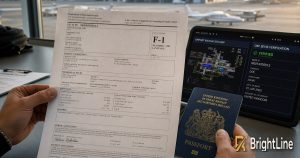
A polished flight school visa interview sample answer collapses the moment the officer asks you to point to the document behind it. Your paperwork is the evidence layer under every sentence you speak, and officers treat a mismatch between the two as a credibility problem, not a clerical one.
- I-20 with ink signature. The school mails this form, and the officer checks that your spoken program matches what it states.
- SEVIS fee receipt. This proves the fee was paid before the interview, and officers cross-check the number against your file.
- DS-160 confirmation page. The DS-160 form for M-1 training captures your answers before you speak, so any contradiction is already on record.
- Proof of funding. Bank statements and sponsor letters must show the same account holder and amount you describe out loud.
- School acceptance letter. This confirms the specific program and start date you’ll reference when asked about your training plan.
- Passport with prior visas. Officers scan for travel history that supports or undermines your stated intent to return home.
The officer may hand your I-20 back and ask which line covers your funding, or point at the DS-160 and ask why an answer changed. Hesitation there reads as concealment, even when the answer itself was fine. Know each document well enough to locate the relevant line without flipping pages.
Official guidance on student visa interview preparation treats document familiarity as a core readiness check, not an afterthought. Schools that run organized admissions support make this alignment routine rather than last-minute.
BrightLine Digital’s admissions packaging work for international student pilots exists precisely to close that gap, matching every spoken answer to the paperwork already submitted. When the file and the answers agree, the interview stops being a test of memory and becomes a conversation you control.
Build Answers You Can Defend, Not Recite
The strongest flight school visa interview sample answers share one trait: the applicant can explain the reasoning behind every line without reaching for the script. That’s the shift worth making now. Stop rehearsing sentences and start rehearsing logic.
Write out, in your own words, why each answer is true. Then test it against the I-20, the DS-160, and the funding documents already on file. An answer that contradicts your own paperwork is a refusal waiting to happen. Rehearse the follow-up, not the opener.
Ask someone to interrupt you mid-answer with a harder question. If the response holds, you’re ready. If it stalls, the gap is in your reasoning, not your delivery. Fix that before the interview, not during it.
FAQ
Flight School Visa Interview Sample Answers: Common Questions
What are the 5 hardest interview questions?
The five that break the most applicants are why this school, who is paying, what happens after training, why not train at home, and what your sponsor does for a living. A flight school visa interview sample answer for any of these fails when the response contradicts a line already printed on your I-20 or DS-160.
How to pass a student visa interview?
Pass by answering in plain sentences you can expand on, not paragraphs you rehearsed in front of a mirror. The officer is scoring whether your story stays identical across every question, so a short answer you can defend beats a polished one you cannot repeat.
What are the common questions asked in a visa interview?
Expect the officer to ask why you picked this program, how the tuition gets paid, who your sponsor is, and what you plan to do once the certificate is finished. Each question tests a different document, which is why hesitation on any single one pulls the officer back into the paperwork you already submitted.
How to pass a visa interview?
Treat the interview as a consistency check rather than a performance, and let your spoken answers match the file the school sent ahead of you. The detail that catches people is the sponsor’s occupation, because a job title spoken at the window that differs from the employment letter reads as a fabricated funding story.