

Hire an Aviation Content Writer: 3 Checks Before You Sign
TL;DR · The short answer4 key points
- Hiring a qualified aviation content writer requires evaluating technical fluency and regulatory comprehension over polished generic portfolios.
- Test candidates on their ability to interpret FAA advisory circulars, eCFR codes, and NTSB investigation reports accurately.
- Verify whether candidate portfolio URLs rank in live search engine results for terms actual industry buyers type.
- Protect your business with clear contracts that mandate cited regulatory sources and transfer full content ownership upon payment.
A director of maintenance reads your new blog post and stops at the second sentence. The writer called a Part 145 repair station a “maintenance shop,” and the director knows instantly that nobody who understands the business wrote this. Hiring an aviation content writer is a vocabulary test before it is a writing test.
Portfolios lie. A writer with a dozen polished SaaS posts can still confuse a Part 61 flight school with a charter operator, and that confusion shows up after the invoice clears.
This article gives you three checks to run before you sign anything. Each exposes a different failure: regulatory illiteracy, buyer-language gaps, and claimed results that never ranked. Run all three in an afternoon and you’ll know whether your aviation content writer speaks the industry or just spells it.
Why Generic Writers Fail in Aviation
A polished portfolio proves a writer can write. It proves nothing about whether that aviation content writer can reach a director of maintenance. The failure is almost never grammar. It is vocabulary the buyer uses and the writer has never heard.
Aviation buyers research in a closed dialect. A flight school prospect types “discovery flight cost,” a director of maintenance types “AOG A320 nose gear,” and a charter customer types “empty leg Florida.” A writer raised on SaaS briefs reaches for “solutions” and lands nowhere.
The industry runs on documents generic writers have never opened. Advisory circulars, NTSB findings, and parts availability data set the terms of every serious purchase. A writer who has not read one will produce copy that reads fine to a marketing manager and wrong to the buyer.
This is why most aviation content marketing fails. Teams port over generic B2B SEO templates built for SaaS and expect them to work on 200-word AOG and MRO queries. They do not. The search intent is different, the buyer is technical, and the stakes are regulated.
Workforce content shows the same gap. A page on FAA maintenance workforce grants speaks to program officers in a register a generalist cannot fake. BrightLine Digital’s aviation-only focus exists because that ramp-up is expensive. Ask what a writer knows before you ask what they charge. The answer tells you whether you are buying a draft or a rewrite.
Check One: Can They Read the Rulebook?
Regulatory literacy is the first filter, not a bonus. An aviation content writer who misstates a rule loses the exact buyers who already know it, and those buyers are the ones with budgets. Hand a candidate these documents and watch what happens. A specialist opens them without flinching.
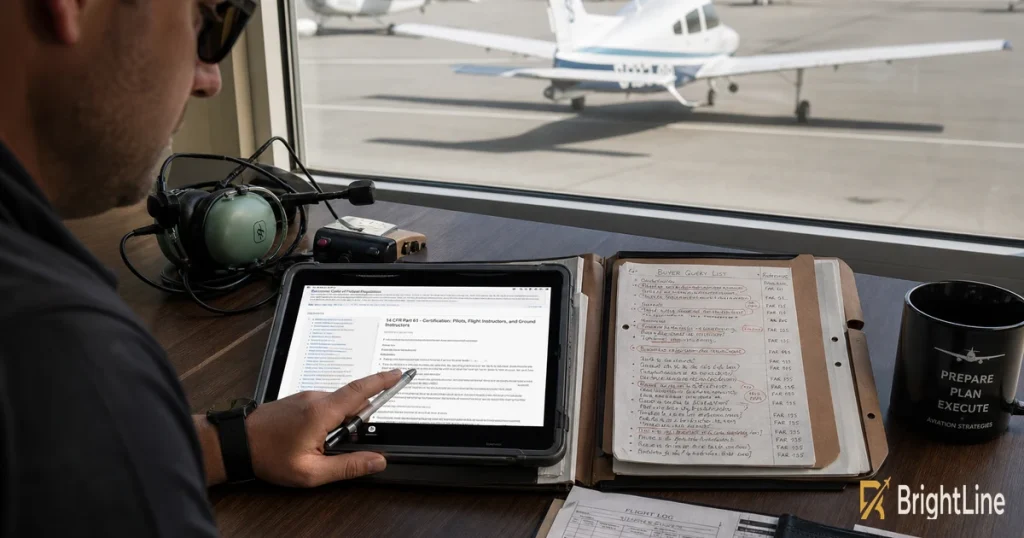
- FAA advisory circulars on SMS. Ask them safety management system requirements and guidance. A competent writer pulls out the four SMS components and what each one obligates an operator to do.
- NTSB investigation reports. These are dense, factual, and unforgiving. The writer should be able to extract probable cause without editorializing or blaming a named party.
- eCFR text of Part 107. Drone content lives or dies here. A writer who cannot find the operating limits for small unmanned aircraft will invent them.
- Advisory circular structure itself. Purpose, applicability, and effective date sit at the top for a reason. A writer who skips to the body misses the scope that governs the whole document.
- Operator category distinctions. Part 61, Part 141, Part 135, and Part 145 describe different businesses under different rules. Confusing them in a draft signals the writer never read past the headline.
The pattern across all five is the same. A writer who can summarize a circular can also spot when a client’s claim contradicts one. Ask for a short written summary of a single document during hiring, and score it on accuracy before you score it on style.
Check Two: Do They Speak Buyer Language?
Vocabulary separates a writer who reaches buyers from one who reaches traffic. The table below puts aviation buyers beside the phrases they actually type and the generic stand-in a non-specialist reaches for.
A writer who cannot produce the middle column from memory is guessing. aviation search engine optimization fails when fixes are generic rather than built on the buyer’s phrasing.
Test the candidate live. Name one of these buyers and watch whether the phrases come back without a keyword tool open. The AOPA ADS-B requirements guide is a fair probe: an owner searching compliance terms needs a direct answer, not a warm-up. BrightLine Digital builds aviation SEO services from that buyer vocabulary first, then checks volume.
The tell is simple. Ask them to name three search terms a director of maintenance would type and watch how fast the answer comes. A genuine aviation content writer answers in seconds. A generalist stalls, then offers something like aircraft maintenance services.
Test this before the contract, not after the first draft. Ask for two sample headlines aimed at a charter customer and one at an aircraft owner. If both sound interchangeable, you have your answer.
Check Three: Can They Prove Search Results?
Claimed results collapse under five minutes of checking. Writers know this, which is why so many send a designed portfolio PDF instead of live URLs. The PDF hides the one thing you need to see: whether the page actually ranks.
Step 1. Request three published URLs in aviation, not a portfolio file. A PDF can hold anything, including work that never indexed. Live URLs let you verify the page exists on a real domain.
Step 2. Search the query a real buyer would type and see if the URL appears. A post ranking for the client’s brand name proves nothing. Test phrases like “AOG parts lead time” or “discovery flight cost” instead.
Step 3. Read the opening paragraph of each article. The buyer’s answer should land there, not three scrolls down after a warm-up. Writers who bury the answer write for word count, not for the reader.
Step 4. Ask who handled the technical side. A writer cannot fix a crawl fault, and a page that never indexed is not proof of writing skill. An aviation technical SEO audit shows when content-first wins and when crawl and index faults must be fixed first. A parts page can get blamed on content when the real fault is technical.
Step 5. Send a short paid test brief on a topic from your own operation. Judge the draft on accuracy first, style second. A writer who gets a regulation wrong in a test will get it wrong on your site.
Finish this sequence and you know whether the candidate’s results are real. That answer is worth more than any portfolio, and it costs one afternoon.
Red Flags in an Aviation Writing Test
A draft that reads clean to a marketing manager can read as illiterate to the buyer it targets. These signals surface in a short paid brief, long before a retainer locks you into a rewrite cycle.
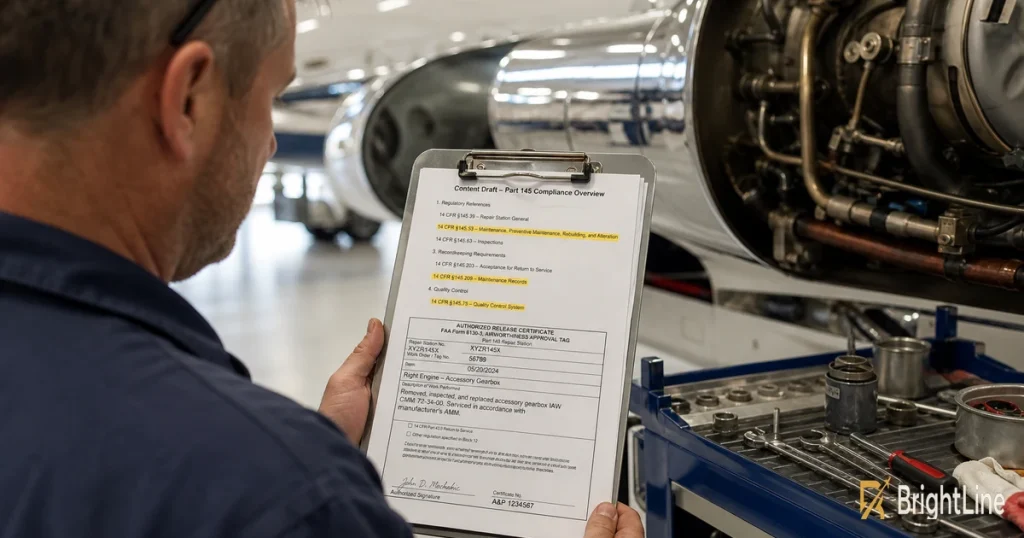
- Passenger language for a maintenance audience. A writer describing an AOG event as a “travel disruption” has never stood in a hangar at midnight.
- Safety treated as a slogan. Phrases like “safety is our priority” replace the actual SMS language a director of maintenance expects to see cited.
- Operator categories blurred. Confusing a Part 61 school with a Part 135 charter operator tells you the writer never learned who buys what.
- Regulations with no source. Any claim about a rule without the advisory circular or eCFR citation behind it is a liability in draft form.
- No next step for the reader. A draft that explains a topic but never routes the buyer toward a quote, a call, or a form is a dead end.
- Keyword-first structure. A post can publish, index, and still sit on page three because the writer skipped the buyer’s real question.
Two or three red flags in one brief usually mean one root cause: the writer is guessing at an industry they have never worked inside.
Send the same brief to two candidates and compare drafts side by side. A specialist will cite the source, name the operator type, and close with a route to inquiry. That gap is the whole reason for the hire.
What an Aviation Content Writer Should Cost
The quote in your inbox tells you nothing until you know what it buys. Three hiring routes price aviation work differently, and the gap is not quality. It is how much industry vocabulary and search groundwork you pay someone to build from scratch.
A generalist draft needing a technical rewrite costs the original fee twice. Aviation-only shops price higher because ramp-up is already done. Compare quotes on total cost to a published, ranking page, not on rate. A cheap draft that never ranks is the most expensive line item in the budget. That is the case for pairing a writer with a real aviation content strategy services engagement rather than a per-post contract.
Pick the aviation-only route when your pages must convert buyers who already know the rules. Pick a specialist freelancer when technical SEO is covered in-house and you only need the writing.
The Contract Terms That Protect the Hire
The most expensive clause in an aviation content contract is the one nobody writes. Silence on ownership, revisions, and sourcing defaults to whoever holds the pen, and that default almost always favors the writer.
Ownership comes first. Confirm in writing that every published page, image, and draft transfers to you on payment, not on termination. A writer who keeps the rights can resell your Part 135 explainer to a competitor.
Tie revisions to accuracy, not taste. A defined round should cover factual corrections to regulatory claims, not a client who wants the tone warmer. Accuracy revisions belong to the writer; preference revisions belong to your budget.
Demand cited sources for any regulatory statement. A sentence about Part 107 waiver timelines without a document reference is a liability sitting on your domain. An uncited regulation claim is a legal exposure wearing a marketing hat.
Reporting cadence closes the loop. Monthly reports should show rankings, organic traffic, and qualified inquiries, the same standard aviation marketing experts hold themselves to. Skip these terms and the first invoice buys you a draft you cannot legally own, cannot correct, and cannot measure.
Run the Three Checks Before the First Invoice
Three checks done in an afternoon beat a retainer signed on instinct. Regulatory literacy, buyer vocabulary, and verifiable search results are filters, and filters are cheap. Skipping them turns an aviation content writer hire into an expensive lesson.
One paid test brief settles it. Pick a topic from your own operation, something a real customer asks about, and send it to your top two candidates with the same scope and deadline. Score the drafts against the checks. Did the writer cite the regulation correctly? Did the language match the buyer? Does the opening answer the question or warm up to it?
FAQ
Aviation Content Writer Questions Buyers Ask
Is AI replacing content writers?
AI is replacing writers who produce generic copy, not writers who can read a regulation and translate it for a maintenance director. The distinction shows up fast in aviation, where a tool can generate a paragraph about Part 107 but cannot tell you whether your operation falls under the recreational exception.
What should I ask an aviation content writer for as a sample?
Request a short written summary of a real FAA advisory circular or an NTSB report, not a polished marketing sample. A capable aviation content writer will pull the actual requirement out of the document and explain who it applies to, while a weak one will paraphrase the title and pad the rest.
How do I check if an aviation writer’s posts actually rank?
Take the URLs they claim, paste the exact headline into a search engine, and see whether the page appears for a phrase a buyer would type. A post can look clean and still sit invisible because the writer never targeted the query a director of maintenance actually searches.