Flight Schools in Arizona for International Students: Visa, Cost, and Training Steps
TL;DR · The short answer4 key points
- Evaluating flight schools in Arizona for international students requires checking SEVP accreditation before reviewing Part 141 approvals.
- Select the appropriate visa category early, choosing an F-1 visa for degree tracks or an M-1 visa for vocational academies.
- Complete your mandatory TSA Security Threat Assessment prior to logging dual flight instruction to keep your timeline on track.
- Calculate true international flight training costs by factoring in SEVIS fees, visa applications, and housing buffers during paperwork clearances.
A deposit wired to the wrong Arizona flight school sits in escrow for months while the student waits on paperwork that was never going to clear. The brochure promised sunshine and a fleet of new aircraft. Nobody mentioned the campus wasn’t SEVP-certified, or that the visa category didn’t match the program.
That gap is where international students lose time and money. Flight schools in Arizona for international students get marketed on weather and hourly rates, almost never on certification. A school can hold FAA Part 141 approval and still be closed to you.
This article connects the four things that decide your outcome: visa category, SEVP certification, TSA clearance, and real cost. You’ll finish knowing which questions to ask before you pay.
What Makes a Flight School in Arizona Open to You
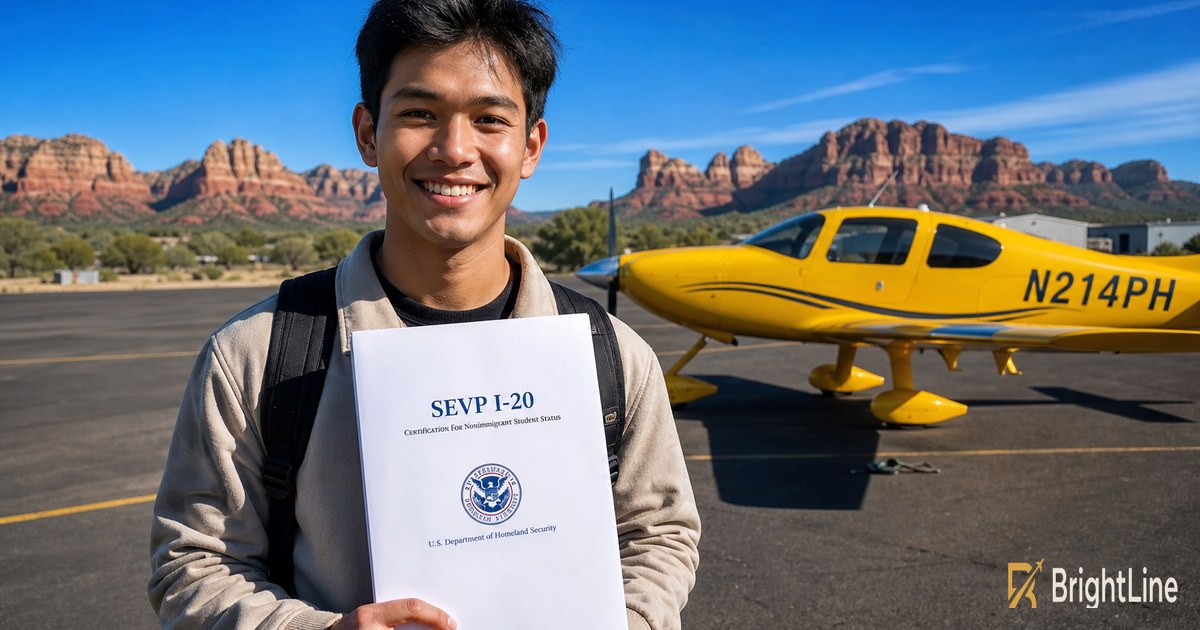
SEVP certification is federal permission for a school to enroll non immigrant students. Only schools certified by the Student and Exchange Visitor Program can enroll F or M non immigrant students, which makes it the first filter on any Arizona shortlist. Without it, the school cannot issue the paperwork your visa depends on.
A school can hold FAA Part 141 approval and still be closed to you. The two certifications answer different questions, and applicants conflate them constantly. Part 141 governs how training is structured and approved. SEVP governs whether you can legally enroll as a non-citizen.
That gap is where deposits get stranded. A Part 141 academy with a beautiful fleet and no SEVP standing cannot generate an I-20, no matter how good the flying is. Check the school against the federal SEVP school certification requirements before you read a single tuition page. The admission requirements for international students live in that certification, not in the marketing copy.
A school that lists flight hours but not its SEVP status is telling you something. The omission is rarely accidental. Ask directly which visa types the campus is approved to issue, and get the answer in writing before any money moves.
Two checks, run in order, save months. Confirm SEVP certification, then confirm Part 141 approval for the specific course you want. Everything else on the brochure is decoration until both come back clean.
F-1 or M-1: The Visa Choice That Sets Your Timeline
The visa category you pick decides how long you can stay, how flexible your program can be, and whether your deposit lands on a real seat. Get it wrong and the paperwork stalls before you touch a checklist.
Step 1. Identify whether your target program is a degree or a standalone certificate. An aeronautical science bachelor’s at an Arizona university maps to F-1. A commercial pilot certificate at a dedicated Part 141 academy maps to M-1.
Step 2. Match the visa to the program, not the other way around. F-1 ties to an academic course of study and generally allows a longer stay with more room to adjust program length. M-1 binds tightly to the training course and its fixed completion date.
Step 3. Ask the school’s international office which visa its programs support. That office knows its SEVP approvals. Guessing strands deposits and delays your start by months.
Step 4. Confirm the campus is approved to issue your visa type using the DHS school search map. A school certified for one visa is not automatically cleared for the other.
Step 5. Lock the visa before you wire money. A deposit paid against the wrong category sits idle while the record gets corrected. That is the gap most applicants never see coming.
Getting the category right is the first real move toward becoming a pilot in the USA without burning a semester. It also sets your proof-of-funds target, since the two visas carry different financial expectations. Confirm it in writing before any payment clears.
The TSA Step That Comes Before Your First Flight
Flight training clearance is a sequence, and the sequence is where applicants lose weeks. TSA sits between your acceptance letter and your first lesson, not after it.
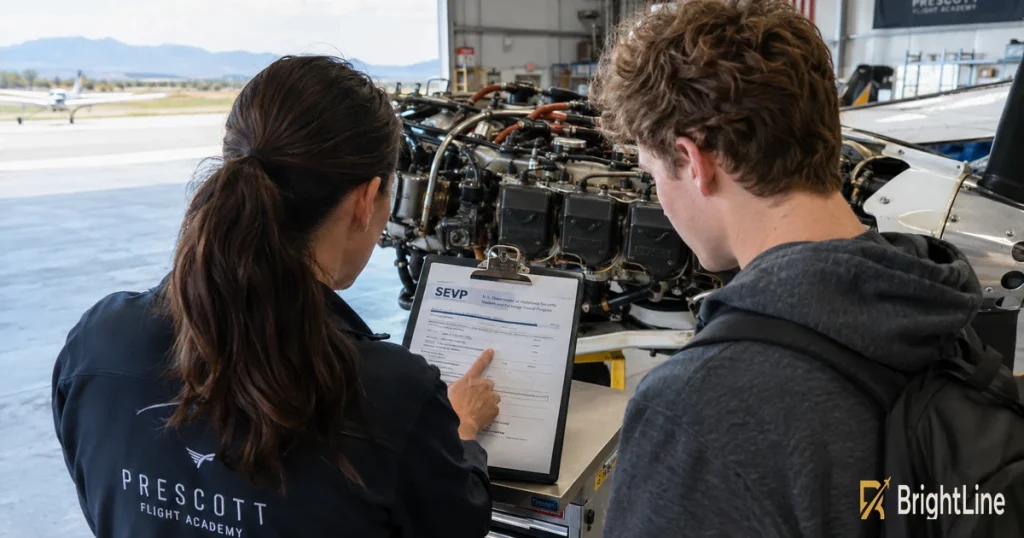
Every non-citizen flight trainee faces a Security Threat Assessment, a TSA-mandated security screening run against multiple government databases. The order of the four moves below decides whether you fly on schedule or wait.
Make the School Start the Assessment
Your flight school initiates the threat assessment as part of enrollment. Ask which staff member owns that submission before you wire anything. A school that leaves you to self-enroll has handed you a process it should be running.
Submit Your Identity and Training Details
The application requires your identity documents and the specific training course you intend to complete. Pay the fee at submission, because an unpaid file sits untouched. Errors here restart the clock.
Wait for Clearance Before Any Flight Time
No dual instruction, no solo, no logged hours until the assessment clears. A deposit paid before clearance is money parked in a school’s account while you sit on the ground.
Keep Approval Tied to One School and Course
Your clearance attaches to a named provider and program. Switch academies or change course type and the TSA background check for foreign students can reset entirely. Treat a program change as a new application. The schools that get international students airborne fastest treat this as an admissions task, not an afterthought. Ask for the process in writing before the deposit leaves your account.
What Flight Training in Arizona Actually Costs You
The number on the school page is a domestic number, and it will not be your number. Flight training in Arizona for international students carries cost lines that never appear in the brochure: the international surcharge, the extra months of rent while paperwork clears, the wire transfer loss on a large payment. Compare the real lines before you commit.
The academy route usually wins on total cash outlay and speed to a certificate. The degree route wins when you want a fallback if hiring slows, and the payoff math is real: airline pilot median pay sat at $232,140 in May 2025.
Request the international-student cost sheet in writing, not the domestic one. If a school cannot produce it, that silence answers your how much flight school costs question more honestly than any domestic pricing page it publishes.
Degree Program or Standalone Certificate: Pick Your Path
Three routes lead to a US commercial pilot certificate, at different costs in money and time. The mistake is choosing a route before checking which visa the school can issue for it.
Step 1. Map the visa category to the program type before comparing tuition. An F-1 fits a four-year aeronautical science bachelor’s at an Arizona university. An M-1 fits a standalone vocational course at a dedicated academy. A program that doesn’t match your visa is a program you can’t legally attend.
Step 2. Weigh the degree route as insurance, not just credential. A bachelor’s in aeronautics pairs flight hours with a four-year academic program and gives you a fallback if airline hiring stalls. It also stretches your timeline and total spend.
Step 3. Price the academy route against the clock. A standalone commercial program at a school certificated under FAA-approved pilot school standards is built around the certificate, not the degree. It moves faster, and leaves you with no academic credential if the market turns.
Step 4. Consider the hybrid if neither path fits cleanly. Some students finish certificates at an academy first, then add a degree once they’re flying. This works only if your visa allows the transition, so verify that before committing.
Step 5. Get the school’s program-to-visa mapping in writing. Schools that package international flight school admissions clearly, the way BrightLine Digital builds them, publish which programs each visa supports. Schools that don’t will leave you guessing after you’ve paid.
Choosing the route that matches your visa, budget, and appetite for a fallback gives you a training plan you can defend at the consular window. The wrong route strands a deposit and restarts your flight training in the USA from zero.
Why Arizona Weather Is Not the Reason to Enroll
Sunshine sells brochures, not seats. An Arizona flight school can offer cloudless skies and still leave an international student grounded for months on a stalled admissions file.

Weather changes how fast you finish once you’re flying. It has no bearing on whether you’re allowed to start. Visa category, SEVP certification, TSA clearance timing, and proof of funds decide your enrollment, and none of them care about the forecast in Phoenix.
Picture two schools side by side. One sits in a glamorous desert corridor with a marketing page full of aerial photography but a generic admissions inbox. The other runs a smaller field outside the tourist radius, staffed by a named international advisor who returns documents in days. The second student flies first, every time. Rank schools by international-student throughput, not by cloud cover. A slow admissions office costs you a semester before your first lesson, and that lost time dwarfs any weather advantage.
This is where the best school sites separate themselves. BrightLine Digital’s aviation SEO work pushes admissions facts to the surface, so a prospective student sees visa support and TSA process instead of a sunset over the ramp. Scenery ranks well in image search. It doesn’t answer the question that decides your timeline.
Weigh the best time of year to start against the paperwork calendar, not the weather calendar. The school that answers your email in a week is worth more than the one with the clearer skies.
How to Compare Flight Schools in Arizona for International Students
Six signals separate a school that enrolls international students well from one that lists them as a footnote. Read them before you email anyone, because the schools that fail these checks will still take your deposit.
Step 1. Verify SEVP certification and the specific visa types the campus can issue. A school approved under FAA Part 141 certification may still be barred from enrolling you. Skipping this check is how deposits end up stranded.
Step 2. Find a named international student advisor, not a generic admissions inbox. A school with one advisor handling overseas applicants answers in days. A school routing you through a shared inbox answers in weeks.
Step 3. Request the international cost sheet in writing. Domestic tuition pages hide the surcharge, the housing months during clearance, and the wire conversion loss.
Step 4. Ask who initiates your TSA threat assessment. Schools that leave self-enrollment to the student create a gap between acceptance and first flight.
Step 5. Confirm documented housing and arrival support. An airport pickup and a signed lease protect your first month more than any brochure photo.
Step 6. Ask for a track record of students from your region. A school that has enrolled applicants from your country already knows the consulate’s patterns.
BrightLine Digital’s international flight school admissions packaging exists because most schools bury these signals. The ones that surface them win the students, and their flight school marketing that fills classes starts with admissions facts instead of scenery. A school that cannot answer all six in writing will cost you months.
Start With the Visa File, Not the Brochure
The paperwork decides who trains in Arizona and who waits at home refreshing an email inbox. A student who maps the visa category, the SEVP status, and the TSA clearance before comparing aircraft fleets arrives at the same schools with a completely different ranking.
That order protects the deposit. Wire money to a campus that cannot issue your visa type and the refund request runs through a business office that has no incentive to hurry. The shortlist you build this week is worth more than the brochure you read last month.
Pull up the DHS school search and list every SEVP-certified campus in the state. Email each one three questions: which visa types the campus issues, the international cost sheet, and the TSA enrollment process in writing. Compare the answers before anyone sees a deposit.
FAQ
International Student Pilot Questions, Answered
Can an international student become a pilot in the USA?
Yes, provided you enroll at an SEVP-certified school that issues the I-20 or M-1 paperwork your visa requires. The catch most applicants miss is that FAA Part 141 approval says nothing about international eligibility, so a school can look fully accredited and still be closed to you.
How much does pilot school cost in AZ?
Arizona flight training runs from a standalone commercial certificate at a Part 141 academy up to a full aeronautical science degree, and the gap between those routes is wide. The figure a school publishes is usually the domestic one, so request the international cost sheet that includes the surcharge and proof-of-funds buffer.
How much does pilot training cost for international students in the USA?
Budget beyond tuition for the TSA processing fee, SEVP and visa costs, and the extra months of housing while clearances pend. Wiring a large sum from overseas also loses value in conversion, and many students cover the shortfall with flight school loans for international students rather than draining family savings.
Where can international students get flight training in the USA?
Any SEVP-certified school approved to issue your visa type can enroll you, which includes university aviation programs and dedicated Part 141 academies across Arizona and other states. Verify each campus on the DHS school search tool before you email, because a school’s approved visa types vary by location.