F-1 Visa for Flight Training: The Direct Path to a US Pilot Career
ℹ️ TL;DR
- The F-1 visa for flight training is designed for professional pilot pathways, allowing zero-to-instructor rating progress without requiring a university degree.
- Unlike the vocational M-1 visa, the F-1 opens the door to Optional Practical Training (OPT), enabling up to 23 months of work authorization as a flight instructor.
- Application requires a SEVP-approved flight school to issue Form I-20, followed by SEVIS I-901 fee payment, DS-160 submission, and an embassy interview.
- Financial documentation must prove liquid assets covering full first-year tuition and living costs; bank statements must demonstrate consistent funding.
- Maintain continuous full-time status: the five-month rule terminates visa status if training pauses or program gap periods extend beyond five months.
Choosing the wrong visa for US flight training strands more international students than any failed checkride. They pick the M-1 because it sounds simpler, then discover it limits their path to a professional pilot career. The F-1 visa for flight training is the direct route, not the complicated university-bound option most guides make it out to be.
Most advice lumps F-1 and M-1 together or insists you need a degree program to qualify. Neither is true. The F-1 is designed for professional pilot training from zero hours to instructor rating, and approved flight schools issue the required I-20 without a university attached.
This article walks through how the F-1 works, where it differs from the M-1, and the exact application sequence. You’ll leave knowing what to prepare, what to expect at the embassy, and how to start training without unnecessary delays.
Why the F-1 Visa Is the Professional Pilot’s Route
The standard advice for international students is wrong on both ends. It either steers you toward the M-1 because it sounds simpler, or it tells you that an F-1 visa for flight training requires a university degree. Neither is true for anyone serious about flying professionally. That advice persists because it feels safe. The reasoning breaks down the moment you ask what happens after training.
Before: A student picks the M-1 to avoid paperwork, expecting the same outcome. They finish their ratings and hold a certificate that limits their practical training options. Building the hours needed for an airline job becomes a bureaucratic puzzle instead of a career step.
After: The same student chooses the F-1 track at a SEVP-approved flight school, no university required. The F-1 visa program for professional pilot training covers airplane and helicopter paths, from zero hours through initial flight instructor rating. That single choice keeps the door open for practical training that builds hours toward a career.
The difference is not paperwork. The F-1 treats you as a professional in training. The M-1 treats you as a student learning a trade, which is fine for a limited goal but a dead end for a pilot career.
Anyone serious about making aviation a profession should evaluate international student flight training through the F-1 lens first. The M-1 can wait for a specific reason to choose it. The F-1 is the route that matches the ambition. Flight schools rarely explain this distinction during a tour. Their admissions staff know which visa fits which student, but the decision is left to the applicant.
The practical implication is simple: ask the school’s designated school official about F-1 eligibility before comparing training programs. If the school cannot answer that question clearly, find one that can. The visa decision belongs at the start of the process, not after you have committed.
F-1 vs. M-1: Which Visa Fits Your Flight School Goals?
The choice between F-1 and M-1 comes down to one question: where does this training lead? For anyone aiming at a professional cockpit, the answer is not close. The F-1 is built for career tracks, while the M-1 caps out at a vocational ceiling.
The F-1 visa covers academic and professional programs, which is why flight schools use it for zero-to-instructor training. It is the recommended route for students who want a career as a professional pilot and plan to complete a full professional training program. The real advantage shows up after training. F-1 status opens the door to practical training options like OPT and CPT, which can be used to build hours and gain experience in the US. That flexibility is exactly what a newly rated pilot needs.
The M-1 visa exists for vocational study, and it is a different animal entirely. It suits a student who wants a limited, defined course without the career trajectory attached. The trade-off is structural. M-1 holders face stricter limits on practical training, and switching to a professional path later means starting the visa process over. The M-1 is a destination visa, not a stepping stone.
For the pilot who wants an airline career, the F-1 wins under nearly every condition. It aligns with the training structure, supports post-graduation hour building, and signals intent to a future employer. The M-1 only makes sense for someone who knows they want a narrow, specific skill and nothing more. Choosing the M-1 to avoid paperwork is choosing a ceiling you cannot raise later. Match the visa to the career, not the convenience. If the goal is a professional pilot career, the F-1 is the only route worth the application fee.
The Real F-1 Application Process for Flight Training
The F-1 visa for flight training follows a fixed sequence, and most applicants stall at the same point: waiting for the I-20 before doing anything else. That delay is self-inflicted. The full process runs about six steps, and each one feeds the next.
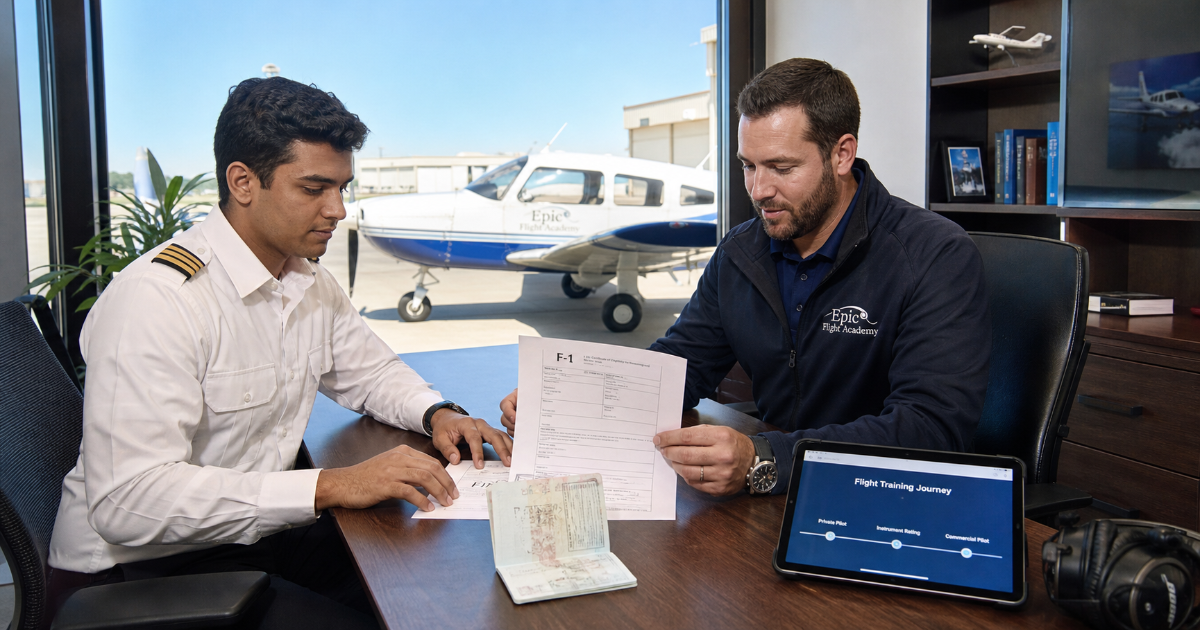
Step 1. Get accepted into a SEVP-approved flight school. Schools certified by the Student and Exchange Visitor Program are the only ones that can issue the I-20 form you need for the visa.
Step 2. Receive your I-20 and verify every detail on it. Name spellings, program dates, and the school’s SEVIS number must match your passport exactly. One typo here means a refused visa interview.
Step 3. Pay the SEVIS I-901 fee online. Keep the receipt, because the consular officer will ask for it during your interview.
Step 4. Complete the DS-160 online application. This form asks for your travel history, background, and the intended course of study. Budget a full afternoon for it.
Step 5. Schedule and attend the embassy interview. Bring your I-20, SEVIS receipt, DS-160 confirmation, financial documents, and your passport. The interview itself usually lasts under five minutes.
Step 6. Book your flight and coordinate your arrival with the school. Some programs offer virtual ground school so you can start academics before you land.
Each step is administrative, not intellectual. The applicants who struggle are the ones who skip ahead, pay fees before the I-20 arrives, or book travel before the visa is stamped. Follow the sequence and the process moves faster than the forums suggest. Completing these steps unlocks your seat in a US flight school. The paperwork is not the barrier; the order of operations is. Get the sequence right and the visa follows.
How Hard Is It to Get an F-1 Visa for Flight School?
The difficulty of the F-1 visa for flight training has almost nothing to do with the visa category itself. The rejection risk lives entirely in your preparation. Officers deny applicants who cannot prove financial ability, show weak ties to their home country, or fail to demonstrate intent to return.
Visa officers process F-1 applications under one governing assumption. You are seeking a nonimmigrant visa, which means you must convince them training ends and departure follows. A clear career plan changes that conversation. When you can articulate exactly how the training builds toward a flying career back home, the interview shifts from interrogation to verification.
Financial documentation carries the most weight. Bank statements must show liquid assets covering tuition and living costs, and sponsorship letters need to name the sponsor and their relationship to you. A legitimate flight school acceptance letter from a SEVP-approved program signals that a real institution vetted your qualifications already. That institutional backing matters more than most applicants realize.
Consular officers see thousands of applicants who cannot explain why they need training in the US rather than at home. The applicant who answers that question with specificity gets the visa. Vague plans to “see what happens” after training read as immigration risk. Concrete intentions, like returning to a family aviation business or joining a national carrier, resolve the officer’s central doubt.
The interview itself rarely lasts long. Preparation determines the outcome weeks before you sit in that chair. Gather documents early, rehearse your story, and treat every answer as evidence of your return. The applicants who struggle are rarely unqualified. They are simply unprepared for the one question that decides everything.
What It Costs to Prove You Can Afford Flight Training
Financial proof sinks more F-1 applications than any other document issue. Embassies want certainty that you can cover the full first year, and vague bank letters do not provide it. Flight schools publish cost estimates for a reason. That number becomes the target your financial documentation must clear, covering both tuition and living expenses.
- Bank statements. Most embassies want statements covering the most recent months, not a single day’s balance.
- Sponsorship letters. A parent or relative funding your training must sign a formal letter accepting financial responsibility.
- Proof of liquid assets. Savings accounts and cash equivalents count far more than property or investments you cannot access quickly.
- Financial affidavit. Some schools require their own sworn form verifying your funding sources before they issue the I-20.
- Sponsor’s bank documents. If someone else funds you, their statements and proof of income become your evidence too.
- Cost estimate from the school. This document aligns your proof with the exact amount the visa procedure for USA entry requires.
The pattern embassies look for is consistency, not a single large deposit. Money that appears suddenly in your account raises questions about where it came from and whether it will stay.
Gather these documents before you apply, not after the interview request arrives. Schools that handle international students daily will tell you exactly what their local embassy expects, so ask for their checklist early. Getting the flight school cost conversation started now gives you time to structure your finances properly. Waiting until the last month turns a solvable paperwork problem into a visa denial.
Every document you prepare is evidence of one thing: you can finish what you start. Embassies approve applicants who look like they will complete training and leave, not ones who look like they will run out of money mid-course. BrightLine Digital helps flight schools communicate these requirements clearly to international applicants. A school that explains financial expectations upfront attracts students who arrive prepared.
Timeline: From Application to Your First Flight Lesson
Most applicants underestimate the calendar by half. They expect to land in the US within weeks of choosing a school, then discover the visa timeline has its own rhythm. Planning backward from your desired start date is the only sane approach.
Step 1. Research SEVP-approved schools and submit applications at least four months before you want to fly. Schools vary in how quickly they process international applicants, so ask about their typical turnaround before committing.
Step 2. Secure your acceptance and pay any required deposit to trigger the I-20 process. The school issues this critical document after verifying your enrollment and financial documentation.
Step 3. Wait for your I-20 to arrive, which typically takes a few weeks once the school processes your paperwork. This document is the foundation of every subsequent step, so confirm its accuracy the day it arrives.
Step 4. Pay the SEVIS I-901 fee and complete the DS-160 online application. Both must be finished before you can schedule your embassy interview, and the DS-160 confirmation page is required at the consulate.
Step 5. Schedule your visa interview at the nearest US embassy or consulate. Wait times vary wildly by location and season, with some posts booking weeks or months out, so check availability the moment your DS-160 is submitted.
Step 6. Attend the interview with your I-20, financial documents, and proof of ties to your home country. A clean, confident interview typically results in visa issuance within days, though administrative processing can extend the wait.
Completing this sequence puts you in the US with a clear runway ahead. The full process runs two to three months on a smooth path, which is why starting early separates students who begin training on schedule from those who watch their planned start date slip away. Schools that handle international admissions daily will guide you through the entry process for flight school, but the calendar discipline is yours to own.
New F-1 Rules for 2026: What International Students Should Watch
Visa rules shift more often than most applicants expect, and the F-1 visa for flight training is no exception. The regulation that catches students off guard is the five-month rule, which resets your status if you leave the program or fall out of compliance.
That rule works like this: an F-1 student who remains out of status for more than five months loses their visa validity. Returning to the US then requires a fresh I-20 and a new visa interview, which means starting the application sequence from the beginning. The five-month rule exists to prevent students from treating the visa as a permanent entry pass.
Flight training creates a specific risk here. Weather cancellations, maintenance delays, and instructor shortages can stretch a training gap past that threshold. A student who pauses training for personal reasons while staying in the US may not realize their clock is running until they try to re-enroll.
Staying compliant is not passive. It means tracking your I-20 end date, maintaining full-time enrollment status, and reporting any program changes to your designated school official before they become gaps. The school’s international office handles this reporting, but the responsibility sits with the student.
New guidance from the State Department and SEVP lands throughout the year. Policy updates around practical training and employment authorization appear without warning, and flight schools adjust their enrollment advice accordingly. The students who succeed treat regulatory monitoring as part of their training schedule, not an afterthought. Checking official guidance before you make any major decision is the only reliable strategy. The rules that applied when you applied may not be the rules when you arrive.
Step Toward USA Flight Training
The F-1 visa for flight training is the direct route to a professional pilot career, and the path is clearer than the noise suggests. You now know the sequence, the financial proof, and the timeline that most guides bury under confusion. Every week you wait is a week of seniority you do not build. The pilots who finish training first are the ones who stopped researching and started applying.
Research SEVP-approved schools today. Gather your bank statements and sponsorship letters. Begin the application with a school that understands the process, and the paperwork becomes their problem, not yours. flight training in USA starts with a single decision, and you have already made it. Now file.
Stop losing high-value charter and MRO leads to competitors who simply outrank you online. See how BrightLine Digital’s aviation-only SEO delivered 340% more traffic and 68% more leads in six months, then book your free growth audit today.
F-1 Visa Flight Training: Questions Answered
Can I get an F1 visa for flight training?
Yes, you can get an F-1 visa for flight training, provided you enroll in a SEVP-approved flight school that issues the Form I-20. The F-1 visa for flight training is the designated route for professional pilot programs, covering everything from zero hours to instructor ratings.
What is the 5 month rule for F-1 students?
The five-month rule terminates your F-1 status if you remain outside the United States or out of status for more than five months. Breaking this rule means starting over with a new I-20 and a fresh visa interview, which resets your entire training timeline.
How difficult is it to get an F1 visa?
The difficulty lies in the preparation, not the visa category itself. Officers deny applicants who cannot prove financial stability or demonstrate clear intent to return home after completing their training program.
What are the new F-1 student visa rules in 2026?
No sweeping rule changes have been announced for 2026, but the five-month rule and SEVP compliance requirements remain the active enforcement priorities. Monitoring State Department and SEVP guidance directly is the only reliable way to stay current, since policies shift without widespread notice.