DS-160 Form for M-1 Visa Pilot Training: 2026 Full Walkthrough
TL;DR
- Completing the DS-160 form for M-1 visa pilot training accurately establishes your official record prior to your U.S. embassy interview.
- Execute steps in strict sequence: receive your Form I-20, pay the $350 SEVIS fee, submit your DS-160 online, and pay the $185 MRV visa application fee before booking an interview slot.
- Avoid major errors by selecting M-1 vocational student status instead of F-1 and matching every name, SEVIS ID, and start date character-for-character with your I-20.
- Filling out the online DS-160 form is completely free on the U.S. State Department portal, though consular application fees are non-refundable.
- Print and bring your DS-160 confirmation page with its clear barcode to your embassy interview alongside your passport and proof of funds.
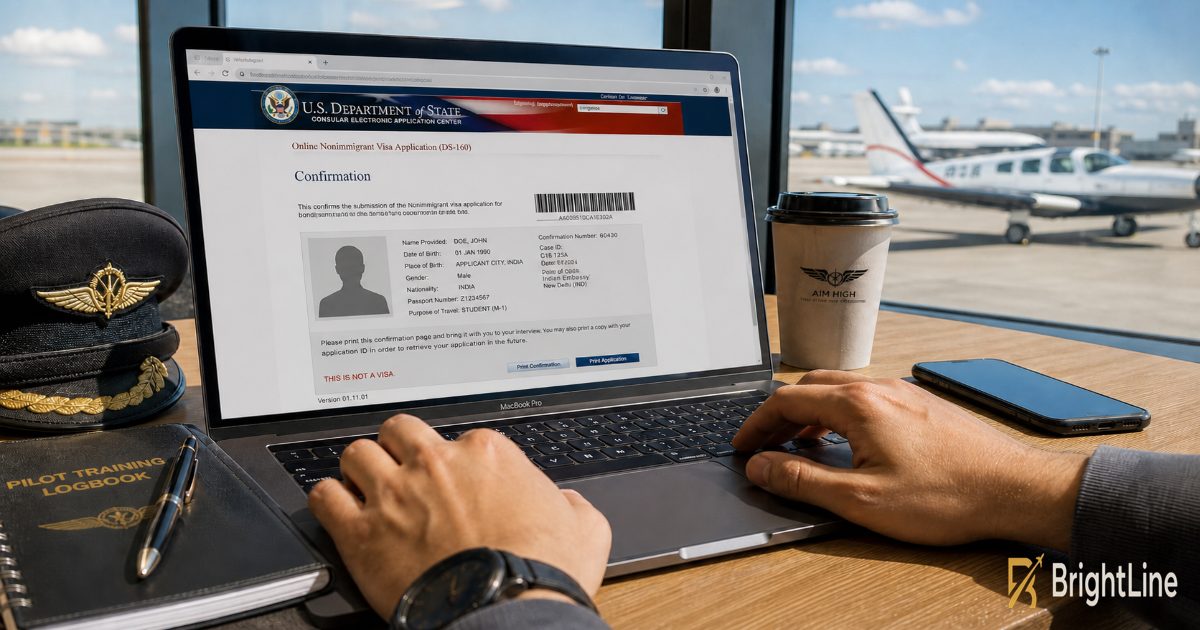
The confirmation page prints with a barcode, and the interview slot you booked three weeks out is already tied to it. That page comes from the DS-160 form for M-1 visa pilot training, the one document applicants treat as a formality until it costs them a seat.
Flight schools hand over an I-20 and applicants assume the hard part is finished. It is not. The DS-160 is the record the consular officer reads before you sit down, and a rushed answer can undercut everything you say at the window.
This article walks through the full 2026 process: what the form asks, what it costs, how long it stays usable, and how it connects to your I-20 and embassy interview. By the end, you will know when to submit it and what breaks if you don’t.
What the DS-160 Actually Is
The DS-160 is the online nonimmigrant visa application the U.S. Department of State uses to open your file. It is not the visa. It is the record that links your name, your passport, your flight school, and your I-20 to the consular system before you ever reach a window. You complete it on the State Department’s Consular Electronic Application Center, and the whole M-1 visa for flight school process runs on that record.
Applicants confuse the form with the visa constantly. A submitted DS-160 grants you nothing. It builds the file the officer reads before you sit down, and every answer you give at the interview gets checked against it.
The costliest early mistake is the visa class. The form asks for your purpose of trip and then the exact category. Flight training at a vocational flight school is M-1, and choosing F-1 by mistake creates a mismatch with your I-20 that the officer has to resolve. The fix is a new DS-160 and an updated appointment, sometimes with a later interview date. Read those two fields twice.
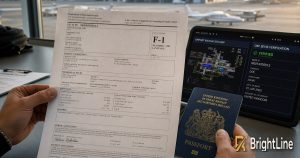
Submission happens entirely online, and the system generates a confirmation page with a barcode at the end. Print that page. The officer uses the barcode to pull up your file, and the official DS-160 guidance tells you to bring it to your interview.
The barcode is your file’s entry point, not a receipt. Carry the printed confirmation with your passport and your I-20 to the interview.
Official DS-160 Form
Start a new application or retrieve a saved one on the U.S. State Department’s own website. The form is free there. Any other site that charges you to fill in or “submit” your DS-160 is not the State Department.
Open the official DS-160 formThe form does not have to be done in one sitting. Write down the Application ID on the first page, because the session times out after about 20 minutes of inactivity, and saved applications that are never submitted are deleted after 30 days. Fill the biographical sections first, then return for the school details once your I-20 is in hand. That keeps you from rushing the visa class and program fields when your start date is already close.
Where the DS-160 Fits in the M-1 Timeline
Sequence decides outcomes here. The DS-160 sits third in a five-step chain, and applicants who jump ahead of it lose weeks they cannot recover before an intake date.
Step 1. Get accepted by your flight school and receive the I-20 issued through SEVIS. Without that I-20 for flight school, the DS-160 has no SEVIS ID, no program dates, and no school details to enter.
Step 2. Pay the $350 I-901 SEVIS fee at FMJfee.com. It activates your student record, and the consulate checks that it has cleared before the visa can be issued. Our SEVIS I-901 fee guide covers the payment steps.
Step 3. Complete the DS-160 on the official DS-160 website with your I-20 open beside you, then save and print the barcode confirmation page.
Step 4. Pay the $185 visa application fee and schedule your embassy interview. The appointment system asks for your DS-160 confirmation number, so applicants who try to book first end up going back to finish the form.
Step 5. Attend the interview with your passport, DS-160 confirmation page, I-20, SEVIS fee receipt, visa fee receipt, appointment letter, and proof of funds. Bring a printed photo if your embassy asks for one. Missing a core document can end the appointment before the officer asks a single question.
Finish the chain in order and your interview lands inside your target intake window. The flight school holds your seat, the I-20 dates hold, and training starts on schedule instead of at the next intake.
Two failure modes cost applicants their intake date. The first is treating the DS-160 as a form to finish once the interview is already close. The second is submitting it with a passport that expires too soon: your passport should be valid for at least six months beyond your planned stay. Fix the order and the rest holds. Pay SEVIS, file the DS-160, save the barcode, pay the visa fee, then book. Any step out of sequence slows down the ones behind it.
The visa is one of seven admission gates between you and your first training flight. Check all seven with the free BrightLine 7-Gate Admission Tracker.
What the Form Asks Pilot Applicants
The DS-160 form for M-1 visa pilot training asks for far more than a name and a passport number, and the school and program fields are where pilot applicants stall. Expect these sections:
- Personal and passport data. Your name must appear exactly as printed on the passport photo page, including middle names. A nickname or shortened spelling creates a mismatch the officer will notice.
- Travel history. Your previous U.S. visits with dates, any U.S. visa you have held, and any visa refusal. An expired B-2 tourist visa from years ago still belongs on the form.
- Contact and family information. Your home address, phone, email, the social media accounts you have used in the last five years, and details about your parents and spouse. The form also asks whether you have immediate relatives in the U.S. and whether you have any other relatives there. Answer accurately.
- Education and work history. Your current job or studies, previous employers, and the schools you attended from secondary level up. Gaps longer than a few months invite questions, so be ready to explain them.
- Purpose of trip. Choose the student category, then select M-1. Choosing F-1 here is the error that forces a new form.
- School and program details. The SEVIS ID from your I-20, the school name and address, and your course. These fields must mirror your I-20 exactly.
- Security and background questions. A block of yes-or-no questions covers criminal history, prior refusals, and immigration violations. Answer honestly. A false answer is far more serious than an honest yes that you explain.
Read together, these fields form a single story that the officer reviews before you speak. Your DS-160 answers, your I-20, and your interview responses must tell one identical story. Pull the I-20 first, fill each field against it, and review the official student visa requirements before you submit. Our guide to flight training in the USA covers the rest of the journey.
What the DS-160 Costs for M-1 Pilot Training
Several separate payments hit a pilot applicant’s account before the embassy interview, and confusing them is how people budget for the wrong number. Filling in the DS-160 itself is free. The visa application fee, the SEVIS fee, and the flight school deposit each go to a different place, with different refund rules.
| Cost | Amount | What It Covers | When It’s Paid |
|---|---|---|---|
| Flight school deposit | Varies by school | Holds your seat and lets the school issue your I-20 | Before the school creates your SEVIS record |
| I-901 SEVIS fee | $350 | Activates your SEVIS student record | After the I-20 arrives, before the interview |
| DS-160 form | Free | The online visa application itself | Submitted before you pay the visa fee and book |
| Visa application (MRV) fee | $185 | Processing of your visa application at the consulate | After the DS-160, before you book the interview |
| Photo and travel costs | Varies | Compliant photo, travel to the embassy or consulate | Throughout the process |
The $350 SEVIS fee and the $185 visa application fee are collected by different systems for different purposes, which is why you pay them at separate points. Neither is refunded if the visa is refused. If you reapply for the same status within 12 months, the SEVIS fee carries over, but each new visa application needs a new visa fee. Check the State Department’s visa fee page before you pay, including whether the $250 visa integrity fee approved in 2025 is being collected at your embassy.
Flight school deposits sit outside government control entirely. Refund terms come from the school’s own enrollment agreement, and they vary from school to school. Read that agreement before wiring anything, because a refusal letter does not automatically trigger a refund.
Consular officers also review your bank balance for the M-1 interview, so the money trail matters beyond the fees themselves. Keep every receipt in one folder. Budget the full sequence, not the headline fee. Applicants who plan for one payment and discover three are the ones scrambling for a later intake.
How Long Your DS-160 Stays Valid
A submitted DS-160 has no expiry date printed on the confirmation page, but it is only as good as the details inside it. It records the embassy or consulate where you said you would apply, your passport, your school, and your program dates. Change any of those and you will usually need a new form.
The embassy you choose matters more in 2026 than it used to. In 2025 the State Department told most visa applicants to apply in their country of nationality or residence, so choose that post in the location field and book your interview there. If you move your appointment to another post, check its instructions, because many will ask for a new DS-160.
Program dates are the quieter trap. A school that pushes your cohort start can leave your DS-160 describing dates that no longer match a reissued I-20. When the I-20 changes, check whether your DS-160 still matches it. A new DS-160 is free to submit. The important step is adding the new confirmation number to your appointment before the interview.
Here is how it plays out. A student files the DS-160 in March for a June intake, then the school shifts the start to September and reissues the I-20. The form still says June. Rather than risk a mismatch at the window, the student submits a new DS-160 and updates the appointment with the new confirmation number. Mismatches like this are a common thread in flight school visa denial cases.
A delayed intake does not just affect the form. It can push you past your flight school’s deposit deadline and into the next enrollment cycle. The cost of a stale DS-160 is measured in months, not dollars. That is the part applicants underestimate until the seat is gone.
The Misconception That Costs an Intake Year
Two pilot applicants sit in the same embassy waiting room with the same I-20 and the same flight school acceptance letter. The difference between them was settled weeks earlier, in how each one treated the DS-160 form for M-1 visa pilot training. One saw it as a formality. The other saw it as the first draft of the interview.
Path A opens the DS-160 the night before the deadline. Answers get typed fast, program dates get approximated from memory, and the school name gets spelled however it appears on a deposit receipt. The officer pulls up a file that contradicts the I-20 on the counter. That raises questions the applicant cannot answer cleanly, and the result can be a refusal or a rescheduled interview while the intake seat goes to someone else.
Path B treats the DS-160 as the document that frames everything the officer asks. This applicant fills it with the I-20 open in a second window, matching program start dates, school name, and SEVIS ID field by field. The story the officer reads before the applicant speaks is the same story the applicant tells at the window.
That consistency is the whole point. The officer forms a first impression from the file, not from the first thirty seconds of conversation. By the time you say good morning, the DS-160 has already answered the question the officer cares about most: does this person know exactly what they signed up for?
If you want a second pair of eyes before you submit, BrightLine international flight school admissions can check your DS-160 answers against your I-20 and walk you through the M-1 versus F-1 visa choice and the document chain that follows it. Nobody else can fill out the form for you, but you never have to fill it out blind.
Path B wins whenever the applicant has an I-20 in hand and a start date that matters. Path A only survives when the intake is flexible and the applicant can absorb a second appointment. For anyone flying toward a fixed cohort date, the rushed form is the expensive one.
DS-160 Photo Rules for M-1 Applicants
The photo is one of the most common reasons applicants get stuck on the DS-160. The upload tool checks your image before you can move on, so a bad photo stops you before a consular officer ever sees your file. Five requirements decide whether it passes:
- Recent capture. The photo must be taken within the last six months, not pulled from an old passport or a graduation album.
- Plain background. White or off-white only, with no doors, curtains, or flight school banners behind your head.
- Front-facing, no glasses. Your full face looks straight at the camera, and eyeglasses are not allowed in visa photos.
- Correct size. A square JPEG between 600 x 600 and 1200 x 1200 pixels, no larger than 240 KB.
- No filters or editing. Retouching, beauty filters, and background swaps all cause rejection, even when the result looks cleaner.
Check the official visa photo requirements before you upload. Some embassies also ask for a printed photo at the interview. If yours does, print it to the same standard on photo paper, not a home laser printer.
If the upload tool rejects your photo, fix the image and upload again before you submit. It costs nothing but time, and that time comes out of the weeks before your interview. Check your image against all five points, then upload once.
Submit the DS-160 Before Your Intake Slips
Act now and your I-20 dates, your DS-160 confirmation, and your interview slot line up into one clean file. Delay, and a date change or a rushed answer can force a new form and a rebooking that lands after your class start. That gap can cost you a full intake. Pull up your I-20 today, open the official DS-160 form, and fill every field against the details printed on that document.
FAQ
DS-160 and M-1 Visa Questions Pilots Ask
How long is a DS-160 form valid?
A submitted DS-160 has no expiry date printed on it, but it only works while its details still match your passport, your I-20, and the embassy where you are applying. If any of those change, submit a new DS-160, which is free, and update the confirmation number on your appointment. Saved applications that are never submitted are deleted after 30 days.
How much does an M-1 visa cost?
Budget for the $185 visa application fee, the $350 SEVIS I-901 fee, and whatever deposit your flight school requires before it issues an I-20. Filling in the DS-160 is free. Neither government fee is refunded after a refusal. If you reapply for the same status within 12 months the SEVIS fee carries over, but the visa fee is paid again. Check the official fee page for any new charges, such as the visa integrity fee approved in 2025.
What happens if my DS-160 has an error after I submit it?
You cannot edit a submitted DS-160. For a serious error, such as the wrong visa category or wrong program dates, submit a new DS-160, which is free, and update the confirmation number on your appointment. Your visa fee payment stays valid. Small typos can often be corrected by the officer at the interview, but do not rely on that for anything important.
Can I use the same DS-160 for a different flight school?
Not if the school name, SEVIS ID, or program dates change, because those details are in the submitted record. Switching schools means a new I-20 and a new DS-160. The form is free, but the delay is the hidden cost of late school changes, so weigh it against how much flight school costs overall.