Flight School CRM System: What It Does and Why Yours Fails
TL;DR · The short answer5 key points
- A flight school CRM system holds the sales conversation and aviation data in one continuous record, not two systems stitched together.
- Generic sales CRMs break because they have no field for flight hours, certificate expirations, or prepaid balances drawn down lesson by lesson.
- Most enrollments leak in the silence before a callback; the system must trigger inquiry replies, discovery-flight reminders, and post-quote follow-up.
- Buying software before writing follow-up rules is why platforms fail. Define who calls, how fast, and what happens next, then configure the tool.
- Audit this week: a spreadsheet beside the CRM, unknown inquiry counts, and untracked no-shows mean your flight school CRM system is already failing.
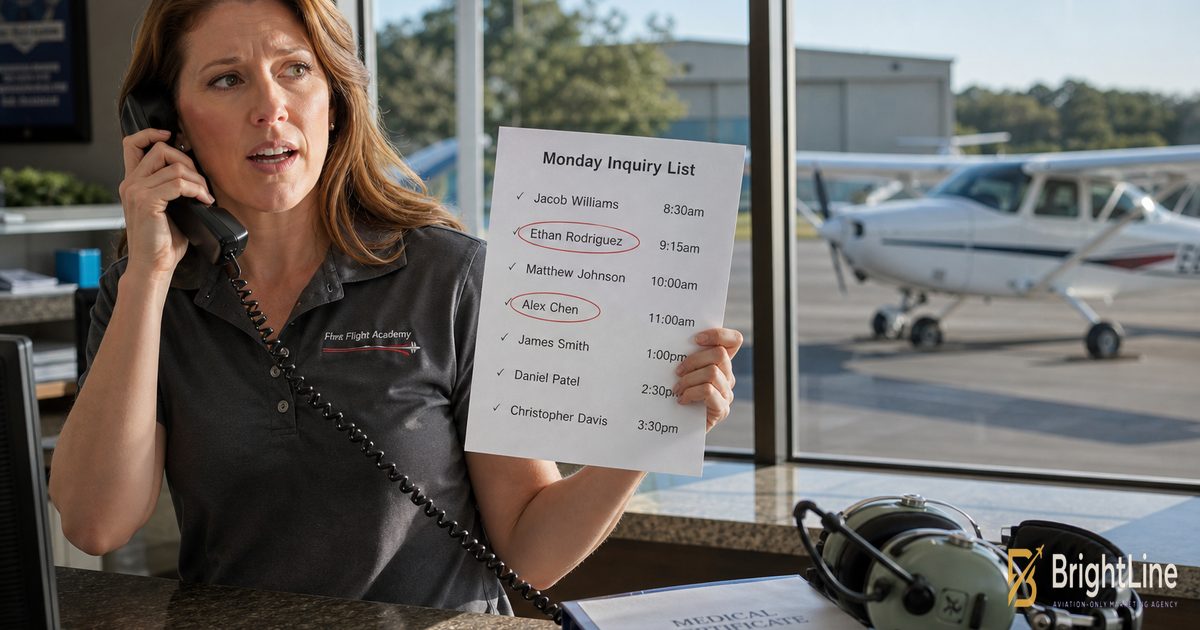
A dispatcher prints the inquiry list every Monday and works it by hand. Two names from last week have no note beside them, and nobody can say whether they were called. That gap is where a flight school CRM system earns its keep, and it is where most of them quietly fail.
The failure rarely comes from a missing feature. Schools buy a generic sales pipeline, bolt it onto a front desk that runs on aviation data, and then wonder why staff keep a spreadsheet beside it. The tool was never built for the way a discovery flight becomes an enrolled student.
This article defines what a flight school CRM system holds, names why these systems break at a flight school, and helps you tell whether yours is one of them.
What a Flight School CRM System Actually Is
A flight school CRM system is the single record of every prospect, applicant, and active student, holding both the sales conversation and the aviation data a generic tool never captures. It is one continuous file, not two systems stitched together. Most schools own the sales half and manage the training half in a spreadsheet someone else maintains.
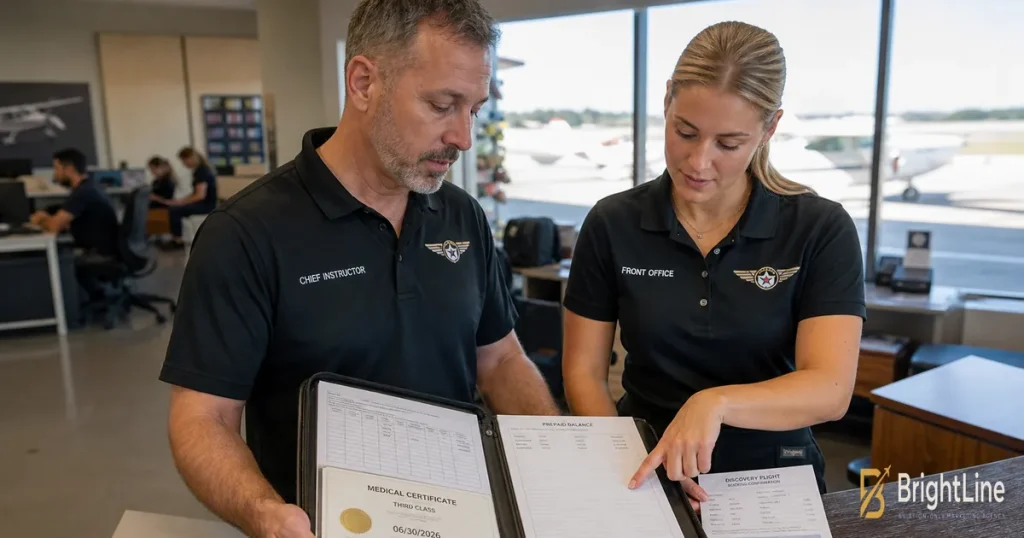
The split runs through the middle of the record. On the lead side: where the inquiry came from, when the discovery flight was booked, who owns the follow-up, and what was said on the last call. On the student side: flight hours logged, training progress toward the next rating, medical and certificate expiration dates, prepaid balances, and scanned documents. A system holding only the lead side is a contact list with a pipeline attached. It cannot tell you that the prospect who toured in March is now three weeks from a checkride.
The failure is common because aviation businesses buy tools built for software sales, then bolt on a scheduling app and a spreadsheet for hours. Nothing connects them. When a lead converts, staff re-enter the same name, phone, and payment details, and the two records drift apart. Aviation CRM software that treats these as one record eliminates the re-entry and the drift.
A generic sales model has no field for a certificate expiration. If your system cannot show a lead becoming a student without anyone typing the name twice, you do not have a flight school CRM yet.
Why Generic CRMs Break at a Flight School
A generic sales CRM and a flight-training CRM look similar on the demo call. They diverge the moment a prospect becomes a student, and that divergence is where enrollments quietly leak.
A generic sales CRM pushes a deal through named stages until someone marks it closed, then files the record away. That rhythm fits a purchase with a clear end date.
Flight training has no clean close. A student moves through ratings, medicals, and payments across years, and the record has to hold all of it. A generic pipeline has no field for flight hours and no concept of a certificate expiration.
Prepaid balances break it further. A generic tool tracks a deal value, not a running account a student draws down lesson by lesson. Staff end up rebuilding that math in a spreadsheet.
The deeper failure is disconnection. A generic CRM never links a lead record to a training record, so the two halves of the same person live apart. That gap is why aviation business automation built for flight schools looks different from a sales tool with aviation labels slapped on.
Staff keep a second spreadsheet beside the CRM because it cannot answer their real questions. The spreadsheet becomes the source of truth, and the system of record becomes a filing cabinet nobody trusts.
The Follow-Up Gap That Costs You Enrollments
Students rarely walk away mid-conversation. They disappear in the silence before anyone calls them back. A flight school CRM system earns its cost at that exact point, and most do nothing there.
- Instant inquiry response. A web form that waits until someone checks email loses the prospect to the school that answered first. The system should fire a reply and alert an owner within minutes.
- Discovery flight confirmation. A booked discovery flight with no automatic confirmation and reminder becomes a no-show.
- The call-back sequence. “I’ll think about it” is a lead, not a close. A structured follow-up sequence keeps that prospect warm.
- Re-engagement after a quote. An applicant who goes quiet after pricing needs a defined path back. Silence after a quote is the most expensive silence in the pipeline.
The system reacts, or a person has to remember. Remembering is not a process. BrightLine Digital builds marketing automation and CRM as the layer that carries an ad click or form fill straight into follow-up, so no inquiry waits on a human to notice it. Schools that treat flight school enrollment marketing as a pipeline of scheduled contacts, rather than a list of names, stop losing students to silence.
A CRM that stores leads but never triggers the next contact is a filing cabinet. The FAA’s U.S. civil airmen statistics count student pilots every year, and each one chose a school. With that many prospects comparing options, the school that follows up first usually wins the enrollment.
The Misconception: A CRM Is a Software Purchase
Flight schools blame the vendor. They switch platforms, pay another setup fee, and watch the same follow-up failures reappear inside a quarter. The software was never the problem.
A flight school CRM system does not decide who calls a prospect back, how fast, or what triggers a second attempt when the first goes to voicemail. Those are decisions the school makes or avoids. Hand a tool undefined rules and it stores contacts with no one accountable for them.
Watch what happens when a school buys first. The demo promises automation, the school signs, and staff discover nobody agreed on what a qualified inquiry looks like. So pipeline stages get named after whatever felt obvious that afternoon. Six months later the reports are unreadable and the team quietly trusts the spreadsheet again.
Schools that get results invert the order. They write down follow-up rules before touching configuration, then make the tool enforce them. A prospect who books a discovery flight gets a confirmation and a reminder without anyone remembering to send it. That is a process decision, not a feature decision. Any flight school marketing agency worth hiring will ask about your follow-up rules before recommending a platform. The ones that lead with software are selling you the same expensive database.
What a Working Flight School CRM System Tracks
Three record types carry everything a working flight school CRM system needs. The lead record answers where the prospect came from. The student record answers where the training stands. The communication record answers who said what and when.
The Lead Record: Source, Inquiry Date, Discovery Flight Status, Follow-Up Owner
Every inquiry needs four fields populated the day it arrives. Source tells you whether the lead came from a Google Ads click, a referral, or a walk-in. Inquiry date starts the clock, and discovery flight status separates the tire-kicker from the person who booked a seat. Follow-up owner names one staff member, not a shared inbox.
The Student Record: Flight Hours, Training Progress, Certificate Expirations, Prepaid Balance, Documents
Training data lives here, and it has to survive the transition from prospect to enrolled student. Flight hours, stage checks, and medical certificate expirations belong on the same record as the prepaid balance and the signed enrollment agreement. A CFI scheduling a stage check should never open a second system to confirm the student’s medical is current.
The Communication Record: Every Call, Email, and Text Tied to the Person
Log the conversation against the person, not the inbox. When a prospect calls back after three weeks and reaches a different staff member, that person needs the full history in one view. A flight school CRM needs contact-level activity timelines, the one habit worth keeping from general sales platforms. An inbox is a mailbox, not a memory.
The Connection Between Records Is the Whole Point
A lead record that converts into a student record without re-entry is the entire reason to own the system. Re-entry is where data dies. When staff retype a name into a training tracker, the link back to the flight school marketing spend that produced the lead disappears.
How to Tell Yours Is Failing Before Enrollment Drops
Run this audit before the next enrollment cycle. Failure signals show up in daily operations long before the enrollment number.

Step 1. Walk the front desk and look for a spreadsheet open beside the CRM. A parallel sheet means staff trust the file more than the system, and prospect data lives where nobody backs it up.
Step 2. Ask one staff member how many inquiries came in last month. A shrug or a guess means the flight school CRM system is not capturing the top of the funnel, so every conversion rate is fiction.
Step 3. Pull the discovery flight schedule and check for no-shows. Untracked no-shows reveal nobody owns the confirmation and reminder, and those seats are your warmest leads going cold.
Step 4. Ask what happens when a prospect goes quiet after a quote. If the answer names a person rather than a sequence, follow-up depends on memory, and memory fails the week that person takes vacation.
Step 5. Request the lead source behind the last ten enrolled students. A system that cannot answer this cannot tell you which ads, referrals, or flight school website design changes actually produce students.
Finish the audit and you’ll know whether the problem is configuration or process, and whether you need to fix the tool or are about to replace it for no reason.
Fixing the System Without Replacing Everything
A failing flight school CRM system usually needs repair, not replacement. The platform already holds the records. What it lacks is a process the school defined and configured it to enforce.
- Audit before you touch anything. List what the system actually stores against what staff track in spreadsheets. That gap names the real problem, and it is rarely the software.
- Write the follow-up rules down. Decide who contacts a new inquiry, how fast, and what happens when a prospect goes quiet. The system can only enforce a rule the school has stated.
- Bridge lead to student. Configure the lead record to convert into the student record without re-entry. Every field typed twice is a field staff will eventually stop typing.
- Build the source-to-enrollment report. One monthly view showing which lead source produced which enrolled student. Without it, the school is guessing where to spend on ads.
The sequence is the point. Configuring before auditing just automates the wrong process faster. A good aviation marketing agency works in the same order: audit and discovery, a strategic roadmap, execution, then optimize and scale. Open the CRM this week and list every field staff still type into a spreadsheet. That list is your audit, and it tells you exactly where to start.
Audit the System You Already Own
The flight school CRM system that fails is almost never the wrong software. It’s the one nobody built a process around, which is why swapping platforms changes nothing. That distinction is the whole point.
Skip the audit and the leak keeps running through your next enrollment cycle. Discovery flight inquiries pile up with no logged follow-up, and the prospects who went quiet after a quote drift to a school that called them back. Every month without a defined process is a month of enrollments you never see leave.
Open the CRM this week. Count how many inquiries from last month have a logged follow-up. Compare that to the inquiries you know came in. That gap is your real enrollment number.
FAQ
Flight School CRM System Questions, Answered
What is a CRM for pilots?
In the cockpit, CRM means crew resource management: the FAA-taught discipline of using every available resource and communicating clearly as a crew. In a flight school’s front office, CRM means customer relationship management, the system that tracks a person from first inquiry through every rating and certificate, with flight hours, medical and certificate expirations, and prepaid balances that a generic contact tool has no field to store.
What CRMs do schools use?
Flight schools split between general sales platforms adapted with custom fields and aviation-specific systems built around training records. The adapted platforms tend to break at the point where a prospect becomes a student, because the lead record and the training record live in separate places.
Why does a flight school CRM system fail?
A flight school CRM system fails when the school buys software before defining who follows up, how fast, and what happens when a prospect goes quiet. The tool then enforces nothing, staff stop trusting it, and the real pipeline migrates back to a spreadsheet beside it.