Pick a Flight School Marketing Agency in 4 Simple Checks
TL;DR · The short answer5 key points
- A flight school marketing agency fills discovery-flight calendars and enrolled starts, not content calendars and vanity traffic graphs.
- Run four checks before you sign: aviation fluency, receipted results, calendar-to-enrollment path, and search demand capture.
- Ask every agency to walk a prospect from search query to booked trial to enrolled start using your real intake process.
- Reject flat fees, lock-in before audit, impression-only reports, and any shop that cannot name a flight school client.
- Score fluency and conversion live on the next call; sign only when the conversion question gets a real answer.
A discovery-flight calendar with open slots next month is not a traffic problem. It is a trust problem, and it usually traces back to the wrong marketing partner. Hiring a flight school marketing agency should feel like adding a team member who already knows your intake process, your certificate pathways, and what a booked trial is worth.
What actually happens is different. Schools sign with a generalist shop that promises posts, ads, and a redesigned site, then spend the first quarter explaining what Part 61 means. The deliverables arrive. The calendar stays thin.
This article gives you four checks to run before you sign. You’ll learn what a real aviation partner sells, how to test fluency and proof, and how to tell whether an agency can fill the calendar or just the form.
What a Flight School Marketing Agency Actually Sells
A flight school marketing agency fills discovery-flight calendars and converts trials into enrolled student starts. It is not a generic digital shop with an aviation logo. The deliverable determines whether your budget produces students or just activity.

Ask a generalist what they sold last quarter and you’ll hear a list: blog posts, a Google Ads campaign, a rebuilt site. Ask what those produced and the room goes quiet. A pipeline is a different product, and flight school marketing that fills classes gets scoped backward from the enrolled start, not forward from the content calendar.
The two student segments make this concrete. A career-track prospect researching airline pathway programs needs different proof than a recreational student pricing a weekend discovery flight. A partner who cannot separate those two buyers is effectively selling to neither. If their plan treats every lead as one funnel, they’ve never sat in your front office.
Here’s the test before your next call. Ask what the agency will hand you at the end of month one. If the answer is deliverables, you’re buying activity. If it’s booked trials and a named owner for each leak, you’re buying a pipeline.
Check One: Do They Speak Aviation Without a Translator?
A partner who asks what Part 141 means has already told you the answer. Fluency comes first, and portfolio size comes a distant second.
Aviation-only focus removes the learning curve entirely. An aviation-only marketing agency walks in already knowing why a 35-hour private certificate path shapes the content, and why discovery flight and intro lesson are not interchangeable words. A generalist sounds confident right up until the first regulatory detail lands in a content brief.
Run one test on the next call. Ask the agency to trace a prospect from a search query to a booked discovery flight to an enrolled start. Listen for your intake process, not a generic funnel.
A competent partner should already have read the FAA pilot schools framework before pitching you. That page explains how an FAA-approved Part 141 pilot school differs from other training providers, the same split behind Part 141 and Part 61 training. An agency that has never opened it cannot write credibly about your programs.
The cost of a slow learner is invisible at first. It shows up months later, in content that describes flight training the way a generalist imagines it. By then the budget is spent.
Check Two: Can They Show Results Like a Receipt?
A traffic graph without a starting number is a picture, not proof. The results an agency shows you should read like a receipt: who, what moved, and when.
- Named client, named school. A real case study puts a school’s name on the result, not a blurred logo and a vague “regional flight academy.”
- Starting and ending figures. The before number matters as much as the after, because a jump from a tiny base proves little.
- The window it happened in. A result with no time frame is unfalsifiable, so ask when the change landed.
- The channel that produced it. Organic search, paid ads, and referrals move for different reasons, and you need to know which one did the work.
- A method attached. Any claim worth publishing should come with the steps that got there.
This is the same bar the FTC substantiation standard sets for advertising: a claim needs evidence before it goes public. BrightLine Digital publishes 340% average organic traffic growth for aviation clients, in as little as 180 days, and walks every prospect through the method behind that number. Ask any agency you talk to for the same.
Bring these five questions to the next call and watch how the aviation marketing experts answer. A partner who can produce the receipt will; one who can’t will change the subject.
Check Three: Will They Fill the Calendar or Just the Form?
Interest is cheap. A booked discovery flight is the first real signal an agency is earning its retainer, and there are four checks you can run on the next call to see whether it can carry a prospect from search to seat.
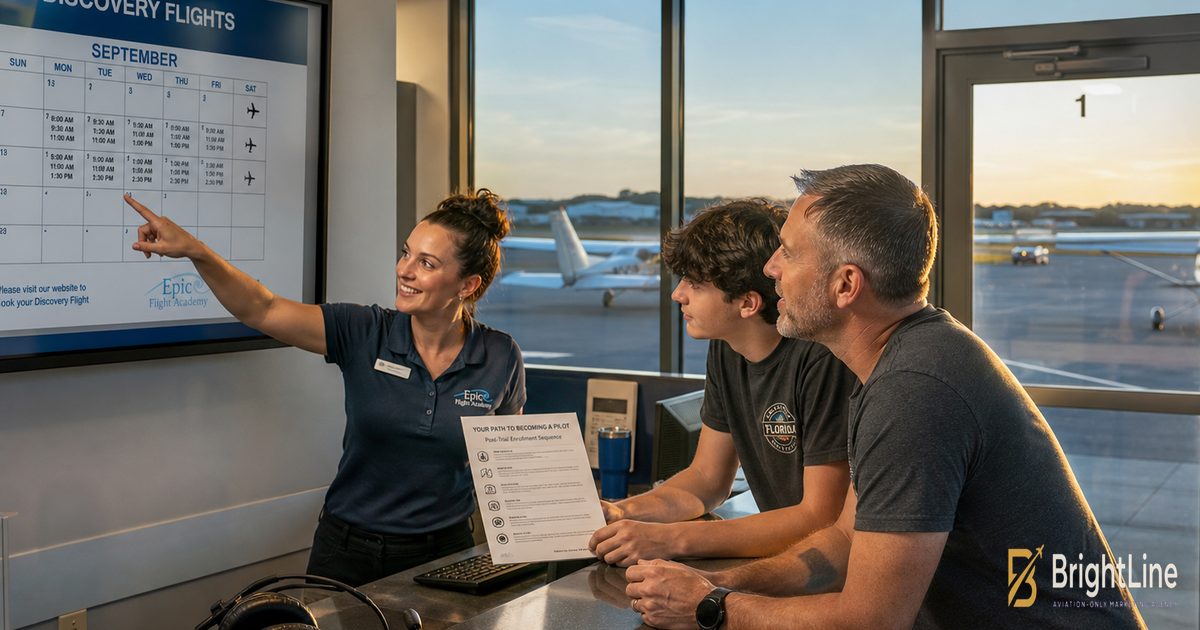
Step 1. Have the agency name every page a prospect touches between a Google search and a confirmed booking. A partner who can trace that path without notes understands your intake. One who improvises is describing a funnel they built for someone else.
Step 2. Ask what happens the day after the discovery flight. The trial is where schools lose the student, and a partner with no follow-up sequence is leaving enrolled starts on the ramp.
Step 3. Require a booking mechanism that works on a phone at a kitchen table. A contact form that disappears into an inbox is where interested prospects go quiet, and a partner who defends that form has never watched a parent try to schedule a lesson.
Step 4. Demand a monthly report that separates traffic, rankings, and qualified leads into three distinct lines. Blended numbers hide the leak, and the school cannot fix a step it cannot see. These are the flight school enrollment marketing steps worth auditing before you sign.
A partner who passes all four can show you exactly where a prospect stalls and what they will do about it. That is the difference between a calendar that fills and a form that collects dust.
Check Four: Do They Win Students Already Searching?
Two postures fill a discovery-flight calendar, and only one keeps filling it after the ad budget stops. Two agencies can look identical on a proposal deck while doing opposite things to your pipeline.
Demand capture builds around what prospects already type into a search bar. A shop working this way publishes pages answering the cost question, the pathway question, and the “how long does it take” question, then layers a tuned Google Business Profile on top. Organic pages compound slowly and hold their position, and paid search can capture the same searchers faster while the pages build.
Demand creation buys attention that would not have arrived on its own. Paid social and display ads can spike trial bookings inside a week, useful for a new location or a spring push. Turn the spend off and the calendar drains with it, because the school built no asset.
Renting attention while a competitor owns the search result is the expensive version of this choice. Prospects compare three schools before they call anyone, and the one whose page answers the cost question first gets the discovery flight.
BrightLine Digital runs the capture side through aviation SEO and local SEO services scoped to flight schools, the layer most generalist shops skip. Pair it with paid campaigns if cash allows, but buy the asset first. A content strategy for flight schools that owns the cost and pathway queries wins the comparison outright.
The Red Flags That Cost Flight Schools a Semester
Nearly every bad agency relationship announced itself in the proposal. The warning signs sat in plain sight, and the school signed anyway.
- A flat monthly number. One figure with no line-item breakdown hides where the money goes. You cannot audit a number that refuses to separate ad spend from management fees from content production.
- A lock-in before any audit. A partner demanding a long contract before looking at your site, rankings, or inquiry flow is selling commitment, not diagnosis.
- Impressions with no leads. A report showing reach and clicks but never qualified inquiries tracks vanity. Your discovery-flight calendar is the only metric that matters.
- An international blind spot. If you train international students, a content plan that never mentions visas, English testing, or the international student pipeline ignores a whole segment of your intake.
- No aviation client to name. A team that cannot point to a single flight school, MRO, or charter operator they have served is learning your industry on your budget.
Each red flag is a refusal to show the work. Before you sign anything, weigh the fee against the cost of building the same function in-house; this breakdown of aviation digital marketing agency cost lays out both.
Score the Four Checks Before You Sign Anything
A polished deck and a big logo tell you nothing about whether an agency can fill a calendar. The comparison that matters is what each partner says when you put a hard question in front of them. Bring this table to the next call and score the answers live.
Weight fluency and conversion above agency size and deck polish. A partner who can explain your intake and follow-up will fix the leaks; a large shop with a beautiful proposal and no aviation vocabulary will bill you while it learns.
A partner who scores well on all four checks is rare. Walk away from any agency that cannot answer the conversion question, no matter how good the flight school website design looks in the mockup.
Run the Checks This Week, Not Next Quarter
Four checks turn a sales pitch into a decision. A flight school marketing agency that survives all four is a partner. One that fails any of them is a bill you’ll pay for a semester.
The calendar doesn’t wait for a slow deliberation. Every week a generalist agency holds your account is a week a competitor answers the cost question first and books the discovery flight you needed. Pull the four questions into your next call. Score the answers live. Sign only when the conversion question gets a real answer.
FAQ
Questions Flight Schools Ask Before Hiring a Marketing Agency
What does a flight school marketing agency do?
A flight school marketing agency builds a pipeline that moves prospects from search to booked discovery flight to enrolled student start. The work spans local search, content, paid ads, and follow-up automation, all scoped to how flight training actually sells rather than to generic lead generation.
How much should a flight school spend on marketing?
Spend should track the value of an enrolled student start, not a fixed percentage of revenue pulled from another industry. A school with a high-ticket career program can justify far more per lead than a small recreational operation running weekend discovery flights.
Can a general marketing agency handle flight school marketing?
A general agency can produce posts and ads, but it will stall the moment a content brief needs Part 61 versus Part 141, medical certificate timelines, or international student visa sequencing. The rework and correction cycles that follow usually cost more than the fee difference.
How long before marketing fills the discovery-flight calendar?
Paid search can produce booked discovery flights within weeks because it captures prospects already searching. Organic growth through local search and content takes longer, which is why the calendar fills faster when both run together from the start.
What should monthly reporting from an agency include?
Reporting should separate traffic, rankings, and qualified leads so the school can see which stage is leaking. A report showing impressions and clicks without booked discovery flights tells the school nothing about whether the spend is working.