M-1 Visa Financial Requirements for Pilot Training: 3 Funding Sources That Pass Muster
TL;DR · The short answer5 key points
- M-1 visa financial requirements for pilot training measure proof of funds against your Form I-20 cost line by line.
- Consular officers test whether funds are fully documented, liquid, and traceable to a lawful, verifiable source.
- Personal savings require months of bank statements; sponsor affidavits need supporting bank records and relationship proof.
- School scholarships must be in writing on official letterhead and listed directly on the I-20 form.
- Assemble and verify your financial documentation with admissions before scheduling your embassy visa interview.
The consular officer asks one question that sinks more pilot applications than any other: how will you pay for flight training? A bank balance answers it only if the money behind it can be explained. That gap is where the M-1 visa financial requirements for pilot training stop being a paperwork exercise and start being a documentary test.
Applicants treat the financial package as a box to check. Officers look for origin, liquidity, and a lawful source; a large balance with no history reads as a red flag, not a strength.
This article ranks the three funding sources that clear the financial-ability bar for M-1 pilot training. You’ll see the exact evidence each source demands, the failure mode that kills each one, and how to sequence the file before you book the interview.
What the Officer Is Actually Testing
Financial ability is documentary proof that you or a sponsor can cover the full I-20 cost of attendance without unauthorized work. It is a paper standard, not a wealth standard. The officer reads the file, not your bank balance.
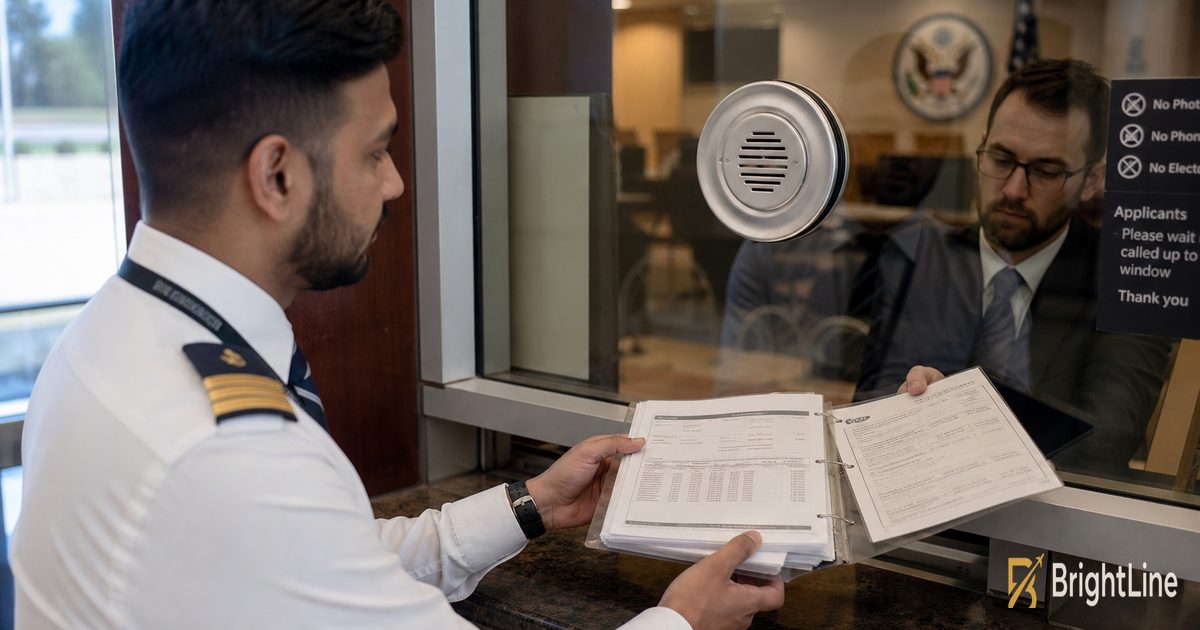
Applicants misread this constantly. They assume a big number wins the window. It does not. A prospective student must have financial evidence showing sufficient funds to cover tuition and living expenses, and the officer wants that evidence documented on paper before the interview starts.
Three tests decide the outcome. Is the money documented, liquid, and traceable to a lawful source? A $90,000 balance that appeared three weeks ago raises the origin question the moment the officer sees it. A $40,000 account with two years of deposits and a salary history passes all three cleanly.
The M-1 visa financial requirements for pilot training are measured against your school’s I-20 figure, not a national average. A Florida flight school’s cost of attendance and an Arizona school’s differ, and the officer uses the number on your specific form.
That distinction matters more than most applicants realize. A student who brings a file matched to the I-20 line by line reads as prepared. One who brings an impressive balance and no explanation reads as a risk. Walk in knowing which of the three tests your evidence satisfies. The officer will ask.
Source One: Personal and Family Savings
Savings is the cleanest funding source because the paper trail is short. An officer can verify an account in minutes, and that speed works in your favor.
The evidence cluster is small but every piece has to line up. The USCIS policy manual makes sufficient funds for the whole course of study a core eligibility requirement, so build the file around what an officer can trace.
- Recent bank statements. Pull several months of statements, not a single page. The officer reads the history to see whether the balance is stable or staged.
- Bank confirmation letter. A letter on bank letterhead confirming the account holder and current balance gives the statement an official second witness.
- Origin of funds note. One short written explanation of where the money came from closes the question before the officer asks it at the window.
- Account holder identity. If a parent holds the account, include the document that proves the relationship to you. An unexplained name on a statement stalls the review.
- Currency clarity. Foreign-currency accounts need the conversion shown plainly. Leave the officer to do the math and the number invites doubt.
A sudden lump-sum deposit with no origin story is the fastest way to turn a strong balance into a refusal. The officer sees money that appeared and cannot place it. Savings works best when the account has history, not just a number. Start the statements running months before your interview date, not weeks.
Source Two: A Sponsor’s Affidavit of Support
A sponsor is the most common funding route for international pilot students. It is also the most commonly botched. Three things decide whether a sponsor file survives: who the sponsor is, what the affidavit says, and what paperwork backs it.
Who Qualifies as a Sponsor, and Why the Relationship Gets Explained
A parent, an uncle, a family friend, or an employer can all sponsor. The relationship still needs a short written explanation, because the officer is testing whether the obligation is real.
What the Affidavit Must State and How It Ties to the I-20
The affidavit has to name a figure that covers the full I-20 cost of attendance, not a round number pulled from memory. Under the federal student visa regulations, the student needs documentary evidence of financial support in the amount shown on the Form I-20. A sponsor pledging less fails before the interview begins.
The Documents That Turn a Promise Into Evidence
An affidavit alone is a statement of intent. Without bank statements behind it, a sponsor letter carries the weight of a handshake. Attach recent statements, a bank confirmation letter, proof of income, and a signed statement of the sponsor’s own obligations. The officer reads the sponsor’s capacity, not their enthusiasm. That gap is where most M-1 visa applications for flight school stall.
Source Three: School-Issued Funding Documentation
A school’s own funding can strengthen your file, but only one kind counts as a funding source. The flight school controls the I-20 figure, so when it also funds part of that figure in writing, the officer is reading one consistent story instead of two competing ones.
What counts is a scholarship or training grant the school issues in writing, on letterhead with a named signatory, and lists on your I-20 as funds from the school. A payment plan or an escrow deposit is different: it spreads out when you pay, but it does not prove you have the money, so it never replaces savings or a sponsor. The State Department’s student visa application overview confirms the school issues the individual Form I-20 required to apply, which makes the school the natural author of any funding commitment tied to it.
A verbal promise from an admissions recruiter carries zero weight at the embassy window. Officers work from paper, not recollection. Ask for the commitment in writing before you book the interview, and treat any school that hesitates as a warning sign about how it handles the M-1 visa interview questions that follow.
The trap sits in the mismatch. A school letter promising partial funding against a full I-20 figure reads as a gap you cannot close. Confirm the numbers line up before you submit anything. BrightLine Admissions checks that your school’s letter, its signatory, and your I-20 figure agree before you reach the embassy.
What Does Not Count as Proof of Funds
Confident presentation of the wrong evidence sinks more pilot applications than thin bank accounts do. The officer isn’t scoring your balance. They’re scoring whether the paper behind it survives a second look.
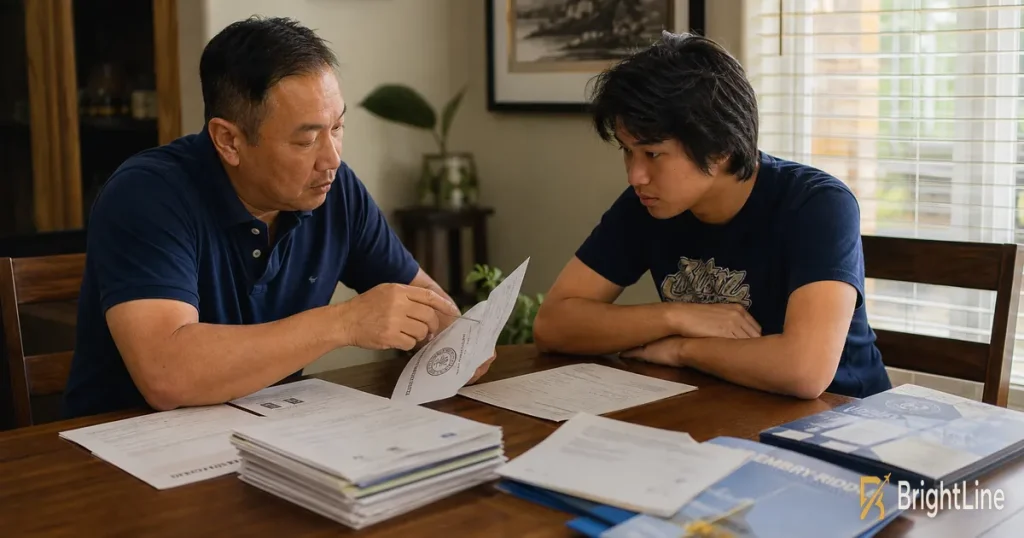
- A balance screenshot with no statement. A phone image proves a number existed once, not that the account has history or a lawful origin.
- A sponsor letter with no bank records. The signature promises money; without statements, the officer can’t confirm the sponsor can deliver it.
- Projected earnings from a future job. Income you haven’t received can’t be documented; the officer evaluates funds available now.
- Informal family loans with nothing in writing. An undocumented transfer has no traceable source, reading as unexplained money rather than support.
- Funds deposited days before the interview. A sudden lump sum with no origin story looks arranged for the appointment.
The pattern is the same: the money may be real, but the record isn’t. SEVP governing regulations require documentary evidence of support matching the Form I-20 figure, and a document that can’t be verified isn’t evidence. Officers reject paper trails, not finances. If your funding is genuine but undocumented, the problem is solvable before the interview, not after a flight school student visa denial.
Audit your file against this list this week. Replace every screenshot with a statement, attach bank records to every sponsor letter, and write one sentence explaining where each dollar came from.
How to Sequence Your Funding Evidence
Sequence beats volume. A funding file in the wrong order produces contradictions the officer spots in seconds, costing you a second interview fee and a delayed class date. The M-1 postsecondary student process runs on a fixed order; mirror it.
Step 1. Get the exact I-20 cost of attendance from your school in writing, including tuition, living expenses, and fees. Otherwise you document a number the school never certified, and the officer compares your file to the I-20, not your estimate.
Step 2. Pick the funding source matching where your money actually sits. Choosing a source you cannot fully document is the fastest route to a refusal, even when the total is sufficient.
Step 3. Pull statements and sponsor records with enough history to show origin, not just balance. A clear deposit trail survives scrutiny that a bare balance does not.
Step 4. Send the package to your school and have admissions confirm it matches the I-20 figure line by line. A school that catches a mismatch before the embassy does saves you from a rebooked interview.
Step 5. Rehearse one sentence explaining where the money comes from and who supplied it. Fumbling that sentence hands the officer a reason to doubt documents that were fine.
Anyone planning to become a pilot in the USA should treat the I-20 figure as the anchor for every document downstream. Get that number first, and the rest organizes itself around it.
M-1 Visa Financial Requirements for Pilot Training: Common Gaps
The three funding sources fail for different reasons. A savings file collapses on origin. A sponsor file collapses on missing records. A school file collapses on verbal promises. The table below maps each source against what the officer needs, how long assembly takes, and where it breaks.
Combining sources is allowed and often necessary. You must have sufficient funds for self-support across the whole course, so a partial savings balance plus a documented sponsor gap is stronger than one thin source stretched alone. Label each contribution against the I-20 total.
Before you book, ask your school for its funding letter in writing and check that the figure matches your I-20 exactly. Then compare it against your M-1 visa vs F-1 visa paperwork, so every document tells the same story.
Build the Funding File Before You Book the Interview
The M-1 visa financial requirements for pilot training reward one thing: a funding story that matches where your money actually sits. Savings, a sponsor, and school-issued documentation are not interchangeable. Each demands a different paper trail, and the officer reads yours against the I-20 figure your school issued.
Booking the interview before the file is assembled is how applicants burn a fee and a class date. The embassy window is not where you fix a gap. A sponsor affidavit without statements behind it, or a balance with no origin, reads as a promise rather than proof. That refusal costs weeks you cannot get back before your cohort starts.
Confirm the exact I-20 cost figure with your flight school first. Pick the funding source you can document most completely, not the one that looks largest on paper. Assemble the statements, letters, and records, then schedule the interview. The file comes before the appointment, every time.
FAQ
M-1 Visa Funding Questions Pilots Ask Before the Interview
Is there financial aid for becoming a pilot?
Financial aid for flight training exists, but it rarely looks like the grants and federal loans that fund a university degree. International students on an M-1 visa cannot access US federal student aid at all, so the realistic options are school-issued scholarships, private loans, and personal or sponsor funds.
How much does an M-1 visa cost?
The visa itself carries a modest application fee, plus the separate SEVIS I-901 fee, but the number that matters is the I-20 cost of attendance your flight school prints on your form. That figure bundles tuition, living expenses, and training costs, and the consular officer measures your entire funding file against it rather than against the visa fee.
What are the requirements for an M-1 student visa?
You need a Form I-20 from a SEVP-certified school, a paid SEVIS I-901 fee, a completed visa application, and documentary proof you can cover the full I-20 amount. The financial evidence carries the most weight, and weak paperwork there sinks otherwise qualified applicants at the interview.
Can I combine more than one funding source on my M-1 application?
Combining sources is allowed and often smart, as long as each one arrives with its own paper trail and the totals add up to the I-20 figure. A half-documented sponsor affidavit stacked on a thin savings account reads worse than one modest account with a clean history behind it.