
FAA Class 1 Medical for Foreign Students: Step-by-Step Guide
TL;DR
- FAA Class 1 medical for foreign students must be secured before leaving your home country; waiting until arrival in the US risks deferrals that derail your enrollment, visa, and flight school deposits.
- Confirm your career track requirements early, as airline-track programs require a First-Class Medical Certificate at enrollment, not the lesser third-class standard that only allows basic solo flight.
- Complete your FAA Form 8500-8 on MedXPress before your exam and gather certified, translated clinical notes (less than 90 days old) to avoid costly, multi-week deferrals.
- Book an appointment with an FAA-designated AME in your home country to resolve medical inquiries locally and arrive in the US with your certificate already in hand.
- Flight schools should screen medical eligibility prior to collecting deposits to protect international admissions timelines and prevent enrollment refunds.
A student books a flight school seat, pays the deposit, lands in the US, and discovers a heart condition blocks the certificate their airline track requires. The FAA Class 1 medical for foreign students is not paperwork you handle after arrival. It is the gate that decides whether the career starts on schedule or stalls before the first solo.
Schools on the airline track require a first-class certificate at enrollment, not the third-class the FAA minimum allows for solo flight. That gap catches students who self-screen against the wrong standard. A condition that clears third-class can defer or disqualify first-class entirely.
This article walks the full sequence, from creating a MedXPress account and filing Form 8500-8 to booking an AME and holding the certificate. You’ll get the disqualifying conditions that trigger deferrals, the AME selection rules that change your timeline, and the steps to complete before you pay a deposit.
Why Foreign Students Need Class 1 Before Arrival
The FAA Class 1 medical for foreign students is a career filter disguised as a formality. A student who can’t pass it discovers that fact in a flight school office in Florida, not in a clinic back home. By then the deposit is paid and the visa is stamped.
The FAA issues three certificate classes, each mapping to a different career ceiling. First-class is designed for the airline transport pilot, second-class for the commercial pilot, and third-class for the student, recreational and private pilot, per the FAA medical certificate classes. A third-class certificate gets you soloing. It does not get you into an airline cockpit.
That gap is where international students lose money. AeroGuard requires first-class certification before enrollment, so students know the medical requirements for this career path are met before training starts. Schools that skip that screen are selling seats they can’t deliver on.
Waiting until arrival creates a second problem. An AME in the US works on US scheduling, and a deferral for a cardiovascular or vision issue can push a start date by weeks. A student who needs to become a pilot in the USA on a fixed cohort calendar has no slack for that delay.
Home-country screening removes the risk while it’s still cheap. A student who clears Class 1 before departure arrives with a certificate in hand and a training slot that holds. The medical decides the timeline, not the flight hours. Every other step in the enrollment sequence assumes the certificate already exists.
The counter-argument is that a home AME might not understand FAA standards. That’s a real risk, but it cuts the other way. A US-based AME who finds a problem has already cost you the visa and the deposit.
Book the exam through an aviation medical examiner listed for your region, and bring your school’s medical checklist. Ask the school which conditions have disqualified prior applicants. Then get the answer in writing before you pay a deposit.
The Class 1 Medical Requirements Foreign Students Must Meet
- Distant vision. You need 20/20 in each eye separately, correctable with glasses or contacts.
- Near vision. Intermediate and near acuity must also meet standard in each eye.
- Hearing. You must hear a conversational voice at six feet, tested per ear.
- Cardiovascular fitness. Blood pressure, rhythm, and any chest pain history get reviewed closely.
- Neurological health. Seizures, unexplained blackouts, and head injuries trigger deeper review.
- Mental health. Active psychiatric diagnoses or certain medications require documentation and clearance.
- Drug and alcohol history. Substance-related diagnoses and treatment records fall under strict FAA rules.
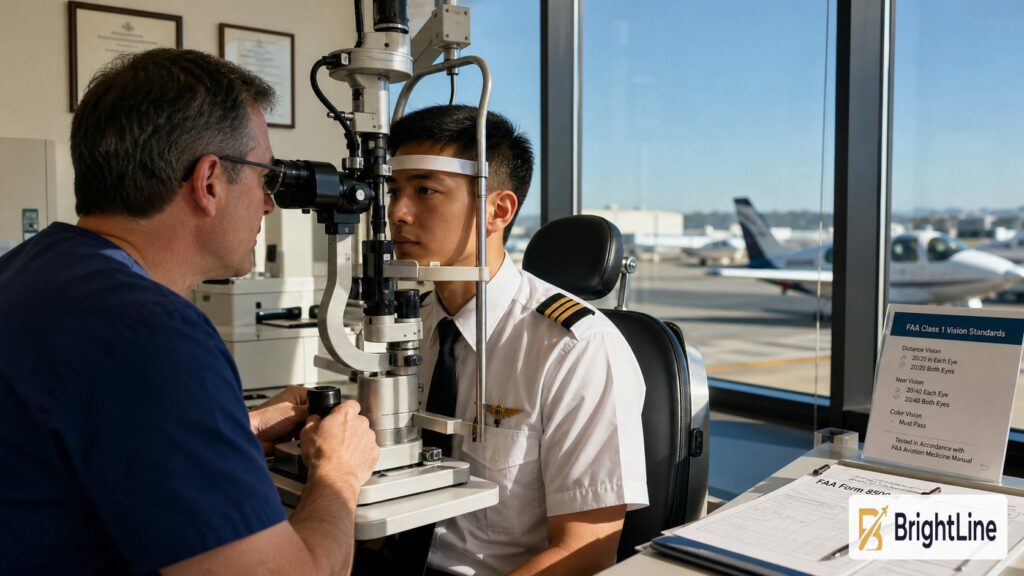
An FAA-designated Medical Examiner conducts the exam under 14 CFR Part 67, and the FAA collects your history through MedXPress before your visit. The examiner verifies fitness, not coach you through a borderline result.
What the bullets hide is that most failures are documentation gaps, not medical verdicts. A controlled condition with clean records often clears. The same condition with missing history becomes a deferral.
Run this self-screen now, then gather your clinical notes before you book anything. Schools that build this step into Part 141 enrollment gates catch problems while there is still time to fix them.
The vision standard catches more applicants than any other line. Correctable to 20/20 sounds forgiving until an examiner finds an uncorrected problem in one eye only. Get a full optometric exam at home first, not a roadside eye chart.
Blood pressure is the quiet disqualifier. A single high reading at the exam can trigger a deferral that costs you weeks. Bring recent readings from a clinic, dated and signed, so the examiner has context instead of one bad morning.
Step-by-Step: From MedXPress to Certificate in Hand
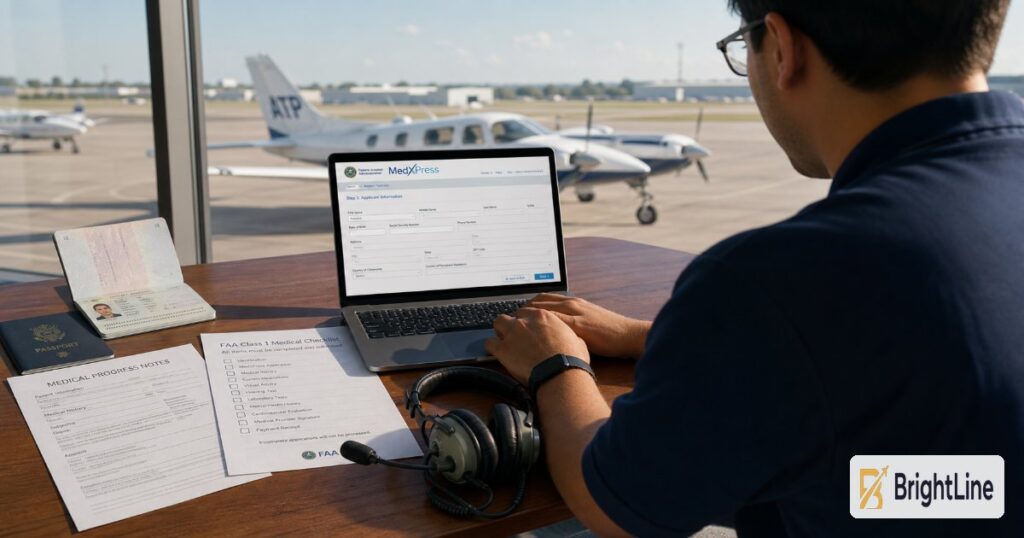
Step 1. Create your MedXPress account and file FAA Form 8500-8. The FAA collects your medical history through an online system called MedXPress before you ever sit in an examiner’s office. Filing the 8500-8 in advance keeps the appointment focused on the physical exam itself. Walk in with a blank form and you’ll burn the slot on paperwork.
Step 2. Gather clinical progress notes for any existing condition. For some conditions, the FAA may require a current, detailed clinical progress note from your treating physician or specialist, dated no more than 90 days before the exam. Request these early. A note that’s three months stale means a new clinic visit and a new wait.
Step 3. Book the AME appointment. Choose an examiner who has handled your specific condition before, not the one with the soonest opening. Ask the office directly whether they’ve issued certificates for your diagnosis. The wrong examiner defers a case the right one clears.
Step 4. Complete the physical exam. The AME reviews your MedXPress submission, runs the vision, hearing, cardiovascular, and neurological checks, then either issues the certificate on the spot or defers it to the FAA. Bring every note and record you gathered in step two. An examiner who has to request documentation after you leave adds weeks to the clock.
Step 5. Receive the certificate or a deferral. A clean exam means a first-class certificate in hand that day. A deferral routes your file to the FAA’s medical review, where the timeline stretches and the outcome depends on the paperwork you supplied. This is the step that collides with timing your I-20 and your flight school start date.
Finishing this sequence before you commit to a training slot converts a variable into a fixed cost. The certificate sits in your file, the deferral risk is gone, and your enrollment date stops depending on a review queue you can’t see.
What Disqualifies You From a First-Class Medical
Almost nothing on the FAA Class 1 medical disqualification list ends a flying career outright. It stalls one. The conditions that fail an applicant are mostly the conditions that trigger a deferral, and a deferral is a paperwork problem with a clock attached.
- Cardiovascular history. A prior heart attack, stent, or arrhythmia diagnosis pulls the file for review. The FAA wants stress test results, an echocardiogram, and a cardiologist’s current assessment, not a summary letter from years ago.
- Vision outside standard. Distant acuity must hit 20/20 in each eye, corrected or not, with near vision at 20/40. A student who wears contacts should bring the prescription record and a spare pair to the exam.
- Neurological and psychiatric history. A seizure, a concussion with lingering symptoms, or a depression diagnosis with medication all require specialist notes. Undisclosed history is worse than disclosed history, because the FAA cross-checks records.
- Substance-related diagnoses. Any alcohol or drug treatment program triggers a defined review path with its own documentation requirements. The FAA looks for the treatment record and a period of verified sobriety, not a character reference.
- Certain medications. Some prescriptions are approved, some require a waiting period, and some are disqualifying while you take them. A student on a long-term prescription should confirm its status before booking the exam.
The pattern across every category is the same: the FAA does not reject applicants for having a condition. It rejects incomplete files. For some conditions, the FAA may require a current clinical progress note from a treating physician dated no more than 90 days before the exam.
Foreign students carry one extra layer of friction here. Records from a home-country physician often need translation and foreign authority verification before an AME will accept them, and that step alone can eat weeks. A deferral costs you a training slot, not a career.
Finding an AME Abroad or After You Land
Two paths exist for the FAA Class 1 medical for foreign students, and the one you pick decides whether your first month in the US is training or waiting. An exam at home before departure beats a local search after arrival in almost every case. The reason is scheduling, not medicine.
Seeing an FAA-designated AME in your home country removes the biggest variable from your first weeks. International students concerned about obtaining their medical once arriving in the United States can find a local AME at home before they fly. You walk into your first ground school session with the certificate already in hand, and any deferral gets resolved on familiar ground with your own doctors.
That home-country path has a catch. AME coverage is thin outside major cities, and some countries have only a handful of designated examiners. Booking early matters, because a single examiner can carry a waitlist that runs into weeks. Pair the appointment with your M-1 visa flight school paperwork so both move on the same timeline instead of competing for your attention.
Waiting until you land feels simpler, and for a student already living near a US flight school it can be. You book a local examiner, often within driving distance, and the FAA’s own records flow straight into the system. The problem is timing. A deferral discovered in week two can push your solo flight back by a month or more, and your training slot does not wait.
The home-country exam wins whenever your start date is fixed. Choose the US path only if you already live near a school, have no existing medical history, and can absorb a delay. Everyone else should book abroad. Schools that sequence medical, visa, and enrollment steps through a partner like BrightLine Digital’s International Flight School Admissions service keep seats filled instead of refunded.
What the FAA Class 1 Medical Costs Foreign Students
| Cost Line Item | Typical Range | Who Sets It | When It Applies |
|---|---|---|---|
| AME exam fee | $100 to $250 | The examiner, not the FAA | Every applicant, first visit |
| Specialist evaluation | $200 to $600+ | Your treating physician | Existing conditions flagged on Form 8500-8 |
| Clinical progress note | $50 to $200 | Clinic or specialist office | FAA requests current documentation |
| Certified translation | $30 to $100 per document | Translation service | Records issued outside the US |
| Repeat exam after deferral | Full AME fee again | The examiner | Certificate not issued on first visit |
The FAA may require a current, detailed clinical progress note generated no more than 90 days before your exam for certain conditions. That window forces a second clinic visit if your records are stale. Students who pull documentation early pay once. Students who wait pay twice.
Budget the AME fee as your floor, not your total. A deferred exam costs more than a clean one because it adds specialist visits and time. Fold these numbers into your total training cost picture before you commit a deposit, and the medical stops being a surprise line item.
Budget for the worst case, not the exam fee. A deferral adds specialist visits, progress notes, and a second AME appointment before the FAA issues anything. That stack routinely costs several times the original exam cost.
Timing multiplies the damage. Every week spent chasing documentation is a week your cohort start date slides. Ask your AME for the full fee schedule before you book, and confirm what a re-exam costs if the first one defers.
How Flight Schools Should Guide International Applicants
A flight school that collects the deposit before screening medical eligibility is selling a seat it may have to refund. The FAA Class 1 medical for foreign students sits upstream of enrollment, not beside it, and admissions teams that treat it as a post-arrival formality absorb the cost when a deferral lands. The fix is sequencing, not persuasion.
Every student needs a medical certificate before solo flight or any pilot certificate, and the FAA issues three classes with different standards. The three classes of medical certificates map to different career tracks, which is why an airline-track applicant cannot settle for the minimum. A school that lets a student enroll on a third-class assumption has already created its own refund case.
Screen eligibility before the deposit clears. Ask for the applicant’s medical history summary, flag anything that triggers FAA scrutiny, and require a home-country AME exam or a written pre-screen before the seat is reserved. Schools that front-load this step convert a refund risk into a confirmed enrollment. It also keeps the visa timeline honest, since a deferred medical pushes the I-20 start date and the interview window together.
Admissions funnels rarely fail on lead volume. They fail on handoffs, where the medical, visa, and enrollment steps run in parallel instead of sequence. BrightLine Digital builds that sequence into a school’s Aviation Content Strategy and International Flight School Admissions flow, so applicants see the medical requirement on the same page as the deposit. A prospect who understands the order before they commit does not become a refund three weeks later.
The operational habit that separates strong programs from struggling ones is boring: one checklist, one owner, one gate before money changes hands. That gate also protects filling discovery flight slots with applicants who can progress to solo. A school that screens late keeps recruiting replacements for students it already lost.
Book the AME Before You Book the Flight
Wait until arrival and the sequence inverts. A deferral then collides with a cohort start date you already paid for, and the school holds a seat it cannot fill. Booking the AME first converts an unknown into a known. That single ordering decision protects the deposit, the visa timeline, and the training slot all at once.
Create the MedXPress account today. Complete FAA Form 8500-8, then book the AME appointment before any flight school deposit leaves your account. The certificate comes first. Everything else follows.
FAQ
FAA Class 1 Medical Questions Foreign Students Ask
What disqualifies you from 1st class medical?
A disqualifying condition is any diagnosis the FAA deems incompatible with safe flight until it is documented, stabilized, and cleared through review, and the list spans cardiovascular disease, vision outside standard, neurological and psychiatric history, and substance-related diagnoses. An FAA Class 1 medical for foreign students hinges on records, not the diagnosis itself, so a student arriving with translated specialist notes dated within the prior months clears faster than one who arrives with nothing.
How much does it cost to get an FAA Class 1 medical certificate?
The AME sets the exam fee, not the FAA, and the total climbs once specialist evaluations, clinical progress notes, and repeat exams enter the picture. A clean exam with no underlying conditions costs the least, while a deferral adds specialist visits and a second appointment that a student never budgeted for.
What are the requirements to qualify for an FAA First Class medical certificate?
Applicants must pass an examination conducted by an FAA-designated Aviation Medical Examiner under 14 CFR Part 67, covering distant and near vision, hearing, cardiovascular fitness, neurological health, and mental status. The examiner submits the results through MedXPress, and the FAA issues the certificate, requests more information, or defers the case for further review.
Where can I get an FAA first class medical?
Any FAA-designated Aviation Medical Examiner can perform the exam, and examiners practice in most major cities worldwide, including many outside the United States. A student can book an AME in their home country before departure, which removes a scheduling risk from the first weeks of training and keeps the enrollment timeline intact.