Cost Commercial Pilot License in USA for International Students: How to Budget in 2026
ℹ️ TL;DR
- Budgeting for a commercial pilot license in USA for international students requires analyzing true landed costs rather than relying solely on advertised tuition minimums.
- Flight hours routinely exceed FAA minimums due to weather cancellations, aircraft maintenance delays, and maneuver repetitions.
- Budget for non-tuition expenses including M-1 SEVIS fees, first-class medical exams, checkride examiner cash, and mandatory health insurance.
- Protect your funds against bank exchange rate spreads and currency conversion shifts across multi-month training windows.
- Lock your visa approvals and review flight school refund policies before wiring non-refundable initial seat deposits.
A flight school quote lands in your inbox and the number looks survivable. Then you read the fine print: it covers flight hours only, not the visa, insurance, checkride fees, or months of rent while you wait for a checkride slot.
The cost of a commercial pilot license in USA for international students is never the brochure figure. It is the figure after every government fee, examiner invoice, and currency conversion has been stacked on top. Schools quote tuition because tuition is what they control. Everything else lands on you, and most applicants discover it in month three when the money runs thin.
Why the Quoted Price Is Never the Real Price
Schools quote the minimum because it is the cleanest number to market. What the brochure cannot show is how many hours a real student flies. Weather grounds a solo cross-country. An aircraft goes into maintenance for a week. An instructor leaves for a regional airline and the replacement teaches differently.
Domestic students absorb those overruns inside a budget they already understand. International students pay a second layer the quote never touches. Visa fees, SEVIS, health insurance required for status compliance, housing for the full program, checkride examiner fees, and currency conversion all sit outside the tuition line. A realistic commercial license budget folds every one of those into a single landed figure.
The gap between minimum hours and actual hours is the largest single variable in your budget. A student who finishes near the FAA floor and a student who finishes well above it can attend the same school, fly the same aircraft, and pay wildly different totals. Flight schools know this. BrightLine Digital’s aviation content strategy work with flight schools shows how carefully schools frame cost data, presenting tuition as the anchor while operational realities sit in the fine print.
This is why a flight school cost comparison built on hourly rates alone fails. Two schools can advertise the same rate and produce different final bills, because the rate says nothing about aircraft availability, instructor retention, or how long you wait between lessons. Build your budget from the bottom up. Start with the fixed costs you cannot avoid, add the hours you will actually fly, then layer the hidden items on top.
The sticker price is the beginning of the conversation, not the end of it. What you do with the gap decides whether your funding survives the program or runs dry halfway through.
What You Must Have Before the Meter Starts
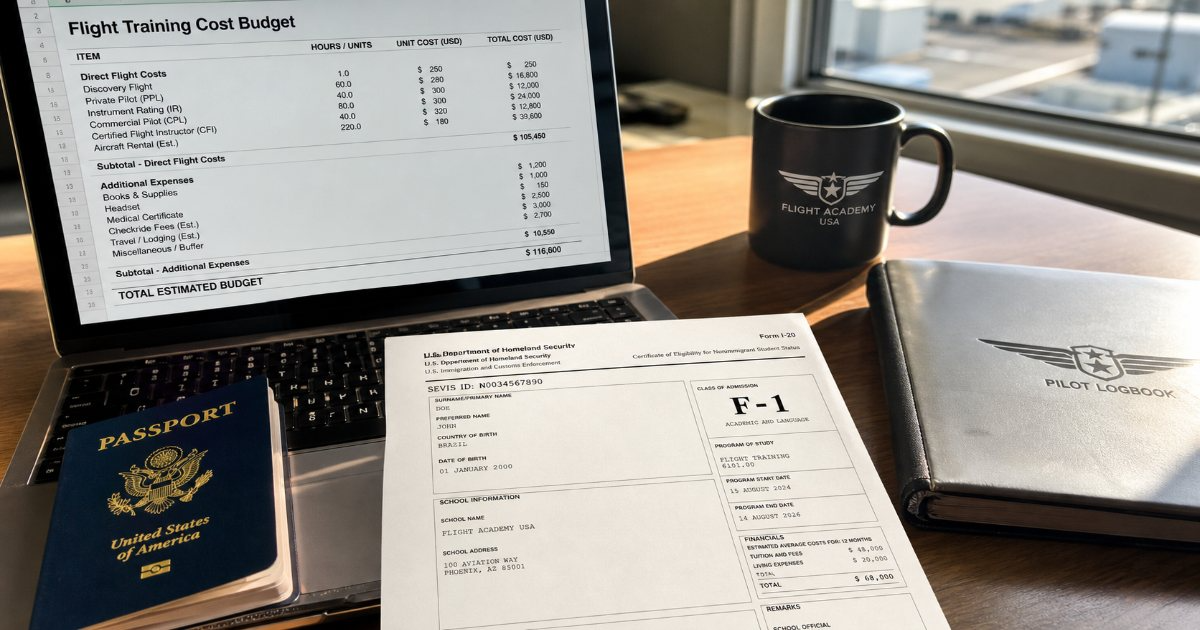
- Visa category selection. Choosing between M-1 and F-1 status determines your enrollment rules and how long you can stay.
- SEVIS and MRV fees. The M-1 student visa runs $350 for SEVIS plus $185 for MRV processing.
- School enrollment charges. Administrative and enrollment fees typically land between $50 and $250, and they clear before your seat is confirmed.
- Medical certification. A first-class medical must be secured early, because a disqualifying condition ends the plan before flight hours begin.
- English proficiency proof. Schools require a language test score or equivalent, and a weak result can push your start date back.
- Initial seat deposit. The deposit holds your slot in a cohort, and it is usually non-refundable once the intake locks.
What the list hides is timing. The M-1 visa for flight school process can run weeks, and a deposit paid before visa approval puts your money at risk if the interview goes badly. Sequencing matters more than the individual amounts.
Build these six items into a single dated checklist before you commit to any school. Confirm each fee in writing, then pay in the order that protects your deposit until the visa clears.
Currency timing is the piece nobody budgets for. The dollar-to-rupee or dollar-to-naira rate moves while your visa sits in processing, and a deposit wired at the wrong moment can cost hundreds more than the same deposit a month later.
Lock your exchange rate before you wire. A forward contract through your bank freezes the rate on a set date, turning an unpredictable cost into a fixed line in your budget.
The Flight Hours That Drive Your Total Cost
| Certificate or Rating | FAA Minimum Hours | Typical Actual Hours | What Drives the Gap |
|---|---|---|---|
| Private Pilot License | 40 hours | 60 to 75 hours | Weather cancellations and repeated maneuvers before solo sign-off |
| Instrument Rating | 40 hours | 50 to 60 hours | Simulator time limits and approach proficiency |
| Commercial Single-Engine | 190 total hours | 220 to 260 hours | Cross-country requirements and complex aircraft transitions |
| Multi-Engine Add-On | No separate minimum | 15 to 25 hours | Engine-out drills and checkride retakes |
Add those columns up and the real range lands where the industry puts it. Most students spend between $45,000 and $70,000 to complete their training from zero hours to a Commercial Pilot License, which is a full flight school cost breakdown rather than a tuition line.
Bundled and fixed-cost pricing exists, and it shifts risk to the school. The trade-off is real: bundled programs usually lock your schedule, limit instructor choice, and charge a premium for the certainty.
Budget the overage, not the minimum. A student who plans for 250 hours and flies 230 keeps money. A student who plans for 190 and flies 250 is wiring home for a second tranche mid-program.
Flight schools in Arizona and Florida advertise faster completion because their weather allows more flying days. That advantage is real, but it only holds if you can get on the schedule. Ask any school for its aircraft-to-student ratio before you commit. A fleet stretched thin adds weeks of waiting, and waiting weeks still costs you rent.
Hidden Costs International Students Always Miss
The gap between the cost of a commercial pilot license in USA for international students and what actually leaves your bank account is built from line items nobody prints on the brochure. Schools quote tuition because tuition is what they control. Everything else lands on you, in the same months your tuition payments are due.

- Checkride examiner fees. An average cost for a pilot check ride is around $1,000, but this does vary. Fees range between $600 and $1300, and a failed ride means paying again for both the examiner and re-training hours.
- Written exam fees. Each knowledge test carries its own fee, and you sit several across the certificate ladder. Budget them as a recurring cost, not a one-time charge.
- Headset, books, and supplies. Text books and manuals are non-tuition costs that also impact flight training costs overall. A noise-cancelling headset alone runs into the hundreds before you log a single hour.
- Medical renewals. Your medical certificate expires on a schedule that does not care where you are in the program. A renewal mid-training means another exam fee and appointment slot to work around.
- Health insurance for visa compliance. Schools enrolling international students typically require proof of coverage, a recurring monthly cost for the entire program, not a one-time purchase.
- Housing and utilities. Rent, deposits, electricity, and internet run for the full length of training, including months you are waiting on weather or aircraft availability rather than flying.
- Transportation to the airfield. Flight schools sit at municipal airports, not downtown. Without a car, you are paying for rideshares on a schedule set by your instructor, not by you.
- Currency conversion and wire fees. Every transfer from your home bank carries a spread and a flat fee. Repeated transfers across a multi-month program quietly add up to a real percentage of your total.
Read as a block, these items reveal something the individual lines hide: the hidden costs scale with program length, not with flight hours. A student who finishes in fourteen months pays less of this block than one who stretches to twenty. Build the block into your budget as its own category before you compare schools on hourly rate.
How to Build Your Budget Step by Step
Step 1. Lock your visa category and total government fees first. The visa category you pursue determines which fees apply to you and when they fall due, so confirm this before you price anything else. Skipping this step means discovering a mandatory payment after you have already committed a deposit.
Step 2. Get the school’s quote in writing and mark what it excludes. Ask for the quote as a document, then annotate every line the school has left out. A verbal figure cannot be audited later when the invoice arrives higher than expected.
Step 3. Multiply quoted flight hours by a realistic overage factor. Schools quote to the FAA minimum, but weather, aircraft downtime, and instructor changes push actual hours well past it. Budgeting to the minimum is the fastest route to a mid-program funding crisis.
Step 4. Add the hidden-cost block as a single line item. Checkride examiner fees, written exams, headsets, medical renewals, health insurance, and supplies belong in one consolidated category. Treating these as surprises rather than line items is how a manageable budget becomes an emergency.
Step 5. Add living costs for the full program duration, not the flight phase. Rent, utilities, food, and transport run for every month you are in the country, including the gaps between checkride slots. Underestimating duration is the most common way international students run short.
Step 6. Add a contingency reserve for re-flights and delays. Visa processing timelines and weather both cost money when they stall your progress. This reserve is not optional for international students, because a failed checkride or a delayed intake means paying for time you did not plan.
Step 7. Convert everything at a conservative rate and add transfer costs. Use a rate that assumes your home currency weakens, then add wire and conversion fees on top. A program that runs many months exposes you to currency movement that a single-day conversion ignores.
Completing these steps gives you a landed-cost figure you can defend in a conversation with any school. That number, not the quoted tuition, is what should drive your decision about where to train as a commercial pilot and when to commit.
Where International Students Get Their Funding
Family savings and home-country income cover most international flight students. The money is already yours, it carries no interest, and it clears the proof-of-funds requirement that consular officers want to see before issuing a visa. The weakness is timing. Wiring a lump sum early locks your exchange rate months before you need the cash.
Home-country bank loans and education financing stretch the same money across a longer runway. Lenders in India, South Korea, and the Gulf states routinely underwrite pilot training, and some release funds in tranches tied to enrollment milestones. Approval takes weeks, and the interest compounds while you sit on a checkride waitlist.
School payment plans and pay-as-you-go structures shift the risk to the school. You pay per block of flight hours rather than upfront, which protects you if training stalls. Read the conditions carefully. Many plans tie continued enrollment to minimum monthly payments, and a missed installment can pause your flight slot.
US federal student aid is generally unavailable to international students, so the funding conversation stays in your home country. Schools that handle international flight school admissions well will tell you upfront which payment structures satisfy the visa proof-of-funds requirement and which do not. BrightLine Digital builds admissions content that walks applicants through exactly this staging.
Choose home savings if you can cover the full program and want the cleanest visa file. Choose a payment plan if your intake date is fixed and your cash arrives in stages. Compare the total commercial pilot license cost under each structure before you commit.
Mistakes That Inflate the Cost of Commercial Pilot License in USA for International Students
- Chasing the lowest hourly rate. A cheap wet rate means nothing if the aircraft is booked solid and instructors keep leaving.
- Budgeting to FAA minimums. Weather, maintenance, and inconsistent instruction push nearly everyone past the minimum hour count.
- Ignoring currency swings. A program spanning many months exposes your home-currency budget to exchange rates you cannot control.
- Paying a deposit before visa approval. A refused visa can strand that money with a school that has no obligation to return it quickly.
- Skipping the contingency reserve. Re-flights, checkride retakes, and weather delays all demand cash you did not plan for.
- Treating health insurance as optional. Coverage ties directly to visa compliance, and a lapse can interrupt your enrollment status.
None of these errors show up in a school’s advertised figure, and several only surface months into training. The realistic training cost breakdown includes variables a brochure never prints.
Take this list to every school you’re considering, including flight schools in Florida, and ask each one directly how they handle aircraft availability, instructor retention, and refund terms. The answers will separate the schools worth your deposit from the ones selling a number.
Schools that bundle a fixed block of hours into one price protect you from the worst version of this. Ask whether the quote locks a total hour count or just an hourly rate.
A locked block means overruns get absorbed by the school. An hourly quote means every weather delay lands on your card. That distinction can swing your final bill more than any tuition discount can.
Turn the Budget Into a Decision This Week
Act before the next intake closes, because visa processing runs on its own clock and a delayed interview pushes your start date into a later cohort. Wait too long and you are rebooking flights, reissuing documents, and paying for a seat that moved.
Take your completed budget to two or three flight schools this week. Ask each one, in writing, to confirm exactly what their quote excludes. Compare the answers, not the headlines. The school that answers clearly is the one worth your deposit.
Commercial Pilot License Costs for International Students: Your Questions Answered
How much does pilot training cost for international students in the USA?
The cost of a commercial pilot license in USA for international students typically lands between $45,000 and $70,000 for flight training alone, before visa fees, insurance, and living costs are added. A school’s advertised figure usually reflects the FAA minimum hour count, so a student who finishes in the minimum hours pays far less than one who takes extra time for weather or aircraft delays.
Can an international student become a pilot in the USA?
Yes, international students can train and earn a commercial pilot license in the USA, but they must enter on an M-1 student visa rather than a tourist or work visa. The M-1 route requires a TSA security clearance before flight training begins, which adds a processing step that domestic students never face.
Is becoming a pilot in 2026 worth it?
Becoming a pilot remains worth it for students who treat the training as a full landed-cost investment rather than a tuition purchase. The career payoff depends less on the year you start and more on whether you finish with a commercial license and the flight hours employers actually require.
What costs do flight school quotes usually leave out for international students?
Flight school quotes typically exclude checkride examiner fees, written exam fees, headset and supplies, medical renewals, health insurance, housing, and currency conversion costs. A checkride alone can run between $600 and $1,300, a figure that sits entirely outside the quoted tuition number.