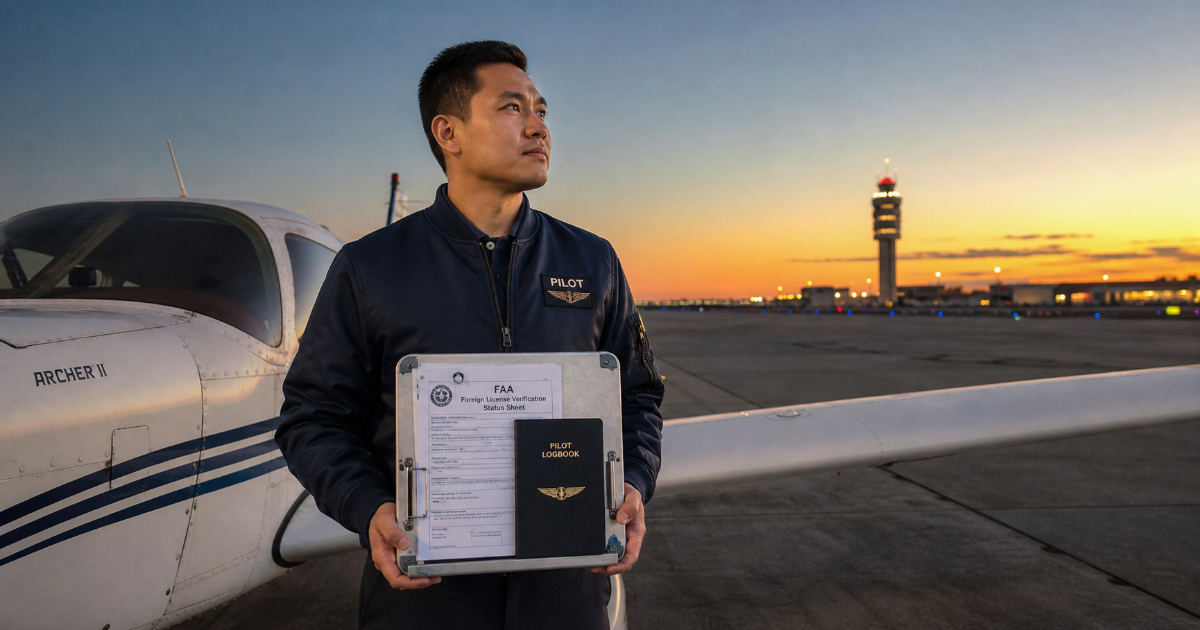
FAA Foreign Pilot Certificate Verification: What Pilots Need to Know
ℹ️ TL;DR
- The FAA foreign pilot certificate verification process relies entirely on your home Civil Aviation Authority (CAA) confirming your credentials directly to Oklahoma City.
- Response timelines average 45 to 60 days, but total wait time depends on your home authority’s responsiveness, not the FAA’s processing speed.
- Common document rejection causes include name mismatches between passport and license, missing endorsement pages, and blurry scans.
- Non-English licenses require a complete, legible English transcription covering every rating and endorsement, though a certified notary stamp is not required.
- Privacy Act rules prevent flight schools or employers from checking your file status directly: you must provide a copy of your verification letter or sign a formal release.
A pilot submits a conversion packet, waits, calls the FAA, and hears the same answer: the file is open and the foreign authority has not replied. That silence is the whole story of FAA foreign pilot certificate verification.
It is not a form you file and forget. The FAA cannot issue anything until your home civil aviation authority confirms your license is valid and current, and that office answers on its own schedule.
Two pilots with identical paperwork can wait wildly different lengths of time for exactly this reason. This article covers the mechanics other guides skip: what the Airmen Certification Branch needs, how to track a pending file, what to do when your license is not in English, who else can request verification, and how a verification letter differs from an authenticity letter.
Verification Is a Foreign Authority’s Decision
The FAA never inspects your foreign license. It asks someone else to vouch for it. That single fact explains why FAA foreign pilot certificate verification behaves nothing like a normal application, and why the pilot who submits the cleanest packet in the room can still wait the longest.
The Airmen Certification Branch must have the Civil Aviation Authority (CAA) verify the validity and currency of the foreign license and medical certificate or endorsement before issuing a certificate on the basis of a foreign license. Read that sentence again, because the actor is not the FAA. The foreign licensing authority holds the pen. Until it signs, the FAA has nothing to act on.
Two pilots with identical logbooks, identical Form 8710-1 packets, and identical medicals can sit months apart on the calendar. One holds a license from a CAA that answers FAA inquiries within weeks. The other holds a license from an office that processes foreign correspondence once a quarter, or never received the request at all. The paperwork is the same. The wait is not.
This is the part most guides bury under a checklist. They describe verification as a task you complete, when it is closer to a request you forward. You assemble the packet, you submit it, and then you wait on a government office in another country that has no obligation to prioritize your timeline.
That reframe matters because it changes where you spend your energy. Chasing the FAA for a status update accomplishes little when the file is parked on someone else’s desk overseas. Tracking the foreign authority side, confirming the request actually arrived, and knowing when the verification letter is due back does.
The rest of this article maps where that wait actually happens: the documents the Airmen Certification Branch needs, the tracking channels that work, the transcription problem for non-English licenses, and the handoffs where files quietly stall. Every one of those is a place the foreign authority’s answer either arrives or does not.
What the Airmen Certification Branch Needs
FAA foreign pilot certificate verification stalls on document completeness far more often than on pilot qualifications. A pilot with thousands of hours and a spotless record can sit in limbo for months over a name mismatch or a missing endorsement line. The Airmen Certification Branch reviews what arrives, not what you intended to send. Three items travel with the completed FAA Form 8710-1, and each one fails in a predictable way.
- The foreign pilot license itself. This is the document the Civil Aviation Authority will be asked to confirm, so a copy that is expired, superseded, or missing its rating pages gives the reviewer nothing to work from. Send the current license, not the one you trained on.
- A legible English transcription. A license not in English needs a transcription the reviewer can actually read, and the FAA accepts a legible English transcription without requiring a certified translation stamp. Partial transcriptions are the quiet killer. If the ratings or endorsements are left off, the file gets questioned on a second pass.
- Permanent home of record. The FAA needs to know where you actually reside, because that address anchors the file and the correspondence that follows. A flight school address or a temporary rental creates ambiguity that costs weeks to untangle.
- Name consistency across documents. Your license, passport, and Form 8710-1 must show the same name in the same order. A middle name present on one document and absent on another triggers a verification question before the foreign authority is ever contacted.
- Scannable source documents. A license photographed at an angle or scanned at low resolution cannot be read by a reviewer who does not know the source language. Clean, flat, full-page scans prevent the resubmission cycle entirely.
The full document packet reveals something the individual items do not: every gap compounds the wait, because each question restarts a review that depends on a foreign office’s reply. Assemble the packet once, correctly, and you remove the only variable you were ever able to control.
Tracking Your FAA Foreign Pilot Certificate Verification
Tracking an FAA foreign pilot certificate verification is not a passive wait. It is a sequence of confirmations you run yourself, because the file only moves when two separate offices act.
Step 1. Confirm the Airmen Certification Branch received your packet. Call or email to establish that the file exists and has been logged. A packet that arrived but was never entered into the system produces the same silence as a packet still in transit.
Step 2. Anchor your expectations to the FAA’s own estimate. Confirming a foreign license typically takes about 45 to 60 days, and a letter follows once it clears. That clock starts when your home authority is contacted, not when you mailed the envelope.
Step 3. Chase the foreign authority directly. A civil aviation authority that never received the request, or received it and never replied, is the single most common reason a file goes quiet. Contact your CAA and ask whether the FAA’s inquiry arrived.
Step 4. Tell your flight school or employer where things stand. Training slots and start dates booked against an unconfirmed certificate create problems no follow-up call can fix. Give them the status of a pending file in writing so nobody schedules against a guess.
Step 5. Treat every date as an estimate. No FAA representative can promise a completion date, because the deciding office is not theirs. Plan backward from the worst case, not the best one.
Working this sequence turns a black box into a series of checkpoints you can actually verify. The pilots who finish fastest are rarely the ones with the cleanest paperwork. They are the ones who started calling the day the packet left.
A common objection is that calling the Airmen Certification Branch too often slows the file down. It does not. A logged inquiry creates a record, and a record is what you cite when a deadline slips.
Keep one document with every date and name. Note when you mailed the packet, when the branch confirmed receipt, and when your CAA replied. That single page settles most disputes before they start.
When Your License Is Not in English
FAA foreign pilot certificate verification stalls hardest on licenses written in a language the reviewer cannot read. A legible English transcription resolves that gap, and the FAA accepts one in place of the original script. Three failure points decide whether your file clears or sits: what counts as acceptable, who can produce it, and what gets rejected on review.
What the FAA Accepts Instead of a Certified Translation
A stamped translation from a certified service is not what the Airmen Certification Branch asks for. A legible English transcription of the license is acceptable, and that standard is lower than most pilots assume. The reviewer needs to read the license details, not admire a notary seal.
Who Can Produce a Transcription That Survives Review
Anyone who reads both languages can transcribe the license, including the pilot. What matters is that every field maps cleanly: holder name, license number, ratings, endorsements, issue and expiry dates. A reviewer comparing your transcription against a scanned original will flag anything that does not line up line for line. Ambiguity is the enemy, not informality.
Why Transcriptions Get Rejected on Second Review
Partial transcriptions top the rejection list. Pilots translate the front of the license and skip the rating page, then wait weeks for a correction request. Name mismatches between license and passport cause the same delay, since the FAA matches the applicant to the document. Poor scan quality kills files that are otherwise complete.
When the Source Document Uses a Non-Latin Script
Cyrillic, Arabic, and Chinese licenses create a second verification problem: the transcription itself must be confirmed against the original. A reviewer who cannot read the source script has no way to check your work. Include a clean, high-resolution scan beside the transcription so the comparison is possible without a follow-up request.
Every item here feeds back into the same discipline from the packet stage. A complete non-English license submission, transcription and scan together, is the version that clears on first pass. The ones that stall are the ones assembled in pieces.
Verification Letter vs. Authenticity Letter
FAA foreign pilot certificate verification produces a specific document, and pilots who request the wrong one lose weeks. The two letters sound interchangeable on a phone call to Oklahoma City. They are not interchangeable on a hiring desk or at a conversion checkride.
A verification letter exists for one purpose: proving your foreign license is valid and current so the FAA can act on it. The Airmen Certification Branch issues it only after your home authority confirms your license and medical status, which is the gate the foreign license verification process is built around. Without that confirmation, no letter gets printed.
An authenticity letter serves a different audience. Employers, insurers, and foreign regulators request it when they need proof that a US certificate is genuine. It confirms the document exists and belongs to you. It says nothing about whether your foreign license cleared verification.
The failure pattern is predictable. A pilot applying to a regional carrier requests a verification letter because the word sounds official, then discovers the airline wanted an authenticity document confirming the US certificate they already hold. Meanwhile, a pilot pursuing a conversion pathway requests an authenticity letter and waits on a document that will never satisfy the FAA’s requirement for a certificate issued on the basis of a foreign license under 14 CFR Part 63, Sections 63.23 and 63.42.
Read the request in front of you before you file anything. If the asking party is the FAA, and the goal is conversion, you need the verification letter, and you need your home authority to answer first. If the asking party is an employer, insurer, or foreign regulator, you need the authenticity letter, which does not depend on any foreign office at all.
Requesting the wrong letter does not just delay you, it restarts the clock on the correct one. Confirm which document the receiving party actually needs before you submit, because the verification letter cannot be issued until a foreign authority you do not control decides to respond.
Can Someone Else Verify a Foreign Pilot Certificate?
Hiring managers and flight school registrars assume they can call Oklahoma City and confirm a foreign pilot certificate directly. They cannot. FAA foreign pilot certificate verification runs through the certificate holder, and the Privacy Act blocks the Airmen Certification Branch from disclosing file details to anyone the pilot has not authorized.
That restriction surprises employers who treat pilot credentials like a standard background check. A regional carrier screening a new hire, an insurer underwriting a policy, and a flight school enrolling an international student admissions cohort all hit the same wall. The FAA will confirm a certificate exists in general terms, but it will not walk a third party through the underlying foreign license, the medical endorsement, or the verification status itself.
What a third party can legitimately obtain is narrower and more useful than most expect. A signed consent or release from the pilot unlocks the conversation. With that release, an employer can request a copy of the verification letter the pilot already holds, rather than asking the FAA to generate something new. The pilot becomes the conduit, not the FAA.
Flight schools carrying international students should build this step into admissions rather than discovering it on day one of ground school. A prospective student arriving from a non-US training system often needs weeks before the Airmen Certification Branch can confirm anything, because the Civil Aviation Authority must first verify the validity and currency of the foreign license and medical certificate through the foreign license verification process. Schools that explain this timeline upfront, before tuition is paid, avoid the refund disputes and schedule collapses that follow a surprise delay.
BrightLine Digital builds aviation content strategy and conversion funnels around exactly this problem, helping flight schools publish verification timelines that prospective students can read before they commit. The schools that do this convert better because they filter for students who understand the wait.
Employers who skip the consent step and call the FAA directly waste everyone’s time. The pilot is the only party who can move the request forward, and any third party waiting on the FAA alone will wait indefinitely.
Where the Process Breaks Down in Practice
FAA foreign pilot certificate verification fails at the handoffs, not at the forms. Every guide that presents this as a linear checklist with a fixed clock is describing a process that does not exist. The delays live in the gaps between offices, and those gaps have no customer service line.
Step 1. Book your Designated Pilot Examiner meeting in person, because virtual appointments are not allowed. Foreign pilot conversion and validations require an in-person meeting with a DPE under the in-person DPE requirement. Pilots who assume a video call will suffice lose weeks rescheduling.
Step 2. Chase the foreign authority directly instead of waiting for the FAA to do it. A civil aviation authority that never received the request, or received it and filed it, is the single most common reason a verification goes silent for months. One phone call to your home authority reveals whether the request even arrived.
Step 3. Assume your transcription will face a second review. A name that shifts between license and passport, a missing rating line, or a scan too dark to read sends the packet back for correction. Fix the obvious mismatches before submission, not after the rejection letter.
Step 4. Never book a training slot against an unconfirmed certificate. Flight schools that hold a seat for a pilot still waiting on a foreign response end up refunding deposits and filling the slot late. Confirm the verification letter exists before you commit tuition or a start date.
Step 5. Treat every date you are given as an estimate. The FAA cannot promise a timeline it does not control, and the foreign authority’s response sets the real clock. Plan travel, employment, and training around the wait itself.
Verification is a scheduling problem wearing the costume of a paperwork problem. Flight schools that say this plainly in their marketing convert better than schools promising a fixed timeline. BrightLine Digital’s aviation SEO management and aviation content strategy work helps schools surface honest timelines to the international students who need them most.
Build Your Timeline Around the Wait, Not the Paperwork
FAA foreign pilot certificate verification is a waiting game you schedule around, not a task you finish. The packet is yours. The response belongs to someone else.
Submit a complete file early and the foreign authority’s reply becomes a date you plan against. Submit late, or submit incomplete, and you surrender control of your own training calendar to an office you cannot call. That is the difference between a pilot who starts on time and one who waits. Confirm your packet is complete. Send it. Then start tracking the foreign authority side yourself, today, instead of waiting for the FAA to chase a reply that may never come.
Turn your aviation expertise into 340% more traffic and 68% more leads in six months with BrightLine Digital. Book a free strategy call today and see exactly where your growth is hiding.
Certificate Verification: Questions Answered
How long does FAA foreign pilot certificate verification take once I submit Form 8710-1?
The FAA’s own estimate for confirming a foreign license is roughly 45 to 60 days, and that clock does not start when your packet lands in Oklahoma City. It starts when your home civil aviation authority is contacted and answers, which is why two pilots filing identical paperwork on the same day can finish months apart.
What happens if my foreign license is not in English?
A legible English transcription of the license is acceptable in place of a certified translation, and the FAA does not require a translator’s stamp or an apostille. The transcription has to carry every rating, endorsement, and limitation line, because a partial version gets flagged on review and sends the file back to the queue.
Can a flight school or employer verify my foreign pilot certificate without my consent?
No. Privacy Act restrictions limit what the Airmen Certification Branch will disclose to a hiring manager, registrar, or insurer who is not the certificate holder, so a third party cannot simply call and confirm your record. What works instead is a copy of your verification or authenticity letter, or a signed release authorizing the FAA to speak with that specific party.
What is the difference between a verification letter and an authenticity letter?
A verification letter confirms your foreign license is valid and current, and it supports conversion or a certificate issued on the basis of that foreign license. An authenticity letter serves a different audience entirely, satisfying an employer, insurer, or foreign regulator that a US certificate is genuine.
Do I need to meet a Designated Pilot Examiner in person?
Yes. Foreign pilot conversion and validation require an in-person meeting with a Designated Pilot Examiner, and virtual appointments are not permitted under any circumstances. Pilots who assume a video call will substitute lose scheduling time they cannot recover, since examiner calendars fill weeks ahead.