Part 141 Flight School Requirements Explained: What You Need to Enroll and Earn Your License
ℹ️ TL;DR
- Understanding Part 141 flight school requirements requires evaluating both institutional certification standards and individual student eligibility gates.
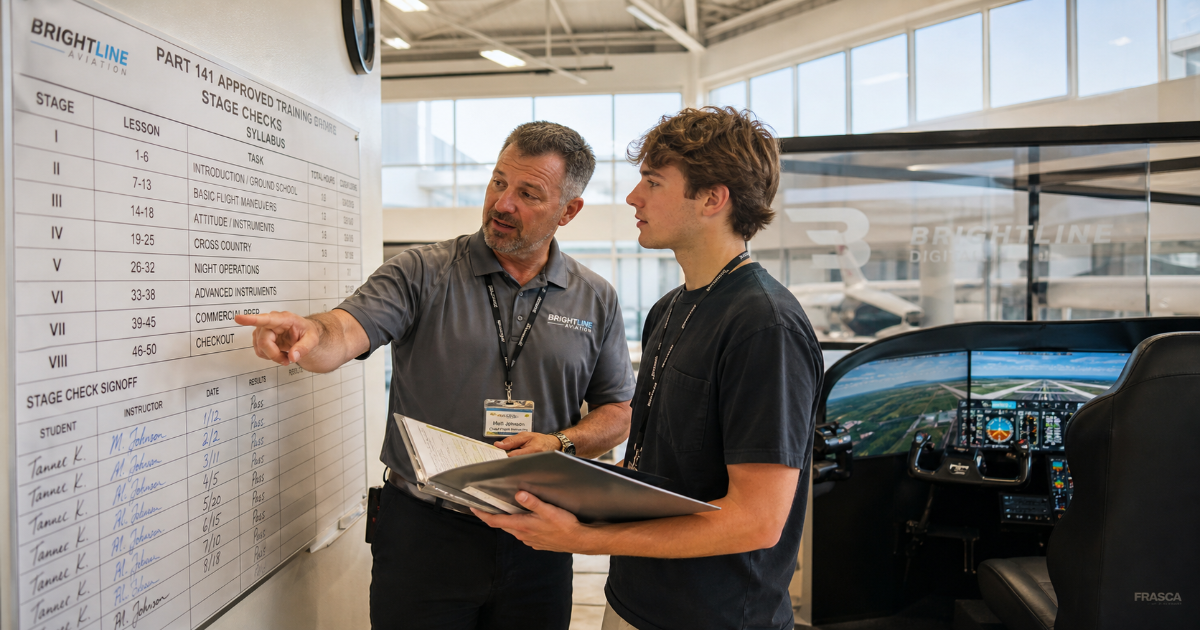
- Certificated Part 141 academies must maintain FAA-approved syllabi, dedicated chief instructors, formal stage checks, and rigorous training recordkeeping.
- Student eligibility relies on passing an FAA medical exam, establishing English proficiency, verifying citizenship or TSA clearance, and obtaining a student pilot certificate.
- Unlike flexible Part 61 operations, Part 141 structured programs allow students to qualify for commercial certificates under reduced flight hour minimums.
- Schedule your aviation medical exam first to prevent expensive mid-syllabus delays before committing to a training package.
Choosing a Part 141 flight school without understanding its requirements costs students months and thousands of dollars. The Part 141 flight school requirements split into two separate stacks, and only one is about you.
What the FAA demands of the school is the half almost every guide skips. Certification, chief instructors, approved syllabi, recordkeeping. Applicants read the student checklist, enroll, then discover the school’s compliance problems are now their delay.
This article covers both stacks, the enrollment gates that stop people, the curriculum structure, and the disqualifiers nobody lists. Clear the gates in the right order and training moves. Clear them wrong and you restart. A student who passes a knowledge test before securing a medical certificate can lose that test’s validity while waiting on a deferred review.
What Part 141 Actually Means Under FAA Rules
Part 141 is the section of the Federal Aviation Regulations that governs FAA-certificated pilot schools, as opposed to Part 61, which covers training outside a certificated school structure. Certificated schools accept a trade: FAA oversight of their syllabus, facilities, and instructor corps in exchange for a standardized training path. That trade is why Part 141 flight school requirements look different from Part 61.
Applicants misread this constantly. They treat Part 141 as a quality badge, a premium tier above Part 61, when it is really a regulatory category with specific obligations. A school holding a Part 141 certificate must run an approved training syllabus and maintain dedicated training facilities Part 61 operations are not required to provide.
Those obligations cut in two directions. The school must hold a pilot school certificate and designate a chief instructor for each course. You, separately, must meet the enrollment eligibility tied to the rating you are pursuing. Two stacks, two authorities, two timelines.
This is what separates an FAA Part 141 flight school from a flight school that simply bills by the hour. The certificate is institutional, not instructional. A school can employ excellent instructors and still lose its provisional status if it fails to document stage checks or maintain records properly.
Understanding both halves changes what you verify before you commit. You stop asking only whether the school feels right and start asking whether its certificate is current, its chief instructor is designated, and its syllabus covers the rating you want.
Provisional certification is the detail applicants miss most. A new Part 141 school operates under provisional authority until it completes the FAA’s required proving period. During that window, the school faces tighter scrutiny of its records and stage checks. Ask which certificate the school currently holds before you enroll. A provisional certificate is not a red flag by itself. It is a fact you should know going in.
The School Side: Certification Requirements
The Part 141 flight school requirements that shape your training most are the ones the school has to satisfy, not you. A pilot school certificate is not a marketing credential. It is a regulatory approval the FAA can suspend, and every course it offers depends on that approval staying current.
- Pilot school certificate. A school must hold either a full certificate or a provisional one, and the provisional version signals a program still under FAA review. Ask which one your school holds before you pay a deposit.
- Chief instructor per course. An applicant for a pilot school certificate must designate a chief instructor for each course it offers, per federal certification rules. That person owns the syllabus quality and the stage-check standards you will be measured against.
- Approved syllabus and outlines. Every course runs on a training program the FAA has reviewed, with defined lesson objectives and completion standards. This is what separates Part 141 from open-ended instruction.
- Facilities and training aids. Certificated schools must maintain dedicated ground training space and the instructional equipment the syllabus requires. A classroom that doubles as a break room tells you something about how seriously the program is run.
- Student recordkeeping. The school must document your training history, stage checks, and endorsements for every lesson. Those records are one of the clearest signals of a well-run school, and they follow you if you transfer.
Read the list as a whole and a pattern appears: each obligation exists to make your progress verifiable. A school that treats recordkeeping or chief instructor oversight as paperwork will lose weeks to disorganization when your check-ride approaches. Verify the certificate type and the chief instructor’s name before you enroll, not after.
Ask any school for its certificate number and its most recent FAA inspection date. A school that answers without hesitation runs a tight operation. A school that deflects is telling you where its attention sits.
This matters more than the hourly rate on the quote sheet. A suspended certificate grounds every student mid-syllabus, and your logged hours do not transfer cleanly to a Part 61 program. Verify the school’s standing before you commit, not after.
Enrollment Requirements for Part 141 Students
The Part 141 flight school requirements that stop applicants are rarely the ones they studied. Schools clear their own certification gates first, then hand you a separate set of enrollment conditions, and those conditions are controlled by four different authorities. None of them talk to each other.
- Age minimums for solo flight. A student can begin dual instruction younger, but solo flight requires meeting the FAA age threshold for the certificate sought.
- FAA medical certificate. The class of medical must match the certificate you’re pursuing, and a deferred issuance stalls enrollment indefinitely.
- Citizenship or TSA clearance. US citizens show a passport or birth certificate, while non-citizens need TSA approval before any flight training begins.
- English language proficiency. You must read, speak, and understand English well enough to communicate with air traffic control and interpret written instructions.
- Student pilot certificate. This must be in hand before your first solo, and the application now runs through the FAA’s IACRA system.
- No formal education requirement. A basic grasp of math and physics helps with aerodynamics, navigation, and weather.
Reading that list in order suggests a sequence. The reality is messier. Your medical certificate depends on an aviation medical examiner’s schedule, your student pilot certificate depends on FAA processing, and your TSA clearance depends on a federal vetting queue. The school controls none of these.
What the list hides is how the gates interact. A deferred medical can pause your enrollment while your TSA clearance quietly expires, forcing a second application and another wait. Applicants who track each gate’s expiration date separately avoid that trap entirely.
Start with the medical certificate before you tour a single school. It is the one gate scheduled by someone else’s calendar, and it determines whether every other requirement matters. Verify how the admission requirements stack up at your target school before you pay a deposit.
Part 141 vs Part 61: Which Requirements Fit You
Part 141 flight school requirements and Part 61 rules describe two regulatory structures for the same certificate, not two quality tiers. The structure you pick controls your timeline, your flexibility, and whether a visa will even be issued.
Part 141 training runs on an FAA-approved syllabus with stage checks, a fixed course outline, and a designated chief instructor overseeing each course. That structure produces a predictable timeline and often a lower minimum hour requirement for the certificate, since the FAA grants credit for the school’s approved curriculum. Students who need a finish date they can plan around get that from a 141 program, and international students generally need this structure because the M-1 visa is tied to enrollment at a certificated school. The trade-off is rigidity: you fly the syllabus the school filed, on the school’s schedule, and switching mid-course means starting over.
Part 61 training is instructor-driven and far more forgiving of real life. You can start next week, fly around a full-time job, and change instructors without triggering a paperwork reset. The catch is that nothing enforces progress. No stage checks, no chief instructor watching your file, no syllabus pacing you toward a check-ride date. Students who train Part 61 part-time frequently stall for months without noticing, because no gate ever closes on them.
One fact settles a lot of the debate: whether you obtain your Private Pilot License under Part 61 or Part 141, the same privileges and limitations apply to the certificate. Employers and the FAA do not care which path issued it. You are choosing a training method, not a better license.
Pick Part 141 when you need a fixed timeline, want the structure to carry your discipline, or need a Part 141 school for a visa. Pick Part 61 when your schedule is unpredictable and you can supply your own accountability. The wrong choice is the one that matches neither your calendar nor your temperament.
What Disqualifies You From a Part 141 Program
Disqualifiers in Part 141 flight school requirements rarely arrive as permanent bans. They are gates that close on a specific timeline, and knowing which ones reopen saves applicants months of stalled training.
Four categories matter, each controlled by a different party. A medical issue answers to an aviation medical examiner. A paperwork gap answers to the FAA or TSA. A training history answers to the school. Money and time answer to nobody but you.
Medical Conditions That Trigger Special Issuance
A diagnosis that grounds you temporarily is not the same as one that grounds you permanently. Conditions like controlled diabetes, certain cardiac histories, or treated sleep apnea usually route through special issuance, where the FAA reviews documentation and grants certification with conditions attached.
The distinction that matters is deferred versus denied. A deferral means the examiner passed your file upward. A denial is a decision, and reversing it takes a formal appeal, not a second opinion.
Expired Certificates and Missing TSA Clearance
Documentation disqualifiers are the easiest to fix and the easiest to overlook. A student pilot certificate that expired while you paused training will block a solo endorsement, and non-citizens need TSA clearance before flight training begins. clearing the medical gate first makes sense because it is scheduled by an external calendar, not yours. Schools verify these documents at enrollment, not at the ramp. Showing up with a lapsed certificate means restarting the paperwork, not the flight lesson.
Prior Training Records a School Will Not Accept
Arriving with logged hours from an uncertificated instructor creates a real problem. Schools operating under an approved training syllabus must document every stage of your progress, and they cannot credit hours they cannot verify.
A history of incomplete courses raises a separate flag. Enrollment officers read a pattern of abandoned programs as a risk signal, and some will require a readiness assessment before accepting you.
Financial and Scheduling Limits That End Training
Regulatory disqualifiers get the attention. Financial ones end more training. A student who runs out of funds mid-syllabus loses currency, and currency loss means repeat lessons at full hourly rates.
The disqualification that stops most students is not medical or legal. It is a schedule that cannot absorb three lessons a week. A disqualification at one school is often solvable at another with the right paperwork, but a schedule that never had room for training will not fix itself.
How Much a Part 141 Program Costs You
Part 141 flight school requirements include a pricing structure that looks worse on first glance than it actually is. Schools quote a packaged course total, while Part 61 instructors bill by the hour, so the two numbers never sit side by side cleanly. Compare what each package actually covers before you decide one is cheaper.
| Certificate or Rating | Typical Part 141 Package | What the Package Covers |
|---|---|---|
| Private Pilot | $10,000 and up | Ground school, aircraft rental, instructor time, stage checks |
| Instrument Rating | $8,000 to $12,000 | Simulator hours, hood time, approach practice, written test prep |
| Commercial Certificate | Up to $80,000 or more | Complex aircraft time, cross-country hours, check-ride preparation |
| Multi-Engine Add-On | $6,000 to $10,000 | Twin-engine dual instruction, systems training, practical test |
A private pilot license starts around $10,000, and commercial training can reach $80,000 or more, which is why the package total matters less than the overage rate attached to it. Those figures come from real flight school prices across the market, not a single school’s brochure.
The packaged price is only comparable if you finish inside the syllabus. Every hour beyond the approved course outline bills separately, at whatever the school’s current aircraft and instructor rates happen to be. A student who needs ten extra dual hours pays for them on top of the package, and that gap is where budgets break.
Ask for the hourly overage rate before signing anything. Schools that publish a clean package price but dodge the overage question are telling you something about how they handle the rest of their approved training course obligations.
The package total hides the line items that push real costs higher. Aircraft rental rates climb with fuel prices, and most schools adjust their hourly rate annually. A quoted $10,000 private pilot package can land closer to $13,000 once surcharges, examiner fees, and extra flight hours get added.
Ask every school for a written breakdown of what sits outside the package. Examiner fees, fuel surcharges, and repeated stage checks are the three line items students miss. A school that quotes a flat rate without those exclusions is telling you something about how it handles surprises later.
How Long Part 141 Training Takes to Finish
The Part 141 flight school requirements for completion look shorter on paper than Part 61 because the syllabus is fixed, but real duration is set by how fast you clear each stage. Four phases control the clock, and each one has its own bottleneck.
Step 1. Complete ground school and pass the written knowledge test. This unlocks the flight phase, and skipping it means paying instructor rates to learn material you could have studied on your own. The written test result stays valid for two years, which sets a hard deadline on everything that follows.
Step 2. Finish dual instruction and clear every stage check. The school must document each stage before it authorizes solo flight, and a failed stage check sends you back through the same material. Students who treat stage checks as formalities usually repeat them.
Step 3. Complete solo and cross-country requirements. Weather and aircraft availability control this phase more than your own effort does, which is why scheduling around a school’s fleet matters as much as your study habits. A grounded aircraft can stall you for a week with no warning.
Step 4. Pass the end-of-course check and the practical test. This is the only step that can reset the clock, because a disapproval means additional training hours before you can retest. Students who fail the practical test typically add two to four weeks and several hundred dollars.
A full-time path through the full training timeline runs six to twelve months and costs about $15,000 to $20,000 for the private certificate. Part-time students should double the timeline, not the budget, because hourly costs stay the same while calendar time stretches. Flight schools that track stage completion rates tend to spot struggling students earlier, which is the kind of visibility FAA-approved training programs are built to support.
Finishing all four stages unlocks your practical test eligibility and a certificate that carries the same privileges as any other private pilot license. The timeline you actually experience depends less on the syllabus than on how quickly you clear each gate.
Clear the Gates in the Right Order
Part 141 flight school requirements are not a wall you climb once. They are a sequence, and the sequence is the whole game.
Clear the medical first and every other gate opens in its natural order. Skip it, tour three schools, pay a deposit, then discover a deferred certificate, and you have burned months on a process that never started. The FAA medical is the one requirement scheduled by an examiner’s calendar, not yours.
Verify the school’s certification status before you sign anything. A provisional certificate means the program is still under FAA review, and that review can pause your training mid-syllabus. Ask to see the certificate, not a brochure. Then book the medical exam. Everything else follows.
Turn your aviation expertise into 340% more traffic and 68% more leads with BrightLine Digital, where monthly reports show real numbers, not vanity metrics. Book your free strategy call today and see exactly how much revenue you are leaving on the runway.
Part 141 Flight School Requirements: Common Questions
Is Part 61 or 141 better?
Neither structure is superior on its own, because both produce the same certificate with identical privileges once you pass the practical test. The real difference shows up in how the school bills you: Part 141 packages the course into a fixed syllabus with stage checks, while Part 61 charges by the hour with no approved outline to follow.
How much does a part 141 flight school cost?
Part 141 flight school requirements come with a packaged price that bundles ground school, aircraft rental, instructor time, and stage checks into one quoted figure. That number only holds if you finish inside the syllabus, since every hour flown beyond the approved course outline gets billed separately at the school’s overage rate.
How long does a part 141 flight school take?
A full-time student typically finishes the private certificate inside a single training year, while part-time students stretch that timeline considerably. Weather cancellations and aircraft availability usually delay progress more than the syllabus itself does, which is why consistent scheduling matters as much as study hours.
What disqualifies you from flight school?
Medical conditions requiring special issuance, missing documentation, and incomplete training records will block enrollment, though each gate closes on its own timeline. Non-citizens face an added layer through international student requirements and TSA clearance, which must be resolved before solo flight.