Pilot Training in USA for St Lucian Students: The Complete Guide to Licensing
TL;DR · The short answer4 key points
- An FAA certificate is the first link in the chain, not the last. To fly commercially at home you convert it to an ECCAA licence.
- Follow the M-1 order: SEVP-certified school, I-20, SEVIS fee, DS-160, interview in Bridgetown, then tuition.
- Apply for TSA flight training clearance yourself, in parallel with the visa, not after it.
- Budget the all-in cost, including housing, examiner fees, the medical, TSA and travel, not just the tuition quote.
The acceptance letter from the Florida flight school is real. So is the TSA clearance email. What neither answers: will this license fly in Castries?
Pilot training in USA for St Lucian students gets sold as a flight-hours problem. It is not. The hard part is the licensing chain, and the FAA certificate is only its first link.
Here you’ll find the complete path: the M-1 visa sequence, the TSA gate that stalls applications, how to choose between Part 61 and Part 141, the all-in cost, and the ECCAA conversion that decides whether your training pays off at home.
Two students can spend the same money and fly the same hours. One returns to Vieux Fort with a license the Eastern Caribbean Civil Aviation Authority recognizes. The other starts over. Read the ECCAA conversion rules before you pay a deposit.
Why St Lucian Students Train in the USA
For most young pilots in Castries, the United States is the closest place to train at full speed. It is a short flight away, the training is in English, and the schools are built to take international students from enrollment to a commercial certificate.
The FAA certificate carries weight because it is one of the most widely recognized pilot credentials in the world. Most countries, St Lucia included, still ask you to convert it into a local licence, but an FAA record of training and checkrides is a strong foundation for that step.
Training environment decides speed. St Lucia has two airports but very little flight training capacity: a small fleet, few instructors, and weather that turns fast. The US gives you a dense fleet, career instructors building their own hours, and enough aircraft that you are not waiting weeks for a slot.
One thing to keep separate: the FAA’s safety rating for the Eastern Caribbean aviation system is a Category 2 rating about how the region oversees its own airlines flying to the US. It says nothing about whether your FAA licence converts. That decision belongs to ECCAA.
None of this matters if the sequence breaks. A student who trains in the US without understanding the conversion step can come home holding a certificate that cannot yet earn a living in Castries.
The M-1 Visa Route for St Lucian Applicants
The sequence protects your money. Get one step out of order and you can lose a deposit. St Lucian citizens apply through the US Embassy in Bridgetown, Barbados, and the M-1 is the standard route for vocational flight training.
Step 1. Secure admission at an SEVP-certified school. Confirm SEVP certification before you discuss payment, because a school that cannot issue an I-20 cannot carry you past this point.
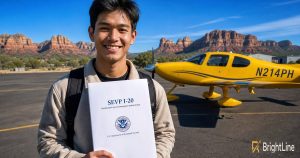
Step 2. Receive your Form I-20 from the school. The I-20 is the document the rest of the chain depends on, and an error in your name or program dates sends you back for a reissue.
Step 3. Pay the SEVIS fee and keep the receipt. The receipt is checked at the interview, and paying late compresses your timeline against the school’s start date.
Step 4. Complete the DS-160 and book your interview in Bridgetown. The TSA flight training security rule runs as a separate gate, so start that process alongside the visa rather than after it.
Step 5. Pay tuition only after the visa is issued. Paying before approval is the single most expensive sequencing error in the M-1 visa for flight school process. A refused application with tuition already paid turns a fixable problem into a refund negotiation.
A completed M-1 puts you in a US cockpit with a fixed training timeline and a record that supports your later ECCAA conversion. The order is the protection. Follow it and the deposit stays yours.
TSA Clearance: The Step That Stalls Applications
Visa approval does not clear you to touch an aircraft. The Flight Training Security Program is a separate gate run by TSA, and it applies to every non-citizen trainee before flight training begins. Three angles decide whether that gate opens on time: what you submit, what the school confirms, and when you start the clock.

What the FTSP Application Actually Requires
You apply yourself, with your biographical details, passport information, and the flight training provider you plan to train with. TSA then collects your fingerprints through an approved channel before it makes a decision.
The governing rules sit in 49 CFR Part 1552 flight training, and they apply to St Lucian applicants exactly as to any other non-citizen. Under the 2024 rule, an approved applicant gets a Certificate of Eligibility for a one-time fee, valid for five years of training.
What the School Has to Confirm
The application is yours, but the school still has a role: it confirms you as its student and handles its own security-awareness and record-keeping duties. A school that cannot explain its side of the process has probably not trained many international students. Ask the admissions office how quickly it confirms new FTSP applicants.
Run the TSA Clock Beside the Visa Clock
Treating TSA as a task for after arrival is how students lose weeks. Start your FTSP application in parallel with your student visa for pilot training application, not after the Bridgetown interview.
The smoothest starts come from a single sequenced checklist covering both tracks. That is the gap BrightLine Admissions fills: we package your school applications and keep the visa and TSA steps in the right order, so a stranded deposit never becomes your problem.
What Pilot Training in USA Really Costs
The tuition figure a flight school quotes you covers flight hours and instruction. It does not cover the money that leaves your account before you ever sit in a cockpit. Budget against the all-in number, not the brochure number.
| Cost Line | Estimated Range (USD) | Often Quoted? |
|---|---|---|
| Private pilot certificate | $8,000 to $15,000 | Yes |
| Instrument rating | $6,000 to $12,000 | Yes |
| Commercial certificate | $15,000 to $30,000 | Yes |
| Multi-engine rating | $4,000 to $9,000 | Sometimes |
| Housing and living | $600 to $1,200 monthly | Rarely |
| Checkride and examiner fees | $600 to $1,000 each | Rarely |
| Medical, TSA fee, travel from St Lucia | $1,500 to $3,000 | Almost never |
These are estimates, and the gap between the tuition quote and the all-in total is where students get stranded. The hidden lines are not small. Housing alone can outrun a multi-engine rating over a full course.
Add every line before you commit. A school that publishes an honest cost breakdown is showing you it has done this before; one that quotes only the tuition line is not. Ask for the all-in figure in writing, and compare it against what you know about how much flight school costs.
Exchange rates are one risk you can mostly ignore: the Eastern Caribbean dollar is pegged to the US dollar, so the amount you owe in EC dollars stays predictable. Timing is the real risk. Ask the school for a payment schedule tied to each rating, not one lump sum, so your family is never asked to fund the whole course at once.
Part 61 or Part 141: Which School Fits You
The certificate is identical under both rule sets. The path is not, and the difference decides how fast a St Lucian student moves through training on a visa clock. Each angle answers a separate question: how the syllabus is built, how much rope you get, whether the school can enroll you, and whether its claims survive a phone call.
Part 141 Locks the Syllabus to a Timeline
A Part 141 school runs an approved syllabus with stage checks and fixed lesson sequences. That suits visa students because the school can show steady progress against a schedule. Ask for the stage-check schedule before you commit.
Part 61 Hands You the Rope
Part 61 training follows no approved syllabus, so your instructor decides the pace and sequence. Flexibility cuts both ways: a disciplined student saves money, an undisciplined one repeats lessons. For an M-1 student, Part 61 is only an option at a school that also holds SEVP certification, which rules out independent instructors.
SEVP Status Is the First Filter
A school must hold SEVP certification to issue the I-20 you need for the M-1 visa. Confirm the certification is active, not just that the school advertises international students. Check it yourself in the government’s SEVP-certified school search, and use the FAA regulations index if you want to read how Part 61 and Part 141 are structured.
Placement Claims Need a Second Call
Every school advertises airline partnerships. Ask for the name of the regional carrier that hired its last international graduate, then verify it. A school that cannot name one graduate is selling a brochure. Weigh that answer alongside our breakdown of Part 141 vs Part 61 for international students, and pick the school that fits your timeline, not its marketing.
From FAA License to ECCAA: The Conversion Path
A US flight school hands you a commercial certificate and calls the job done. It is not done. The licence that lets you fly for hire in the Eastern Caribbean is a separate document, issued by a separate authority.
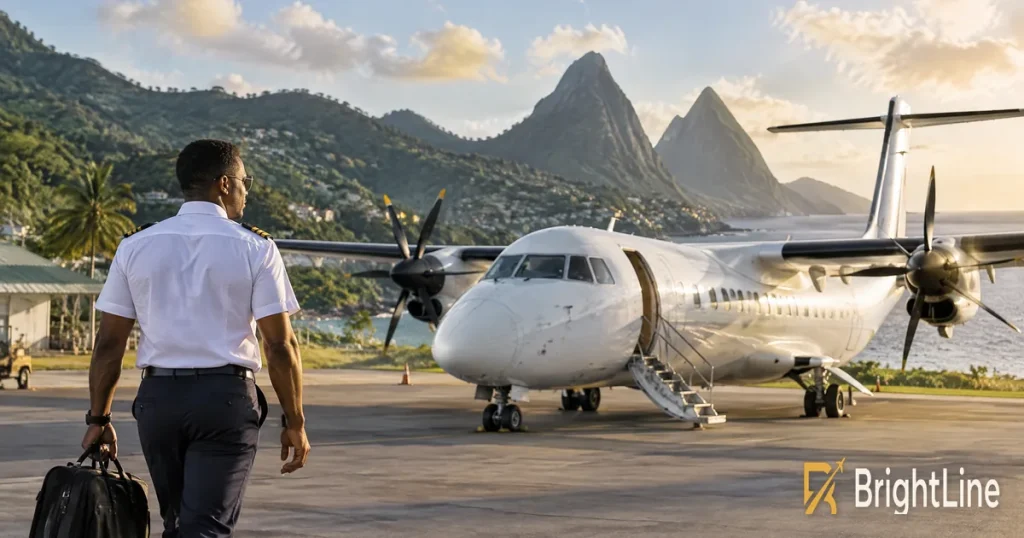
ECCAA converts foreign licences in line with ICAO requirements, but conversion is a process you drive, not a stamp you receive. The OECS conversion announcement describes how one pilot converted his FAA licence: application forms and fees, his valid licence and medical, his logbook, proof of nationality, and two exams.
Step 1. Hold a valid FAA commercial certificate with current medical and ratings before you apply. ECCAA builds the conversion on a foreign licence that is active and in good standing.
Step 2. Confirm your logged experience meets the ECCAA minimums for the licence grade you want. Hours flown under Part 61 and Part 141 both count, but totals must be documented in an auditable logbook.
Step 3. Secure a medical certificate ECCAA accepts. A valid FAA medical does not automatically satisfy this. Book early, because a lapsed medical stalls the whole file.
Step 4. Complete the exams ECCAA assigns to your application. These vary by licence type and experience, so confirm the exact list in writing before you book travel.
Step 5. Submit the application with your logbook, medical, FAA certificate copies and proof of nationality, then track it through the authority. Missing paperwork is the most common reason files sit idle.
Finishing the conversion unlocks what the FAA certificate alone cannot: the right to fly commercially for an Eastern Caribbean operator. Before you commit to a US school, ask how many of its graduates have converted their licences at home, and how long it took.
What St Lucian Students Get Wrong Before Day One
Time gets lost in Castries, not in the air. Applicants who restart training a year later usually made one of five decisions that looked harmless at the time.
- Paying tuition before visa approval. A deposit sent before the M-1 is stamped turns a routine refusal into a refund negotiation with a school that already has your money. The M-1 versus F-1 visa distinction matters here, because vocational flight training runs on the M-1 and its rules are stricter.
- Choosing a school with no FTSP history. A flight school that has never confirmed a foreign trainee in the Flight Training Security Program will learn the process on your timeline. Ask how many international students it has trained.
- Budgeting the tuition line only. Housing, checkride fees, the aviation medical, TSA processing, and travel from St Lucia sit outside the quoted figure. Students who budget the brochure number run out of money mid-ratings.
- Deferring the medical certificate. Waiting until arrival to book an FAA medical exam risks a disqualifying finding after you’ve paid for a seat and a flight. Find the nearest FAA aviation medical examiner and get the exam done before you pay tuition.
- Assuming the FAA certificate travels. An FAA commercial certificate does not automatically authorize commercial flying in the Eastern Caribbean. ICAO licensing standards set the conversion baseline, and ECCAA applies its own requirements on top.
These aren’t talent problems. They’re sequencing problems, and sequencing is the one variable a student controls before leaving home.
To see which admission gate will slow you down most, run the free 7-Gate Admission Tracker before you contact a school.
Build the Licensing Path Before You Book the Flight
Chasing pilot training in USA for St Lucian students is not a search for a school. It is a search for a chain that holds from the Bridgetown interview desk to the ECCAA licensing office. Break one link and the certificate still exists. It just cannot earn you a seat in an Eastern Caribbean cockpit.
Confirm the school’s SEVP and FTSP status in writing before the deposit leaves your account. Ask for the ECCAA conversion requirements in the same email. A school that answers both in plain language has done this before. A school that deflects has not. That silence is your answer, and it costs nothing to hear it now.
BrightLine Admissions packages your international flight school application, from choosing an SEVP-certified school to keeping your visa and TSA steps in order, with the ECCAA conversion planned from day one. Start your application with us today.
FAQ
Pilot Training in USA for St Lucian Students: Your Questions Answered
How much does pilot training cost for international students in the USA?
Using the estimates above, the private, instrument, commercial and multi-engine training alone adds up to roughly $33,000 to $66,000, before housing, examiner fees, the medical, the TSA fee and airfare from Hewanorra. Ask every school for its all-in figure in writing, because the tuition quote is never the whole bill.
What is a student pilot called?
In FAA terms it is simply a student pilot: someone training for a first certificate who holds a student pilot certificate. You apply for it through the FAA’s IACRA system with your instructor, and you must have it before you fly solo.
Do St Lucian students need a visa to train as a pilot in the USA?
Yes, St Lucian citizens need an M-1 vocational student visa for flight training, and the application goes through the US Embassy in Bridgetown, Barbados. The M-1 requires a Form I-20 from an SEVP-certified school before the interview, so admission comes first and the visa follows.
Can a St Lucian pilot use an FAA license in the Eastern Caribbean?
Not directly, because an FAA certificate does not authorize commercial flying under an Eastern Caribbean registry without conversion. ECCAA converts foreign licences in line with ICAO standards, and approval depends on a valid foreign licence, a current medical, your logbook and the exams ECCAA sets.