TSA Background Check for Foreign Flight Students: Flight School vs. Self-Enrollment
TL;DR · The short answer4 key points
- Clearing the TSA background check for foreign flight students requires choosing between flight school sponsorship and self-enrollment.
- Flight school sponsorship transfers administrative paperwork and file tracking to experienced admissions departments.
- Self-enrollment gives applicants direct schedule control but leaves document errors and flagged requests without institutional support.
- Mismatched names or incomplete immigration records remain the primary reasons international applications face vetting delays.
Your acceptance letter is in hand, the deposit invoice is open in another tab, and the school’s admissions officer just told you the TSA background check for foreign flight students is “handled on your end.” That sentence should stop you cold.
The check is not a solo application. It runs through a sponsorship relationship, and the school you pick controls the paperwork, the timing, and much of the outcome. Choose a school that doesn’t sponsor international students and the process stalls before it starts.
This article breaks down how flight school sponsorship and self-enrollment actually differ, what each path demands of you, and how to pick before a single dollar leaves your account. The wrong choice costs you a semester, not a form.
What the TSA Check Actually Screens For
A Security Threat Assessment is a federal vetting process that checks whether an applicant poses a risk to aviation or national security. It is not a flight aptitude test, and it does not measure whether you can fly. All non-citizen flight trainees are subject to a Security Threat Assessment, which is the TSA background check foreign flight students must clear before training begins.
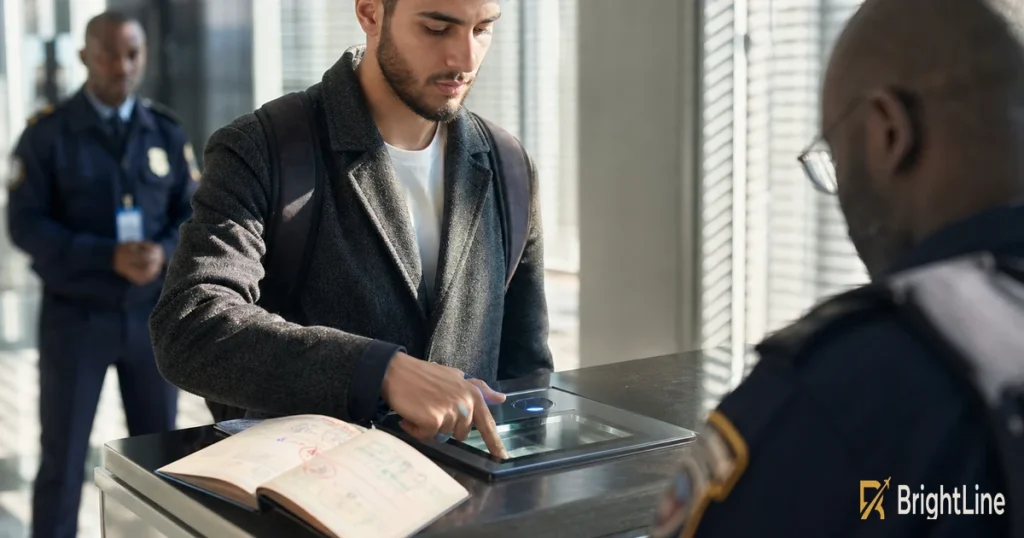
Applicants misread the scope constantly. They assume a clean police record means a clean result, then get blindsided when the request stalls on something as small as a name spelled two ways across documents. The assessment pulls from identity records, criminal history, immigration status, and watchlist matches across federal databases.
Here is the part that changes how you prepare. TSA runs the check, not the flight school. The school’s job is to submit the request and track the determination, which is why a school that files international students weekly catches errors a first-timer never sees. The Flight Training Security Program final rule formalized this process for every non-citizen trainee.
A clean record does not guarantee a fast result. A mismatch between your passport and your application can hold the determination just as long as a genuine flag, because the system is verifying identity first and threat second. Treat the paperwork as the test it is.
Flight School Sponsorship: Who Submits the Request
The request that starts your TSA background check for foreign flight students is filed by the school, not by you. That single fact reshapes how you should evaluate every flight school on your shortlist.
An FAA-certificated school enrolled in the program initiates the candidate request directly with TSA. It collects your identity documents, submits them under its own enrollment, and tracks the determination until a decision lands. The federal Flight Training Security Program rules place that submission duty on the provider, which is why the school’s administrative competence matters as much as its aircraft.
Schools that train international students every month know the sequence cold. They catch a passport name that doesn’t match the application, a missing document, a date that contradicts the I-20, all before the file reaches TSA. A school running its first foreign student is learning the process on your timeline.
Not every flight school participates in the program. Plenty of small Part 61 operations never enroll because they never needed to. Asking whether a school sponsors international students is a screening question, not a courtesy.
BrightLine Digital’s international flight school admissions work exists because this handoff breaks down quietly. Schools that package the sponsorship step clearly, before a deposit changes hands, spend less time correcting files and more time filling seats.
Your flight school admission requirements list should put sponsorship near the top, above fleet size and hourly rate. A school that can’t answer who owns your request in writing is telling you something.
Self-Enrollment: When You Apply Without a School
Control over timing sounds like an advantage until a flagged request lands in your inbox with no one to call. Self-enrollment and school sponsorship both clear the same federal check, but they distribute risk in opposite directions.
Self-enrollment lets a candidate initiate the request directly with TSA. You gather the identity documents, file the submission, and pay the fee yourself. The Flight Training Security Program final rule requires a candidate to submit a fee the first time that candidate requests an STA and with each STA renewal. That payment is yours to track, and so is every follow-up.
The trade-off is real. Self-initiating gives you a start date you control, which helps if you’re coordinating around a visa window or a course start you can’t move. What disappears is the institutional buffer. A school that trains international students daily has seen the common mismatches before and catches them pre-submission.
Self-enrollment does not skip the check. It only changes who drives it. A school still has to be identified before training can begin, so you’re eventually handing your determination to an institution anyway.
Choose self-enrollment only if you already hold a school commitment and your documents are clean. A first-time applicant working to become a pilot in USA should let a sponsoring school drive the request instead. The deciding factor is who absorbs the cost of an error. When you self-file, that cost is entirely yours.
TSA Background Check for Foreign Flight Students: Side by Side
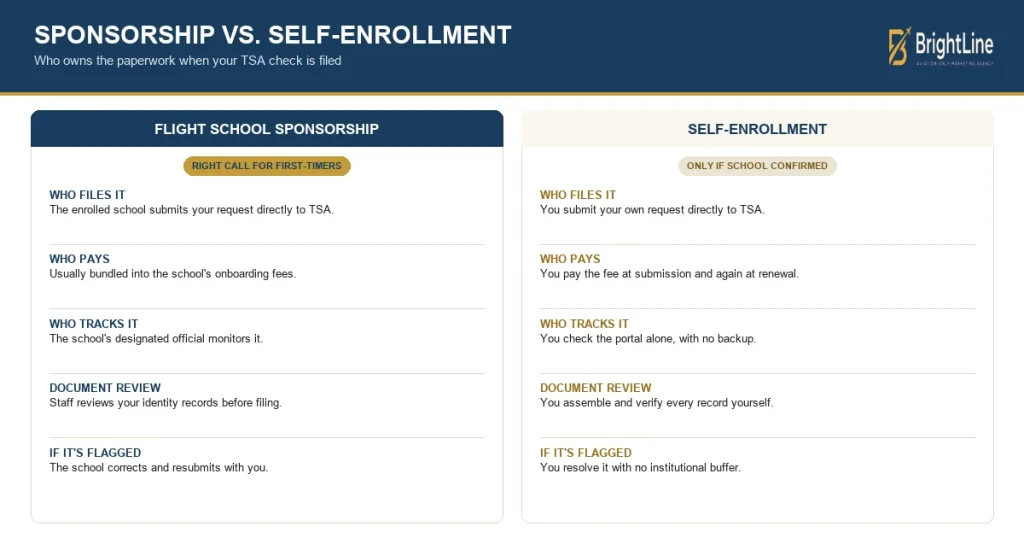
The two paths diverge on one thing that matters more than anything else: who absorbs the risk when something goes wrong. Sponsorship and self-enrollment both end at the same federal determination, but they distribute the work and the blame very differently. The table below shows where the split actually falls.
That flagged-request row is where the paths stop being equivalent. GAO’s review of TSA vetting documents real weaknesses in how foreign flight students get screened, which makes a knowledgeable second set of eyes worth more than control over timing.
A first-time international applicant should take the sponsorship column every time. Someone already inside the US, with a school confirmed and documents clean, can self-initiate to move faster. Confirm the school accepts a self-filed determination before you commit, and check its Part 141 flight school requirements page for how it handles international enrollment.
Self-enrollment looks cheaper until a single misfiled record costs a rebooking and a lost start date. The school path trades a little control for a buffer against your own paperwork errors. Pick the path that matches who you trust to catch mistakes. If the answer is nobody, choose the school that files on your behalf.
What Disqualifies an Applicant and What Does Not
Denials rarely trace back to a criminal record. They trace back to a name that doesn’t match a passport, a status that was never resolved, or a form that contradicts itself. The TSA background check for foreign flight students is an identity verification exercise first, and a threat screening second.
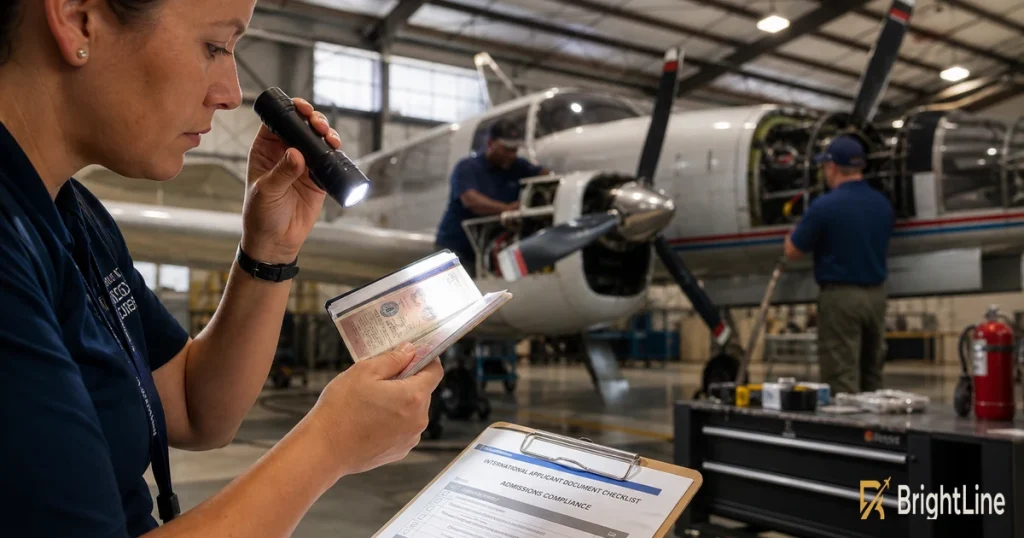
- Name inconsistencies across documents. A middle name dropped on an I-20, a transliteration that shifts between passport and application, or a maiden name left off a form all read as identity gaps. The system flags the mismatch, not the person.
- Unresolved immigration status. A pending change of status, an expired visa with no extension on file, or a gap in authorized presence triggers review before training can begin.
- Prior removal or visa violations. A past overstay, a removal order, or a violated student visa condition surfaces in federal databases and requires explanation, not silence.
- Watchlist matches. A name hit on a federal watchlist, even a false positive from a common name, stalls the determination until it’s manually cleared.
- Missing or mismatched training details. A school’s training request that doesn’t align with the applicant’s stated program creates a contradiction the reviewer has to resolve.
A clean record doesn’t protect you from any of these. TSA vets foreign flight student applicants through AFSP, but weaknesses in the vetting process mean the burden of a clean submission falls on the school and the applicant, not the system.
That’s why school-side review matters more than your background check. A school that catches a name mismatch before submission saves you a flagged request. The same scrutiny that clears an FAA Class 1 medical review applies here: paperwork consistency decides the outcome.
Timing the Check Around Your Visa and Deposit
Sequence decides whether the TSA background check for foreign flight students runs alongside your visa interview or collides with it. Applicants who wire a deposit first and ask about sponsorship second are the ones who lose both.
Step 1. Confirm in writing that the school sponsors international students before you discuss money. A school outside the program cannot file the candidate request, and the discovery usually lands after you have paid.
Step 2. Gather identity documents before any payment clears. Passport name, spelling, and date of birth must match the application exactly, because a mismatch stalls the request at the front desk.
Step 3. Let the school initiate the request and track the determination. The Flight Training Security Program rules place submission duty on the provider, so a self-filed request can leave the school uninformed.
Step 4. Wait for the determination before booking travel or scheduling the visa interview. A consular officer who sees an unresolved security request has a reason to hold the file.
Step 5. Keep the approval on file for renewal. Lapse it and the process restarts, which strands you mid-program with a training record already open.
BrightLine Digital builds admissions packaging for international student pilots around this exact sequence. Schools that follow it stop promising seats before clearance, and students stop discovering the gap after the invoice. Working the steps in order turns a stack of forms into a cleared path to pilot training in USA programs. The deposit then buys a seat instead of a gamble.
Which Path Fits Your Situation
A first-time international applicant with no US footprint should not be choosing between paths at all. Sponsorship is the only defensible route when you have no American address, no domestic bank history, and no way to verify a school’s claims from abroad. The situations below are narrower than they look.
First-Time Applicants From Abroad: Take the Sponsored Route
A school enrolled in the program absorbs the documentation risk you cannot see. Its admissions staff has watched name mismatches and expired passport scans kill requests before. That institutional memory is worth more than any control you think you gain by filing yourself.
Already in the US With a School Confirmed
Self-initiation makes sense only after the school has agreed in writing to accept your determination. A student on an existing visa who files independently and then discovers the school won’t honor it has burned the fee for nothing. Confirm acceptance first, then file.
The One Question to Ask Before Any Deposit
Ask plainly: do you sponsor international students through the program, and who tracks my request. A school that hesitates on either half is telling you something. Schools serious about international enrollment publish this on their sites, and strong flight school marketing makes the sponsorship process visible before a prospect ever emails.
BrightLine Digital builds admissions pages around exactly that clarity. The TSA program directory index confirms which programs exist, but only the school can confirm it participates.
Clear the Check Before You Commit a Dollar
The TSA background check for foreign flight students is a sponsorship decision wearing the costume of a form. Read the clearance as a test of the school’s process, not of your character. That reframe is the whole game.
Get the answer in writing before a deposit leaves your account. An email that names who files the request and who tracks the determination is worth more than any verbal reassurance at a recruitment fair. Without it, a flagged submission lands with no owner and your start date slips. Ask the school plainly: do you sponsor international students, and who owns my request once it’s filed? Wait for the determination. Then pay.
FAQ
Foreign Flight Student TSA Questions, Answered
Can international students apply for TSA PreCheck?
International students cannot join TSA PreCheck, and the TSA background check for foreign flight students is a separate program with its own rules. PreCheck requires US citizenship or lawful permanent residency, so a foreign applicant clears the flight training vetting instead and never receives a Known Traveler Number from it.
What disqualifies you from TSA background check?
A disqualifying result comes from an unresolved immigration status, a prior removal, a watchlist match, or identity details that conflict across documents. A criminal record alone does not automatically end the process, but a passport name that differs from the training request by a single character can stall it indefinitely.
Does a student pilot need a TSA endorsement?
No TSA endorsement exists for student pilots, and the clearance a foreign trainee needs is a Security Threat Assessment determination tied to a specific flight training request.
How hard is it to pass a TSA background check?
Passing is routine for applicants whose identity documents agree with each other and whose immigration status is clean. Difficulty comes from the paperwork, not the vetting, and a request flagged for a mismatched address or an expired document can hold a seat longer than any criminal history question.