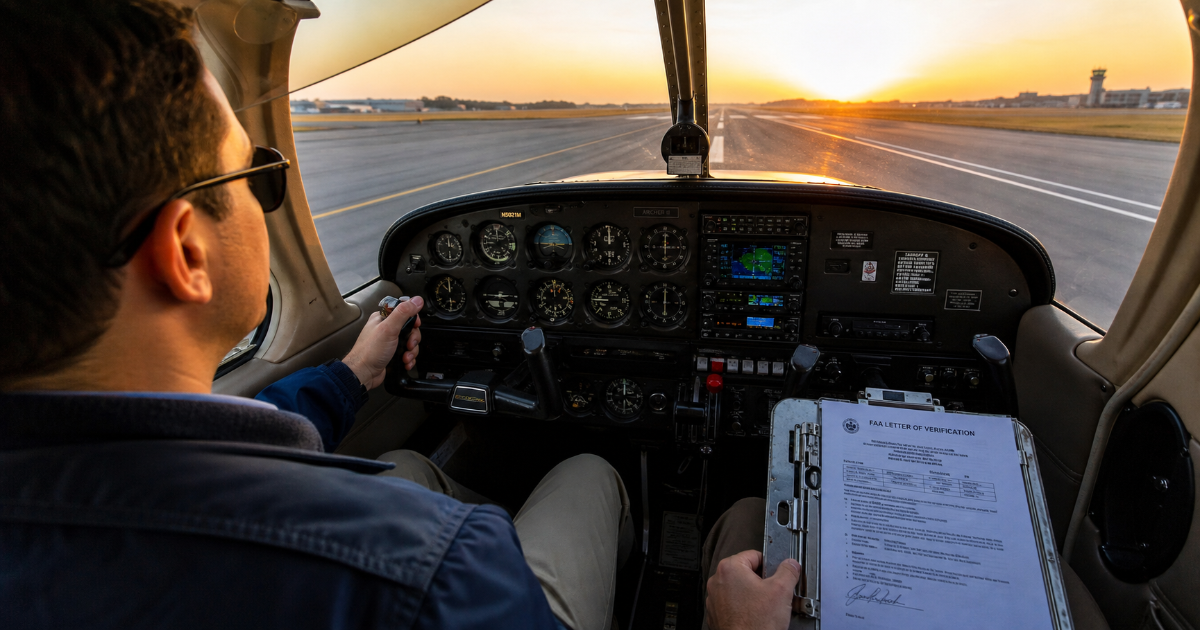
FAA License Validation for Foreign Pilots: The Complete Conversion Guide
ℹ️ TL;DR
- FAA license validation for foreign pilots depends on your home country’s Civil Aviation Authority verifying your credentials directly to the FAA Airmen Certification Branch.
- File Form AC 8060-71 immediately as step one, since verification takes 45 to 60 days and controls your entire US training calendar.
- Validation under 14 CFR 61.75 issues a restricted US Private Pilot certificate tied directly to the validity of your foreign license.
- Foreign instrument ratings convert without a practical flight test once you pass the FAA Instrument Foreign Pilot written knowledge exam.
- Never book flight training blocks or DPE appointments before the official Letter of Verification clears and arrives in your hands.
Book flight training before the verification letter arrives and the money sits idle while a foreign authority decides your timeline. FAA license validation for foreign pilots is not a paperwork problem. It is a waiting problem.
Guides hand you Form AC 8060-71 and stop there. They skip the part that costs you: your home Civil Aviation Authority controls the clock. This article maps the full conversion, from eligibility and CAA verification through written exams, ratings, and flight school decisions.
Pilots from EASA states, Canada, and Australia face different verification timelines. Some authorities return the letter in weeks. Others take months, and the FAA will not schedule your check ride without it. Treat the verification request as your first action, not your last.
What FAA License Validation Actually Means
FAA license validation is the process by which the FAA confirms a foreign pilot certificate is genuine and current before issuing any US certificate or authorization based on it. It is not a conversion, and it is not a formality you clear on the way to something bigger. Validation is the gate that conversion passes through.
Pilots conflate the two constantly. They assume a valid Australian or British license converts into an FAA certificate the way a currency exchange works, with the rate set and the transaction immediate. The Airmen Certification Branch must have the Civil Aviation Authority verify the validity and currency of the foreign license and medical certificate before you apply for any FAA certificate or authorization, and that verification is a separate approval step entirely.
The practical consequence is that your foreign license does not become an FAA credential the moment you land in the country. Any foreign certificate that is held may be validated, but validation produces a verification letter, not a certificate. That letter is the document the rest of your US flying depends on, and it is the one piece of the process you cannot produce yourself.
This distinction matters because it changes what you do first. A pilot who understands validation as a gate files the paperwork immediately and treats the foreign license verification letter as the critical path. A pilot who mistakes it for conversion books flight training, pays tuition, and then discovers the gate has not opened yet.
For flying in the US or obtaining an FAA certificate based on a foreign license, the Letter of Verification is a mandatory requirement. No training hours substitute for it, and no school can waive it. Understand validation as the gate, and the sequence of every decision after it becomes obvious.
The Verification Letter Is the Whole Clock
Foreign pilots lose more time to FAA license validation than to any other step, and almost none of it is spent working. The verification letter is not a document you produce. It is a document you wait for, and the pace is set by a civil aviation authority you do not answer to.
The FAA sends a request to your local Civil Aviation Authority to confirm the validity of your foreign-based pilot license, the standard validation process. Once the FAA receives confirmation, it issues a letter of verification.
That confirmation window runs roughly 45 to 60 days, per FAA guidance on foreign licenses. A pilot who books a Part 141 start date two weeks out has already scheduled against a clock someone else controls.
No amount of preparation on your side compresses this window. You can have your medical booked, your ground school finished, and your study materials memorized. The letter still arrives when the foreign authority decides to send it. This is the conversion timeline reality that separates pilots who plan well from pilots who plan optimistically.
Some authorities respond only when prompted. A follow-up call to your home CAA confirming the FAA request arrived can shave days off a stall.
The strategic move is not to work harder during the wait. It is to start the clock earlier than feels necessary, then build every other decision around its expected finish. Pilots who treat the letter as an afterthought lose semesters and training slots they cannot recover.
Pilots from countries with slow-responding authorities face the longest delays. India’s DGCA and several Southeast Asian authorities are known for processing FAA verification requests only after repeated follow-ups. If your license originates there, build an extra month into your timeline before committing to any training start date.
Call your CAA before the FAA even sends the request. Confirm they know the process, get a named contact, and ask how they handle incoming FAA verification inquiries.
Form AC 8060-71 and the Documents That Matter
FAA license validation for foreign pilots lives or dies on document order. Submit the package correctly and the clock starts once. Submit it wrong and you restart a wait you cannot shorten. The sequence below is not a suggestion. Each step feeds the next, and skipping one stalls everything downstream.
Step 1. Complete Form AC 8060-71, Verification of Authenticity of Foreign License and Medical Certification. The FAA cannot request verification from your Civil Aviation Authority without it. An incomplete form gets returned, not processed.
Step 2. Attach copies of your foreign license, your foreign medical certificate or endorsement, and every rating you want validated. Ratings left off the form are not validated later without a fresh submission. Include the instrument rating now if you intend to use it.
Step 3. Submit the package to the FAA Airmen Certification Branch by the method the FAA specifies. Fax remains an accepted channel: send the form and required documents to (405) 954-9922. Confirm receipt before assuming the clock has started.
Step 4. Contact your home Civil Aviation Authority and confirm the FAA’s verification request arrived. Several authorities respond only when prompted. A request sitting unopened in an inbox looks identical to a request being processed.
Step 5. Hold the letter of verification once it lands, then build the FAA medical and knowledge test steps on top of it. This is the foundation for the entire ICAO to FAA conversion, not a formality you file and forget.
Step 6. Keep a dated copy of every submission and every confirmation. If a document goes missing in transit, that paper trail is the only way to prove the clock started when you say it did.
Completing this sequence unlocks the next phase: FAA medical certification, knowledge testing, and eventually flight training against a validated foreign certificate. Get the order right and the rest of the conversion runs on a schedule you set.
Country-Specific Rules Most Guides Skip
Country of origin changes the FAA license validation timeline more than any other variable. Six nations carry extra documentation expectations, and each moves at its own pace. Treat these rules as planning inputs, not trivia. They decide when your training slot opens.
Australia, Cyprus, Ireland, Malaysia, New Zealand, and the UK
Applicants from these six countries face additional documentation beyond the standard package. Expect your home authority to request supplementary records before it confirms your certificate to the FAA. Build an extra buffer into your international student pilot pathway if you trained in any of them. The paperwork is manageable, but not instant.
Why Your Home Authority Sets the Pace
Some civil aviation authorities answer the FAA within days. Others respond only after repeated follow-up, and a few require the pilot to prompt them directly. That variance is the biggest reason two pilots with identical credentials finish months apart. Your planning horizon has to reflect your authority’s habits, not your urgency.
Instrument Ratings Travel Through the Same Gate
An instrument rating on your foreign license is validated through the identical verification process. The rating does not shortcut anything. You still sit the instrument foreign pilot written test, available at any computerized knowledge testing center that administers FAA written exams.
Private Validation Versus Commercial and ATP
Validating a private-level certificate is the short road. It is faster, cheaper, and caps your earning potential at recreational flying. Commercial and ATP-level certificates carry heavier requirements. ATP applicants face additional written examination and course requirements, including the ATP-CTP course, stacked on top of validation.
Commercial and ATP candidates face a longer road, and the gap is not small. A private validation gets you flying. A commercial certificate requires the full practical test standards, flown to FAA tolerances. Plan the commercial path around that reality. Budget for additional dual instruction with a US instructor, because your home-country habits will not pass an FAA check ride unmodified.
Written Exams, Ratings, and What Validation Unlocks
Every foreign pilot holding a validated certificate faces the same fork, and the choice made at that fork shapes the next decade of their career. FAA license validation for foreign pilots unlocks two distinct paths, and the comparison below reveals which one matches your actual goals.
The private-level path is the faster option. A pilot validates a foreign private certificate, passes no additional written exam, and holds a US private pilot certificate usable for personal flying. The trade-off is stark: this certificate caps earning potential entirely, since no US operator can hire a private-rated pilot for commercial work.
The professional path treats validation as a foundation, not a destination. A pilot adds an instrument rating by passing the instrument foreign pilot written test, which is available at any computerized knowledge testing center that gives FAA written tests. Commercial and ATP progression follow, though ATP certificates carry additional requirements including a written examination and the ATP-CTP course.
What separates these paths is not difficulty but time and money. The professional route demands more testing, more training hours, and a longer runway before any return. That runway opens airline and charter careers, which the private path never will open.
The validation letter is the shared prerequisite for both paths, which means the decision must be made before the letter arrives, not after. Pilots who wait until the letter lands to choose a path lose the weeks they could have spent scheduling exams and researching the flight school process at their target schools.
Choose the private path only if you fly for personal recreation and have no commercial ambition. Everyone else should commit to the professional path before filing Form AC 8060-71, because the exams and training hours stack up fastest when planned in parallel with the verification wait. Converting a foreign license rewards pilots who decide early.
Choosing a Flight School That Fits Your Timeline
FAA license validation for foreign pilots runs on a clock the school either works around or ignores. A school built for international enrollment absorbs the verification wait into its schedule. A school built for domestic students multiplies it.
Step 1. Ask whether the program runs under Part 141 or Part 61 before you compare anything else. A Part 141 syllabus locks you into a fixed sequence of lessons that assumes your certificate is already in hand. Part 61 lets you train around a pending verification letter without falling behind a cohort.
Step 2. Confirm the school has one named contact for international students. That person owns the CAA follow-up, the paperwork trail, and the answers when your home authority goes quiet. Without that role, you become your own case manager from another time zone.
Step 3. Ask how the school schedules FAA medical exams for foreign applicants. A school that books your medical while the verification letter is still pending keeps two clocks running at once. A school that waits until the letter lands leaves you idle for weeks afterward.
Step 4. Read the enrollment materials for how they describe the verification window. Schools that promise a fast start without mentioning the CAA confirmation step are selling a timeline they cannot deliver. Schools that explain it up front are telling you they have done this before.
Step 5. Check whether the school supports an M-1 visa flight school enrollment path. Your visa category shapes how long you can stay in the country while you wait, and a school unfamiliar with that constraint will hand you a plan that expires.
Schools that treat international pilots as a distinct pipeline convert faster because they sequence training around the verification letter instead of against it. That is the work BrightLine Digital does with aviation content strategy and conversion funnels, helping flight schools attract international pilots without overpromising a timeline the CAA controls.
What Pilots Get Wrong About FAA License Validation
FAA license validation for foreign pilots fails most often because pilots treat it as a form to file. They download the paperwork, submit it, and book flight training the same week. The form is not the bottleneck. The foreign authority’s reply is.
The mistake feels logical because every other aviation document works this way. You submit, you wait, you get approved. Nothing prepares a pilot for a verification window measured in weeks, where the FAA waits on a government office in another country with no reason to prioritize the request.
Before: A pilot from the UK arrives in Florida on a training visa, enrolls in a Part 141 program, and pays a deposit against sixty scheduled flight hours. Six weeks in, the CAA still has not confirmed the license, the school pauses instruction, and the deposit sits against hours that cannot legally be flown.
After: The same pilot files Form AC 8060-71 on arrival, then calls the CAA to confirm the FAA’s request landed. The waiting window becomes productive: FAA medical certification, ground school, and instrument written test prep. Flight training begins the day the letter arrives, with no pause and no wasted tuition.
The difference is not effort. It is sequencing. Pilots who convert fastest treat the foreign authority’s response as the critical path and schedule everything else around it, a discipline the FAA certificate conversion process rewards and impatience punishes.
The letter of verification is a mandatory requirement for foreign license holders, and no volume of logged hours substitutes for it. A pilot with two hundred hours and no letter is grounded. A pilot with forty hours and a letter is flying.
Schools that understand this build their flight training for international students intake around the clock rather than against it. Ask any school you’re considering how they handle the wait. The answer tells you whether they’ve enrolled foreign pilots before or are learning on your deposit.
Start the Clock Before You Book the Flight
FAA license validation for foreign pilots rewards the pilot who files first and schedules second. The pilots who reach a US certificate fastest understood that the foreign authority sets the pace, not the flight school, not the examiner, and not the training syllabus.
Delay the filing and the cost compounds. A training slot booked against an unverified license sits idle, tuition sits committed, and currency lapses while a CAA inbox decides your semester. Sequence beats effort every time. The pilot who files early trains on schedule. The pilot who files late trains around someone else’s calendar.
File Form AC 8060-71 today. Confirm the home authority has received the FAA request. Then build every medical appointment, ground school module, and flight hour around that clock. The letter of verification is the gate, and you control when it opens.
Turn your aviation expertise into 340% more traffic and 68% more leads in six months with BrightLine Digital, an agency that speaks your language from day one. Book a free strategy call today and see exactly where your growth is hiding.
FAA License Validation: Questions Answered
How long does FAA license validation take for a foreign pilot?
The confirmation window runs roughly 45 to 60 days once the FAA’s request reaches your home authority. That range assumes your Civil Aviation Authority replies promptly, and the reply speed is the one variable you cannot control.
What form do foreign pilots submit to validate a license?
Form AC 8060-71, Verification of Authenticity of Foreign License and Medical Certification, goes to the FAA Airmen Certification Branch with copies of your foreign license and medical. Ratings you want validated must be attached to the same package, because an omission forces a resubmission and restarts the clock.
Can a foreign pilot fly in the US before the verification letter arrives?
No. FAA license validation for foreign pilots produces a Letter of Verification that is a mandatory requirement for any US certificate based on your foreign license. Logged training hours do not substitute for it, and a school that lets you start anyway is spending your money on a certificate you cannot yet hold.
Does a foreign instrument rating carry over to an FAA certificate?
The rating rides through the same validation process as your base certificate, so it appears on the verification letter once your authority confirms it. You still sit the instrument foreign pilot written test at an FAA-approved knowledge testing center before the rating is issued.
Do ATP-level applicants face extra requirements?
Yes. ATP certificates stack a written examination and the ATP-CTP course on top of validation, which is why the professional pathway needs a longer runway than a private-level conversion. Lock that decision in before the letter arrives, since the training plan changes entirely once you commit to it.