FAA License Conversion: Why the Verification Letter Is the Whole Game
ⓘ TL;DR
- The biggest trap in FAA license conversion is treating the process as a checklist instead of a sequence. The verification letter must come first.
- Verification is not an FAA background check; it is a bilateral transaction where your home Civil Aviation Authority (CAA) confirms your license is real and valid.
- Wait times span 45 to 60 days because the clock depends entirely on your home country’s regulatory speed. Booking checkrides before the letter arrives wastes money.
- Foreign flight hours do not map one-to-one with FAA requirements. Expect to budget for remedial US flight training to bridge the gap between foreign and FAA Part 61 minimums.
- The final step is an in-person validation visit, which cannot be scheduled until the verification letter is physically in hand.
Every pilot starting FAA license conversion assumes the hard part is paperwork. It is not. The hard part is waiting on a foreign civil aviation authority to confirm your license is real, current, and valid, and that confirmation sits upstream of everything you control. You can have every form filled, every fee paid, and a checkride on the calendar. None of it moves until your home country answers the FAA.
This article lays out the real sequence, the real timeline, and the one step that decides whether the conversion succeeds or stalls. You’ll know where to start and why starting anywhere else costs months.
Pilots from Canada, Australia, and the UK hit this wall constantly. Their licensing authorities move on their own schedules, not the FAA’s. So the conversion clock starts the day you request that verification letter, not the day you book a checkride.
The Checklist Myth That Sinks Conversions
FAA license conversion gets sold as a linear checklist, and the checklist itself is not the problem. The order is. Nearly every guide stacks the steps as forms, fees, and an in-person visit, which implies that finishing each item in sequence produces a certificate. That framing collapses the moment you hit the one step you cannot complete yourself.
Your foreign license verification is not a task on your list. It is a task another country’s civil aviation authority performs on your behalf, and it sits upstream of everything you can control. You fill out a form and send documents. Then you wait on a foreign regulator’s internal process, which runs on its own schedule and answers to no one in the United States. Pilots who understand this stop treating the verification letter as a formality and start treating it as the gate.
A pilot who books a checkride before that verification clears is building on sand. The appointment exists, the money is committed, and the certificate still cannot issue because the underlying confirmation has not arrived. This is where conversions stall, and it is entirely preventable. The sequence is the strategy, not the paperwork volume.
Flight schools that recruit internationally have learned this the hard way. The ones converting the most foreign students front-load the verification step inside their own intake process, prompting applicants to start it before enrollment rather than letting them discover it three weeks into ground school.
BrightLine Digital’s Aviation Content Strategy work with flight schools reflects this pattern: the schools that publish clear guidance on the verification timeline first see fewer applicants arriving with unrealistic expectations about how fast flight training for international students can begin. What makes the checklist myth so persistent is that every item on it is real. The forms exist. The fees exist. The in-person visit exists.
Nothing in the standard guide is fabricated, which is exactly why pilots trust it and then get burned by it. A correct list in the wrong order is worse than no list at all, because it creates false confidence about timing.
Reorder the same steps and the whole conversion changes character. Verification starts first, because it is the only step governed by someone else’s calendar. Everything you control, medical certification, school selection, study prep, fills the waiting period instead of racing against it. The pilots who lose months are not the ones who wait. They are the ones who start the clock late.
What the FAA Actually Verifies Before You Apply
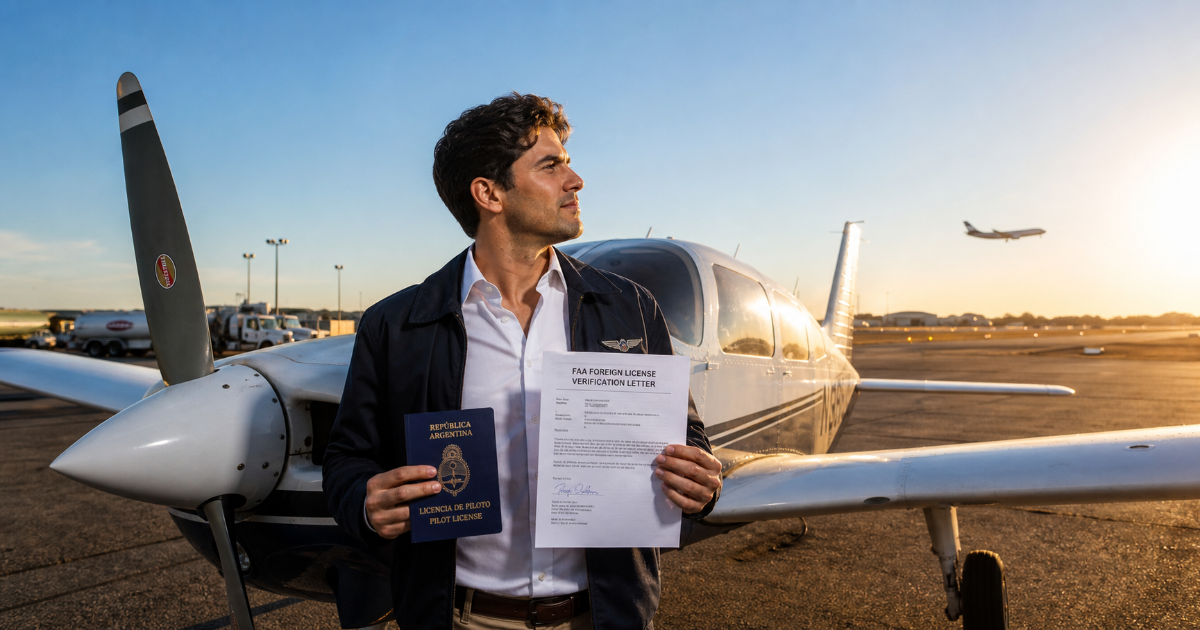
Foreign license verification is the FAA’s confirmation, obtained through your home country’s civil aviation authority, that your foreign license and medical certificate are valid and current. It is not a review of your logbook, training history, or record as a pilot. The subject of the check is the document, not the person holding it, and that distinction changes how the entire FAA license conversion process should be planned.
Pilots misread this step constantly. They assume the FAA is vetting them, so they prepare character references, training records, and hour summaries nobody asked for. The actual transaction runs between two government agencies. Your home country’s CAA confirms the license exists and remains in good standing, and the FAA accepts that confirmation as the basis for everything that follows.
That structure explains why calling the FAA to hurry things along accomplishes nothing. The Airmen Certification Branch must have the Civil Aviation Authority verify the validity and currency of your foreign license and medical certificate before you can apply for an FAA certificate or authorization. The FAA cannot verify a document it did not issue. Only your home authority can do that, and it works on its own schedule.
A pilot from South Africa learned this the expensive way after booking a checkride date three weeks out. The verification had not cleared. The checkride moved, the instructor’s slot was lost, and the school charged a rescheduling fee. The letter is not a formality you file alongside your application. It is the gate your application passes through, and nothing downstream moves until it opens.
Treat the verification request as the first action of your conversion, not the fourth. Pilots who understand the bilateral nature of this step stop asking the FAA for updates and start tracking their home authority’s processing time instead.
Australia’s Civil Aviation Safety Authority publishes its own processing window for verification requests. That window is measured in weeks, not days, and it starts only after your paperwork arrives complete. A missing medical currency date resets the clock.
So the practical move is sequencing, not chasing. Request verification the day you decide to convert, before you book a checkride, before you pay a school deposit. Every week you delay the request is a week added to your total timeline, and no US-side preparation buys that time back.
How to Start the Verification Without Losing Months
Starting FAA license conversion with the verification request is the only move that compresses the timeline, because it puts the slowest clock in motion first. Skipping this step to focus on school tours and checkride prep feels productive and costs months.
Step 1. Complete the verification request form and gather your foreign license and medical documentation before contacting anyone else. An incomplete packet restarts the clock the moment the Airmen Certification Branch flags it. Assemble the full set once, correctly, and you never lose that ground.
Step 2. Submit the form and required documents to the Airmen Certification Branch, AFS-760, P.O. Box 25082, Oklahoma City, OK 73125-0082. The FAA accepts the packet by fax at (405) 954-9922, which is often faster than mail. Confirm receipt rather than assuming delivery.
Step 3. Expect the FAA to take about 45 to 60 days to confirm your license. Plan your entire US training timeline around that window, not against it. Treating the wait as a delay rather than a fixed constraint is what wrecks schedules.
Step 4. Use the waiting period for work that does not depend on the letter, such as medical certification and school selection. the F-1 visa path, for instance, requires its own paperwork that runs parallel to the verification. Pilots who fill this window arrive in the US with two processes already cleared.
Step 5. Verify your foreign license carries no limitation the FAA cannot map to a US privilege before the letter arrives. A missing night rating, for example, becomes a day-VFR-only restriction that forces additional training later. Catching it early lets you plan remedial hours instead of discovering them mid-program.
Pilots who lose months are the ones who start the clock late, not the ones who wait. The verification request is the first action, not the fifth. Completing this sequence unlocks a US training timeline built on a confirmed license rather than an assumption.
Waiting on a foreign authority is not passive time, but pilots treat it that way. The letter clears one gate; medical certification, TSA clearance, and school enrollment each run on their own clocks. Start all of them the same week you mail the verification packet.
Pilots who file the verification last spend that same window waiting on everything at once. The ones who file it first overlap four timelines into one. That sequencing is the entire difference between a conversion that takes months and one that takes a year.
Country-Specific Traps in FAA License Conversion
The country printed on your license changes the FAA license conversion process more than any form you fill out. Six nations trigger additional requirements, and each of the four traps below operates on a different mechanism. Treat your country of issue as a variable, not a footnote.
Additional Requirements for Six Specific Countries
Applicants from Australia, Cyprus, Ireland, Malaysia, New Zealand, and the United Kingdom face extra steps that no generic guide lists. The FAA applies additional verification requirements to these authorities because their licensing frameworks do not map cleanly onto US categories. A UK-issued license and a German-issued license can produce two different conversion paths.
A Missing Night Rating Becomes a Day-Only Certificate
Foreign certificates without a night rating often convert into an FAA certificate restricted to day-VFR operations. The restriction follows you onto the new certificate, and lifting it means logging the night hours you never needed at home. Pilots who want to become a pilot in the USA with full privileges should check their night endorsement before submitting anything.
When a Foreign Limitation Has No US Equivalent
Some foreign licenses carry limitations the FAA cannot translate into a US privilege. A restriction tied to your home country’s airspace rules, for instance, has no counterpart in the FAA system. The FAA resolves the mismatch by issuing a narrower certificate, not by granting the benefit of the doubt.
Why the Country of Issue Sets Your Timeline
Response speed from your civil aviation authority determines how long verification takes, and that speed varies widely by country. An authority that answers the FAA within weeks produces a fast conversion. One that answers in months stalls everything downstream, regardless of how prepared you are.
A missing instrument rating creates the same trap. A commercial pilot from South Africa who never added the rating converts to an FAA certificate without instrument privileges. Adding it later means a full checkride, not a paperwork amendment.
The practical move is sequencing. Confirm what your home license actually grants before you submit anything. Then decide whether to upgrade at home first or accept a narrower US certificate and build from there.
What an Unrestricted FAA Certificate Really Costs
FAA license conversion costs split into two tiers, and only one of them is predictable. The visible tier is small, fixed, and documented. The hidden tier is flight hours, and it scales with how far your foreign experience sits from the certificate you actually want. Budget the visible tier and you’ll finish the paperwork with money left over. Budget only the visible tier and the training bill arrives as a surprise you can’t absorb.
The guided conversion service costs $49.99 and covers the application and validation support. That line item is the cheapest thing on the table, and it’s the one pilots fixate on.
The cheap line item is never the expensive part. A pilot who budgets $49.99 plus a few hundred in fees and stops there has budgeted for the wrong process. The real exposure sits in the training row, and it’s driven by how the FAA maps your foreign hours against US requirements.
Flight schools that publish transparent flight school costs for converting pilots do their applicants a favor, because the number that matters is total hours to certificate, not the application fee. Ask for that figure before you commit. If a school can’t produce it, you’re the one carrying the variance.
A commercial pilot from Brazil with 1,500 hours still pays for extra training if those hours were logged under Part 61 rules. The FAA maps experience to the target certificate, not to total time. That gap is where conversion budgets collapse. A pilot who qualifies on paper can still need a dozen hours of US instruction before a checkride.
Why Your Foreign Hours Do Not Convert One to One
FAA license conversion runs on two competing assumptions about foreign flight time. One holds that logged hours transfer as credit. The other holds that the FAA maps foreign experience against US requirements and grants only what fits. The second assumption is correct, and pilots who plan around it finish without a mid-program stall.
The direct-credit assumption feels reasonable because the logbook is objective. Hours are hours, and a pilot who flew cross-country in another country has clearly done the work. Where it falls short is the mapping problem: the FAA evaluates foreign experience against the specific certificate you’re pursuing, not against a universal standard. Time that doesn’t satisfy a US requirement simply doesn’t count toward it.
The selective-recognition model is less intuitive but more accurate. The FAA reviews foreign experience through the lens of foreign license conversion requirements, which means recognition and equivalence are different things. A pilot with substantial foreign time can still need additional US flight training.
Recognition is not equivalence, and that gap is where budgets break. A pilot who assumes full credit plans a short conversion and books a checkride date. A pilot who plans for a training gap builds in the hours, the instructor time, and the calendar slack that the certificate actually requires. The second pilot finishes. The first one stalls.
Flight schools that handle converting pilots well front-load this expectation. BrightLine Digital’s Aviation Conversion Funnels work with flight schools shows the pattern: schools that set accurate training-gap expectations during intake see less drop-off later, because applicants aren’t blindsided by the hours they still need. The intake conversation is where the flight school process either prepares a converting pilot or sets them up for a financial surprise.
Plan for the gap. Assume your foreign hours will be recognized selectively, not accepted wholesale, and budget the training, instructor time, and calendar space the certificate actually demands. The pilots who finish FAA license conversion without a mid-program stall are the ones who built that gap into the plan before they started.
Consider the pilot who trained under EASA rules in Europe. Their logbook shows hundreds of hours, but the FAA still evaluates those hours against Part 61 requirements. Cross-country time logged under EASA definitions may not satisfy the US cross-country requirement.
That mismatch is not a technicality. It is the difference between a two-month conversion and a six-month one. The fix is straightforward: before you commit to a training timeline, request a written evaluation of your foreign hours against the specific certificate you’re pursuing.
The In-Person Step Most Guides Bury
FAA license conversion ends at a counter, not in an inbox. The application starts online, which convinces pilots the whole process is remote. Then they reach the validation appointment and discover the calendar belongs to someone else.
Step 1. Confirm the verification letter has arrived before scheduling anything. An appointment booked against an unconfirmed foreign license is a placeholder, not a plan. Officers cannot validate a certificate the Airmen Certification Branch has not cleared.
Step 2. Identify the office that handles your validation and confirm its current appointment process. Some locations run walk-in windows, others require advance booking weeks out. Calling ahead costs minutes and prevents a wasted trip across state lines.
Step 3. Book travel only after the letter is physically in hand. Flights and hotels bought early feel efficient until the verification stalls in another country’s queue. Rebooking fees punish the pilots who scheduled against hope rather than confirmation.
Step 4. Bring the original foreign license, current medical, logbooks, and the verification documentation to the appointment. Missing paperwork at the counter means a second visit and a second round of travel costs. The EASA to FAA conversion process follows the same physical validation logic, which is why European pilots hit the identical wall.
Step 5. Arrive with the certificate category you intend to pursue already mapped. Officers issue what your documentation supports, not what you hoped for. Pilots who clarify the target rating beforehand avoid leaving with a narrower certificate than they needed.
Step 6. Treat the appointment as the final gate, not the beginning of the work. Everything upstream exists to make this one visit uneventful. Pilots who planned around the verification letter walk in, validate, and walk out.
Schools positioned near validation offices understand this rhythm. BrightLine Digital’s Local SEO Mastery work helps those schools appear when converting pilots search for a nearby appointment, capturing students at the exact moment the process turns physical.
Completing validation converts a foreign certificate into a US one you can actually fly on. The pilots who finish fastest are not the ones who moved quickest. They are the ones who let the verification letter set the schedule, then booked everything else around it.
Start the Verification Before You Book Anything Else
FAA license conversion rewards the pilot who files first and books last. That order feels backwards, which is exactly why so many conversions stall.
The verification request is the only step that starts a clock you cannot touch. File it, then spend the wait on medical certification, school visits, and budget planning. Pilots who wait for the letter before starting anything lose the same months twice.
Submit the verification form and your foreign license and medical documents to the Airmen Certification Branch now. Before you tour a school. Before you pick a checkride date. Before you book a flight. Stop reading FAA license conversion as a checklist. Read it as a sequence with one step that governs every other, and put that step first.
Turn your aviation expertise into 340% more traffic and 68% more leads, the kind of growth only an aviation-only SEO team like BrightLine Digital delivers. Book your free strategy call today and see exactly where those leads will come from.
FAA License Conversion: Questions Answered
How to convert a foreign license to an FAA license?
You convert a foreign license by filing a verification request with the Airmen Certification Branch, waiting for your home authority to confirm your credentials, then completing an in-person validation visit. The FAA will not schedule that visit until the verification letter is already in hand, so the application itself is the fastest part of the entire FAA license conversion.
Can I use my FAA license in another country?
An FAA certificate is recognized in many countries, but each foreign authority sets its own validation rules and most require a separate application through that country’s civil aviation authority. Some nations accept your FAA certificate with minimal paperwork, while others demand a full conversion process that mirrors what you just completed in the other direction.
How easy is it to convert an FAA license to EASA?
Converting an FAA license to an EASA certificate is a separate process run by the European Union Aviation Safety Agency, and it does not inherit any of the verification work you did for the FAA. EASA applies its own credit rules for foreign experience, which means a pilot who holds an unrestricted FAA certificate can still face additional exams and flight time in Europe.
How long does the verification letter take?
The Airmen Certification Branch typically needs roughly 45 to 60 days to confirm a foreign license, though the real clock starts when your home civil aviation authority responds, not when you mail the packet. An incomplete submission restarts that window entirely, which is why pilots who gather every document before filing rarely wait as long as pilots who file first and chase paperwork later.