Flight Training in USA for Nigerian Students: The 2026 Guide
ℹ️ TL;DR
- Securing the proper visa category before paying non-refundable school deposits is critical for successful flight training in USA for Nigerian students.
- Select between M-1 vocational training and F-1 degree-track visas based on your long-term airline career goals and financial requirements.
- Gather verified proof of funds, academic transcripts, and official sponsor letters early to pass embassy interview scrutiny in Lagos or Abuja.
- Factor currency transfer fees, bank exchange rate spreads, and US living costs into your total training budget.
- Choose FAA Part 141 approved flight academies with proven track records of supporting Nigerian student pilots through admissions and onboarding.
Booking a flight school before choosing a visa category is how Nigerian applicants lose an entire intake year. The school deposit clears, the calendar moves, and the visa category that school cannot sponsor surfaces too late. Flight training in USA for Nigerian students works in one direction only, and it starts with the visa.
Nearly every guide reverses that order. They list schools first, costs second, and treat the visa as paperwork you handle after acceptance. That sequence forces reversals: a deposit refunded at a loss, a deferred start date, or a scramble into a program that never fit.
This article lays out the 2026 sequence from Lagos to a US cockpit. You’ll learn how to pick the right visa category, verify a school’s Nigerian track record, and budget the naira-to-dollar reality before any money moves.
Why Nigerian Applicants Get the Order Wrong
Flight training in USA for Nigerian students fails at the sequencing stage, not the application stage. Applicants shop for schools like universities, then discover the visa category decides which schools can legally enroll them.
A school approved for F-1 enrollment operates differently from one that only issues M-1 documentation. The F-1 route suits degree-track students and carries different duration and work rules. The M-1 route fits vocational flight training and restricts what you can do after your certificate. Pick the school first, and you may lock yourself into a category that blocks your airline-track plan.
Consider a Lagos applicant who pays a deposit to a Part 61 school advertising cheap hourly rates. The school cannot issue an I-20 for a degree program. The applicant wanted a restricted ATP pathway, which requires structured Part 141 training and a specific visa category. The deposit is gone, and the intake window has closed.
Timelines diverge just as sharply. F-1 applicants work within academic calendars and program start dates set by the school. M-1 applicants face fixed vocational program lengths with limited extension options. Choosing the school before understanding flight training visa options means you discover the mismatch after the calendar has moved. Post-training outcomes hinge on the same decision. The category you enter under shapes whether you can build hours, instruct, or transition toward regional airline hiring.
Some applicants argue the school matters more because a strong program can guide your visa choice. That logic collapses when the school has no international admissions staff.
Ask one question before any deposit. How many Nigerian students has this school enrolled under each visa category in the past two years? A school that cannot answer is a school you should not pay.
What You Need Before You Apply Anywhere
Flight training in USA for Nigerian students stalls at the documentation stage far more often than at the flying stage. Schools cannot issue your I-20 or M-1 paperwork until every prerequisite below is already in hand.
- Valid international passport. A passport expiring inside the training window gets rejected at the embassy window, not at the airport.
- Proof of funds covering tuition and living costs. Bank statements that show a lump sum deposited weeks ago read as borrowed money to a consular officer.
- Academic records and transcripts. Missing WAEC or university transcripts delay the school’s admission letter, which delays everything downstream.
- FAA medical certificate pathway. You must clear an aviation medical examiner before solo flight, and certain conditions require extra review time.
- English proficiency evidence. TOEFL or IELTS scores, or a school-administered placement test, prove you can handle radio communication and ground school.
- Sponsor documentation. A signed sponsor letter must match your verbal story at the interview word for word.
- SEVIS and visa fee funds. These fees are paid separately from tuition and cannot be pulled from your school deposit.
The list reveals something the bullets hide: these items are not parallel. A passport and transcripts are administrative. Proof of funds and sponsor documentation are evidentiary, and they carry the most weight at the interview.
Treat the evidentiary items as your real preparation. If you plan to enroll from Nigeria, gather the funding and sponsor paperwork first, then build the rest of your file around it. That order is what lets you become a pilot in the USA without paying a second interview fee.
The 2026 Steps From Lagos to a US Cockpit
Sequence is the whole game in flight training in USA for Nigerian students. Run these steps in order and the paperwork lines up with your intake date. Run them out of order and you pay for the same mistake twice.
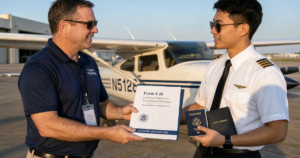
Step 1. Lock your visa category before you talk to any school. Degree-track training points to the F-1 visa for flight training, while vocational flight training points to the M-1. Choose this first, because the category decides which schools can even issue your paperwork.
Step 2. Shortlist Part 141 schools that enroll Nigerian students. Part 141 certification means the school runs an FAA-approved syllabus, which matters for your training structure and visa file. Verify Nigerian enrollment history directly with the school’s international office, not with a recruiter’s brochure.
Step 3. Request your I-20 or M-1 documentation. The school issues this only after your funding proof, passport, and academic records clear their review. Requesting it before your funds are documented stalls the file for weeks.
Step 4. Pay the SEVIS fee and complete the DS-160. Your SEVIS receipt number feeds directly into the DS-160 form, so paying in the wrong order breaks the application. Complete both before you attempt to book an interview slot.
Step 5. Book your embassy interview in Lagos or Abuja. Lagos handles the heaviest student volume, so slots fill fast during peak intake months. Booking late pushes your interview past your school’s start date, which forces a deferred enrollment.
Step 6. Arrange your funding transfer before the interview. A sponsor letter that matches your bank records word for word survives consular scrutiny. Transferring funds after the interview creates a paper trail gap officers notice.
Step 7. Confirm arrival logistics with the school. Housing, airport pickup, and your first simulator slot need confirming before you fly. Schools with a real international pipeline, like those running Nigerian pilot programs, handle this as standard onboarding.
Finish this sequence and you land in a cockpit seat with a valid status, funded tuition, and a school expecting you. Skip a step and you rebuild the entire timeline from Lagos.
Step 8. Confirm your school’s Nigerian student track record in writing. Ask the international office how many Nigerian students they enrolled in the last two intakes. A school that cannot answer that question clearly is a school that has never processed your file type.
This step is where deposits get lost. Pay nothing until the enrollment numbers arrive in an email you can forward, not a phone call you cannot prove.
F-1 or M-1: The Choice That Shapes Everything
Two visa categories govern flight training in USA for Nigerian students, and the wrong pick strands you mid-program. The F-1 and M-1 differ on duration, work rights, and what happens after your last checkride. The category you choose decides how long you can stay, not just whether you can enter.
The F-1 fits degree-track training. Enroll in an associate or bachelor’s aviation program at a school certified by SEVP, and you get a defined academic term with structured breaks. It also opens practical training options after graduation, which matters if your goal is an airline cockpit rather than a commercial certificate alone.
Its weakness is cost and time. A degree program runs longer than a certificate course, and tuition reflects that. Nigerian applicants chasing a fast airline track often find the F-1 adds years they did not budget for.
The M-1 visa for flight school covers vocational training. It suits applicants who want private through commercial certificates without a degree attached, and it maps cleanly to Part 141 programs built around flight hours. Approval tends to move faster when the school’s documentation is clean.
Where the M-1 bites is flexibility. It carries tighter duration limits and far more restrictive post-completion options. Extensions are harder to win, and switching to work authorization after training is not a realistic path for most holders.
Airline-track Nigerian applicants usually need the F-1, because major carriers and regional airlines want a degree alongside the hours. The M-1 works for applicants funding their own certificates with a clear plan to convert hours elsewhere. Choosing the M-1 for airline ambitions is the mistake that forces a costly restart.
Schools with real international admissions infrastructure catch this before the I-20 is issued. BrightLine Digital’s International Flight School Admissions service exists because that intake review is where misclassification gets caught, not at the embassy window. Review the international flight training requirements before you commit to either category.
Pick the F-1 if you want a degree, airline eligibility, and post-training work options. Pick the M-1 if you are funding certificates yourself and need the fastest route to commercial hours. Decide this before you shortlist a single school.
What Flight Training in USA Really Costs Nigerians
Flight training in USA for Nigerian students carries a second price tag that no brochure prints: the cost of moving naira into dollars. The comparison below separates what schools quote from what you actually wire, and the gap is where budgets collapse.
| Cost Category | What It Covers | Paid To |
|---|---|---|
| Tuition, private through commercial | Ground school, checkride fees, written exams | The flight school |
| Aircraft rental and instructor hours | Wet rate per hour, dual instruction time | School, billed as you fly |
| Living costs | Housing, transport, food across the program | Landlord, local vendors |
| SEVIS and visa fees | I-901 payment, DS-160 processing | US government, in dollars |
| Medical certification | FAA medical exam with an aviation examiner | Designated examiner |
| Currency transfer costs | Exchange spread plus wire fees per transfer | Bank or transfer service |
Currency transfer is the line item schools never quote, and it compounds every other cost. A deposit wired at one rate and a final payment wired at another can shift your total by more than any single flight hour. Budget the full program in dollars, not naira, and hold a buffer for rate movement between payments.
Compare real US flight school costs against the average flight school costs published in brochures, and the tuition line usually matches. What never matches is the transfer layer sitting underneath it. Schools that disclose total program cost in dollars, transfer costs included, are the ones worth trusting.
For a Nigerian applicant funding the full commercial track, the honest recommendation is to over-budget on the transfer side and treat every quoted tuition figure as the floor, not the total. Ask each school for a written dollar figure covering tuition, hours, and fees before you wire anything. If they cannot produce one, that silence is your answer.
Spotting Schools That Actually Support Nigerians
Plenty of US flight schools advertise international enrollment and have never processed a Nigerian applicant through a consulate interview. The gap between marketing and pipeline is where deposits disappear. A school can hold Part 141 certification and still leave you guessing on visa paperwork, housing, and who answers the phone when the embassy calls. Separate real programs from brochures by checking these signals before any money moves.
- Named international coordinator. A specific person with a direct line, not a generic admissions inbox. Ask for their title and how long they have held the role.
- Documented Nigerian alumni. Names, graduation dates, and current flying positions you can verify. A school that cannot produce this is selling a promise, not a track record.
- Housing and transport plans. Written arrangements for foreign students arriving without a car or US credit history. Schools that leave this to you are telling you how they handle everything else.
- Transparent total-cost disclosure. A written dollar figure covering tuition, aircraft rental, instructor hours, and living costs. Schools that quote hourly rates only are hiding the real number.
- Visa interview history. A record of applicants clearing the Lagos or Abuja consulate, including how the school supports a refused applicant. Ask what they do when a 214(b) slip lands.
Read the list as a single test, not five separate boxes. A school with a coordinator but no verifiable alumni is still a gamble. A school with strong alumni but no housing plan will strand you on arrival.
BrightLine Digital works with flight schools on aviation SEO and review management, which is why programs with genuine international outcomes tend to rank above those with polished websites and thin results. That visibility gap matters when you are comparing flight schools for international students from Lagos. Verify every signal before the deposit clears. Once the wire leaves your account, your is gone.
When the Visa Interview Goes Wrong
A flight school visa denial at the Lagos or Abuja embassy is not a verdict on your future. It is a coded instruction, and the slip the officer hands back tells you which path to take next. Treating that slip as a rejection rather than a diagnostic is how applicants burn a second interview fee on the same mistake.
The refusal code is your decision input. A 214(b) refusal points to the intent-to-return presumption, which means the officer doubted you would leave the US after training. That is a documentation problem, not an eligibility problem. A code citing missing or contradictory school records points back to your I-20 or M-1 paperwork, not your bank statement.
Three paths exist, and the code picks yours. Reapply with corrected evidence when the gap was intent-to-return or funding proof. Request a corrected record and a fresh interview when the school’s documentation was the problem. Switch visa category or country only when no clear fix exists and your cohort date is fixed.
Reapplying with the same file and a new interview date is the most expensive mistake in this process. The officer’s doubt compounds when your answers contradict what your school submitted. Walk in with a sponsor letter that matches your verbal story word for word, and confirm your I-20 start date is one you can defend.
Schools with real international admissions support change the math here. A named coordinator who has shepherded Nigerian applicants through 214(b) refusals knows which documents to strengthen and which to replace. That support is worth more than a lower tuition quote when your intake window is closing. BrightLine Digital’s international flight school admissions work exists because schools that track these outcomes consistently produce better interview results.
Verify that support before you need it, not after a refusal slip is in your hand. The schools worth your deposit are the ones that can name their Nigerian alumni and explain what they did when an interview went sideways. If they cannot, you are carrying the risk alone.
Book the Visa Slot Before You Book the Flight
Flight training in USA for Nigerian students rewards sequence over school prestige. The applicant who confirms a visa category first walks into every later decision with. The one who pays a deposit first is negotiating from behind.
Act now and your 2026 intake stays intact. Wait until the school brochure looks perfect and you risk a category mismatch that forces a deferred start and a second round of fees. A deposit is reversible. A lost intake year is not. Confirm your category. Shortlist Part 141 schools that enroll Nigerian students. Then pay. That order protects everything you spend after it.
Flight Training in USA for Nigerian Students: Common Questions
Which course is best for pilots?
The airline-track path runs private pilot, instrument rating, commercial certificate, then multi-engine and flight instructor ratings, because airlines hire on total logged hours rather than on any single certificate. A degree-track F-1 program bundles that same sequence with a university diploma, which matters if you ever want to convert your licenses in a country that requires a four-year credential.
How much is basic flight training?
Private pilot training in the US typically lands between $12,000 and $20,000 depending on aircraft type, instructor rates, and how many hours you need beyond the FAA minimum. The figure that catches Nigerian students is the gap between that quote and the true all-in cost, since housing, medical certification, and currency transfer fees sit outside every school brochure.
Do Nigerian students need an F-1 or M-1 visa for flight training in the USA?
Vocational flight training runs on the M-1, while degree-track aviation programs use the F-1, and the school’s certification determines which one it can issue. Choosing the wrong category after your I-20 is printed means a new SEVIS record, a new fee, and a fresh interview slot, which is why flight training in USA for Nigerian students starts with the visa question.
Can I work while training as a Nigerian student pilot in the USA?
On-campus employment is generally allowed for F-1 students, but M-1 holders face stricter limits and cannot take most off-campus jobs during training. Flight instructing after you earn your CFI is the exception that matters, because it converts your training hours into paid hours while you build toward airline minimums.